
AI prompts for social media: ready-to-use posts, captions and content
Ready-to-use AI social media prompts for Instagram, LinkedIn, Facebook and TikTok. Real Italian SME examples, mistakes to avoid and prompt structure.
Reading time: 9 min
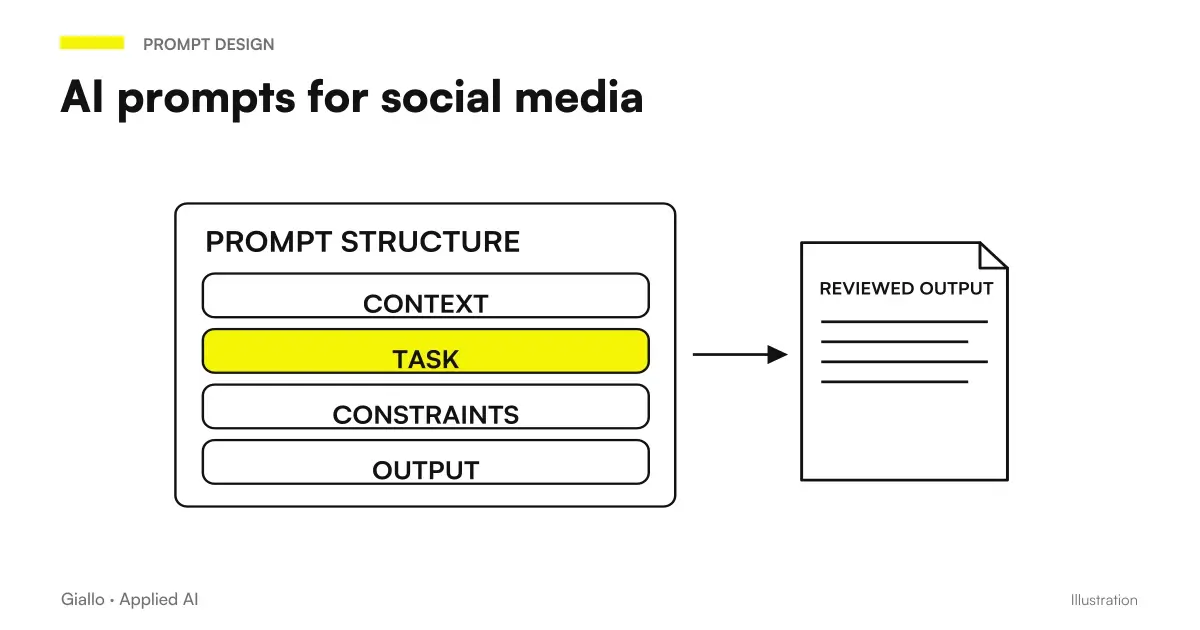
Use AI prompt for social media It means giving artificial intelligence the precise instructions to generate posts, captures and content that fit the tone of your brand and the platform on which you publish. It is not enough to open ChatGPT and write "write a post for Instagram": the result will be generic and probably useless. The difference between a text you publish right away and one you throw away is almost always in the prompt.
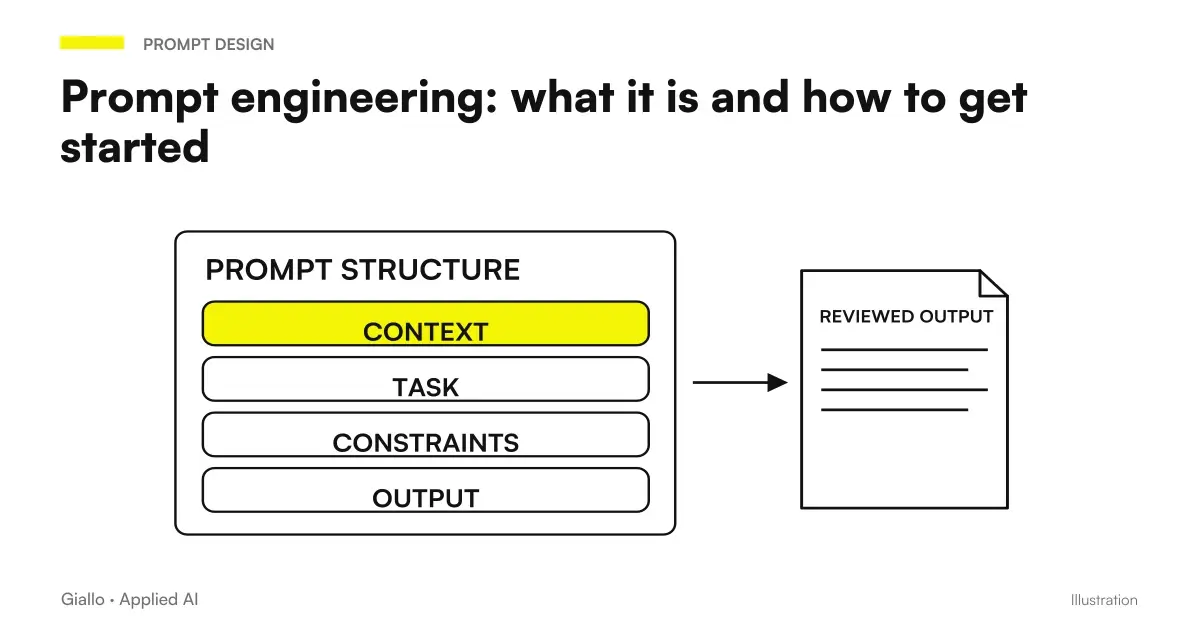
This guide collects ready prompt examples, divided by platform and type of content, with a focus on Italian SMEs who manage social networks internally: the pharmacy that publishes tips on seasonal health, the restaurant that tells the dishes of the day, the professional studio that wants to build authority on LinkedIn, the store that launches a promotion on Instagram. If you want to first understand the basics of how to build an effective prompt, read the prompt engineering guide.
In summary
- A AI prompt for social must specify platform, tone, target, audience and format: without these elements the output is generic.
- Instagram, LinkedIn, Facebook and TikTok have different styles: the prompt must be adapted, not copied between platforms.
- For Italian SMEs, insert Real Details (product, city, event) makes the text publishable with few edits.
- AI generates the first draft; the person checks tone, correctness and consistency with the brand before publishing.
- Saving prompts that work in an internal library reduces content production time by 60-70%.
Why generic AI prompts don't work on social media
The most common problem is this: you open an AI, you write "write an Instagram post for my pharmacy" and you receive a flat text, full of empty adjectives ("your health is our priority") that does not represent the brand and does not involve anyone.
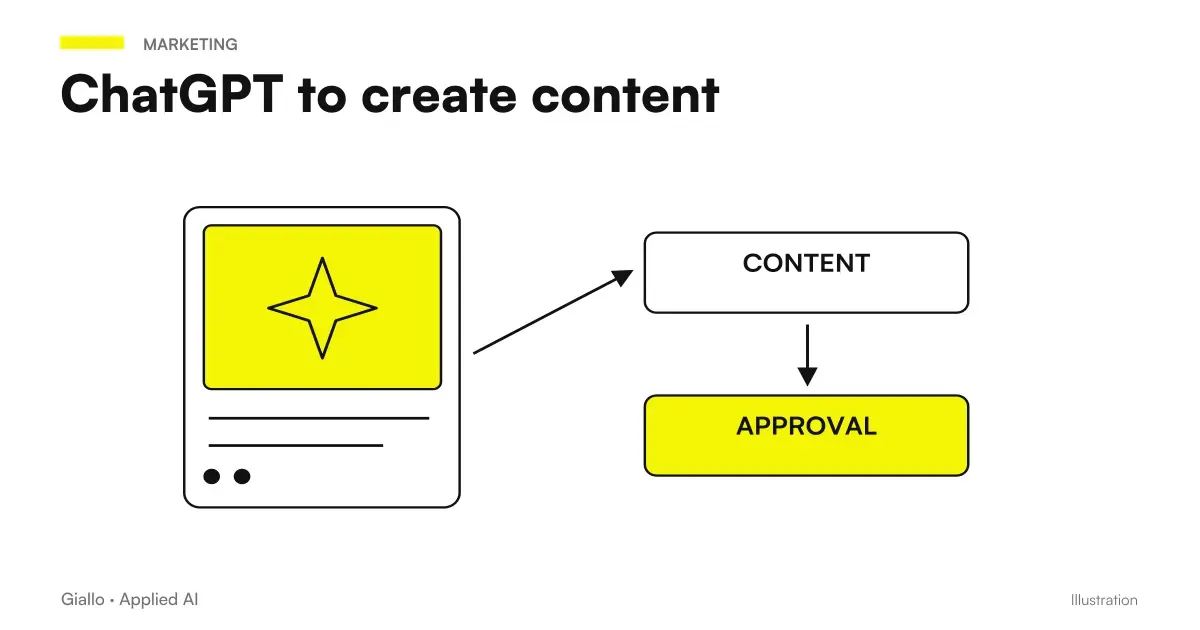
The reason is simple: AI doesn't know your brand, your customers, and your tone. If you don't tell him in the prompt, invent something medium. To learn more about how this mechanism works, read how to use ChatGPT to create content: the principles apply to any model.
A good prompt for socials always contains these elements:
- Platform (Instagram, LinkedIn, Facebook, TikTok)
- Format (caption with hashtag, long post, reel script, story)
- Tone of voice (formal, friendly, ironic, technical)
- Objective (inform, sell, engage, build authority)
- Public (who reads: age, interests, technical level)
- Real context (product, event, story, season)
These six elements are enough to turn a generic output into something publishable.
AI prompt for Instagram: ready examples
Instagram rewards caption visual, short and engaging. The text must complete the image, not describe it. Hashtags go at the bottom (5-10, not 30). Emojis help visual scanning but should not dominate.
Basic prompt structure for Instagram
Write an Instagram caption for [business type]. Tone: [friendly/professional/ironic]. Length: maximum 150 words. Include: an opening that captures attention in the first two lines, the main message, a call to action and 7 relevant hashtags in Italian and English. Context: [describe the image, product, event].
Example 1 Farmaci Pharmacy, seasonal post:
Write an Instagram caption for a neighbourhood pharmacy in Milan. Friendly, reassuring tone, never clinical. The image shows sun protection products on display. Goal: remind customers to protect themselves as warmer weather arrives. Maximum 120 words, moderate emojis, 6 hashtags mixing Italian and English. Close with a question for followers.
Example 2 — Restaurant, dish of the day:
You are the social media manager of a Ligurian restaurant in Genoa. Write an Instagram caption for the dish of the day: fresh basil pesto trofie with green beans. Warm and narrative tone, as if the cook described it. Include a sensory detail (perfume, texture). Maximum 100 words + 5 hashtags. No phrases like "we're waiting for you" or "come and see us".
Example 3 — Store, promotion launch:
Write an Instagram caption for a sportswear store in Turin that launches a 20% discount on running shoes. Tone energetic and direct. First line: you have to stop the scroll. Include the duration of the promo (until Sunday), a clear CTA ("slide the link in bio") and 8 hashtags. No exaggerated exclamation points.
AI prompt for LinkedIn: ready examples
LinkedIn requires an opposite approach: text longer, reflective, professional. Posts that perform best tell an experience, share a lesson or open up a debate. Hashtags are few (3-5). Emojis are optional and should be used with measure.
Example 1 — Professional study, authority:
Write a LinkedIn post for a job consulting firm based in Bologna. Professional yet accessible tone, suitable for SME entrepreneurs. Topic: the news about futures contracts after the last decree. Structure: opening with a given or a practical question, 3 key points explained simple, conclusion with invitation to comment. Length: 250-300 words. No legal jargon, write like you're explaining to a customer on the phone. 3 relevant hashtags.
Example 2 — Professional, thought leadership:
I am an accountant with 15 years of experience working mainly with manufacturing SMEs in Veneto. Write a first-person LinkedIn post where I tell a lesson learned this year about cash flow management in small businesses. Direct tone, no sentences made. Opening with a phrase that creates narrative tension. 200 words. Close with a question open to readers.
AI prompt for Facebook and TikTok
Facebook has a more heterogeneous audience by age and tolerates slightly longer texts than Instagram. TikTok requires synthetic scripts for videos, with strong hooks in the first 3 seconds.
Example Facebook — Local Store:
Write a Facebook post for a family-run hardware store in Brescia. The post announces the arrival of spring gardening products. Tone warm and neighborhood, as if writing the holder. Length: 80-100 words. Include an invitation to go to the store and an opening time. No links or hashtags.
TikTok — Script reel example:
Write a script for a 30-second TikTok reel for a homemade pastry shop in Naples. The video shows the preparation of rice pastiers. Structure: hook in the first 3 seconds (must stop the scroll), visual narration in 4-5 short sentences (synchronized with the scenes of the video), closure with CTA to follow the profile. Playful, fast tone, suitable for an audience 25-40 years old.
Table: Prompt per platform compared
| Platform | Text length | Tone | Hashtags | Key element in prompt |
|---|---|---|---|---|
| 80–150 words | Visual, emotional | 5–10 | Describe the accompanying image | |
| 200–350 words | Professional, reflective | 3–5 | Specify the sector and target audience | |
| 60–120 words | Hot, local | 0–3 | Indicate geographic/local context | |
| TikTok | Script 30–60 sec | Quick, narrative | 3–6 | Structuring for video scenes, 3 sec hook |
| Stories (IG/FB) | 1–2 sentences + CTA | Urgent, direct | 0 | Indicate the specific action (swipe up, poll) |
Advanced prompts: tone of voice and planning
As you become familiar with basic prompts, you can move on to more sophisticated instructions that further reduce revision work.
Define the tone of voice only once:
Our brand is an Italian natural cosmetics startup, founded by two sisters. Our tone on social media is: direct, curious, never patinated. We use the singular "you", short sentences, some rhetorical questions. We never use words like "innovative", "sustainable" (unless strictly necessary) or "unique experience". Save this tone and use it for all the posts I'm going to ask you today.
Monthly editorial plan:
Create an editorial plan for the month of July for an optics store in Florence with an active Instagram profile. 3 posts a week. Each entry must include: day, post theme, format (carousel/single photo/reel), lens (inform/sell/involve) and a line of briefs for the caption. Consider the Italian holidays and summer season.
To learn more about how to build prompts for marketing in the broadest sense, the guide on AI prompt for marketing It also covers emails, landing pages and paid ads.
Mistakes to Avoid
- Not stating the platform. A LinkedIn text used on TikTok sounds like a press release. Each platform has its own rules and must be specified in the prompt.
- Prompt too vague. "Write a post for my company" contains nothing useful. AI invents a non-existent brand. The more real context you put, the less revisions you do.
- Publishing without reading. AI can produce inaccurate information, wrong tones or claims you don't want to make. Every text should be read before publishing, always. To understand why this happens, read what the AI Hallucinations.
- Using the same prompt for all channels. Copy-paste between platforms rarely works. Fit at least length and tone.
- Abandoning the brand tone of voice. If your profile has always communicated in a certain way, instruct AI on that specific style. Otherwise your feed becomes inconsistent over time.
How to apply it in the company
An SME that manages social media internally (the holder, an assistant, a junior) can build a simple and efficient system in a few days.
- Create a "tone of voice" document. 10-15 lines describing how the brand communicates: used words, forbidden words, example of a post that works, example of a post to avoid. This becomes the fixed context to be inserted in each prompt.
- Build a prompt library. A file (Google Doc, Notion, even an Excel sheet) with prompts that work, broken down by platform and type of content. You don't have to reinvent them every time.
- Generate in weekly batch. Spend 30-45 minutes a week generating texts for the next 7 days. Review, approve and program with a scheduler (Meta Business Suite, Buffer, Later).
- Keep the human content separate. Authentic stories (the behind-the-scenes, the team, a real customer) work best if written directly. Use AI for informational and promotional content; reserve your personal style for relationship moments.
To understand which AI tools are best integrated into this flow, the guide on Best AI for Social Media compare the options available today for SMEs and professionals.
Conclusion
The AI prompt for social media They are not magic formulas: they are precise instructions that turn a generic tool into a useful editorial assistant. The difference between a post you post and one you throw away is in the context you give: platform, tone, goal, audience, real details. For a pharmacy, restaurant, studio or store that runs social in-house, building a library of working prompts means producing quality content in less time, without delegating to an agency or inventing from scratch every week.
The next step is to move from individual prompts to a system: editorial calendar, weekly batch, coded tone of voice. If you want to understand how to integrate AI in a structured way into your communication processes, Giallo Studio can help you turn the problem into a real workflow. Or explore the tools tested in The Lab to see concrete examples of editorial automations.
Giallo Studio guides: methodology and sources
How we apply it in the company
Related resources
 AI prompts: a complete guide to effective instructions
 ChatGPT prompts: ready-to-use examples to copy and adapt
 AI marketing prompts: copy, campaigns and content
 Best AI for social media: tools for content and management
 ChatGPT to create content
 Prompt engineering: what it is and how to get started
 Do Dots work when your computer is off? Cloud, local access and login
 Lead scoring with Jev AI: Prioritizing requests in CRM
Prompt Collections
Ready prompts for other roles and tasks.
- AI SEO prompts: optimise content and rankings
- AI sales prompts: emails, offers and follow-ups
- AI coding prompts: write, fix and explain code
- AI video prompts: Runway, Kling and Gemini alternatives to Sora
- AI presentation prompts: PowerPoint and Google Slides examples
- AI prompts for real estate agents: ready-made examples for ads, emails and customers
- AI marketing prompts: copy, campaigns and content
- AI prompts for lawyers: legal documents and communications
- AI image prompts: examples for Midjourney, ChatGPT and Firefly
- AI prompts for accountants: ready-made examples for documents, analytics and clients
- AI prompts for Excel and Google Sheets: formulas and data analysis
- AI customer support prompts: ready-to-use examples
FAQ
How do you write a good AI prompt for social media?
An effective social-media prompt always specifies the platform (Instagram, LinkedIn…), brand tone of voice, post objective (inform, sell or engage), audience and desired format (length, hashtags and emojis). The more context you provide, the closer the generated text is to something you would publish without changes.
Which AI is better for creating social content?
ChatGPT, Claude and Gemini all give great results for social texts. The difference is the prompt, not the model: a well-structured prompt on any good model beats a vague prompt on the best model. For social images you need dedicated tools such as Midjourney or Firefly.
Do AI-generated posts look artificial?
Only if the prompt is generic. Including a specific tone of voice, examples of previous brand posts and real details (a product, an event or a team story), and asking for a revision in conversational Italian, makes the output natural and consistent with the profile.
Can I use AI prompts for Instagram and LinkedIn in the same way?
No: the two platforms have very different styles. Instagram rewards short, visual captions with emojis and hashtags. LinkedIn calls for longer, professional text with an angle based on reflection or experience. Adapt the prompt to the platform rather than copying and pasting it.
How many posts can I generate per day with AI?
There is no technical limit, but quality beats quantity. It is better to have 5 carefully crafted posts from detailed prompts than 20 generic texts that weaken the brand's voice. AI should speed up the work of refining content, rather than replacing it with automated volume.
Can AI manage the social media editorial calendar?
It can help plan it: with the right prompt it generates a monthly plan with topics, formats and platforms. Approval and publication remain human, but the ideation work is greatly reduced.