
AI SEO prompts: optimise content and rankings
Ready-to-use AI SEO prompts: keyword research, meta titles, meta descriptions, optimised articles and FAQs. Real output examples and clear limitations.
Reading time: 9 min
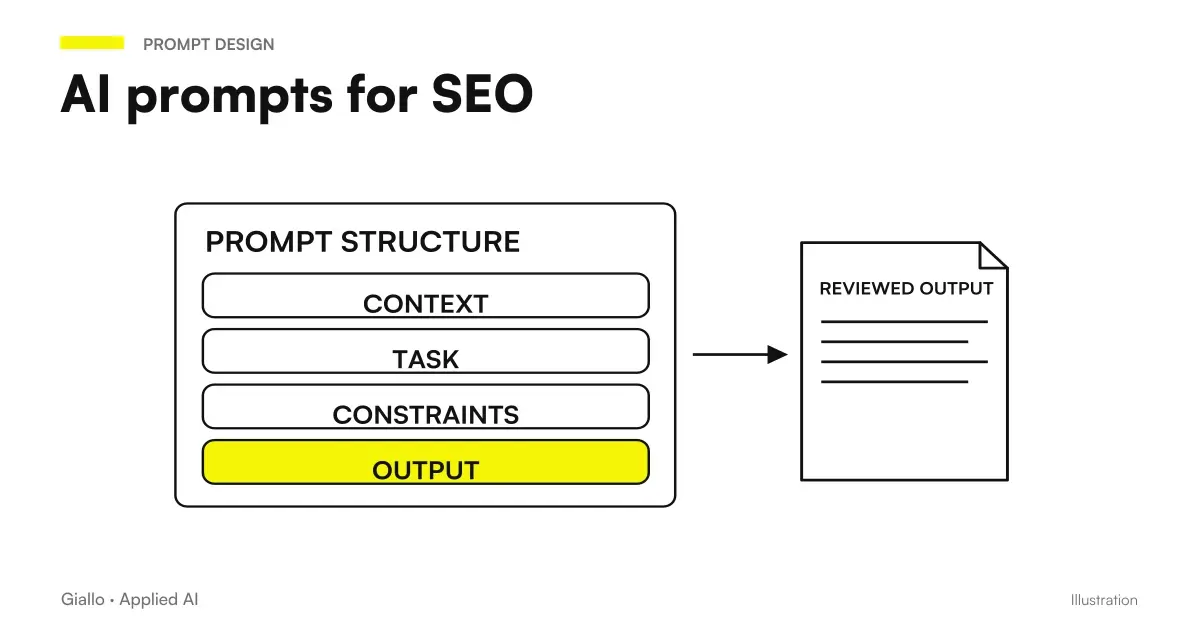
Using AI for SEO means having access to a fast editor who knows the optimized structures, knows how to vary tags and produces drafts in seconds. The real value is not in total automation, but in speed: those who know how to build the right prompts produce more optimized content at the same time, with fewer blocks in front of the empty cursor.
This guide collects prompts ready for major SEO tasks key assisted keyword research, meta title, meta description, article structure, FAQ — with real output examples and boundary notes. Each prompt is designed to be copied, adapted to your context and used immediately. To understand the basics of how to build an effective prompt, you can read the guide to prompt engineering.
AI does not replace data analysis tools, does not know real search volumes, and does not link building. But on the tasks of writing and structure it is concretely useful today, in an SME or in a communication study, without advanced technical skills.
In summary
- The AI prompt for SEO speed up the production of meta tags, article drafts, and secondary keyword clusters.
- AI has no access to real search volumes: for quantitative keyword research serve Ahrefs, Semrush or Keyword Planner.
- An effective prompt always specifies the main keyword, search intent, target audience, and desired length.
- The best prompts include precise constraints (e.g. "≤60 characters", "informal tone", "no empty adjectives") that reduce rewrites.
- AI output should always be overhauled: fluent does not mean correct, and optimized does not mean positioned.
Why AI prompts are useful for SEO
SEO requires many repetitive tasks: writing dozens of meta descriptions for an e-commerce, structuring articles around specific keywords, generating title variants, answering Google's "related questions". They are high volume, low creative margin tasks — exactly where AI produces measurable value.
A ChatGPT prompt for SEO Well-built reduces the production time of an optimized item from hours to minutes. The person remains responsible for reviewing, adding real data and consistency with the strategy. AI deals with structure, fluency, and compliance with optimization instructions.
The critical point is that the prompt is operational instruction: a vague prompt produces a generic output that you have to rewrite almost everything. A specific prompt produces something directly usable or with few corrections.
Prompt for assisted keyword research
AI doesn't know real volumes, but it knows how to reason for semantic clusters and related questions. This is useful in the exploratory phase, when you are building the thematic map before verifying the data on a dedicated tool.
Semantic cluster prompt:
You are an SEO expert. For the main keyword "[KEYWORD]", generate:
1. 10 secondary long-tail keywords with informational intent
2. 5 keywords with commercial/transactional intent
3. 8 frequently asked questions users ask about this topic (in the format "How...", "What...", "When...", "Why...")
Context: Italian audience, [SECTOR] sector. No repetitions, no obvious synonyms.
Example applied (keyword: "PMI management software"):
Expected output: AI returns variants such as “small business management software”, “cloud management software for tradespeople”, “how to choose business management software”, “difference between ERP and SME management software”. Not volumes — you check those afterwards on Semrush or Ahrefs — but the cluster structure is already useful for the content map.
Prompt for meta title and meta description
This is the task where AI gives the highest return. Generating 20 meta titles for an e-commerce would take hours: with the right prompt it's 2 minutes.
Meta title prompt:
Write 5 SEO meta title variations for a [PAGE TYPE] page about "[MAIN KEYWORD]".
Constraints: ≤60 characters including spaces, keyword in the first half of the title, [informative/commercial/urgent] tone, no empty adjectives (innovative, extraordinary, unique). Sector: [SECTOR], audience: [TARGET].
Meta description prompt:
Write 3 meta description variations for this page:
- Main keyword: [KEYWORD]
- Page title: [TITLE]
- The page's main value: [WHAT THE USER GAINS]
Constraints: ≤155 characters, include the keyword, end with an implicit call to action (no "click here"). Tone: [TONE].
Example of output (keyword: "online Excel courses"):
Meta title: "Online Excel courses: from the basic to the advanced in autonomy" (53 car.) Meta description: "Learn Excel with hands-on video lessons, real-life exercises, and direct support. Choose the level and leave now." (110 car.)
The output is already usable. Revision requires checking that the count character is correct (some models count poorly) and that it reflects the actual content of the page.
Prompt to structure an optimized article
Starting with the structure before text reduces rewrites and ensures that H2 tags cover real user questions.
Prompt structure article:
Create the SEO structure of an article about "[MAIN KEYWORD]".
- Search intent: informational
- Audience: [TARGET, e.g. "SME owners without technical expertise"]
- Length: approximately 1500 words
- Include: H1 (with keyword), 5-7 H2 headings (real user questions), and a bullet for each H2 listing the subtopics to cover
- Also include: a suggested location for a comparison table and an FAQ box
- No generic introductions about the importance of the topic
This prompt produces a skeleton. The second prompt uses the skeleton as input:
Based on this structure [PASTE STRUCTURE], write the "[SPECIFIC H2]" section of the article.
Keywords to include naturally: [MAIN KEYWORD], [SECONDARY KWs].
Tone: [TONE]. Length: 200-250 words. No bullet lists (continuous prose).
Proceeding H2 for H2 instead of asking for the entire article at once produces more precise and controllable outputs.
Prompt for SEO FAQ
SEO-optimized FAQs are a double asset: they improve placement on long-tail questions and power the FAQPage scheme for Google rich results.
Prompt FAQ:
Write 6 FAQ questions and answers for an article about "[TOPIC]".
Format: question + an answer of 2-4 sentences.
The questions must reflect actual searches by Italian users (use the format "How...", "What...", "When...", "Why...", "What is...").
Keyword to include: [MAIN KEYWORD].
Answers must be direct and quotable (also useful for generative search engines such as Perplexity or Google AI Overview).
Avoid vague answers such as "it depends on the context" without explaining what it depends on.
The responses generated must be checked on factual accuracy before publishing. If the article is about a regulated sector (legal, medical, financial), review by an expert is necessary.
Table: prompt for specific SEO tasks
| SEO Task | Prompt type | Inputs needed | Typical Output |
|---|---|---|---|
| Exploratory keyword research | Semantic Cluster + Questions | Main Keyword, Sector, Public | 10-20 keyword + 8 related questions |
| Meta title | Variant Generation | Keywords, page type, tone, max length | 3-5 variants ≤60 characters |
| Meta description | Variant Generation | Keyword, page value, tone, max length | 3 variants ≤155 characters |
| Article Structure | Outline H1/H2/H3 | Keywords, intent, target, length | Skeleton with subpoints |
| Draft section | Targeted Writing | H2 specific, keyword, tone, length | 200-300 words per section |
| Optimized FAQs | Question/answer | Topic, keyword, number FAQ | 5-8 FAQ with Quotable Answers |
| Title tag e-commerce | Batch meta title | Product list + keyword category | Meta title for each product |
Practical examples
Case 1 — Communications agency, B2B client blog. An agency runs the blogs of 8 SME clients. For each monthly article, the copywriter used 3-4 hours of structure research, first drafts, and meta tags. With a prompt-based workflow (structure → drafts per section → meta tag), the same amount of articles takes 1.5-2 hours. The time saved goes on the in-depth review and addition of real data (interviews, case studies). The final quality is comparable or higher, production times halve.
Case 2 — E-commerce clothing, 400 products. Each product card had identical or missing meta description. With a batch prompt (product list + category + category keyword), AI generated 400 meta descriptions in 20 minutes. The team manually reviewed the top 50 to calibrate the tone, then approved the rest with sample control. The result in Search Console after 3 months: Average CTR of product pages +18%.
Mistakes to Avoid
- Prompt without length constraints. Without "≤60 characters" the meta title comes out from 80 to 100 characters, unusable without cut.
- Asking for the entire article at once. The output is often flat and repetitive. Better separate structure, then single sections.
- Not specifying search intent. An informational article and a transactional article have completely different structure and tone. Without indicating it, AI chooses for you — often bad.
- Publishing without factual review. AI can safely write inaccurate things or exceed the update date of its knowledge. On regulations, prices, market data: always verify.
- Ignoring the business context. A generic prompt produces generic text. Including industry, audience, tone, and differentiation from competitors improves output significantly. To learn more about how to avoid misleading output, see also the guide on AI Hallucinations.
How to apply it in the company
I have an e-commerce site with many product tabs
Construct a template prompt with fixed fields (category, tone, keyword category) and variables by product (name, material, use). Export product data to CSV, use a batch-input LLM, or copy-paste into 20-30 product blocks. Sample revision (10-15%) is sufficient if the template is calibrated.
I produce blog content for B2B customers
Recommended workflow: 1) prompt structure with customer brief → 2) draft prompt for each H2 → 3) meta tag prompt → 4) Human review with added real data and brand voice adaptation. The customer brief is the most important input: the more specific it is, the less it rewrites.
I want to optimize existing pages
Paste the existing text into the prompt and ask, "Optimize this text for the [KEYWORD] keyword, intent [INTENT]. Keep the original tone. Also suggest a meta title and a meta description. Length result: similar to the original." The AI returns a revised version with tags. Compare to the original and get the best parts.
For more structured tasks — content production streams integrated with CMS, batch automations, SEO audits on a scale — you can explore what it does Giallo Studio in terms of concrete automations for digital marketing.
If you are still choosing which AI tool to use for SEO, the guide to Best AI Tools provides task-oriented hands-on comparison.
Conclusion
The AI prompt for SEO They are a real productivity tool, not a magic automation. The value lies in the speed on repetitive high-volume tasks — meta tags, article structures, title variants, thematic clusters — leaving the person the strategic part: data analysis, choice of priorities, factual review, link building.
The best way to get started is to choose a single task (for example: write the meta descriptions of the 20 most visited pages of your site) and build a specific prompt with all the constraints you need. If the output takes less than 10 minutes of review on 20 items, the workflow works. Otherwise, the problem is in the prompt not in the tool.
To deepen the use of AI in content creation in a broader way, read the guide to AI prompt for marketing. To better understand how to structure effective instructions in general, the overview on AI prompt is the starting point.
AI becomes useful when it enters processes. Giallo Studio helps SMEs and teams build concrete, measurable and sustainable automations. also for the production of SEO content on a scale.
Giallo Studio guides: methodology and sources
How we apply it in the company
Related resources
 AI prompts: a complete guide to effective instructions
 ChatGPT prompts: ready-to-use examples to copy and adapt
 AI marketing prompts: copy, campaigns and content
 ChatGPT for SEO
 Best AI for SEO: Tools to Optimize Content
 Prompt engineering: what it is and how to get started
 Gemini prompts: useful examples for Google AI
Prompt Collections
Ready prompts for other roles and tasks.
- AI coding prompts: write, fix and explain code
- AI prompts for social media: ready-to-use posts, captions and content
- AI presentation prompts: PowerPoint and Google Slides examples
- AI sales prompts: emails, offers and follow-ups
- AI marketing prompts: copy, campaigns and content
- AI video prompts: Runway, Kling and Gemini alternatives to Sora
- AI image prompts: examples for Midjourney, ChatGPT and Firefly
- AI prompts for real estate agents: ready-made examples for ads, emails and customers
- AI prompts for Excel and Google Sheets: formulas and data analysis
- AI prompts for lawyers: legal documents and communications
- AI email prompts: ready-to-use examples for every situation
- AI prompts for accountants: ready-made examples for documents, analytics and clients
FAQ
Can AI prompts replace an SEO specialist?
No. AI is useful for speeding up the production of optimised text, generating meta-tag variants and structuring articles around a keyword. It cannot replace analysis of actual search volumes, building a link-building strategy, interpreting Search Console data or strategic decisions about which content to prioritise.
Which AI model is better for SEO prompts?
ChatGPT (the most recent model available), Claude and Gemini all produce useful outputs for SEO. The choice depends on the task: ChatGPT is fluent and fast on meta tags and drafts; Claude handles longer texts and detailed instructions better; Gemini has native integration with Google Workspace. Test with your real context and check the official page for updated versions.
How do you write a good prompt to optimize an SEO article?
Specify the primary keyword, search intent (informational, commercial or transactional), target audience, desired length and secondary keywords. The more context you provide, the more usable the output is without rewriting. A generic prompt produces generic copy.
Can AI do keyword research?
Partially. It can suggest thematic clusters, related questions and semantic variants useful as a cue. It does not have access to real volume data: to know how many people look for a keyword per month you have to use tools such as Ahrefs, Semrush or Google Keyword Planner.
Is AI-generated content penalised by Google?
Google does not penalize AI content as such, but poor quality content, not original or generated en masse without added value. An AI article revised, enriched with real data and adapted to the specific audience is treated like any other content. Google's criterion remains the quality for the user, not the tool used to produce it.
How many prompts do you need to optimize a full article?
For a 1000-1500 word article, 3-5 well-built prompts are enough: one for the H2/H3 structure, one for the text body draft, one for intro and conclusion, one for meta title and description, one for FAQs. The real time saved compared to writing from scratch is significant, but human review remains necessary.