
AI for wedding planners: suppliers, deadlines and guest data
AI for wedding planners: supplier quotes and contracts, timelines for marriage notice deadlines, guest lists and dietary intolerances under GDPR.
Reading time: 9 min
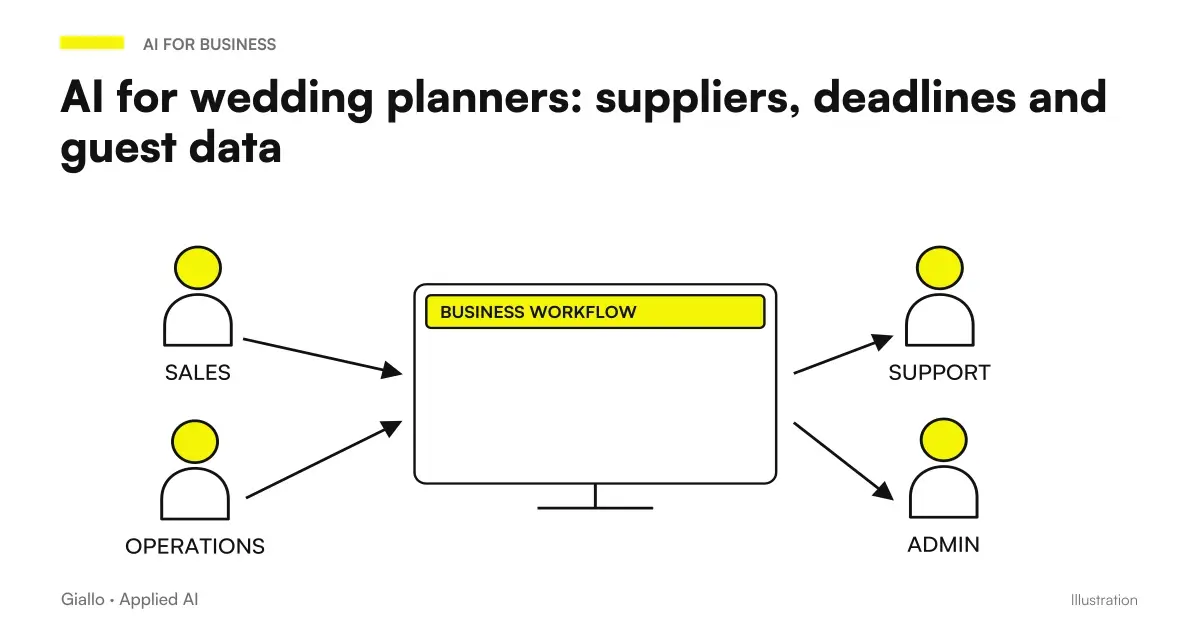
The AI for wedding planners serves where work becomes administration: quotes from suppliers that do not compare with each other, contracts with different clauses for advances and cancellations, a timeline that mixes legal deadlines and deadlines of suppliers, a list of guests with contact details and intolerances. An assistant can keep everything in a file for a couple, read the documents and prepare reminders and summaries. The taste, the choice of suppliers and the decisions of the wedding day remain yours.
There is also one aspect that many planners underestimate: with guests handling data from people you have never met, some delicate, such as an allergy or a faith-related request. Before uploading them to an AI tool it is better to know which rules apply, because they are different from those that apply to the bride and groom.
In summary
- An AI assistant holds the couple's file: decisions, quotes, contracts, payments and deadlines in one place.
- On suppliers the AI makes the estimates comparable and reports the clauses that weigh: advance payments, overtime, cancellation, bad weather.
- The timeline starts from fixed deadlines: the publication remains posted at least eight days and the wedding must be celebrated within the next hundred and eighty days.
- The guest list in your tools falls under the GDPR even if it is a personal activity for the bride and groom.
- At catering they pass type of menu, table and place, not the reasons for the food requests.
- If you sign the contracts with the suppliers, you answer to them: the assistant must know which model applies to each contract.
The couple's file: decisions scattered between chat, email and voice
A couple’s choices arrive through every channel: a voice message about the bouquet, an image board for the decorations, an email from the mother about the number of guests, a photo of the tasting menu. After a few months, nobody remembers whether the flower budget included the centrepiece. An AI assistant can read these messages, extract the decisions and write them in a log with the date and source: "peonies confirmed, florist quote version two, stated by the bride on 12 March".
Think of a planner who follows alone about twenty weddings between May and October. Every Monday the assistant prepares for each couple a three-line summary: what has been decided, what waits for an answer, what deadline arrives in the coming weeks. She rereads it, corrects where it is needed and sends it. The couple has a feeling of being followed, and the planner stops reconstructing conversations by scrolling through the chat.
The log also serves you, when a couple disputes a choice. If each decision has its source, the discussion closes by looking at the original message and not someone's memory.
Suppliers: quotes to compare and clauses not to be missed
A wedding brings together locations, catering, photographer, florist, music, transportation and sometimes many other suppliers, each with their own way of writing a quote. One includes overtime hours, the other does not; one asks for the down payment at the signing, the other ninety days after the event. The assistant reads the PDFs, as described in the guide to business document analysis with AI, and brings them back to a common pattern: what is included, what is extra, when you pay, what happens if you cancel or if it rains.
Then there is the question of who signs. If you are the one who enters into contracts with the suppliers in your name, on behalf of the couple, the Article 1705 of the Civil Code establishes that it acquires the rights and assumes the obligations arising from those contracts, even if the supplier knows of the mandate, and that the third parties have no relationship with the principal. If instead they sign the bride and groom, the relationship is direct between them and the supplier. It's a choice to make with your counselor, and the assistant needs to know her for every contract, because it changes who gets bills, reminders and penalties.
From those contracts the assistant derives the schedule of payments and terms: when the final number of guests is to be communicated, by when the date can be moved, which confirmations are to be given in writing. For the photographer and for the catering, their own logics apply, which you can find in the articles on AI for Photographers and up AI for catering.
The timeline: deadlines that don't depend on you
A wedding timeline is built backwards from the date of the wedding. Some deadlines the stores with suppliers, others sets the law. When the marriage requires publications in the Common, the publication has a minimum duration and a deadline, and to miss the moment of the request forces to redo it.
| Deadline | Where it came from | What the assistant does |
|---|---|---|
| Publication posted at least eight days | DPR 396/2000, art. 55 | Calculate when the affix ends |
| Wedding not earlier than the fourth day after the end of publication, and within the next hundred and eighty days | Civil Code, Art. 99 | Check that the wedding date falls in the window and notify if the request is too early or too late |
| Nothing stands in the way of the bridegroom or the foreign bride | Civil code, art. 116 | Remind the couple to ask their country's authority and follow the delivery |
| Payments and balances of suppliers | Contracts of suppliers | Builds the payment calendar and sends reminders |
| Final number of guests | Catering contracts and locations | Ask the couple for the closed list before the deadline |
| Final Playlist of the Day | Planner Agreements | Send each supplier his share with schedules and contacts |
The dates of the law are the fixed point, those of the suppliers get stuck around. If a couple moves the wedding by two months, the assistant recalculates everything and shows what it jumps: a publication already made that would expire before the new date, a down payment that falls at a different time, a location to be reconfirmed. The practical times of each office confirm them anyway with the Municipality.
Invited and intolerant: what goes into catering and what doesn't
For the newlyweds the guest list is a family thing. For you not. The GDPR excludes activities “of a purely personal or household nature”, but recital 18 adds that the regulation applies to controllers or processors “which provide the means for processing personal data” within those activities. When the list enters your business management software, shared spreadsheet or AI assistant, you process it as a professional, under GDPR rules.
Confirmations of participation are the most repetitive work of all preparation. The assistant sends the invitation to answer, gathers the answers in a single list, remembers the deadline for those who have not yet answered and prepares a first draft of tableau starting from the groups that the couple has indicated, families, colleagues, friends of the university. The final arrangement of the tables you decide with the bride and groom, because it depends on things that no list contains.
Responses to the invitation carry delicate data. A gluten-free menu for celiac disease is a data related to health, and a request related to faith can reveal religious beliefs: Article 9 puts them among the particular categories. Article 5 calls for ‘adequate, relevant and limited to what is necessary’ data. In practice, each supplier receives only the part they need.
What goes into catering
- Number of menus per type: children, vegetarian, gluten-free
- Table and place of those who have a different menu
- Allergies to report to the chief hall
- Final number of guests and times of the day
What remains in the planner's file
- Addresses of the guests and responses to the invitation
- The reasons for the food requests, if the guest wrote them
- Notes on Families and Delicate Relationships to Handle at Tables
- The couple's documents for the Municipality
The AI tool you use for these lists is a provider that processes data on your behalf. Article 28 calls for recourse only to those responsible who offer "sufficient guarantees", with a contract that regulates the treatment: what to check before signing it is explained in contract with an AI provider, while what happens to the data pasted into a generic chatbot is in Business Data and AI. Information for guests and roles between you and the couple should be defined with your privacy advisor.
Destination wedding: two languages and a nulla osta
A couple from Munich who get married on Lake Como write in German, the suppliers reply in Italian, and the location sends the contract in English. The assistant translates in both directions and keeps the two versions of each message, so you can always check what was said; to choose the tool can help comparison on AI for translations. Texts with contract value reread them by a person who knows both languages.
The document determining the date is the nulla osta, or certificate of no impediment. Under Article 116 of the Civil Code, a foreign national wishing to marry in Italy presents the civil registrar with a statement from their country’s competent authority showing that nothing prevents the marriage. How long it takes depends on the country and consulate; details must be requested from the municipality where the ceremony will take place. The assistant maintains the document list for each person getting married, flags missing documents and schedules delivery before deadlines dependent on that document.
The day of the wedding: the ladder answers, you decide
On the day of the wedding the planner's phone rings for questions that the playlist has already answered: what time does the quartet arrive, where the florist downloads, who is the referent in the kitchen. An assistant who knows the playlist responds to the providers on WhatsApp and leaves your line free for what matters. Anything that changes the schedule, such as the rain floor, a bride delay or a supplier who doesn't arrive, goes straight to you or the coordinator on the spot.
Four Ways an Assistant Puts a Planner in Trouble
The first risk is the assistant who confirms for you. A supplier asks if he can anticipate the arrival and receives a "yes" that no one has decided: confirmations must pass to you, always.
The second is the file that becomes an archive of everything. If the assistant keeps every voice and screenshot of the guests without a deletion rule after the event, you accumulate data that you no longer need and that you will still need to protect.
The third is the translation taken for good on a contract. A penalty clause mistranslated is worth as much as a wrong clause.
The last one is about tone. A couple gladly accepts a summary prepared by an assistant, but not an automatic response to an emotional message, such as a bereavement in the family a month after the wedding. Those conversations remain yours.
Which Marriage to Start From
Don't start next month's wedding. Choose the pairs of the following season, when there is time to build the file from the beginning, and start from one piece: the comparison of the suppliers' quotes, or the timeline with the legal deadlines. In the meantime, write down which contracts you sign and which ones the bride and groom sign, which guest data you collect, and how long you keep them after the event.
The framework for events, catering and hospitality is on the page AI for tourism and hospitality. If you want an assistant who keeps file, suppliers and timelines of each couple starting from the tools you already use, Giallo Studio He designs it with you and tries it on a wedding before extending it to others.
Giallo Studio guides: methodology and sources
How we apply it in the company
Related resources
 AI for catering and banqueting: event quotes and customers
 AI for photographers: requests, selection of shots, galleries and image rights
 Contract with an AI provider: what to check
 Business Data and AI: What Happens to What You Write
 AI for business document analysis: a practical guide
 Best AI for Translations: Tools and Comparison
AI by sector
The same reasoning, applied to the other areas we follow.
- AI for veterinary clinics: recalls, prescriptions and pet owners
- AI for procurement and supplier management
- AI for staff shift scheduling
- AI for marketing agencies: content, reports and AI labels
- AI for removals: inventory, quotes, permits and damage
- AI for travel agencies: quotes, packages and assistance to travellers
- AI for technical firms: surveyors, architects and engineers
- AI for automatic appointment scheduling
- AI for medical practices: reception, appointments and reminders
- AI for craftspeople: custom quotes, job orders and electronic invoicing
- AI for wellness centres and spas: admissions, gift vouchers and packages
- AI for insurance agencies: renewals, quotes and complaints
FAQ
Does the GDPR also apply to the guest list the couple sends me?
For the bride and groom the guest list normally falls into the personal activities, but recital 18 of the GDPR specifies that the regulation applies to those who provide the means to process data in the context of personal or domestic activities. You work as a professional, so the guest data in your tools fall under the GDPR. Roles, the privacy notice, and the legal basis should be defined with your privacy consultant.
Can I pass the guest list with dietary intolerances to the caterer?
Pass only what the kitchen and service team need: menu type, table and seat, and allergies to flag to the head waiter. Dietary needs can reveal health data or religious beliefs, which Article 9 of the GDPR treats as special categories, and Article 5 requires data to be limited to what is necessary. The reasons for requests stay in your file.
When should marriage banns be requested from the municipality?
The notice remains displayed for at least eight days, the marriage cannot take place before the fourth day after the publication period ends, and if it does not take place within the following one hundred and eighty days, the publication is considered not to have occurred. Requesting it too early or too late creates problems. The assistant calculates the window from the wedding date; you confirm office processing times with the municipality.
If I sign supplier contracts on the couple’s behalf, who is liable to the suppliers?
If you act in your name, Article 1705 of the Civil Code states that you acquire the rights and assume the obligations arising from the contracts, even if the supplier knows that you work for the couple, and that the third parties do not have relations with the principal. If the couple signs instead, the relationship is between them and the supplier. Choose the model with your consultant and indicate in the file which applies to each contract.
What documents does a foreign couple need to marry in Italy?
The Civil Code, in Article 116, asks the foreigner for a declaration of the competent authority of his country from which it appears that nothing stands in the way of marriage. The practical details change from country to country and from Municipality to Municipality, so they must be verified with the consulate and with the civil status office. The assistant can keep the list of documents, translate it and remember the deadlines.
Can the assistant answer the suppliers on the day of the wedding?
It can answer questions already solved in the schedule, such as the time of arrival, the unloading point or the contact person on location. Changes in schedule, delays and unexpected events come immediately to you or to those who coordinate on the spot, because there you need a decision.