
Business Data and AI: What Happens to What You Write
What happens to data entered into AI tools, which data is used for training and how to protect confidential business information.
Reading time: 9 min
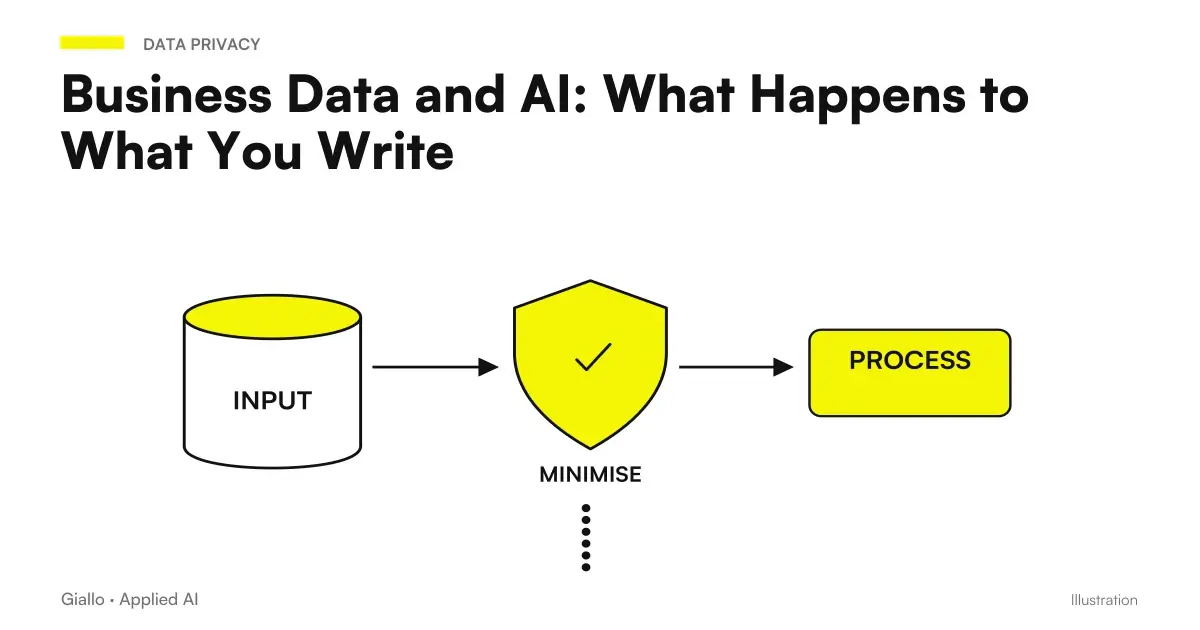
When a contributor pastes a document into an AI assistant, that content leaves the company. It is not an alarmist consideration: it is a technical description. From there on the fate of that information depends on the conditions of the service, the active plan and choices that almost no one has read.
This article explains what really happens to data, what are the concrete risks —which aren't the ones we talk about the most —and how to govern it without banning everything.
In summary
- Content processing varies significantly between plans consumer and plans business/API from the same provider.
- The decisive question is: content is used for train The models?
- Deleting a conversation does not always amount to immediate deletion from the provider's systems.
- The three real risks are: personal data, confidentiality obligations to customers, strategic information.
- The greatest risk in an SME is the use individual unadjusted, not the company system.
- Banning without offering a comfortable alternative only produces clandestine use.
What Really Happens at a Prompt
The tab on privacy and business data in Kimi AI applies these questions to the conditions of the different Moonshot products. It should be consulted before transferring documents, prompts or results from your own process to the external service. The data decision precedes the model test: the guide to JEV AI and corporate data privacy distinguishes service conditions, log and test sample in Italian.
The path of a content is more articulated than «I write it, I receive a response».
- The text comes transmitted the supplier's infrastructure, often outside the European Union.
- Comes elaborated from the model to produce the answer.
- Comes preserved in history, for periods that depend on the service.
- Depending on the plan and settings, it can contribute to improvement of models.
- It can be accessed by staff of the provider for security and abuse purposes, under the stated conditions.
Point 4 is the one that distinguishes an acceptable use from one to be avoided, and radically changes between versions of the same product.
The three risks, in order of frequency
| Risk | What Happens | How frequent |
|---|---|---|
| Personal Data | Processing without legal basis or without agreement with the supplier | Very frequent |
| Contractual confidentiality | Infringement of NDAs or clauses to a customer | Frequent in B2B services |
| Strategic information | Loss of control on price lists, margins, projects | Undervalued |
The first is the norm: it is spoken of in GDPR and AI in the company.
The second is the one that costs the most in professional services. Many B2B contracts contain confidentiality clauses that prohibit communicating information to third parties without permission. An AI Provider is A third.
The third one does not produce sanctions and for this reason it is ignored. It is also the only one that you do not realize that you have suffered.
What should not be entered, as a practical rule
As a rule, you can
- Public texts or intended to become one
- Internal drafts without data of people
- Generic Technical Documentation
- Anonymized or sample data
Better not.
- Documents of clients covered by confidentiality
- Lists of contacts, registry records, historians
- Balance sheets, price lists, margins
- Credentials, keys, configurations
- Health, judicial, trade union data
A mnemonic rule that works better than a long regulation: don't include in an external tool what you wouldn't email to a provider you haven't selected.
Practical examples
Law firm summarizing a file. Double problem: personal data, often of particular categories, and professional secrecy. It doesn't mean giving up AI: it means using an instrument with proper conditions, with a signed agreement and with data that stays where they have to. It is exactly the difference between a public assistant and a system built for study.
Agency that uploads a customer's marketing plan. No personal data, but almost certainly a confidentiality clause in the contract. The risk here is not the Guarantor: it is the customer.
Manufacturing company analyzing production data. No personal data if they are machine numbers and cycles. It is the case that you can work freely, and it is more frequent than companies think: much fear is misdirected.
Commercial that pastes the customer list to "get done" a segmentation. The most common and most problematic case: personal data, strategic value, no authorization. You don't need a cyber attack to lose control of a database: you just need a copy-paste done in good faith.
Alternatives when data cannot exit
There is a category of companies —professional studies, health care, defense, those who work on orders covered by strict confidentiality —so the answer "use the business plan" is not enough. There the question becomes: can you use AI without the data coming out?
The answer is yes, with three levels of increasing compromise between control and simplicity.
| Approach | Where the data is | Cost | When it makes sense |
|---|---|---|---|
| Cloud service with business plan | Outside, with contractual guarantees | Low | Most cases |
| Dedicated cloud in EU area | Out, but perimeter defined | Medium | Sensitive data, contractual requirements |
| Internally executed model | Inside the company | High | Non-negotiable Confidentiality |
The third level is what companies underestimate as an option and overestimate as complexity. There is no need for a data center: for many use cases a small model run on enterprise hardware is sufficient, especially when the task is circumscribed — extracting data from documents, classifying requests, summarizing internal texts.
The theme is deepened in Local AI Models and Open Source AI Models. The criterion of choice is honest: the quality is lower than that of top business models, but on specific and well-defined tasks the difference often does not count, while control over data does.
An agent can also expose information through requests to the tools. The Claude Managed Agents Network Controls They help to define the destinations that can be reached; they must be combined with an explicit choice of the data that the process can send.
The risk that no one measures: what comes out in the answers
There is a lot of talk about what goes in and almost never what comes out. Yet an AI system connected to corporate data can reveal to a user information that that user should not see.
The typical scenario: an assistant connected to internal documentation is exposed to customers to answer product questions. However, the document collection also contains confidential price lists, margin notes and internal comments about suppliers. The assistant does not distinguish: if a well-phrased question leads it there, it answers.
- Check which documents are actually accessible to the system, not which you thought you gave them
- Separate sources by recipient: audience, customers, internal
- Try interrogating it with uncomfortable questions before putting it online
- Predict a log of conversations to be reviewed periodically
It's a configuration problem, not a model problem, and it's the reason why source selection matters more than tool choice. The reverse also applies: a system that answers questions with confidence that it has no information on can invent, as explained in AI hallucinations: how to avoid them. On this front it is also useful contract with an AI provider.
Mistakes to Avoid
- Evaluating the wrong plan. Read the terms of the version that people will use.
- Banning without alternatives. The dry ban produces clandestine use, which is worse than regulated use.
- Confusing deletion and removal. Disappearing from the interface does not mean disappearing from the systems.
- To think that "so much is corporate data". A contact person's name and email are personal data.
- Not training people. Almost all accidents are born of good faith, not doom — see training the team on AI.
How to apply it in the company
- Choose Authorized Tools and check the conditions of the plan you will really activate.
- Make them comfortable. If the business tool is more inconvenient than the personal one, you have already lost.
- Write the list of what doesn't come out from the company, with concrete examples of your work.
- Explain why at least once in conversation: rules whose reasons are not explained last only a few weeks.
- Predict a channel to ask "can I use this for that?" without feeling like I'm on trial.
- For sensitive cases, evaluate solutions where data remain under control, with limited access to what is needed.
Point 2 is what decides the outcome. Data security in the company is won by making the right path easier than the wrong one, not multiplying the prohibitions. The complete frame is in How to Write a Business Policy on AI.
A rule worth more than one rule
If I were to reduce the whole article to just one operational indication to give to a team, it would be this: Before pasting something, ask yourself if you would be comfortable telling the customer that that document has passed for an external service.
It is not a legal rule, it is a common sense test that works better than many checklists because it is impossible to misunderstand and applies in two seconds. It covers professional secrecy, confidentiality agreements, personal data and strategic information at once.
When the answer is "no" or "I don't know", the road isn't to give up AI: it's to use a different tool, with proper conditions, or to work on anonymized data. In most cases the task can be reformulated so as not to bring out anything identifiable — ask for a response model instead of having the actual case processed, for example.
Conclusion
The data that enters an AI tool comes out of the corporate perimeter, and what happens next depends on conditions that hardly anyone reads. Variables are few —active plane, training use, storage, location —and verifying them takes half an hour only once.
The biggest risk, however, is not technical. It is that no one has told people what they can do, and that everyone decides on their own with the best intentions.
If you want to go from testing with ChatGPT to an AI system integrated into business processes, Giallo Studio designs custom agents and automations, with the data remaining where they need to be.
Giallo Studio guides: methodology and sources
How we apply it in the company
Related resources
 GDPR and artificial intelligence in the company
 Corporate policy on the use of AI: how to write it
 AI Act: the guide for Italian companies
 How to Assess the Risks of an AI System
 Training the team on AI: what works
 Claude switched to an earlier model: why it happens and what to do
 AI for Business Functions: Where to Start
 Best AI model for data analysis
FAQ
Is what I write in an AI assistant used to train the model?
It depends on the provider and especially on the plan. Several services distinguish between consumer versions, where content may contribute to model improvement unless you opt out, and business versions or APIs, where contracts normally exclude this. It is the first thing to check before authorising a tool in the company, and it must be checked for the plan people will actually use.
If I delete a conversation, does the data disappear?
Deletion from the interface does not always amount to immediate deletion from the provider's systems, which may retain copies for defined periods for security reasons or legal obligations. Conditions vary: they should be read in the specific service information instead of presumed.
Can I paste a contract or financial statements into an AI assistant?
Technically yes, but it is the decision that needs to be governed upstream. If the document contains personal data the GDPR applies; if it contains confidential information or covered by confidentiality agreements, the risk is contractual to your customer. The practical rule is: do not insert in an external tool what you would not email to an unselected provider.
Are business versions really safer?
In terms of contractual provisions, yes: they typically exclude the use of content for training and offer tools for managing data and access. They do not, however, make misuse safe: if a team member uploads a document that should not have left the company, the business plan does not solve the organisational problem.
What do I risk concretely if an employee pastes confidential data?
The realistic risks are three: breach of the GDPR if it was personal data, breach of an obligation of confidentiality towards a customer, and loss of control over strategic information. The third has no sanctions but can cost more than the other two, and no one notices until it is late.
How do you control unauthorized use of AI tools?
With a combination of three things: a clear policy that says what you can do, approved business tools that are convenient enough to be preferred to personal ones, and training that explains why. A prohibition alone does not work: if the authorized tool is inconvenient, people use their own.