
Voice AI for companies: what it is and when it is needed
Voice AI explained: how a business voice assistant works, when it is worthwhile and the limitations to understand before starting.
Reading time: 12 min
Voice AI is a system that He answers his phone, understands what is being said to him and brings the conversation to a useful conclusion. It is not the old menu responder with keys to press: that followed a rigid tree, this understands freely formulated requests and accesses business data to really respond.
For many Italian SMEs it is more relevant than a chatbot, for a trivial reason that is often ignored: their customers call. In catering, crafts, personal services, technical assistance, the real channel is voice, and the phone ringing in empty is a daily loss.
In summary
- The voice AI understands the Natural Language, does not require keyed menus.
- Makes sense where customers phone, not where they write.
- The highest value is on calls out of hours and on the peaks.
- Acceptance depends on really solving and allowing one to reach out to a person.
- The cost has one more entry than the text: the minutes of conversation.
- It should be stated that it is an automatic system, at the beginning of the call.
How it works, in concrete
The technical chain is simpler than it seems, and understanding it helps to assess the limits.
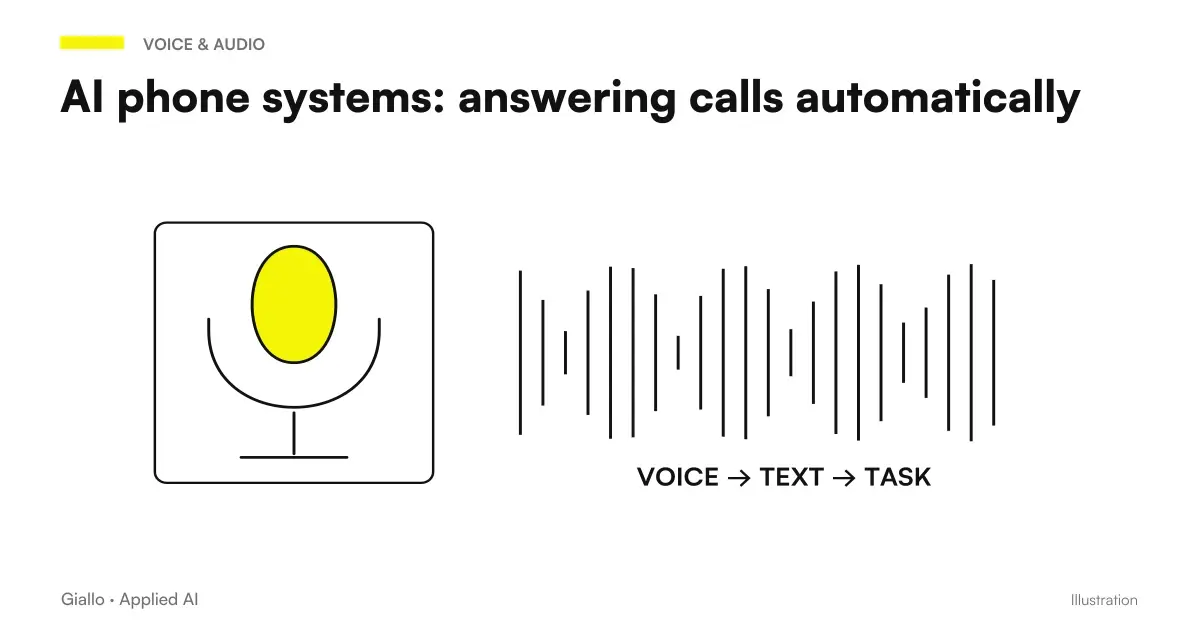
- The call comes and is routed to the system instead of the phone.
- The Voice Comes transcribed in text, in real time.
- The text is interpreted: what does this person want?
- The system retrieve or write information in business systems.
- Formulate the answer and transform it into synthetic voice.
- If it fails, it switches to a person or takes a structured message.
The weak points of the chain are 2 and 6. Transcription is where quality is lost with noise, accents and disturbed lines. The transition to a person is where poorly designed systems fail, leaving the caller in a dead end.
Where it Really Makes
| Situation | Why Voice AI Helps |
|---|---|
| Calls out of hours | Today they are completely lost |
| Peaks where the phone sounds empty | No one answers anyway |
| Repetitive Questions | Timetables, availability, practical status |
| Simple reservations and appointments | Defined flow, clear outcome |
| First Call Qualification | Sorting towards the right person |
| Outgoing confirmation and reminder | Volume calls, fixed text |
The first point is what is surprising. Many companies evaluate voice AI by comparing it to the switchboard during work hours, and conclude that it does not need to be. The right comparison is with what happens at 20:30 or on a Sunday, when the phone rings and no one answers. There the comparison is not with a person: it is with nothing.
Where Not Needed
Makes sense
- High and repetitive telephone volumes
- Many calls out of hours
- Requests with definable outcome
- Information recoverable from a system
It doesn't make sense.
- Few calls a day
- Complex and Negotiated Conversations
- Customers who write instead of calling
- Very noisy environments at the two ends
- Relationships where the human voice is the service
The last point of the right column deserves attention. In some trades answer the phone in person is part of the perceived value: a high-end professional studio, a tailor-made service, a relationship-building relationship. Automating there saves time and costs customers.
The cost: what changes from the text
A voice system has the same voices as a text agent plus one: the talk time. Every minute on the phone has a cost of transcription and synthesis that adds to the consumption of the model.
This changes the way we design. With the text, a long conversation costs little. With the voice, a conversation that runs around in a vacuum costs and irritates together. It follows that the project must be designed for close quickly: understand what those who call in the first exchanges want, and if they can not immediately pass to a person instead of insisting.
The cost framework is in how much does an AI agent cost and the calculation of consumption in cost of AI API.
To compare voice patterns, the new Amazon Nova 2.5 Sonic offers a case to be assessed on supported dialogue, tools and languages. Regional availability and individual functions must be checked separately before connecting it to a telephone service.
Real conditions matter more than technology
It's worth being concrete about the limits, because that's where expectations break.
- Background noise from the caller's side: workshops, construction sites, road, crowded premises
- Unstable moving lines with cut words
- Marked regional accents and high speaking speed
- Older people talking on the phone with long breaks
- Talkers who say three things together in the same sentence
None of these make the project impossible, but all must be tested before with real calls. A system rated in the office with clear voice and fixed line will give different results from the real world, and disappointment comes after release.
Practical examples
Restaurant with 40 calls per day. Most are reservations and questions about schedules. Many come at times when the staff is in the room and cannot answer. Solid case: the system takes simple bookings and passes the special requests. Detail in AI for phone bookings.
Mechanical workshop. The owner is underneath a car when the phone rings. Calls are often “when is my car ready?” and “can you take a look at something for me?”. The first can be automated if connected to the business management software; the second must be handed over. Pay attention to the workshop’s background noise, which is a real factor here.
Medical study. Bookings, rescheduling and requests for prescriptions. High, repetitive volume. The main issue is data rather than technology: health information is processed, changing the compliance framework — see GDPR and AI in the company.
B2B company with few important customers. It doesn't make sense. Calls are few, long and relational. An automatic system here communicates exactly the wrong message.
What happens to call recording
It is the aspect that companies face last and that should be clarified first, because it touches on different rules and has practical implications.
A voice system transcribes to work: without text it cannot understand. This means that each conversation produces written content, which must be decided where it ends and for what remains. The transcript contains personal data, often even of delicate categories if it is health bookings or requests that reveal personal situations.
- Decide whether to keep the transcripts and for how long
- Inform the caller at first, in an understandable way
- Verify where the data resides and who accesses it
- Distinguish between audio recording and transcription: different obligations
- If there are employees involved, also consider the regulations on controls
The fourth point is the less well-known one: preserving audio and preserving text are not the same thing from the point of view of obligations and risk. Many projects don't need audio, and not storing it simplifies a lot. The complete picture is in GDPR and AI in the company and in Business Data and AI.
The Structured Message: The Underrated Alternative
There is a middle ground between ‘the system solves the demand’ and ‘the phone rings empty’, and for many SMEs it is the best choice ever.
The system responds, presents itself, understands what is needed, collects the necessary data and takes a structured message: who called, for what, with what urgency, what number to call, with the transcript of the request. Then notify the right person.
It does not solve anything independently, and precisely for this reason it is simple, cheap and does not go wrong. But it turns a lost call into a tracked task, which someone can call back knowing what it is instead of starting over.
Advantages
- Costs a fraction of a system that solves
- No risk of wrong answers
- It also works with complex requests
- It is realized in a short time
When Enough
- Requests are varied and non-standardizable
- The problem is not to lose contact
- Those who call can do so within a few hours
- Volumes do not justify a large project
For an SME who loses out-of-hours calls, this is often the right project: it solves the real problem —the lost contact —without paying for the complexity of a system that needs to understand and act.
How do you measure if it's working
A voice project must be measured with numbers that hardly anyone picks up, because before there was nothing to measure: lost calls leave no trace.
Calls handled without human intervention. It says if the system really serves or if it only moves the work. If the quota is low, the perimeter is too ambitious and it's better to narrow it down.
Average duration of the conversation. If it grows over time, the flow is poorly designed: the system asks unnecessary questions or does not understand at the first stroke.
Hang up in the first seconds. It is the measure of acceptance, and it is the most honest of all. If a significant share hangs up as soon as it hears the synthetic entry, no technical optimization solves: that audience must be served differently.
Repeated calls from the same number. It indicates unresolved requests on the first attempt, which is the most expensive failure because the customer tried twice.
These four numbers take a few minutes a month and turn the assessment from impression to fact. The general method is in How to Assess the Risks of an AI System.
The design of the voice agent can be assisted, but publication requires scrutiny. ElevenAgents Architect in alpha prepare changes and analyses to be reviewed: availability, costs during alpha and chat processing must be verified before entering real data.
The Path by Degrees
As with the other uses of AI, it is best to step up one step at a time instead of immediately aiming for the system that manages everything.
- Text structured out of hours. No integration, minimal cost, recovers contacts that are lost today.
- Smart sorting. He understands the reason and switches to the right person with a summary.
- Data response. Retrieves information from systems: practice status, availability, deadlines.
- Complete action. Book, edit, confirm, write in systems.
Each step benefits on its own and costs a fraction of the next. Many companies find that the first or second solves the perceived problem, and that the fourth does not serve. Starting from above means paying complexity for cases that don't show up.
Mistakes to Avoid
- Evaluate it against the switchboard on time. The real comparison is with missed calls.
- Don't link it to the data. A system that only gives generic information is immediately exposed.
- Making it hard to get to a person. It's the mistake that generates the most anger.
- Testing it only under ideal conditions. The real world has noise and bad lines.
- Don't declare it. Obligation of transparency and wrong expectations.
- Use it where the human voice is service. You save time and you lose customers.
How to apply it in the company
Record for a week how many calls you receive, how many remain unanswered and what they talk about. These are three numbers that almost no SME has, and that decide everything.
If the missed calls are few, the project does not justify itself. If there are many and they relate to repetitive requests, you have a solid case. If there are many but they concern complex issues, the right answer is not a system that manages them: it is a system that takes a structured message and alerts those who need to call back.
It always starts from a narrow perimeter —one or two typical requests —and expands after that. The comparison with the written channel is in voice AI or chatbot, the typical errors in mistakes to avoid with voice AI.
Conclusion
Voice AI makes sense where customers call, where calls get lost, and where requests are repetitive with a definable outcome. It is a mature technology, and its real limits are not the quality of the voice but the noise, the lines and the ability to connect to business data.
The practical rule for deciding: counts calls that no one answers today. If there are many, the comparison is not with one person but with silence, and almost any decent system is better than silence.
If you want to go from testing with ChatGPT to an AI system integrated into business processes, Giallo Studio designs custom-made agents and automations. You can see some working in The Lab.
Giallo Studio guides: methodology and sources
How we apply it in the company
Related resources
FAQ
What is voice AI applied to a company?
It is a system that answers the phone, understands what the interlocutor says, retrieves or records information in business systems and leads the conversation to a conclusion. It differs from the old menu responder because it does not ask to press keys: it understands natural language and handles requests formulated in different ways.
When is it better than a chatbot?
When your customers call rather than write. It seems obvious but is often overlooked: in sectors such as hospitality, personal services, trades and support, the actual channel is voice. Building a chatbot where nobody writes solves a problem that does not exist.
Do customers agree to talk with an automatic system?
Acceptance depends almost entirely on two factors: that the system really solves the demand, and that it is easy to get to a person when it fails. A system that works is tolerated well; one that spins in circles produces more harm than not answering at all.
How much does an AI voice system cost?
It falls within the range for custom AI agents, with an additional variable: cost per minute of conversation, added to model usage costs. Estimate it using actual call volume, because voice, unlike text, has a cost that visibly scales.
Does it work well in Italian?
The quality of recognition in Italian is good today under normal conditions. It worsens with background noise, marked dialects, disturbed lines or interlocutors who speak very fast. They are frequent conditions in contexts such as workshops, construction sites or premises, and should be considered in the evaluation.
Does it have to be said that it is an automatic system?
Yes. This is a transparency obligation for systems interacting with people, and for voice it must be stated clearly at the start of the conversation. Beyond the regulation, it also sets callers' expectations correctly.