
AI e-commerce prompts: product descriptions, email and support
Ready-to-use AI prompts for e-commerce: product descriptions, abandoned cart emails, review replies and customer support. Examples for online stores.
Reading time: 9 min
A AI prompt for e-commerce is a precise instruction you tell the model (ChatGPT, Claude or others) to get a ready-to-use output: the description of a product, the email to retrieve an abandoned cart, the response to a three-star review. It's not about magic: it's the same logic as any other communication, only that the recipient is a machine that needs explicit context not to produce generic and useless texts.
The difference between those who get concrete results from AI and those who stop at the two-day tests is almost always in the prompt quality: Different tools (ChatGPT, Claude, Gemini) produce similar outputs when the request is well structured, and bad outputs when the request is vague. This guide collects ready-made examples and explains how to adapt them to your store.
To understand where an effective prompt starts, read first what is prompt engineering: the basic principles (context, format, tone, length) apply equally to e-commerce.
In summary
- An effective e-commerce prompt always specifies: product, target, brand tone and expected format.
- The most useful applications: product cards, email marketing, response reviews, customer care FAQ, seasonal campaigns.
- A generic prompt ("write a description") produces generic texts; a specific prompt produces revised drafts in minutes.
- For large catalogs, automate generation with a AI Agent connected to the management software reduces the cataloging time from hours to minutes per product.
- AI produces the first draft; human review remains necessary —especially on pricing, technical specifications, and brand tone.
How to structure an AI prompt for e-commerce
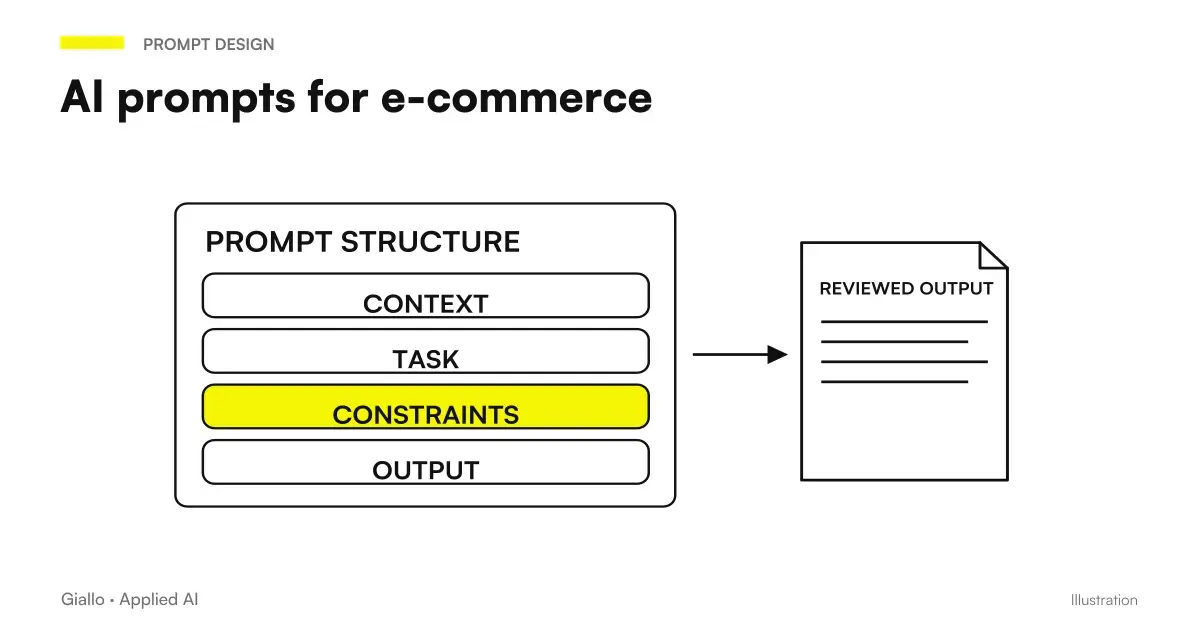
All prompts that work in e-commerce have the same skeleton: role + context + task + format. Translated into practice:
- Role: "You are an experienced copywriter of e-commerce for mid-range products."
- Background: product information (name, material, benefits, target, guide price).
- Task: what it needs to produce (product sheet, email, reply to review).
- Format: length, structure, tone (formal/informal), what to avoid.
The more detail you give, the closer the output comes to what you would use without modification. This applies to both ChatGPT than for any other model.
Reusable template structure
Copy and compile this scheme for any e-commerce task:
Role: You are an experienced copywriter of e-commerce for [sector/brand].
Product: [name, main features, materials, price].
Target: [who buys this product, age, needs].
Tone: [e.g. friendly and direct/elegant and professional/technical and informative].
Task: [what you need to write].
Format: [length, structure, what to avoid].
Ready prompts for product cards
The product card is the use case where AI gives the most immediate return: repetitive text, standardized structure, high volume. On a catalog of a few hundred products the gain is measured in man-days saved.
Prompt base — product sheet:
You are a copywriter specialising in e-commerce. Write a product listing for: [product name]. Material: [e.g. organic cotton 200g/m²]. Target audience: [e.g. men aged 30-50, casual chic]. Tone: direct, with no empty adjectives such as “exclusive” or “revolutionary”. Structure: SEO title (max 65 characters), short description (2 lines for search engines), long description (3 paragraphs: main benefit, technical details, occasion of use). Total length: 200-250 words.
Prompt for technical products:
You are an expert in [sector, e.g. consumer electronics]. Write the product sheet for [product name, key technical specifications]. The typical customer already knows what he wants but compares two models: highlight competitive advantages without inventing them. Avoid phrases like "higher quality" without supporting data. Format: feature list (5 entries), narrative description (150 words), bullet benefit (3 points).
Prompt for lifestyle/gift products:
Write a product card for [product name] designed for those looking for a gift. The product is worth [price]: it emphasizes the perceived value without writing "the perfect gift" (chopped phrase). Tone: warm, concrete. Include a sentence on how the product is packaged/shipped (delivery in 24h, gift box available). Max 180 words.
Email prompt: abandoned cart, promo and follow-up
Email is the channel with the best ROI in e-commerce — and also the one where a mediocre text is most noticeable. AI models produce solid drafts if they receive the right information. To learn more about email prompts go to AI prompt by email.
Abandoned cart — first email (after 1 hour):
Write an email for an abandoned cart. The customer left in the cart: [product name, price]. It is the first email (within 1 hour of leaving). Tone: light, no pressure. Subject: max 50 characters, no emoji. CTA: one "Back to Cart" button. No discount: this will come in the second email. Max 80 words in the body.
Seasonal promotional campaign:
You are the marketing manager of an e-commerce [sector]. Write a promotional email for [seasonal event: e.g. summer sales, Black Friday, school re-entry]. Promotional product/category: [X]. Discount: [Y%]. Subject: real urgency (deadline [date]), max 55 characters. Text: 3 introductory sentences + featured products + CTA. Tone: enthusiastic but not shouted. Avoid: "Don't lose", "Last chance", "Unrepeatable offer".
Follow-up post purchase:
Write a follow-up email to be sent 7 days after purchasing [product]. Objective: to ask for a review in a natural way, without looking automated. Tone: human, sincere. CTA: link to review page. Add a suggestion on how to best use the product (e.g. care, pairing, maintenance). Max 100 words.
Prompt for response to reviews
Responding to reviews —positive and negative èis high-volume, low-priority work perfettoperfect for AI. The risks are low on the positives, higher on the negatives: in both cases the prompt must prevent you from playing robotic.
Positive review response (5 stars):
Write a reply to this positive review: “[review text]”. Tone: authentic, not excessive. No “Thank you so much for your fantastic review!” Thank them naturally, personalise the reply around the specific thing the customer appreciated, and invite them back. Max 3 lines.
Response to negative review:
The customer wrote this review: "[text]". Rating: [2-3 stars]. The problem reported concerns [e.g. delay in delivery/product defect/service]. Write an answer that: admits the problem without empty excuses, explains what has been done or what we will do, offers a concrete solution ([e.g. refund, replacement, coupon]). Tone: professional and human. No defensive phrases. Max 5 lines.
Table: prompt for e-commerce task
| Task | Key elements in the prompt | Expected Output | Recommended Length |
|---|---|---|---|
| Standard Product Sheet | Name, material, target, tone, structure | SEO title + short description + long | 200-250 words |
| Abandoned Cart Email | Product, price, email number in sequence, CTA | Object + body + CTA | 80-120 words |
| Positive review response | Text review, specific aspect appreciated | Custom response | 2-3 lines |
| Negative review response | Text review, cause of problem, solution available | Professional response with solution | 4-5 lines |
| Seasonal Promo | Event, product/category, discount, deadline, tone | Subject + full email | 150-200 words |
| Follow-up post purchase | Product, days from purchase, target (review) | Human Email with CTA | 80-100 words |
| FAQ assistance | Frequently asked question, brand tone, max words | Clear and autonomous response | 3-5 lines |
Prompt for customer care
An AI assistant that answers frequently asked questions around the clock is one of the most practical e-commerce use cases, especially during peaks such as Black Friday. To produce consistent answers, always start with a base prompt that defines the model’s tone and limits. For a detailed look at customer care, see automation AI what it is.
Prompt for FAQ shipping:
You are the virtual assistant of [store name], an e-commerce of [sector]. Answer this customer question clearly and directly: "[question, e.g. when does my order arrive?]". Available information: [e.g. standard shipping 3-5 working days, express 24h with additional charge]. Tone: friendly but professional. Max 3 lines. If the answer requires data that you do not have (order number, address), ask the customer to provide it and offer to transfer it to an operator.
Prompt for response to return request:
The customer asks, "[text request returned]". Our policy includes: [e.g. free return within 30 days, unused product, with original packaging]. Write a reply that: confirms acceptance (or explains why it is not possible), indicates the exact steps to start the return, closes with an invitation to contact us for doubts. Tone: clear, reassuring. Max 5 lines.
Practical examples
Scenario 1 — E-commerce clothing from 600 SKU. An Italian fashion brand has seasonal raises every 3 months with 80-120 new products. The marketing team wrote the cards in 30-40 minutes per piece. With a prompt calibrated to brand tone (minimalist, featured materials, no empty adjectives), the draft comes in 20 seconds and the revision takes 5-8 minutes. Savings: .200 hours per season. The team also standardized the tab structure, improving SEO consistency in the catalog.
Scenario 2 — Online shop for pet products. The customer care received 40-60 repetitive emails every day on shipments, product compatibility, returns. With a tone-calibrated response prompt (friendly, informative, safe) and a list of type responses, the AI assistant handles 70% of the tickets on its own. Operators focus on complex cases (claims, animal health problems, disputed reimbursements). Customer satisfaction has not dropped; average response times have gone from 8 hours to under an hour. For cases like this, a Customized AI Agent connected to the ticketing system also automates the routing of urgent cases.
Product content must answer real questions, even when the search goes through an assistant. The Shopify Italy report on shopping with AI distinguishes interest in some tasks and delegated purchase: they are signals to be used for a test on the catalog, not guaranteed forecasts of turnover.
Mistakes to Avoid
- Prompt without brand tone. "Write a product card for this bag" produces generic catalog text. If your brand is minimalist and speaks to an adult audience, say so explicitly.
- Giving too many contradictory instructions. "Write short but detailed, formal but fun, technical but accessible" confuses the model. Choose a direction per session.
- Publishing without review. AI can invent technical specifications, measurements or materials that do not match the actual product. Every verifiable data (size, weight, certifications) must be checked before publication.
- Using the same prompt for very different products. A clothing prompt does not work on electronics. Keep separate prompts by product category.
- Ignoring SEO in the prompt. If you do not specify focus keyword and structure (H1, meta, body), AI writes good copy but not search engine-optimized tabs. Include the target keyword in the prompt.
How to apply it in the company
- Identify high-volume tasks. What content do you write several times a week? Product cards, email replies, social messages. Start there.
- Create a base prompt for each task. Start with a real product and iterate on the prompt until the output needs less than 5 minutes of review.
- Standardize in a shared document. Working prompts should be saved and shared with the team, not kept in the browser memory.
- Measure before and after. Time per product card, tickets handled per hour, email response rate. Without numbers you don't know if you're really buying time.
- Scale with automation. When prompts are stable, consider automating the flow with an agent that reads the catalog and generates drafts in batch, without manual copy-paste. Read how the AI agents to understand when it makes sense.
To learn more about how AI can concretely integrate into an online store — not only for text but also for logistics, pricing and support — read the guide on AI for e-commerce and the overview on Best AI for Companies.
Conclusion
The AI prompt for e-commerce are a practical tool, not a future promise: product cards, cart recovery emails, responses to reviews and customer care are high-volume tasks, low creative complexity and very high repetitiveness — exactly the type of work where AI offers measurable return as early as the first few days. The point is not to delete the team: it is to move the time from the first draft to review and decisions. To better understand how to build effective prompts in general, it is worth delving into the basics of prompt engineering and watch the examples of AI prompts for marketing.
If you want to go from testing with ChatGPT to an AI system integrated into business processes, Giallo Studio custom designed agents and automations.
Giallo Studio guides: methodology and sources
How we apply it in the company
Related resources
 AI prompts: a complete guide to effective instructions
 ChatGPT prompts: ready-to-use examples to copy and adapt
 AI email prompts: ready-to-use examples for every situation
 AI marketing prompts: copy, campaigns and content
 Best AI for business: which to choose in October 2026?
 AI agents: what they are and how they work
 AI SEO prompts: optimise content and rankings
 AI prompts for lawyers: legal documents and communications
Prompt Collections
Ready prompts for other roles and tasks.
- AI document analysis prompts: contracts, reports and PDFs
- AI email prompts: ready-to-use examples for every situation
- AI customer support prompts: ready-to-use examples
- AI prompts for Excel and Google Sheets: formulas and data analysis
- AI prompts for accountants: ready-made examples for documents, analytics and clients
- AI image prompts: examples for Midjourney, ChatGPT and Firefly
- AI prompts for lawyers: legal documents and communications
- AI marketing prompts: copy, campaigns and content
- AI prompts for real estate agents: ready-made examples for ads, emails and customers
- AI presentation prompts: PowerPoint and Google Slides examples
- AI video prompts: Runway, Kling and Gemini alternatives to Sora
- AI coding prompts: write, fix and explain code
FAQ
What is meant by an AI prompt for e-commerce?
An AI prompt for e-commerce is a text instruction guiding a model such as ChatGPT or Claude to produce something useful for an online store: a product description, a promotional email, a reply to a negative review or an abandoned-cart message. Prompt quality directly determines output quality.
Can AI write product descriptions for an online store?
Yes, and it is one of the most effective uses. A good prompt specifies product name, materials, target, brand tone and desired length. AI produces a draft in seconds; the team reviews it and publishes it. For large catalogs (hundreds of products) time savings are relevant.
Which AI models are suitable for e-commerce?
ChatGPT (OpenAI) and Claude (Anthropic) are the most widely used for copy, emails and customer care. To integrate automation into business processes, you need an AI agent connected to the management system or e-commerce platform, rather than just manual chatbot use.
Do AI prompts work on all e-commerce platforms?
Prompts produce text: they work independently of the platform (Shopify, WooCommerce, Magento, Prestashop). Integration with the platform is a separate layer that concerns how the text is imported and published, not how it is generated.
How many hours do you save by using AI for an e-commerce catalog?
It depends on the current process. For a catalogue of 500 products, writing a product description from scratch takes 20-40 minutes per product; with an AI prompt, the draft arrives in 10-20 seconds and review takes 5 minutes. The savings can amount to hundreds of hours for the entire initial catalogue.
Can AI respond to negative reviews on my behalf?
It can generate a draft response to be reviewed, not self-published. For negative reviews, a human check is recommended before publication: the reputational risk of a wrong response exceeds the time saved.