
AI for phone bookings
How AI phone booking works: voice workflows, cancellations, identifying itself as AI and call recording.
Reading time: 9 min
Taking reservations over the phone is one of the most robust use cases of artificial voice, for one precise reason: the flow is defined and the outcome is verifiable. Date, time, number of people, name, contact: little information, no ambiguity about what it means to have completed the request.
It is also the case where the value is seen immediately, because in many activities the share of calls to which no one answers is high and no one really measures it. But it is also a case where the answering machine has to comply with certain precise rules towards the caller, not just work well from a technical point of view.
In summary
- The flow of a reservation is defined, and that is what makes this use case simpler than others.
- From 2 August 2026 the system must declare itself as AI from the beginning of the call, by legal obligation.
- The highest value lies in the calls that today no one answers, not in those already well managed.
- The cancelled automatically managed are often worth as much as new bookings.
- Recording calls requires a stated reason, policy, and retention time decided in advance.
- Special requests must be passed to a person, not forced into the standard stream.
The flow, step by step
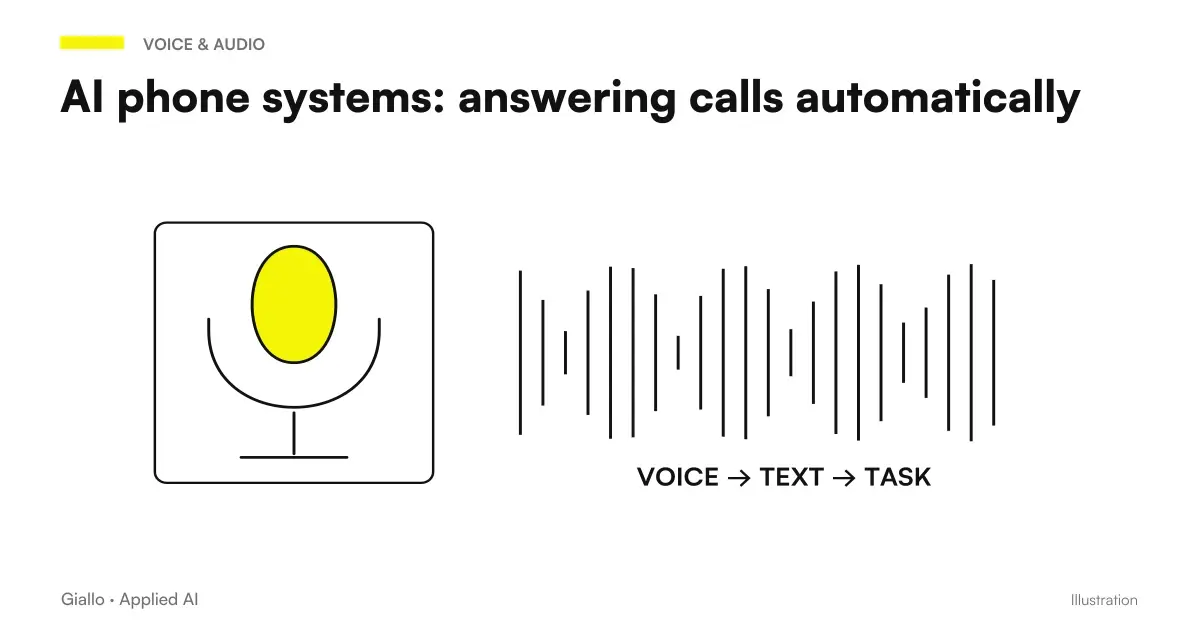
- The system responds and immediately declares its own nature of automatic assistant.
- It asks in an open way what is needed, without a multiple-choice menu.
- It collects the missing data one at a time, repeating for confirmation.
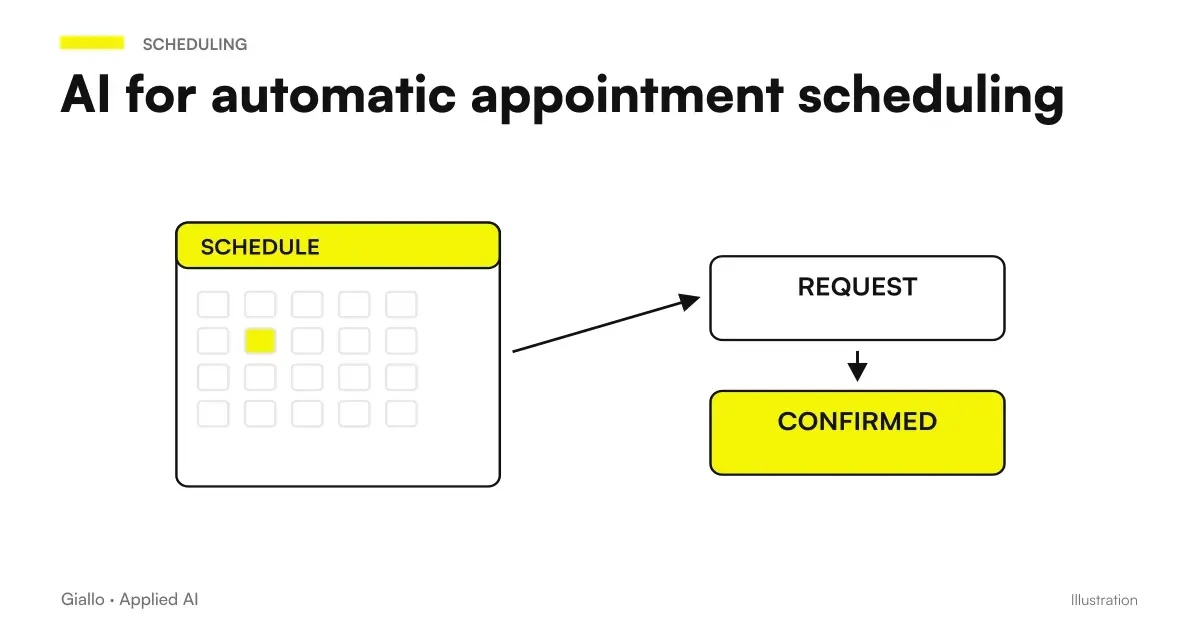
- Check the real availability on the calendar or on the booking manager.
- Confirm by voice and record the reservation in the same place where it is recorded by those who work in the hall.
- Send a written confirmation if you have a valid contact.
- If something comes out of the standard, it switches to a person or takes a detailed message.
Point 4 is the difference between a useful and a harmful system. A system that accepts bookings without seeing real availability creates overlaps, and the damage of a twice-booked table vastly outweighs the benefit of automation.
Declare an AI is no longer just good education
The first step of the flow, immediately tell who you are talking to, now has a precise regulatory basis. The Article 50 of the AI Act establishes that AI systems intended to interact directly with physical people must be designed so that callers know they are dealing with an AI, unless it is already apparent. The date of application, as set out in Article 113 of that Regulation, is 2 August 2026.
For a phone reservation this results in a simple sentence as soon as you reply, not a confusing notice in the middle of the conversation. Those who adopt it already today, before it becomes mandatory, also avoid a practical problem: a customer who discovers in retrospect that he has spoken with an automatic system tends to trust the booking itself less.
Dismisses: The Hidden Value
In most activities, you think about how to take more bookings, and you neglect the opposite side. Yet a notified cancellation is a place that can be resold, while an uncommunicated cancellation is a place lost twice: empty and not reoccupyable.
The problem is that canceling usually requires you to call at a time when someone answers, and many people simply don't. A system that always answers lowers that barrier.
- Identify who calls from the number associated with the booking
- Confirm details before undoing
- Immediately free up availability on the shared calendar
- Warn who runs the hall, so he can call any people on the waiting list
What the system needs to know and pass
Manages well
- Standard Reservations
- Date or time changes
- Cancelled
- Questions about times and address
It must pass to a person
- Large groups and events
- Allergies and special needs
- Requests on specific tables or spaces
- Regular customers with informal agreements
The last point is what assets underestimate the most: the long-standing customer who expects to be recognized. A system that treats it like anyone else communicates an unpleasant message, and in certain contexts that message costs more than all bookings recovered with automation.
Recording Calls: What the Guarantor Asks
If you decide to keep calls, even just to check the quality of the service, it is not enough to activate them in the switchboard management software: you need a stated reason, a clear information and a defined storage time. In a 2011 case on a call recording system, the Privacy Guarantor has authorized the registration for quality verification with a sampling of 25-30%, a listening limited to 6-8% and a maximum retention of 90 days, in addition to a separate information for customers who call.
For a small business this does not mean having to replicate exactly those same numbers, which concerned a much larger context, but following the same principle: to record only what is needed, to tell the caller, and not to preserve indefinitely. Often, for a reservation, the structured transcription of the data (date, time, covered, name) is enough without also holding the audio.
The general principle of the Article 13 of the GDPR: the person who collects a personal data, including that collected on the phone, must tell who treats it and for what purpose, at the same time as he collects it. For a reservation, a short sentence is enough during the call, with a reference to the site for full details: you do not need to read a whole statement by voice.
The languages of those who call
In an area with tourism, some of the calls come in a language other than Italian, and it is an aspect to consider before choosing the system, not after. An assistant who recognizes only the Italian loses exactly the calls that most often do not find answer in any other way, because those who are passing by hardly recall a number to which no one has answered the first time.
Who called, really
To modify or cancel a reservation the system must know with reasonable certainty who is in front of it. caller number is the most convenient method: if it corresponds to that of a reservation, the system finds it, even if it is not infallible (shared phones, reservations made by others). request for verification, as a more given name, adds security to the cost of lengthening the conversation by a few seconds.
When there is no availability
It is the situation that distinguishes a useful system from one that does damage, and is almost always neglected at the project stage. If there is no place in the requested time, the system has three possibilities: propose nearby alternatives, put on the waiting list, or switch to a person. The wrong choice is simply to say there is no place and close the call: that was still a customer who wanted to come.
| Request | Management | Why |
|---|---|---|
| Standard booking | Automatic | Defined flow, verifiable outcome |
| Change of date or time | Automatic | Same data, same control |
| Termination | Automatic | Free the slot right away |
| No availability | Alternative or waiting list | Avoid losing the customer |
| Large group or event | To one person | Requires space assessment |
| Regular customer with agreements | To one person | Recognition is part of the service |
Two concrete situations
Think of a restaurant with a portion of the calls concentrated right during the service, when the staff is busy in the hall. The system covers those bands and local calls closed, while requests with something particular are passed in the morning after. It is the narrowest perimeter and also the easiest to start.
Instead, think of a physiotherapy study, where in addition to the standard reservations there are movements and cancellations, with the addition that the data collected are sanitary: an extra attention is needed on what is recorded and stored, with the verifications described in GDPR and AI in the company.
Finally, think of a small salon with only one location, where the volumes are low but the calls come just while you are working on a customer. Nothing sophisticated is needed here: just answer the system, take the essential data and alerts. No complex integration, no handling of particular cases to automate.
How to get started without creating two parallel lists
Count for a week the calls received and, if you can, those left unanswered. Then look at how many reservations are standard and how many have something special: that proportion tells how much of the traffic the system can really cover. Start with the standard flow and cancellations, leaving the rest to one person.
There is an organizational aspect that decides the adoption more than the technical characteristics: if the reservations taken by the system end up in a different place than those taken by voice, two lists are created, and sooner or later someone books the same table twice. Before activating any automation it must be decided that it exists one agenda, and that everyone, including the system, write there. It is an organizational work of a few hours that no supplier can do for you.
Then there is one aspect that concerns those who work in the hall more than technology: if the staff continues to hand-mark reservations taken in person on a notebook, while the system writes on a digital agenda, the system will see an availability that no longer really exists. The rule of thumb is that anyone who makes a reservation, by whatever means, should write it in the same place, within minutes.
The general framework on the voice applied to companies is in voice AI for companies, the typical errors in mistakes to avoid with voice AI, the comparison between voice and text in voice AI or chatbot. If your problem is more the agenda as a whole, with reminders and confirmations across multiple channels, the right angle is AI for automatic appointment scheduling.
If you want to figure out which part of your switchboard is best automated first, the AI consulting services by Giallo Studio They start with a real call count, not a standard package.
Giallo Studio guides: methodology and sources
How we apply it in the company
Related resources
AI by sector
The same reasoning, applied to the other areas we follow.
- AI for SMEs: a practical guide to really getting started
- AI for cleaning companies: specifications, shifts, DUVRI and safety data sheets
- AI for hairdressers and beauty salons: bookings and fewer schedule gaps
- AI for customer callbacks
- AI for gyms and sports centres: class bookings, medical certificates and memberships
- AI for recruiting and staff selection
- AI for opticians: prescriptions, collections, contact lenses and recalls
- AI for business reporting: fewer hours, the same data
- AI for customer onboarding: automate the first moment that matters
- AI for human resources: concrete uses
- AI for car workshops: quotes, appointments and customers
- AI for restaurants: reservations, allergens and responses to reviews
FAQ
Can an AI system really take bookings over the phone?
Yes, and it is one of the most mature use cases of artificial voice, because the flow is defined: date, time, number of people, name, contact. However, it must see the real availability on the calendar, otherwise it only takes note and someone will have to double-check by hand.
Does the system have to say immediately that it is an artificial intelligence and not a person?
Yes. Article 50 of Regulation (EU) 2024/1689, the AI Act, obliges systems that interact with people to let them know, unless it is already obvious from the context. The rule applies from August 2, 2026, but saying so immediately avoids ambiguity with who calls.
What happens with special requests, such as allergies or large groups?
They must be recognized as an exception, not forced into a pattern that does not provide for them. The system must collect data and pass the call to a person: insisting on handling them alone produces errors and unhappy customers.
Can call recordings be retained?
Only if it is really needed and with a stated reason, such as checking the quality of the service, with a clear privacy notice to the caller and retention times defined in advance. If the transcript is enough to complete the reservation, often there is no need to keep the audio as well.
How much does it cost compared to a person answering the phone?
The correct comparison is not with the person on duty, but with the calls lost when they are busy or the activity is closed. In many activities those calls are the majority, and there the comparison is with zero answers, not with an available human alternative.
Does it work with the noise of a crowded venue?
The noise that matters the most is from the caller's side, not from your venue. A phone call made on the street or from a noisy environment produces audio that is harder to recognise: it is a variable to be tested with real calls before activating the system on all time slots.