
Gemini 4 Argon vs ChatGPT and Claude: which should you choose?
Gemini 4 Argon vs ChatGPT and Claude: models, benchmarks and business criteria. Decide when to test Argon, Astra or Claude beyond the brand name.
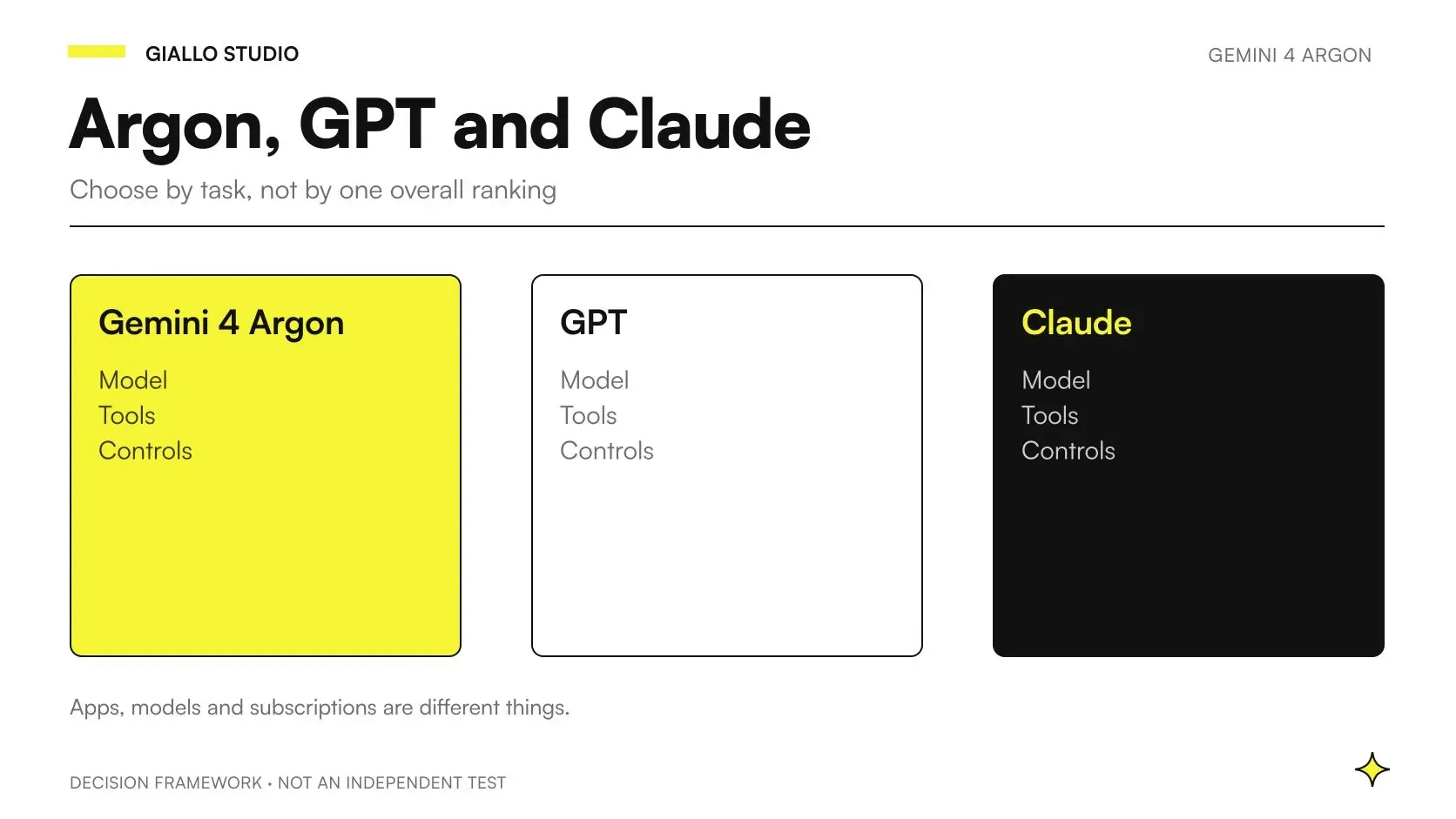
When comparing Gemini 4 Argon vs ChatGPT and Claude, the first step is to separate the model from the application that makes it usable. Argon, GPT-6 Astra, Claude Fable 5.1 and Claude Opus 5.5 are model identifiers in the documentation considered. ChatGPT and Claude also refer to product experiences: tools, plans, permissions and workflows can change the result you obtain.
As of 23 October 2026, public evidence does not support a universal winner. The Google Argon model card reports advantages and losses against those models; the Vals v2.2 leaderboard dated 22 October adds a different snapshot, sensitive to how refusals are handled. Here we analyse those sources without presenting a practical test conducted by Giallo.
For an overview of its capabilities, start with what Gemini 4 Argon is. This guide helps you decide which system to test for a specific process, and which conditions to check before replacing a tool already in use.
In summary
- Compare model identifiers and versions first, then applications and service terms.
- Argon leads some published benchmarks and loses on others: the type of task changes the choice.
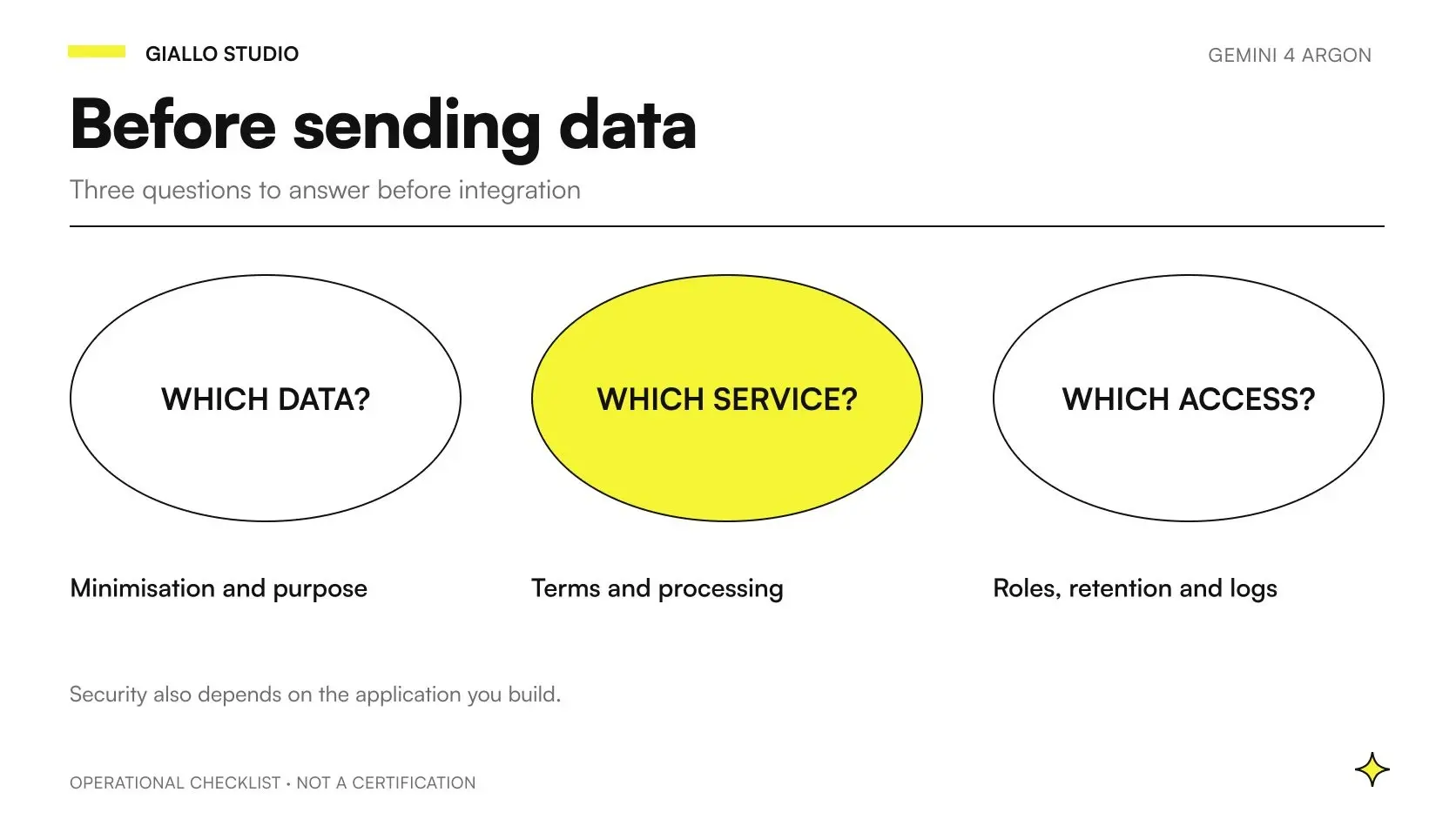
- A Workspace account, a consumer plan and an API do not automatically share the same protections.
- Useful tools matter only if the process can use them with appropriate permissions and controls.
- Decide on migration after a trial with verifiable results and visible review costs.
Are you choosing a model or an application?
The model generates a response given a context. The application determines which information can reach it, which tools are available and how the result is presented. A business integration adds further choices: authentication, connections to management software, storage and authorisations. You may prefer one model for a task and a competing application for another workflow.
This distinction avoids a common misunderstanding: a figure obtained by GPT-6 Astra in a benchmark does not establish what any ChatGPT conversation will do. Similarly, a feature of the Claude app cannot be accurately described by reporting only a Fable or Opus score. You need to identify the configuration used rather than infer it from the logo.
For Argon, Google distinguishes the API model specification from the Gemini app announcement. Connected apps and interface workflows do not automatically become standalone model capabilities. The same principle applies when comparing a personal assistant with software integrated into business processes.
Which models does the Argon documentation actually compare?
The following table reproduces three tests from Google's October 2026 compilation. The versions are exactly those published: GPT-6 Astra, Claude Fable 5.1 and Claude Opus 5.5. These are not generic ChatGPT or Claude results. The data and conditions come from the model card and from Google methodology, accessed on 23 October.
| Model | DeepSWE 1.1, pass@1 success | FrontierSWE v2, success | GraphWalks 256K–1M, BFS F1 |
|---|---|---|---|
| Gemini 4 Argon | 77,9% | 55,0% | 84,2 |
| GPT-6 Astra | 74,1% | 65,5% | 71,8 |
| Claude Fable 5.1 | 67,4% | 56,3% | 65,0 |
| Claude Opus 5.5 | 74,2% | 62,3% | 66,8 |
The columns do not have a common denominator that can be added together. On DeepSWE, Google computes Argon's result with mini-swe, while competitor results come from the published sources listed in the methodology. FrontierSWE uses the Proximal leaderboard. Google computes GraphWalks for all models on the long-context subset of synthetic problems. These different origins prevent the table from being treated as our own controlled contest.
The picture suggests testing hypotheses: Argon for some long-context and coding problems, with Astra and Opus retained as competitors when the work resembles the more challenging tasks in the software comparison. It does not automatically assign a model to a department. The Argon benchmark guide explains the metrics and exceptions.
Why does Vals add a different comparison?
The Vals Index v2.2 dated 22 October aggregates finance, coding, legal and tax tasks with weights based on US GDP. In the headline ranking, Sonnet 5.5 scores 70,85%, Opus 5.5 scores 70,18%, Argon scores 69,24% and Astra scores 65,02%. Sonnet 5.5 is a different model from Fable 5.1: we do not substitute its name in the previous columns.
| Vals Index v2.2 | Headline score | With refusals treated as failures |
|---|---|---|
| Claude Sonnet 5.5 | 70,85% | 69,03% |
| Claude Opus 5.5 | 70,18% | 64,16% |
| Gemini 4 Argon | 69,24% | 69,24% |
| GPT-6 Astra | 65,02% | Not stated separately in the snapshot used |
The source reports fallbacks for some Claude tasks following provider refusals. Counting these as failures puts Argon ahead of the two Claude models shown. This difference helps you choose an operational policy: should a refusal stop your process, hand over to a person or activate an alternative model? The answer concerns the whole system, not an abstract preference.
Do not interpret the index as a percentage of Italian tasks that can be automated. An evaluation of US law does not establish reliability for Italian contracts, and aggregate accuracy does not include the cost of integrating your archives. The ranking helps build a shortlist; the rest requires your own data and criteria.
When is it worth adding Argon to the shortlist?
Argon deserves consideration when a task benefits from different inputs or a broad context, provided the result can be checked. The API model page confirms text, image, audio, video and PDF inputs, with text output. This does not mean direct image or audio generation, or identical availability in every Gemini application.
A long archive may make the model interesting, but you need to decide whether to pass it directly or retrieve only relevant documents. The RAG approach with Argon is a system-level choice: indexing, sources and authorisations matter at least as much as context capacity. If a user cannot read a contract, a good model must not receive it to prepare a response.
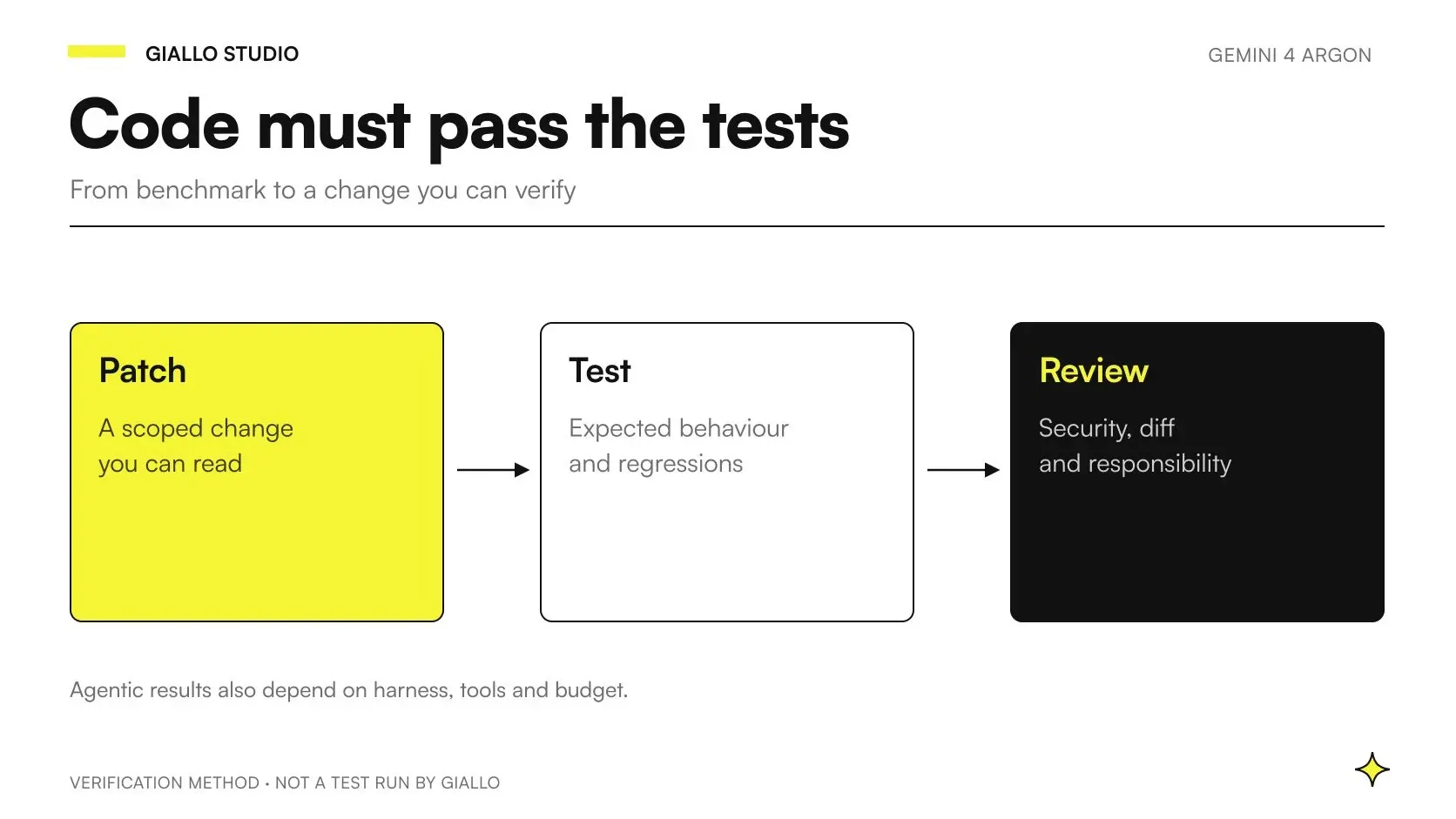
In coding, Argon is a candidate for comparing patches and repository analysis; a DeepSWE result is not enough to entrust it with a release. If the issue is instead the daily work of an already equipped team, also measure the cost of changing interfaces and procedures. A test advantage may not offset the operational work required by replacement.
When to broaden the comparison
- You have a sample of tasks with verifiable results.
- The current model fails on specific documents or constraints.
- You can test different candidates with authorised data and documented tools.
When to keep the current process for now
- You do not yet know which errors you want to reduce.
- Migration would require new access that has not been evaluated.
- There is no responsible person able to judge the results.
How should you choose when the work involves Google Workspace?
Already using Gmail and Drive may make a Workspace-based approach more natural. That is a workflow assessment, however, not proof that Argon is present in every editor. In the sources considered, we found no statement identifying Argon as the model behind every operation in Gmail, Docs or Sheets. Check the feature and edition rather than transferring API specifications to the interface.
The Workspace Privacy Hub, accessed on 23 October, describes protections for qualifying editions and access to content according to user permissions. A business-domain address alone does not establish that those terms apply. An overly broadly shared folder also remains a problem to fix.
For an initial comparison, prepare a matrix of accounts, sources, tasks and results. “Summarise an authorised document” is different from “search all email”. The Gemini for business guide provides general context; for specific contractual boundaries, see Argon privacy and security.
How would a technical practice set up the comparison?
Hypothetical scenario: a technical practice wants to prepare internal briefs from specifications and meeting minutes. The example does not describe a client or a Giallo test. The person responsible selects sanitised documents and defines what the brief must contain: constraints, deadlines, references and open questions. The material also contains a superseded revision to check how the system handles contradictions.
Argon, Astra and the available Claude models are compared without assuming a winner. The test requires distinguishing current and obsolete sources, linking every important statement to its document and abstaining when evidence is missing. The reviewer assesses the content without choosing based on the brand that produced it.
If Argon finds a reference more easily but introduces an unsupported deadline, the case is not resolved. If a competitor asks an appropriate clarification question, that request may be desirable behaviour. The acceptance criteria must reward handling uncertainty, not just the brief's apparent completeness.
How would the choice change for an e-commerce business?
Hypothetical scenario: an Italian e-commerce business prepares drafts for enquiries about returns and warranties. The proposed trial uses synthetic enquiries and approved policies, with no real customer data. The result remains an internal draft. No model is given permission to send messages or authorise refunds.
The priority is to reproduce the shop's terms correctly, not write the most impressive answer. Include incomplete requests, excluded products and messages attempting to impose instructions outside the procedure. Check that the system asks for missing information and that an external source cannot change the task delegated by the business.
The comparison may reveal that the interface or policy retrieval matters more than the difference between models. Before migrating, check whether correcting the documents, prompt or permissions is enough. The design of agents and automations with Argon distinguishes generating a proposal from executing an action.
What should you compare beyond token cost?
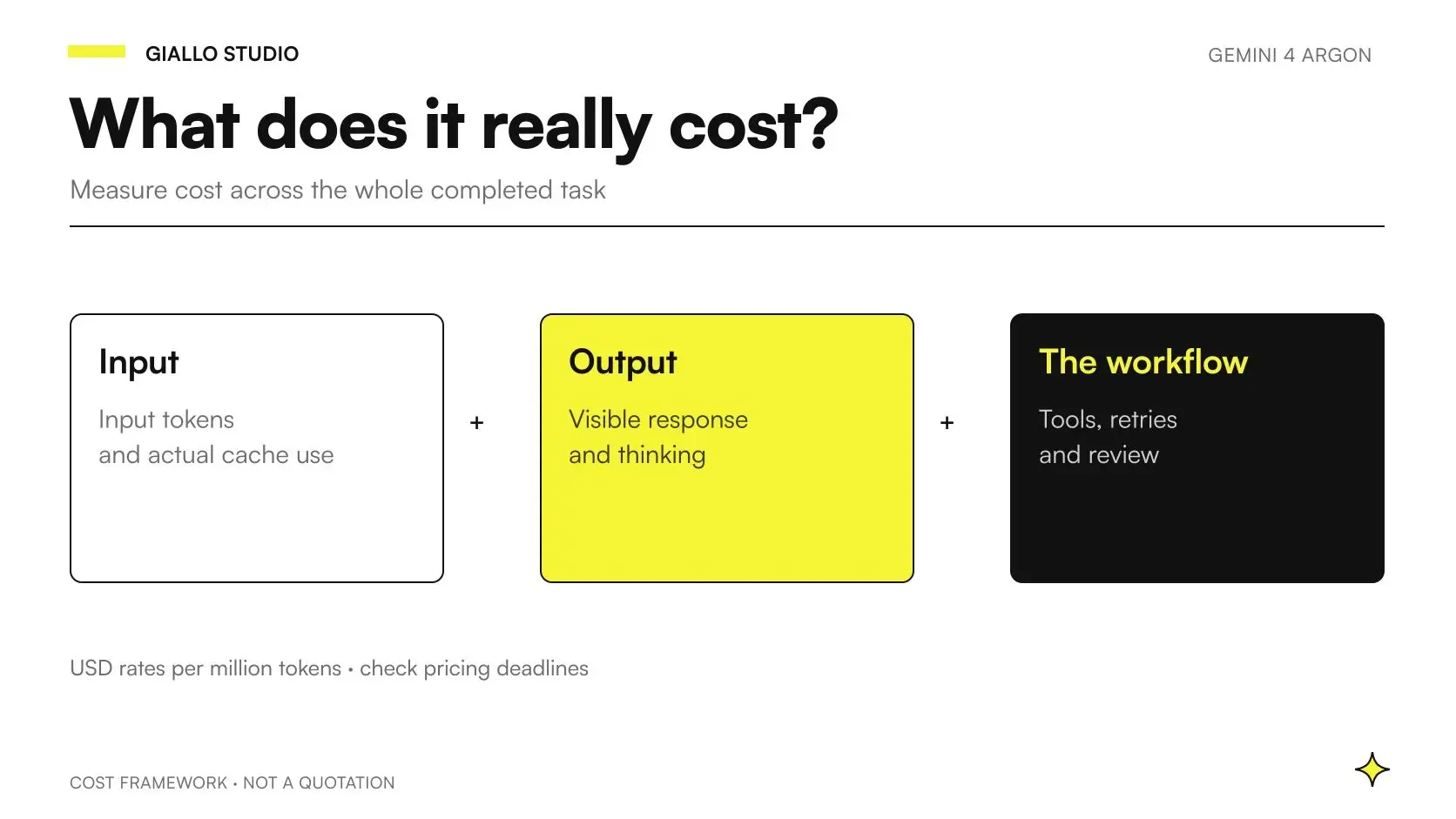
The process cost includes requests, any tools, rejected attempts and human work. A model that is cheaper per token may require longer answers or more corrections; a more capable model may be excessive for simple classification. The useful metric is cost per accepted result, alongside quality and tolerable waiting times.
For Argon, the Google API pricing page, checked on 23 October, distinguishes introductory rates until 30 November 2026 from subsequent rates; billed output includes thinking. For other providers, consult their official pages before preparing a quotation. Do not compare a consumer subscription price with an API call price as if they were the same unit.
A considered decision also addresses exit and maintenance: can you export evaluation cases, change models and inspect logs without rewriting everything? The answer does not require complex architecture, but a clear boundary between business data, integration and provider configuration. The Argon API integration pathway examines these steps.
Open the criteria to agree before comparing
- Which result actually enables your colleague to continue working?
- Which error prevents use even if the rest of the answer is correct?
- What should happen when documents or authorisations are missing?
- Which tools and data are granted to each candidate?
- How are interruptions, retries and human review counted?
- Who decides whether the results justify a new project phase?
Which mistakes should you avoid before changing AI assistants?
The first mistake is attributing the score of a single model version to an entire application. The second is changing systems because a chart shows a win while ignoring benchmarks where the candidate loses. The third is assuming that a product's business-plan privacy terms also apply to its personal account.
The fourth is comparing answers with different inputs: a candidate with current documents and active tools does not have the same task as one without sources. The fifth is using only easy questions already seen during preparation. Keep a fresh sample to find out whether the system really follows the requirements or merely reproduces optimised examples.
You do not need to wait for a definitive ranking. You need a bounded, reversible decision based on a problem that already exists. If you have a useful assistant, a new candidate must demonstrate an advantage that matters to that process, including its terms of use and the effort of changing.
What should the first evaluation produce?
The first trial should produce a readable record: cases used, configurations, accepted results, blocking errors and unresolved questions. It may justify a migration, suggest limited use of Argon or confirm that keeping the current system is preferable. All are useful outcomes when supported by evidence.
To prepare the transition, read the Argon migration guide. If you want to base the comparison on a real process, AI consulting of Giallo can help turn documents, constraints and responsibilities into a verifiable sample before choosing a provider.
Giallo Studio guides: methodology and sources
How we apply it in the company
Related resources
 Gemini 4 Argon: what it is, what it does and when to use it in business
 Gemini 4 Argon benchmarks: how to read the LLM comparison
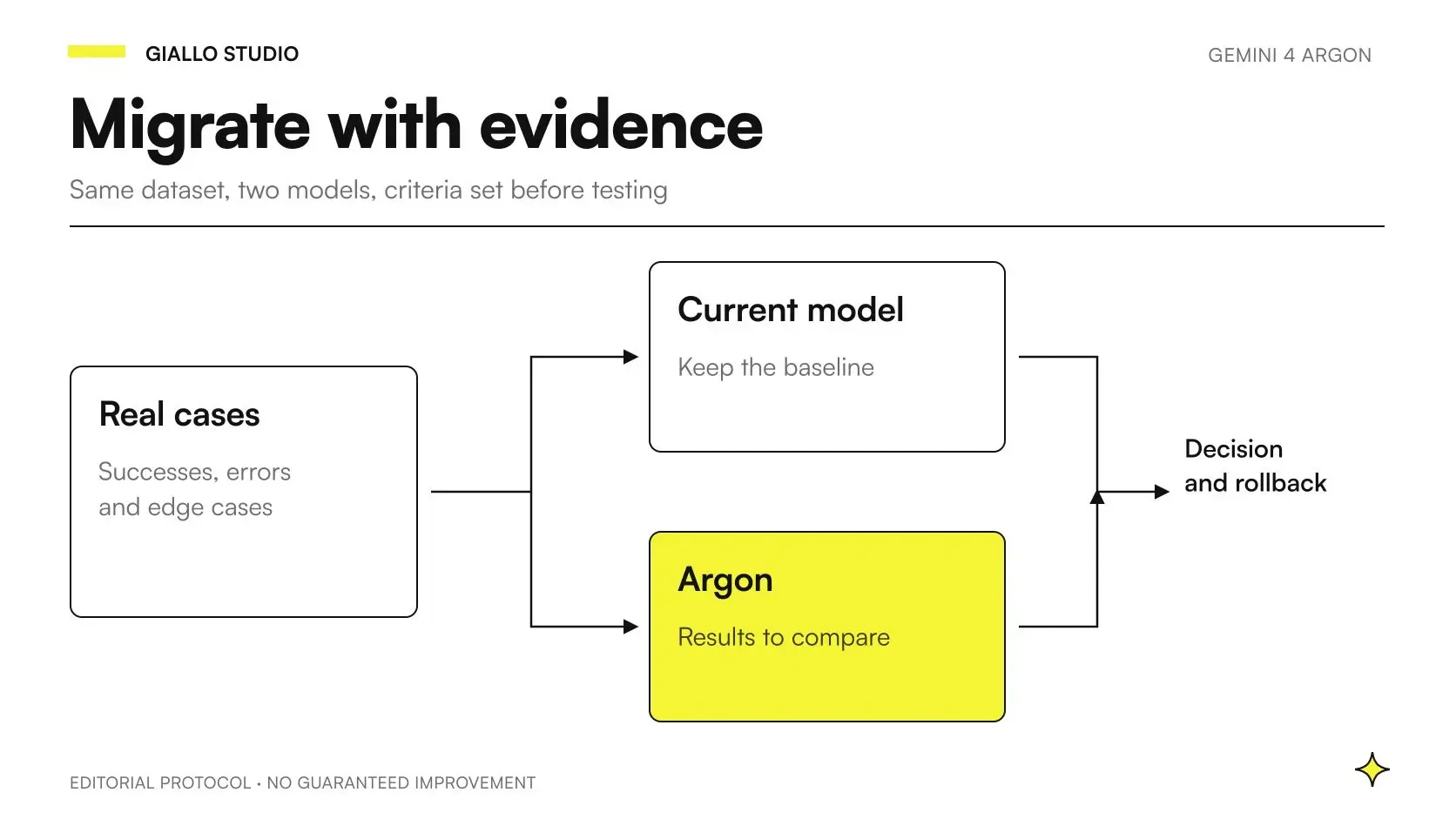 Migrating to Gemini 4 Argon: evaluation, testing and rollback
 Gemini 4 Argon privacy and security: a business guide
 Gemini 4 Argon coding: how to assess it for software development
 Gemini 4 Argon: API pricing and business cost calculations
 ChatGPT vs Grok
 Mistral vs Llama: comparison between the two open weight models
Other direct comparisons
The same criteria applied to other model pairs.
- Gemini 3.6 Flash vs 3.5 Flash
- ChatGPT vs Gemini: which subscription is worthwhile in October 2026?
- Claude Fable 5.1 vs Sonnet 5
- Gemini vs Copilot: Which to Choose
- Claude vs Perplexity
- GPT-5.6 Sol vs Terra: which makes sense?
- Claude vs Gemini: Which to Use
- GPT-6 Astra vs Claude Fable 5.1
- Claude vs DeepSeek: Which to Choose
- GPT-6 Astra vs GPT-5.6 Sol
- Claude Duet, Cowork and Claude Code: which to choose
- GPT-6 Sol vs Claude Opus 5.5: the official numbers and when to use which
FAQ
Is Gemini 4 Argon better than ChatGPT and Claude?
There is no proven winner for every task. Google's October 2026 compilation places Argon ahead on DeepSWE 1.1 and long-context GraphWalks, but behind GPT-6 Astra and Claude Opus 5.5 on FrontierSWE v2. The choice requires a trial on the business process.
Is ChatGPT the same model as GPT-6 Astra?
ChatGPT is the name of an application; GPT-6 Astra identifies a model in the comparison reported here. An Astra benchmark does not automatically describe every answer obtained in the app, across every plan and configuration. The model and product actually used must be verified.
Why does the comparison include Fable 5.1 and Opus 5.5?
These are the Claude versions in the table in Argon's October 2026 model card. The updated Vals leaderboard also includes Sonnet 5.5: it must not be treated as another name for Fable. Every result remains tied to its published version.
Can a consumer subscription be transferred to an API integration?
An app subscription and API usage have terms, quotas and billing that must be checked separately. Do not assume a personal plan includes free or unlimited calls for business management software.
Is Argon worthwhile if the business already uses Google Workspace?
Familiarity with Workspace can help define the operational approach, but it does not prove that every Gemini feature in Gmail or Docs uses Argon. Check the edition, account, feature availability and permissions. Then evaluate quality on the actual task.
What should you test before changing AI providers?
Prepare sanitised cases with expected answers, authorised sources and criteria for serious errors. Run the comparison under documented conditions and also measure human review, interruptions and the cost of rejected responses. A benchmark result helps select candidates; it does not decide the migration.