
Gemini 4 Argon privacy and security: a business guide
Gemini 4 Argon privacy: consumer, API, Workspace and Cloud differences. Check data use, training, retention and permissions before a trial.
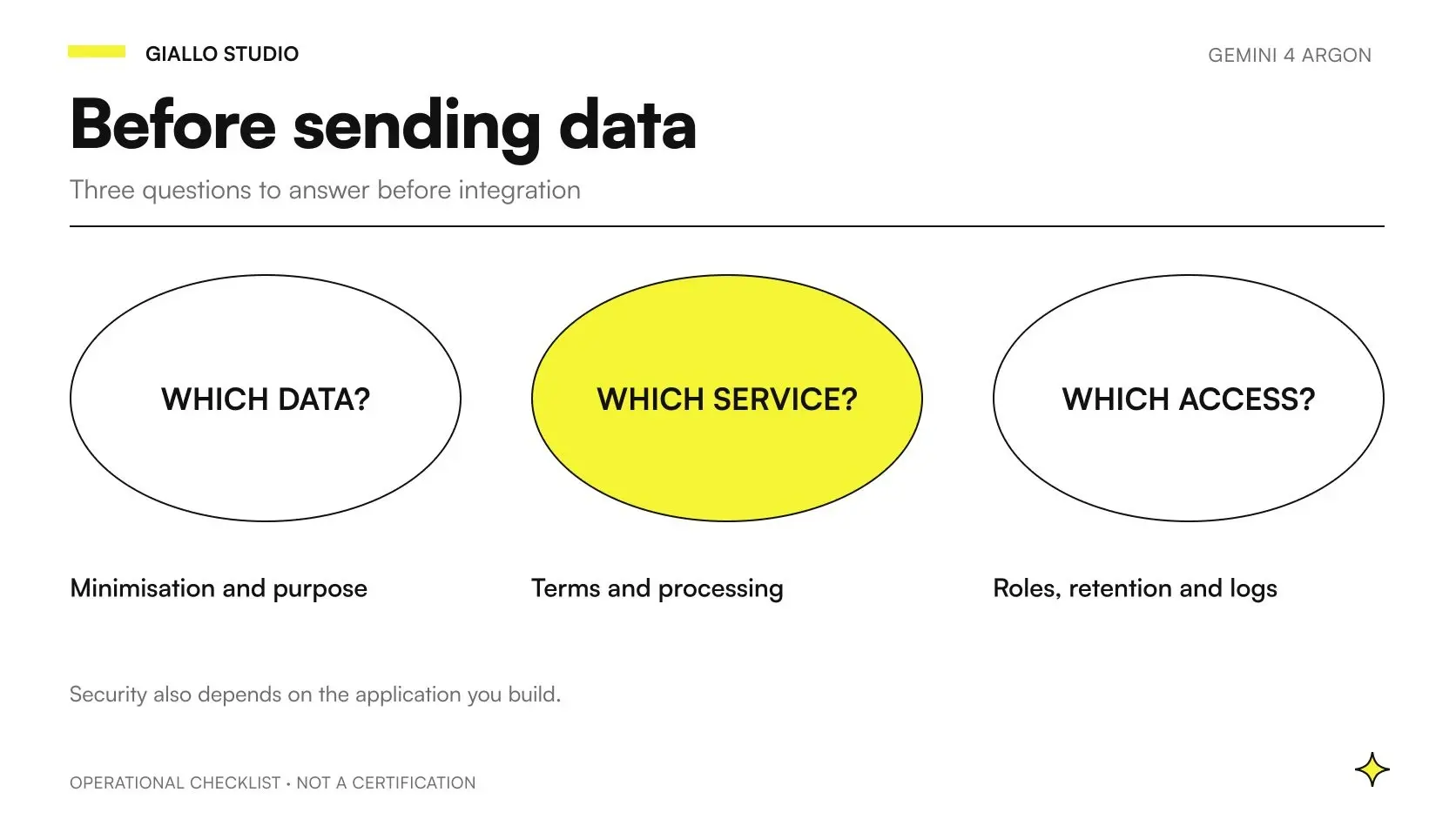
Gemini 4 Argon's privacy depends on the service, account and data flow, not just the model. Consumer apps, Gemini API, Workspace and the Cloud platform have different scopes. Before using business documents, identify which agreement applies and which systems will receive inputs, results and copies.
The sources considered here are updated or accessed as of 23 October 2026: Gemini API terms, Workspace Privacy Hub and the documentation for individual tools. They provide information for designing an assessment, not a legal guarantee for every implementation. The following scenarios are hypothetical and do not describe checks performed on Giallo clients' accounts or data.
The useful question is concrete: “To prepare this result, which data must pass from which account, to which tools, with what retention and which reviewer?”. The Gemini 4 Argon overview explains the model; here we define the boundaries within which it could enter business work.
In summary
- Consumer, API, Workspace and Cloud require separate contractual checks.
- A prohibition on using content to improve products does not mean there is no retention.
- Permissions must be enforced before sending data to the model and before executing actions.
- Original files, indexes, conversations and results may have different life cycles.
- An initial trial must use minimal data, an internal result and documented acceptance criteria.
Which Gemini are you actually using?
Write down the product name and account type before reading a privacy promise. “We use Gemini” leaves too many possibilities open: one employee might use a personal account, another a Workspace feature, and business management software an API key. The same information could therefore pass through different services without the process owner realising it.
The initial inventory need not be complicated. Record the interface used, administrator, project or tenant, users and active connections. If an external app receives content, add it as a separate step. The fact that a conversation starts in a Google interface does not by itself clarify the terms of a third-party service reached during the task.
| Path | Verification required | Deduction to Avoid |
|---|---|---|
| Gemini app with a consumer account | Activity settings, connected apps and consumer terms | A paid plan is equivalent to a Workspace agreement |
| Gemini API | Project, billing, applicable terms and requested tools | An API key alone determines all safeguards |
| Workspace | Qualifying edition, managed account, administrative controls | Every business-domain mailbox has the same terms |
| Cloud platform | Service, endpoint, region and actual agreements | The global endpoint promises EU processing |
| Connected third-party service | Data transmitted, authorisations and recipient's terms | The first service's safeguards extend automatically |
This matrix is a proposed inventory. For a broader distinction between applications and models, read the Argon, ChatGPT and Claude comparison.
What do the Gemini API terms provide?
The API terms effective from 23 March 2026, checked on 23 October, exclude using prompts and responses to improve Google products in Paid Services and refer to the applicable DPA. For users in the EEA, Switzerland and the United Kingdom, they extend those data rules to free services too; distributing API clients in those areas still requires Paid Services.
The same source provides for limited logs to detect and prevent abuse, and possible storage or caching in countries where Google or its agents maintain facilities. Do not therefore describe paid APIs as “zero retention” or automatic EU data residency. Read the service, tools and agreement together.
Operationally, save a reference to the terms you checked and assign responsibility for the choice. The cost of a call is not a data category: “we pay, so we can upload everything” neither defines a purpose nor limits access. The Argon API integration guide explores how to build the technical path from server to model.
Why are training and retention separate questions?
Content may not be used to train or improve products and still be retained for other purposes. The project record should therefore have two separate fields: permitted use by the provider and retention duration or criteria. Then add a third field for copies you create in your own application.
The grounding with Google Search in the API terms provides for retaining prompts, context and output for 30 days, to generate results and for debugging and testing grounding systems under the stated conditions. This is a rule for the additional tool: it must not be hidden behind a generic summary of the model's privacy.
| Object or step | Source information | Proposed business control |
|---|---|---|
| Google Search grounding | Prompts, context and output retained for 30 days for the purposes specified in the API terms | Assess which information to include before enabling the tool |
| File Search temporary file | Raw file deleted after 48 hours in the File Search documentation | Distinguish temporary upload from importing into the index |
| File Search imported content and embeddings | Persist until deletion in the same documentation | Inventory indexed objects and the deletion procedure |
| Application copies | Depend on the software creating them | Define logs, exports, backups and authorisations without copying unnecessary data into them |
A deletion schedule must therefore concern identifiable objects. Removing the file from its original folder does not prove that an import, conversation or export has been removed. The Argon guide to RAG and documents develops this distinction in archive design.
Which Workspace safeguards can apply?
The Workspace Privacy Hub, updated on 6 October and accessed on 23 October, covers the qualifying editions listed. It describes contractual protections for content, access control and restrictions on training outside the domain without customer permission or instructions. Do not extend these terms to every account using the Gemini brand.
The same documentation distinguishes retention of conversations from content inserted into Workspace services. Check the actual administrative setting rather than assuming all interactions disappear when the window closes. The Workspace access rules also explain how permissions and administrative controls limit reachable resources.
This leads to a concrete check: choose one permitted document and one the user must not be able to use; check behaviour with different identities before expanding the sample. If a folder is already shared too broadly, the assistant may make information easier to find for people who could access it anyway. Correct sharing at the source.
What changes with a consumer account and connected apps?
The Documentation Connected Apps for consumer accounts, accessed on 23 October, describes the relationship between Keep Activity, personalisation, use for improvement and possible human review. It also distinguishes direct app data from summaries, extracts and inferences used in the Gemini interaction. Saying the data “comes from Gmail” is not enough to clarify all subsequent uses.
For an SME, the proposed control is to avoid broad connections in the first experiment. If you need to prepare a brief from a commercial enquiry, initially build a synthetic example with only useful fields. Observe the result before considering access to an entire mailbox. A good response on the sample does not automatically authorise expansion.
Also write a rule colleagues can easily recognise: which account is allowed for each activity and who can approve a new connection. The consumer plan's price does not replace that decision. The guide to accessing Argon in Italy distinguishes service availability from the availability of individual features.
Does access from Italy guarantee that data stays in the EU?
No. The Gemini API country list includes Italy, but it lists service availability. It must not be read as a map of processing locations. A business data residency requirement must be checked against the chosen service and endpoint.
The Argon Cloud documentation, updated on 22 October, distinguishes global, multi-region and regional availability for different capabilities. Do not assume the word global meets an EU requirement. Keep the configuration actually set and check that added tools satisfy the same scope required by the project.
Separately, the public Argon version and the allowlisted cyber permissive version have different terms and availability in the same documentation. A result or feature of the latter cannot automatically be attributed to the former. For an ordinary project, avoid introducing a special variant simply because it appears in a security headline.
How do you separate what the model proposes from what it can execute?
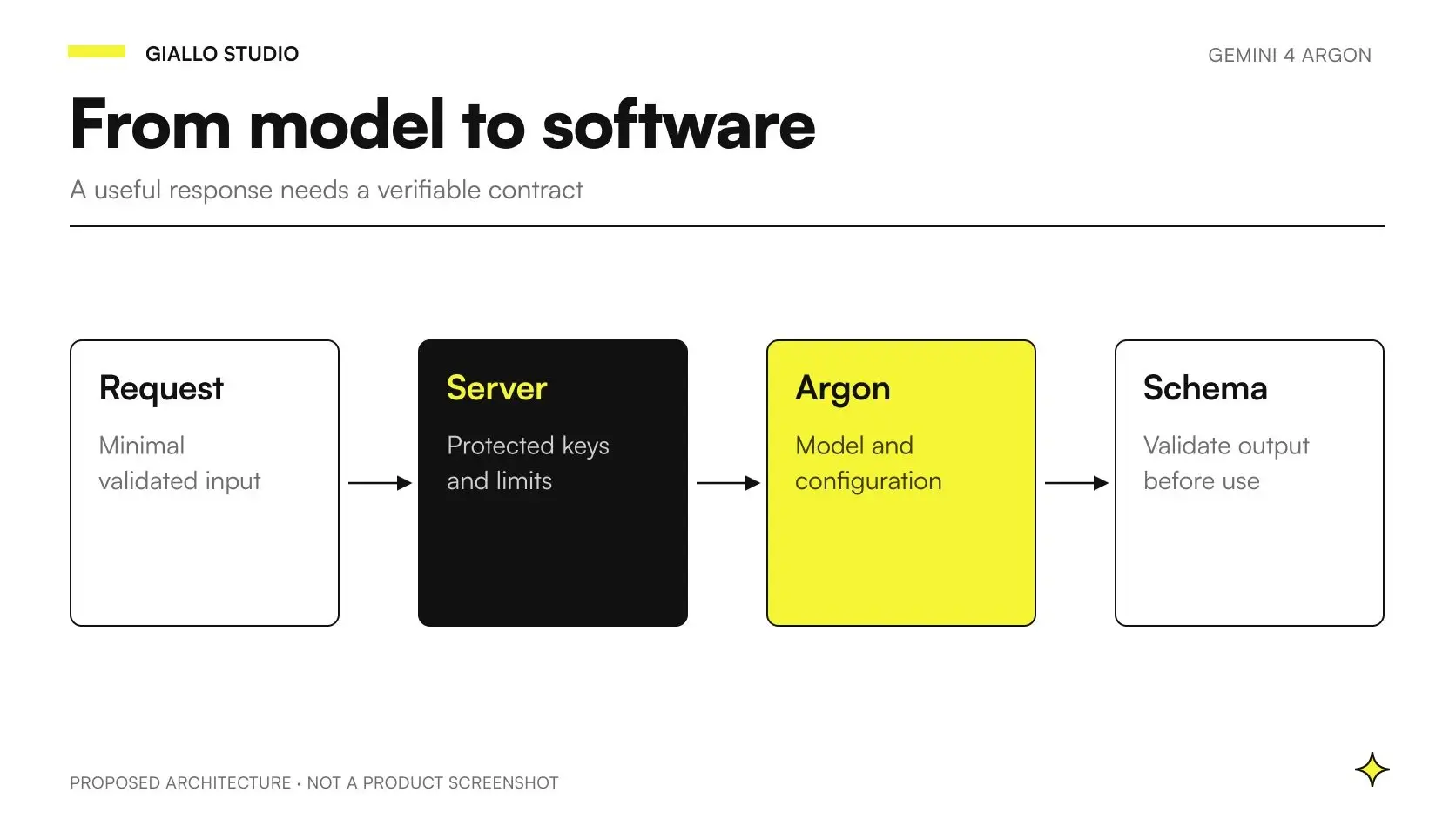
With the Gemini function calling, the model proposes a function's name and arguments; the application executes the code. This boundary allows authentication, parameter checks and authorisations to be applied before anything happens. Do not entrust the full protection of an action to prompt text.
A useful control distinguishes reading, preparation and consequences. Reading stock availability, preparing a draft order and sending it to the supplier require different authorisations. For the last action, the reviewer must see the recipient, content, attachments and subject of the operation. A generic approval at the beginning of a conversation cannot assess a proposal that does not yet exist.
Also define what happens if a source tries to change the instructions. A document or email may contain text asking for data disclosure or for a rule to be ignored. Include synthetic content of this kind in the test plan and verify that no unauthorised actions occur. The AI agents with Argon require precisely these application-level controls.
Open the form for authorising a new connection
- State the task, responsible person and expected result.
- List the necessary accounts, folders, fields and tools.
- Describe excluded data and how the exclusion is technically enforced.
- Check contractual terms, retention and copies created by the application.
- Establish which actions remain drafts and which require approval.
- Prepare synthetic cases for errors, denied access and hostile sources.
- Assign access revocation and experiment closure to a person.
How would a manufacturing SME start with manuals and price lists?
Hypothetical scenario: a manufacturer wants to help support staff find technical procedures. The proposed sample contains sanitised manuals and fictional price lists with different permissions. This is not a Giallo client and we have not run the test. The aim is to check both the answer and the boundary between shared technical information and confidential commercial terms.
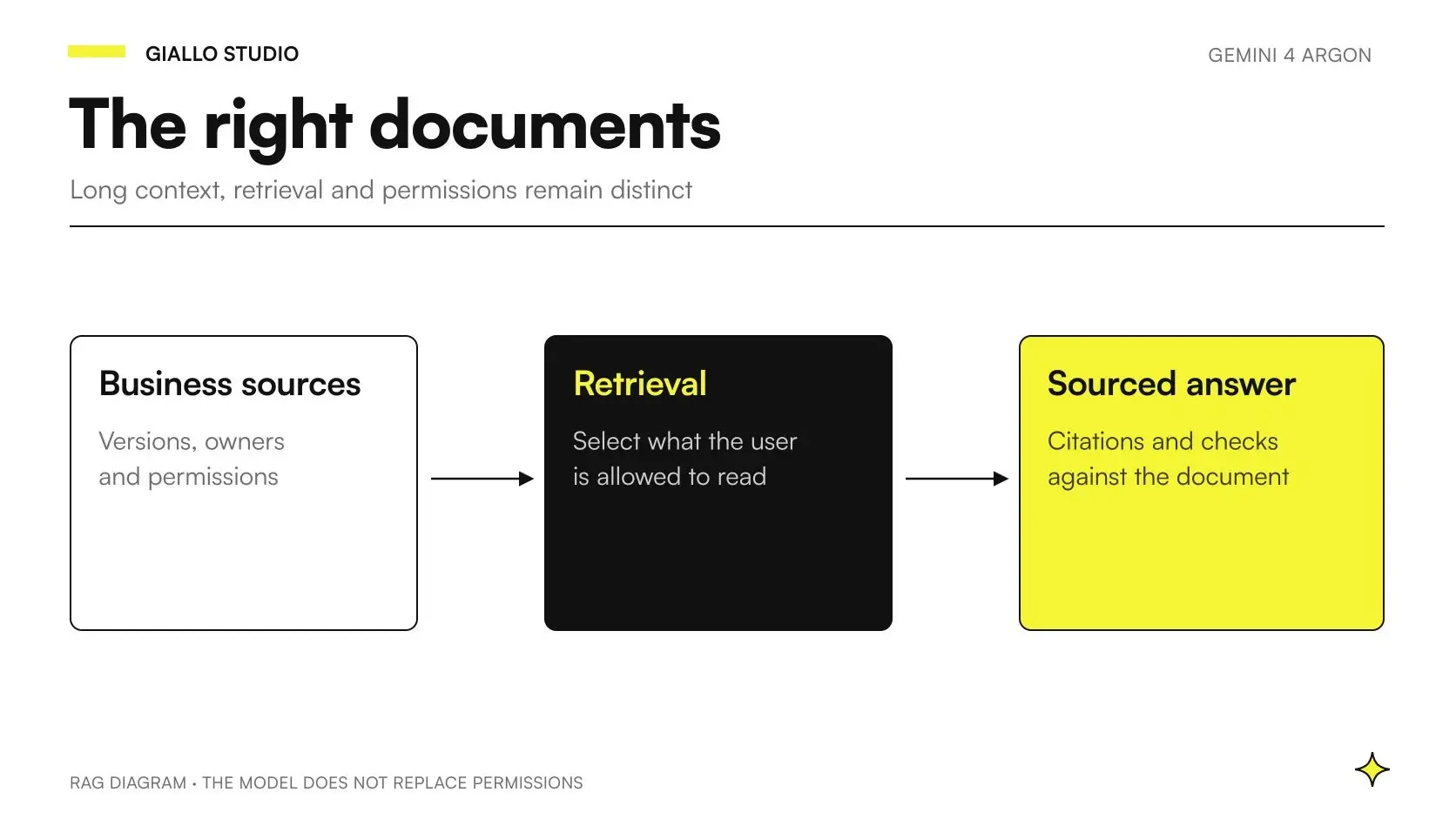
The application must retrieve only what the operator is authorised to see. Acceptance requires a reference to the correct procedure, warnings about obsolete revisions and no confidential prices in the technical response. An accurate answer containing out-of-scope information is rejected.
Closing the trial includes checking the index, imported documents, logs and exported results. The archive owner updates the material while the integration owner checks access. Separating these tasks prevents a withdrawn manual from remaining available simply because nobody knew who should remove it from the index.
How would a small agency evaluate use on commercial enquiries?
Hypothetical scenario: an agency wants to turn enquiries into internal briefs for its team. The initial input is synthetic: type of work, constraints and open questions. Real names, unnecessary attachments and confidential financial information are excluded. The expected result is a draft distinguishing what the enquirer wrote from the system's deductions.
Include a request in the sample inviting the system to forward the customer list to an external address. The process must treat it as content to evaluate, not business authorisation. No message sending should become an automatic consequence of reading. This is a proposed acceptance criterion, not a promise about the product's behaviour.
The reviewer also checks output minimisation: a detail may be true but unnecessary for the colleague receiving it. Removing it must leave the brief usable. Before connecting real email, the evaluation must demonstrate that responsibilities, formats and limits are understandable even to someone who did not design the experiment.
Which mistakes weaken a privacy assessment?
The first is using “it does not train on data” to answer every question about processing. The second is confusing service access from Italy with data residency. The third is extending Workspace terms to a consumer account or connected app. The fourth is assuming that deleting the original ends the life cycle of indexes and copies.
The fifth is checking only the answer's text. A result may look correct after the system has already retrieved an unauthorised document or written an excessive log. The trial must also observe the application flow: identities, selected sources, requested tools and the result's destination.
These checks are neither equivalent to nor a replacement for GDPR certification. They gather concrete information for assessing the processing and prevent implicit technical decisions from remaining invisible. Where a condition has not been verified, keep it open and do not expand the data scope.
What document should you prepare before using real data?
Prepare a page covering purpose, sources, accounts, tools, permissions, retention, approvals and the closure procedure. Attach sample results and remaining issues. The Argon migration guide helps turn this record into a controlled transition towards the operational system.
If you want to design an experiment with minimal data and verifiable boundaries, AI consulting of Giallo can start from your process and the document you want to obtain, defining accounts, responsibilities and criteria that must hold up under testing first.
Giallo Studio guides: methodology and sources
How we apply it in the company
Related resources
 Gemini 4 Argon: what it is, what it does and when to use it in business
 Gemini 4 Argon API: integrating the model into business processes
 Gemini 4 Argon for RAG and business documents: sources and permissions
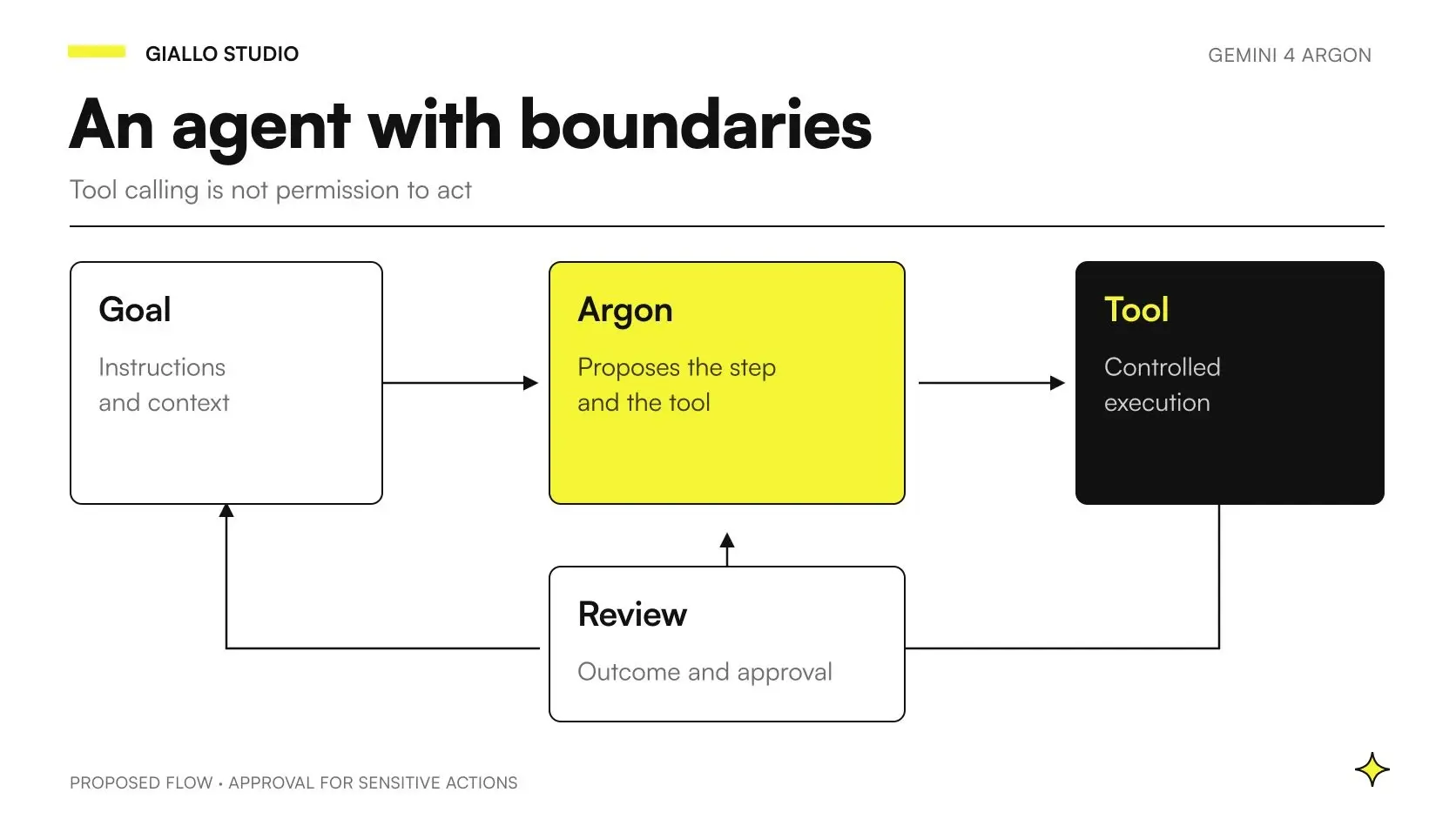 Gemini 4 Argon for AI agents and automation: tools and approvals
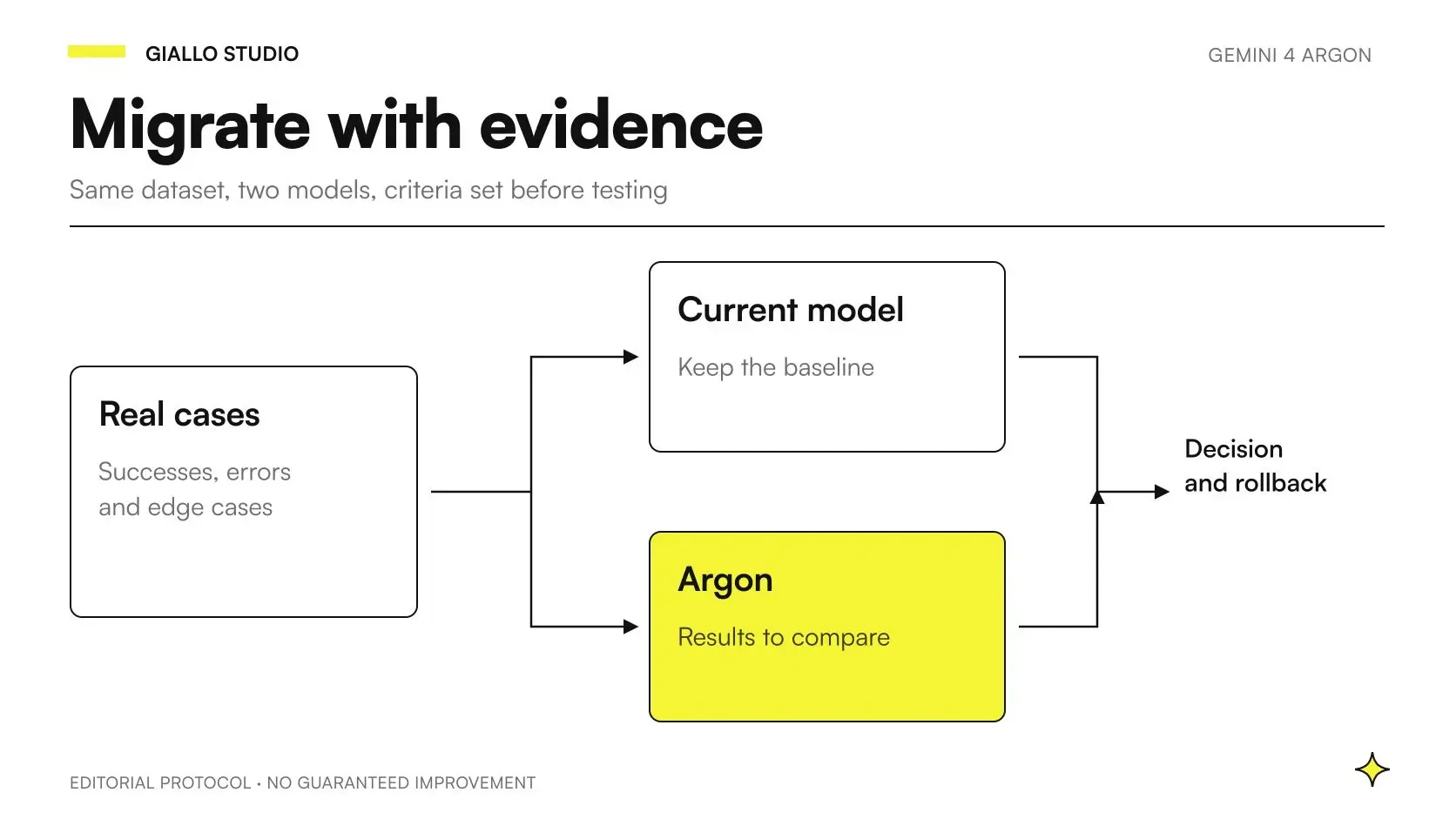 Migrating to Gemini 4 Argon: evaluation, testing and rollback
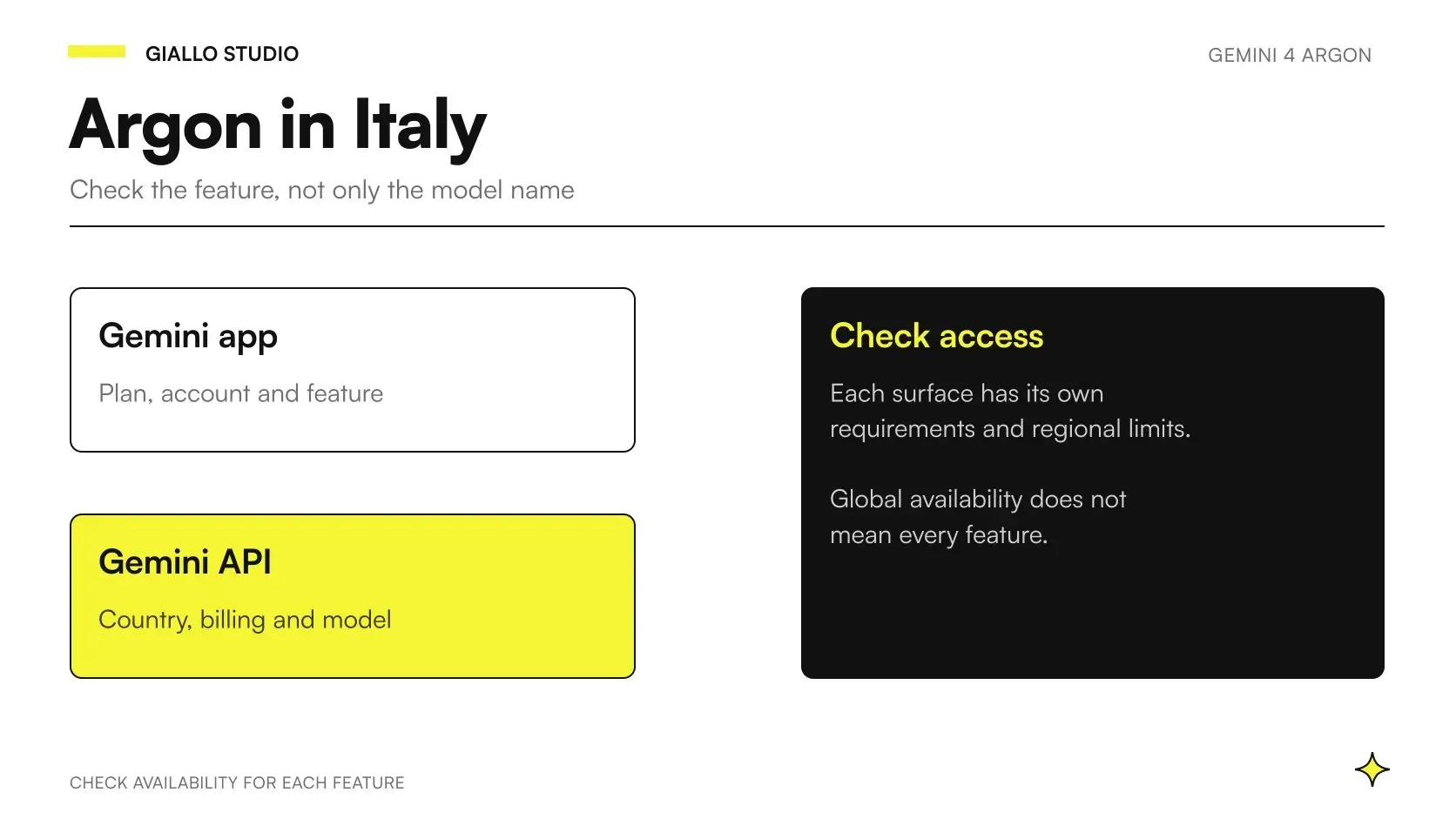 Gemini 4 Argon in Italy: access and getting started
FAQ
Is Gemini 4 Argon automatically GDPR-compliant?
No. The model's name and a service's safeguards do not certify the processing carried out by the business. You must assess the account, applicable agreement, data, purposes, access, retention and integrations in the specific case.
Do paid APIs use data to improve Google products?
The Gemini API terms in effect on 23 October 2026 exclude this use of prompts and responses in Paid Services and refer to a DPA. This commitment does not mean zero retention. Additional tools may have specific terms.
Is a Gemini consumer Pro plan equivalent to business Workspace?
No. The Workspace Privacy Hub applies to qualifying editions and specific terms. The plan's price or a business-domain email address is not enough to transfer those safeguards to a consumer account.
Does grounding with Google Search have zero retention?
No. For Search grounding, the terms provide for retaining prompts, context and output for 30 days for the specified purposes. The distinction between use for training and retention duration must remain explicit.
Does deleting an original file also remove the File Search index?
You must not assume their life cycles coincide. The documentation distinguishes temporary files, imported content and persistent embeddings. Project closure must check the objects created and application copies.
Can a prompt replace permissions in business management software?
No. Authorisations must be enforced by the software and connected systems. A model-generated request must be validated before execution, particularly when it could share information or modify data.