
Gemini 4 Argon: what it is, what it does and when to use it in business
Gemini 4 Argon explained: model, app, API, multimodal capabilities, context, limits and availability. Practical criteria for an initial business trial.
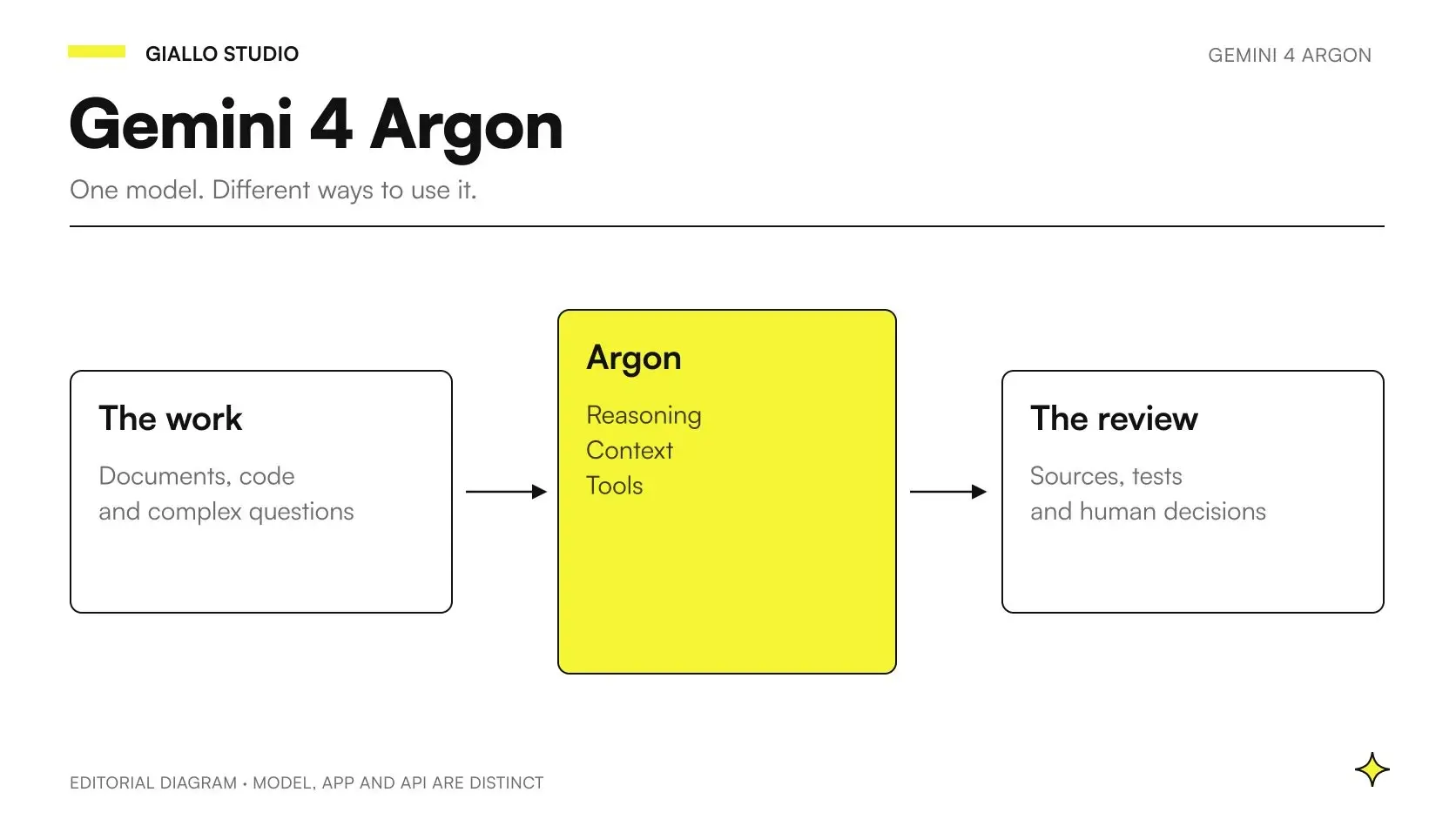
Gemini 4 Argon is Google’s multimodal model designed to tackle complex tasks involving text, documents and other content. It was announced on 30 September 2026 and made publicly available on 13 October. The name identifies the model: the Gemini app, the API and the environments that use it add their own interfaces, tools and terms. The dates come from the initial Google announcement and the public release, checked on 23 October 2026.
For a business, the useful question is what it can help improve in a particular process. Reading a technical specification, interpreting varied material and preparing a verifiable result are concrete needs; “adopting the newest model” does not yet define a project. This guide brings together documented facts and proposes evaluation examples, without attributing performance or financial returns measured by Giallo to Argon.
In summary
- Gemini 4 Argon is a model; apps, APIs and platforms determine how it is used.
- The Gemini API documents multimodal inputs and text output, with tools that must be configured in the system.
- The context limit is shared across input and output and does not itself guarantee correct interpretation.
- Availability, pricing and terms must be checked for the specific channel and feature.
- Benchmarks and demonstrations help you choose what to try; a business decision requires your own cases.
- A useful first application keeps sources, uncertainty and the responsible person’s oversight visible.
Is Gemini 4 Argon an app, a model or an AI agent?
It is a model. To understand its role, it helps to separate processing capabilities from the system that organises the work. A model receives content and instructions, produces a response and can participate in tool interactions. An app makes these capabilities available to a person. An integration connects them to business software. An agent adds an operational loop, with tools and rules for carrying out an assignment.
This distinction changes what can be promised. A feature shown in the app does not automatically become a ready-made integration for business management software. A tool available in the API requires appropriate configuration and oversight. An agent that prepares code is not the same as the model reasoning about that code.
| Level | What it identifies | Question to ask before use |
|---|---|---|
| Gemini 4 Argon model | Ability to process inputs and generate the response | Which formats, limits and tools are documented? |
| Gemini App | Conversational experience and user features | Which plan, account and features are available? |
| Gemini Developer API | Integration channel for software | Which calls, costs and controls does the process require? |
| Cloud platform | Business environment with its own terms and configurations | Which regions, requirements and contracts apply? |
| Agent or automation | System using a model, tools and rules | What can it do, with which permissions and approvals? |
The overview of Gemini AI remains useful for understanding the product family. Here, the focus is on the Argon version and the decisions it requires, without repeating every historical Gemini feature.
What do official sources tell us about the model?
The model card describes Argon as a multimodal model with a mixture-of-experts architecture, rather than simply a fine-tuned predecessor. It gives a March 2026 knowledge cutoff and acknowledges possible hallucinations, slowness and timeouts. This information comes from the Google DeepMind model card, published on 13 October and checked on 23 October 2026.
The knowledge cutoff means that answers about later events cannot be considered current simply because the model is new. If the process requires up-to-date information, it must be supplied through appropriate sources or tools, and its use must be checked. Even with external sources, claims, references and interpretations still need verification.
The Gemini API technical specification, checked on 23 October 2026, documents the stable identifier gemini-4-argon and support for tools including Search and Maps grounding, file search, function calling, code execution, structured outputs and URL context. Computer use is listed as a preview. The existence of individual tools does not demonstrate that every combination is supported in the same way.
For those making project decisions, what matters most is connecting these capabilities to a concrete result. Structured output can help transfer fields into software, but the system must still verify that those fields accurately represent the source. A search can add current context, but does not independently decide which information is relevant to the business decision.
What does multimodal mean for an SME’s documents?
In the Gemini API, Argon accepts text, images, audio, video and PDFs; it produces text output. The same specification does not document direct image or audio generation and states that Live API is not supported. Source: Gemini 4 Argon specifications, checked on 23 October 2026. Understanding visual content and generating images are different capabilities.
In practice, a business request may arrive as mixed material. A report contains photographs; meeting minutes refer to a floor plan; a video shows a step that the text describes ambiguously. The potential benefit is a coherent interpretation that retains a reference to the material supporting each claim.
A photograph should not, however, be treated as a reliable measurement without verification. A detail may be hard to read, footage may not show the entire environment, or a document may contain an outdated version of a data point. The test must include these limitations, rather than only ideal material chosen for a presentation.
The Guide to Argon for images, audio and video explores how to frame multimodal requests. The initial question for the team is simple: what information must be retrieved from the material, and how will we confirm its accuracy?
How much context does it support, and why is uploading everything not enough?
The documented Gemini API limit is 1.048.576 tokens shared across input and output. This is not one million input tokens plus another million output tokens. The specification also distinguishes ordinary synchronous output, up to 65.536 tokens, from methods for longer responses. The source is the Argon specification, consulted on 23 October 2026.
The migration guide explains that extended processing requires background execution and continuation: it is not a matter of requesting a normal synchronous response of one million tokens. The reference is Google’s guide to what is new in the model, checked on 23 October 2026. This detail concerns the process architecture, not just the length of the final text.
A large context allows substantial material to be included, but does not decide which version is valid or which clause takes precedence. An archive can contain expired instructions, unapproved proposals and documents concerning different customers. If these boundaries are not visible, uploading more content can make the result harder to control.
The first step therefore remains organising the material: current version, author, date, scope and permissions. When the work requires an archive, it is worth evaluating retrieval of relevant sources. The guide to Argon with RAG and business documents addresses this choice; it should not be confused with a simple contest for the largest prompt.
What changes when the model can use tools?
Function calling allows the model to participate in a workflow that requests operations from configured tools. This capability is documented in the Argon API specification, checked on 23 October 2026. Authorisation and actual execution, however, depend on the system receiving those requests.
In a business, reading a case’s status, preparing an update and sending it to the customer are different steps. The project must assign permissions consistent with each step. If the task is to prepare a draft, the tool does not need permission to send it simply because a sending API technically exists.
This is where choosing a model becomes process design. You need to define what happens when data is missing, a tool fails to respond or the result appears contradictory. A useful system must make the state of the work visible even when it cannot complete it.
The Guide to Argon for AI agents and automation explores these boundaries. If the goal is instead to connect it to existing software, the guide to Argon API integration helps distinguish model calls, tools and application controls.
First hypothetical scenario: preparing a brief after a site visit
Imagine an installation contractor collecting notes, photographs and a list of requirements after a site visit. The manager needs to prepare an internal brief before the quotation. The material may describe the same point in different words or leave a measurement unresolved. This scenario is proposed to explain the method; it is neither a customer case nor a Giallo test.
The initial task could be to organise explicit requests, list observations in the material and flag items still requiring verification. The result must distinguish what the customer asked for from what a technician hypothesised. It must not turn a photograph into a certification or fill in missing dimensions.
To make the trial useful, also prepare a case with a contradictory note. A photograph shows an area, but the note refers to another version of the work. The response should expose the conflict rather than silently choose the most plausible description. The reviewer checks the origin of important points before the brief feeds into the quotation.
If the system helps interpret the material, a subsequent phase can be evaluated. If it systematically confuses observations and commitments, the process is not ready. The first useful result does not have to be automation: it can be better organised preparation that a person knows how to check.
Second hypothetical scenario: supporting a software maintenance team
A small software company receives a bug report with a description, logs and code snippets. The team wants to prepare a possible diagnosis and a proposed check. The initial goal is to help the maintainer find their bearings, without automatically changing the customer’s product.
The requested brief can distinguish observed behaviour, causes consistent with the evidence and data still needed. A proposed change must include a way to reproduce the problem and a relevant check. This is a hypothetical design: it does not claim that Argon has fixed a particular bug or passed a test run by our team.
Quality is measured against concrete criteria. Does the diagnosis cite relevant lines? Does the proposed code respect the repository’s constraints? Does the check fail before the fix and pass afterwards? Does the change avoid touching unrelated parts? A convincing but unverifiable response leaves the maintainer with the most important work.
The Guide to Argon for coding and software development explores this area and distinguishes the model from the agentic environments that can use it. Access to Antigravity, for example, is not synonymous with a Gemini API call: tools, configuration and ways of working differ.
Do benchmarks prove that Argon is the best model?
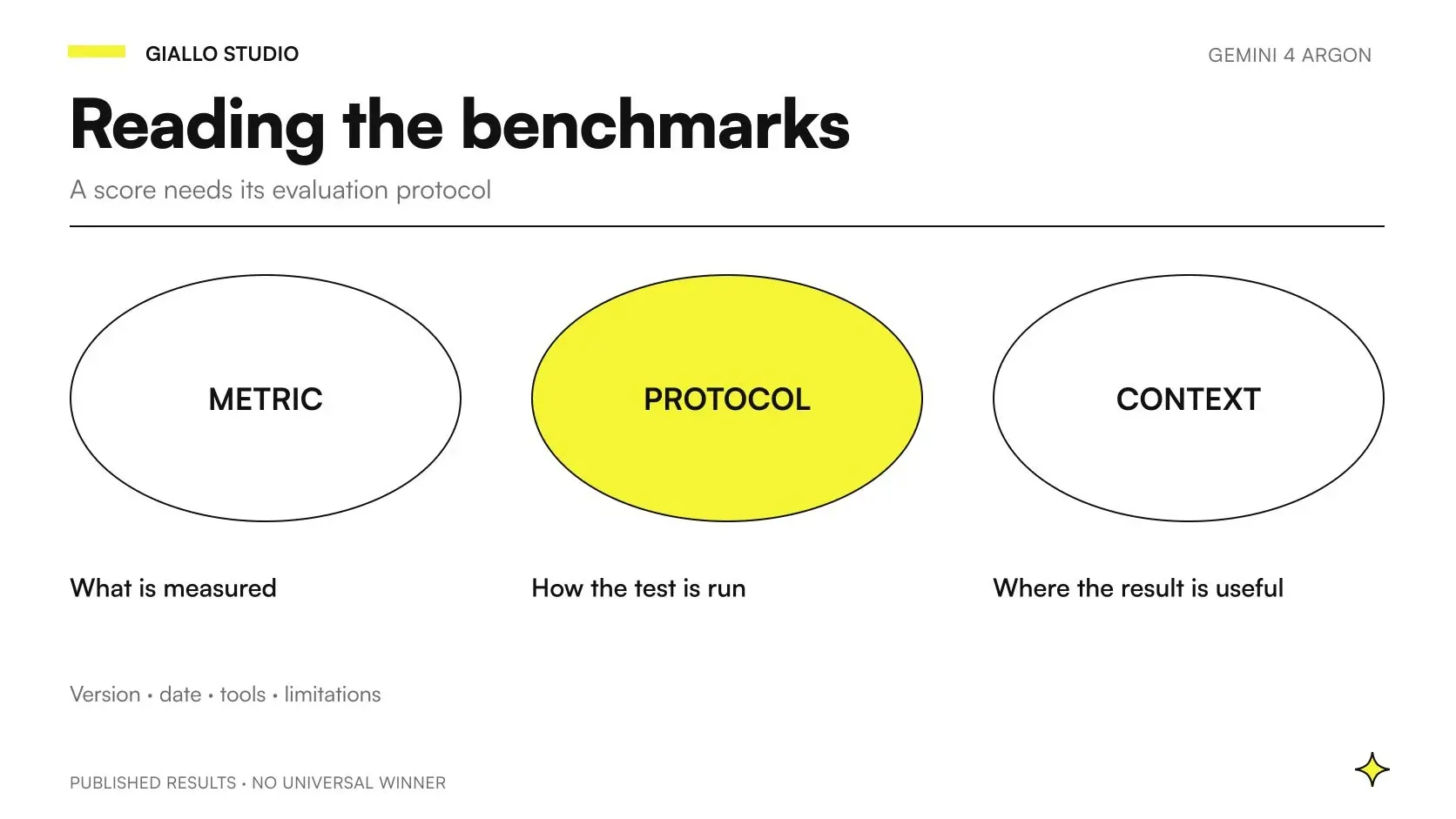
Public results describe specific tests, not a winner for every need. Google’s model card includes comparisons favouring Argon and tests where other models achieve higher results. The benchmark methodology, checked alongside the model card on 23 October 2026, documents settings and differences to consider before interpreting the tables.
Relevant information includes the thinking level, the type of agent used, execution conditions and how outcomes are counted. Two similar numbers may answer different questions. A result on a set of coding problems also does not automatically measure the quality of business summaries in Italian.
To choose what to try, you can read the guide to Gemini 4 Argon benchmarks. To choose between providers, the Argon, ChatGPT and Claude comparison separates model, product and use case. Business testing comes afterwards: the same examples, explicit criteria and costs for the entire workflow.
Where can it be used from Italy, and what does it cost to start?
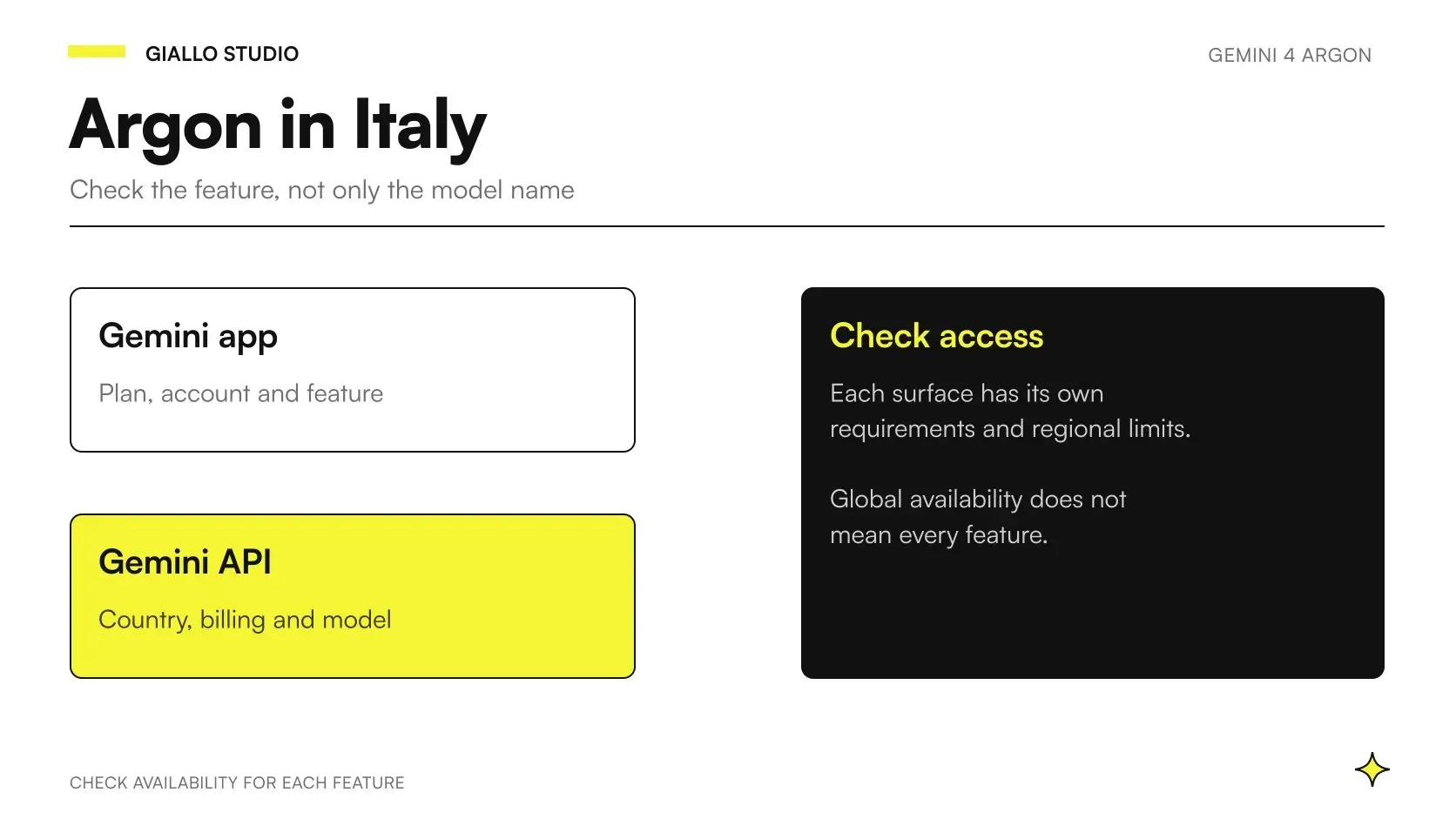
Italy appears on the official list of countries available for AI Studio and Gemini API. This concerns access to the channel, not the availability of every feature or data residency. Source: countries supported by AI Studio and Gemini API, checked on 23 October 2026.
For app features, the specific documentation must be consulted. As of the same date, the list dedicated to Argon in AI Mode does not include Italy, while Tasks in Gemini is not listed as available in the EU. Sources: Google Search support for AI Mode and Google AI Ultra support for Tasks. The guide to how to use Argon in Italy organises the options without extending a global announcement to every account.
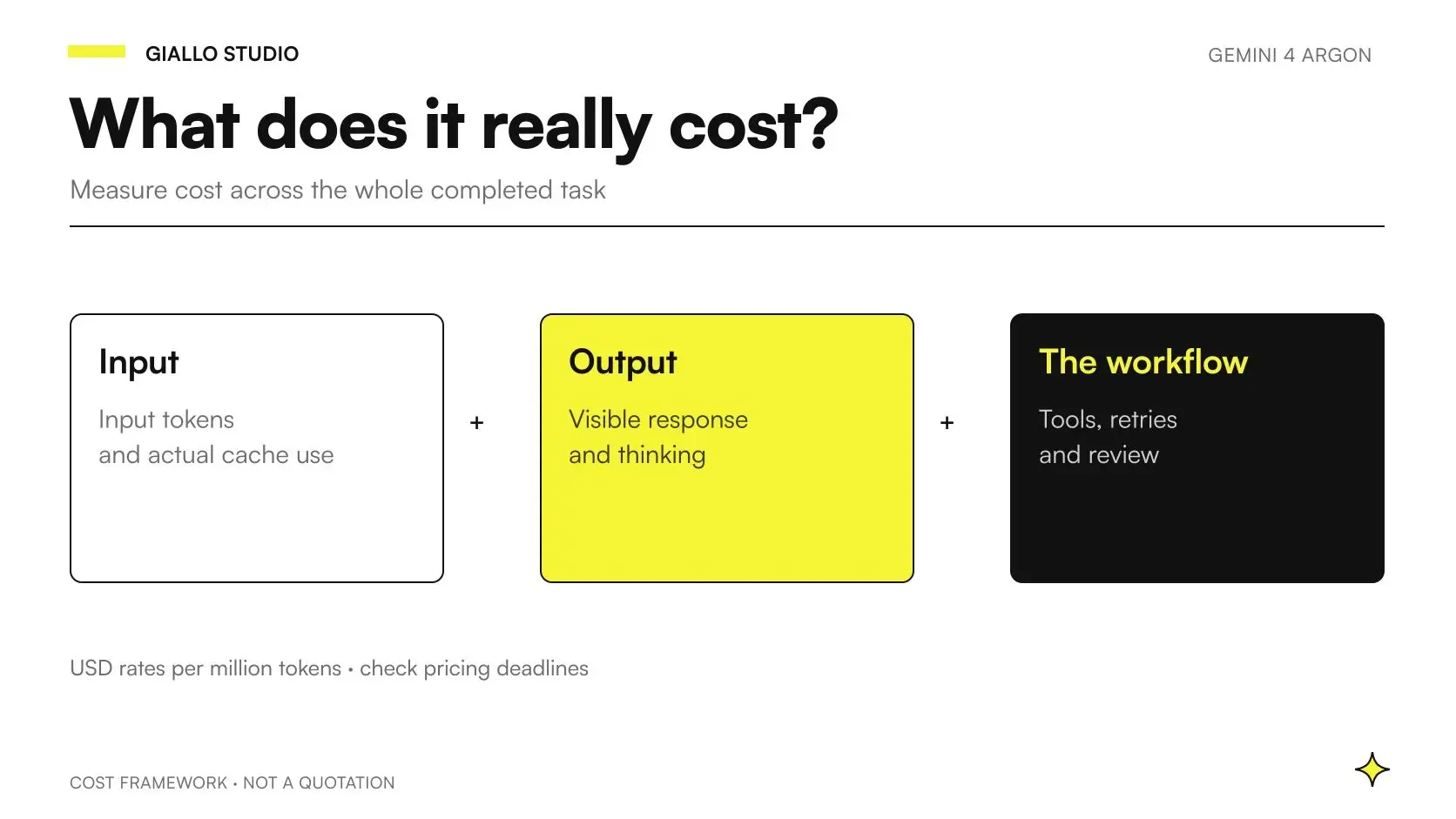
Pricing also depends on the channel. The Gemini Developer API does not include Argon in the Free tier and publishes introductory rates through 30 November 2026. Thinking is part of billed output. Source: Gemini API Pricing, checked on 23 October 2026. For budgeting, the guide to Argon API pricing and costs distinguishes tokens, caching, tools and the promotion’s expiry date.
What risks remain even with a more capable model?
The first is a coherent response unsupported by the material. The system can retain the right tone while attributing a condition to the wrong document. The model card acknowledges hallucinations among the model’s limitations; an evaluation must therefore check the link between claim and source, not just readability. Argon model card, checked on 23 October 2026.
The second risk concerns the process: a result prepared for internal use may be treated as a final communication. Clear statuses, responsible people and a boundary between draft and approval are needed. The model’s output does not gain authority simply because it appears in business management software.
The third concerns data and permissions. Access to an archive does not mean exposing its entire contents to every request. The channel, applicable terms and source selection must be checked. The guide to Argon privacy and security for businesses explores the questions to resolve before using operational documents.
How can you plan an initial evaluation without expanding the project too far?
Choose a single task with a responsible person who can judge the result. Prepare a small set of representative cases, including incomplete and contradictory material. For each case, define the information needed, the errors that make the response unusable and an acceptable level of review.
Open the worksheet to choose the first task to evaluate
- Problem: which step currently requires reading, comparison or preparation?
- Material: which minimum sources are sufficient, and which version is valid?
- Deliverable: what should be returned to the person, and in what format?
- Control: how will important claims be checked?
- Border: which actions and decisions remain out of scope?
- Decision: what evidence will justify continuing, changing or stopping the trial?
Then record the configuration, consumption and corrections needed. If the result deteriorates when realistic cases are added, look for the cause: a missing source, ambiguous instruction, incorrect document retrieval or a model limitation. Adding tools before understanding the defect makes it harder to identify the problem’s origin.
Those already using another model can follow the protocol for evaluating a migration to Argon. The transition must also include a way back to the previous configuration. A successful trial justifies a defined extension, not the indiscriminate replacement of every workflow.
When might a simpler configuration be enough?
Not every step requires the same model or amount of reasoning. A process may contain ordinary classification, complex interpretation and a mechanical transformation of the result. Choose at each step by examining what is actually needed and which errors are acceptable. Using Argon everywhere before testing would prevent you from understanding where it adds value.
Consider a support request as a design example. Checking whether an order number is present can be deterministic; reconstructing a situation from contradictory documents requires a different evaluation. There is no need to assign the mechanical check to the model simply because it is already in the workflow. The system can use explicit rules where they suffice and reserve model processing for the task actually being evaluated.
This choice also makes responsibility for errors clearer. If a code is missing, the program can flag it before generation. If two sources disagree, the result must bring the conflict to someone who can resolve it. A simple configuration is useful when it keeps the workflow understandable and gives the model a precise assignment rather than indiscriminately assigning every decision to it.
Which mistakes should you avoid in a first Argon project?
The first is treating the model, app and agent as the same product. The second is uploading more material without identifying versions and permissions. The third is treating a ranking as proof of quality on your own work. The fourth is measuring only generation speed while ignoring the time needed to correct and approve the result.
The fifth is expanding autonomy after a favourable demonstration. A task that prepares material and a system that updates software or communicates with customers require different checks. Response quality is a necessary condition; it does not, by itself, establish permission to act.
Gemini 4 Argon should therefore be evaluated as a component of an understandable process. For an SME, a useful outcome is being able to state which task improves, within what limits and under whose supervision. The guide to Gemini for businesses helps place this choice within the organisation; the detailed guides let you tackle one problem at a time.
Giallo Studio guides: methodology and sources
How we apply it in the company
Related resources
 Gemini 4 Argon in Italy: access and getting started
 Gemini 4 Argon: API pricing and business cost calculations
 Gemini 4 Argon benchmarks: how to read the LLM comparison
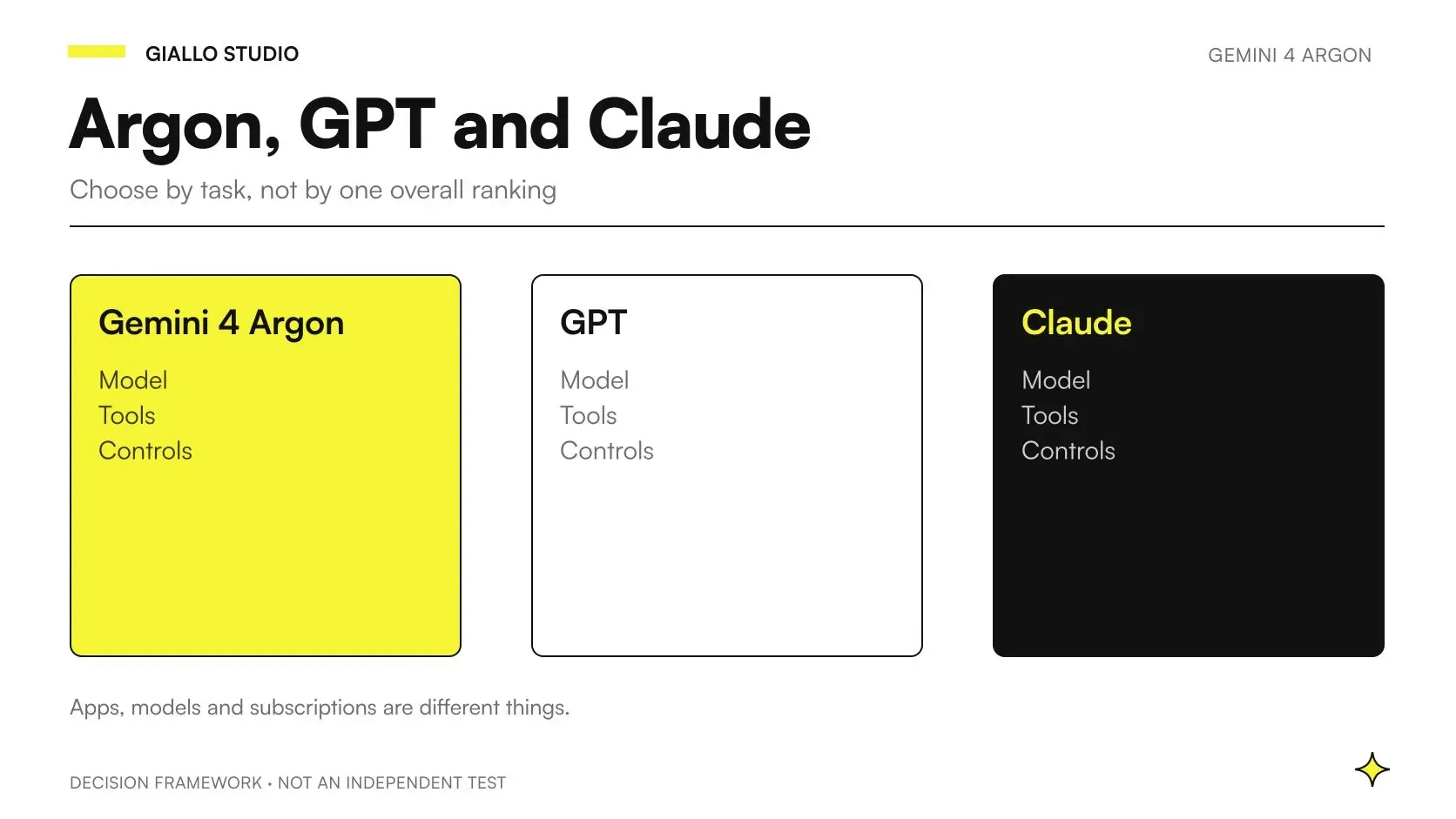 Gemini 4 Argon vs ChatGPT and Claude: which should you choose?
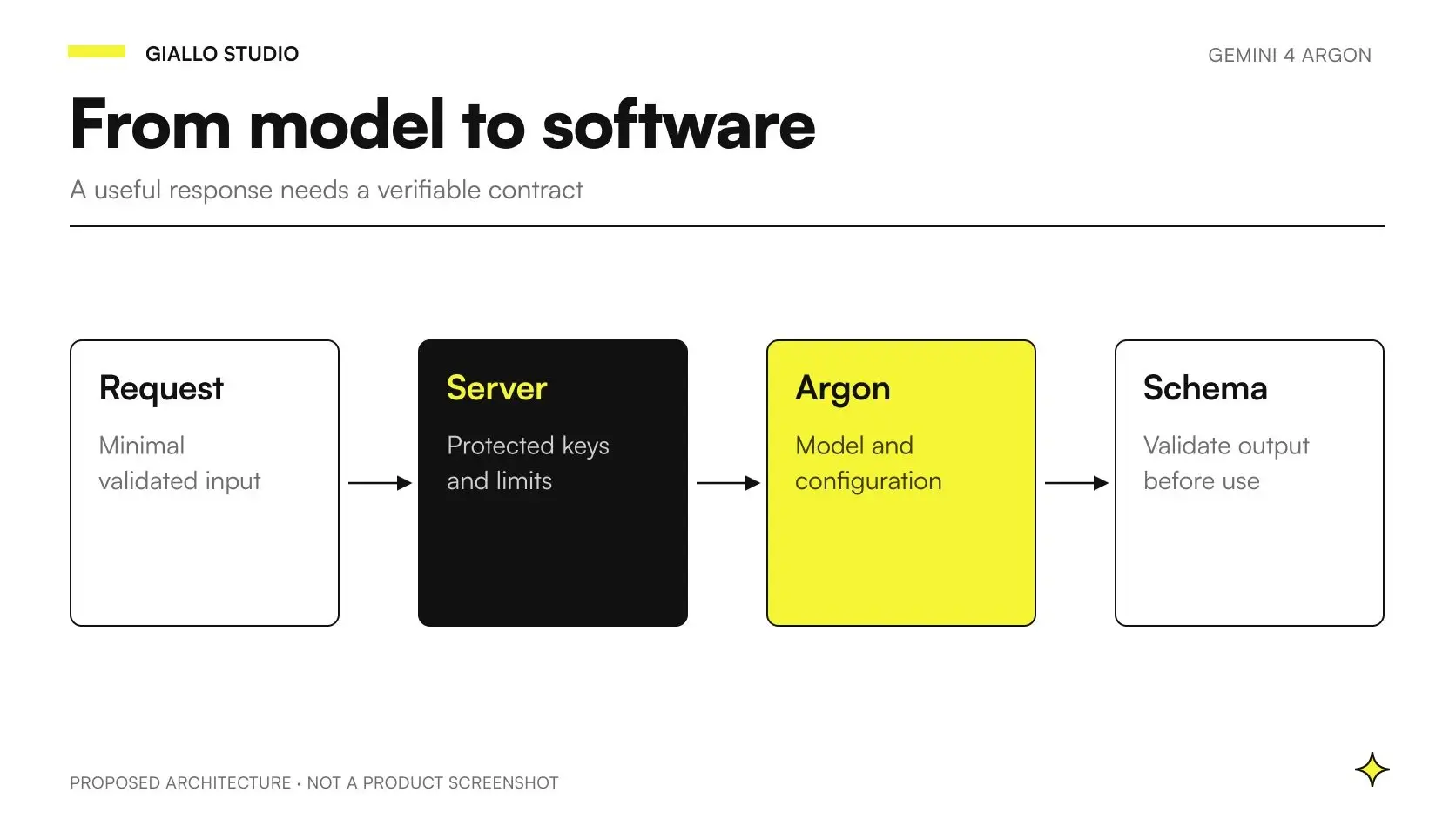 Gemini 4 Argon API: integrating the model into business processes
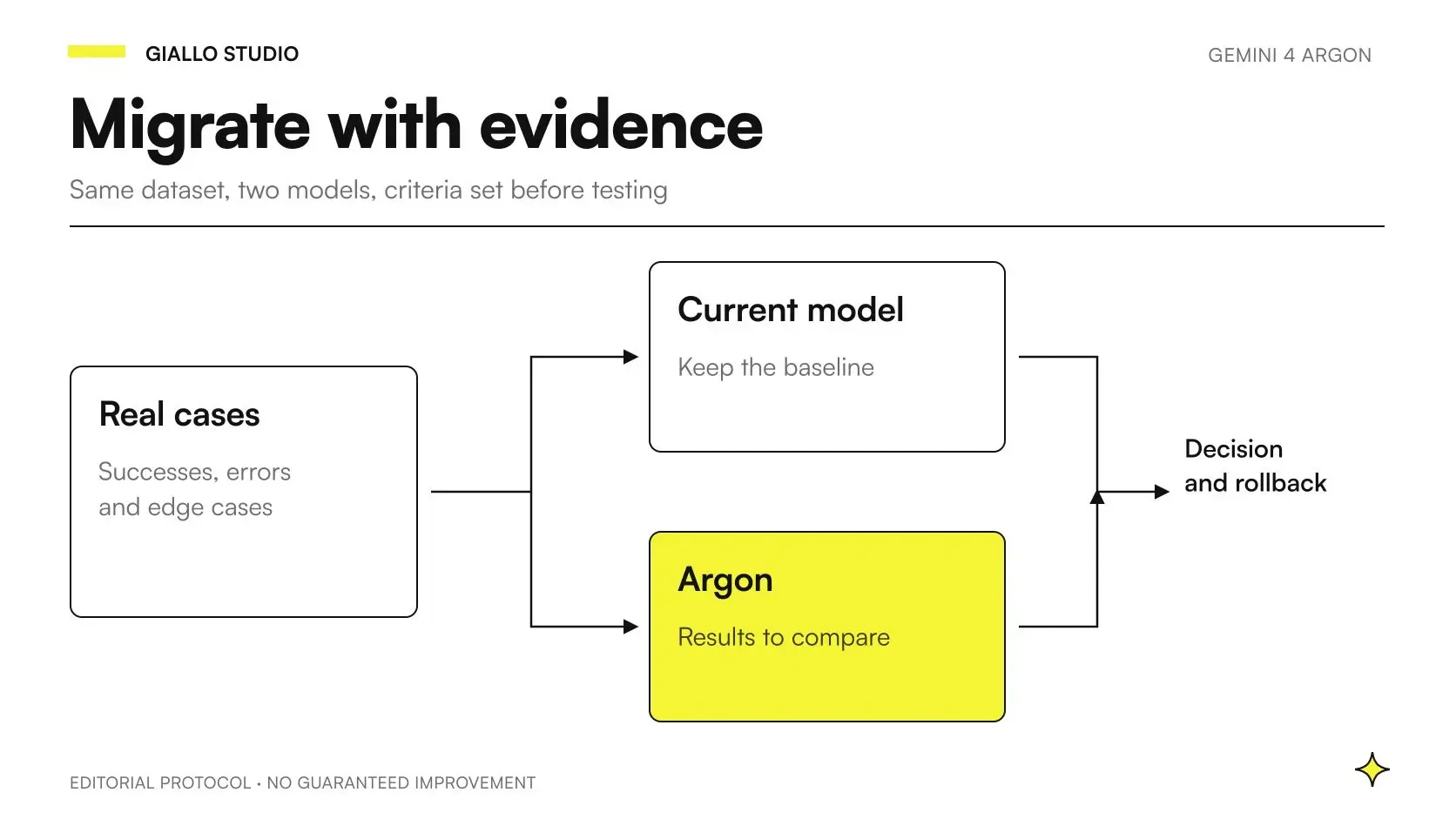 Migrating to Gemini 4 Argon: evaluation, testing and rollback
 Gemini vs Copilot: Which to Choose
 Grok AI: what it is and how it works
FAQ
What is Gemini 4 Argon?
It is a multimodal Google model, announced on 30 September 2026 and made publicly available on 13 October. Its documented stable identifier in the Gemini Developer API is gemini-4-argon. The model must be distinguished from the Gemini app and the platforms that use it.
What types of content can it process?
The Gemini API specification documents text, image, audio, video and PDF inputs, with text output. This does not mean that Argon directly generates images or audio, or that every app exposes all formats in the same way.
How much context does Gemini 4 Argon support?
The specification documents a shared limit of 1.048.576 tokens across input and output. This is not one million input tokens plus another million output tokens; very long responses also require the documented continuation methods.
Is Gemini 4 Argon already available in Italy?
Italy is on the official list of countries supported by AI Studio and Gemini API. Apps and additional features require separate checks: as of 23 October 2026, the relevant support pages do not list Argon in AI Mode and Tasks in Gemini as usable in Italy.
Is Argon better than ChatGPT and Claude?
Public data does not establish a universal winner. Results vary by task, configuration and evaluation protocol. A business needs to compare systems using its own cases and criteria for quality, cost and control.
Does using Argon automatically make business documents secure?
No. You need to choose the channel, examine its terms and define data, permissions, retention and responsibilities. The model’s capabilities do not replace system controls or eliminate errors and hallucinations.
What task should an SME start with?
A bounded task whose result can be checked against clear sources and criteria, such as preparing an internal brief from sample documents. The initial evaluation must precede automated sending, updates or commitments to customers.