
Gemini 4 Argon for RAG and business documents: sources and permissions
Gemini 4 Argon RAG for business documents: when retrieval helps, how to enforce permissions and check citations, versions and missing answers.
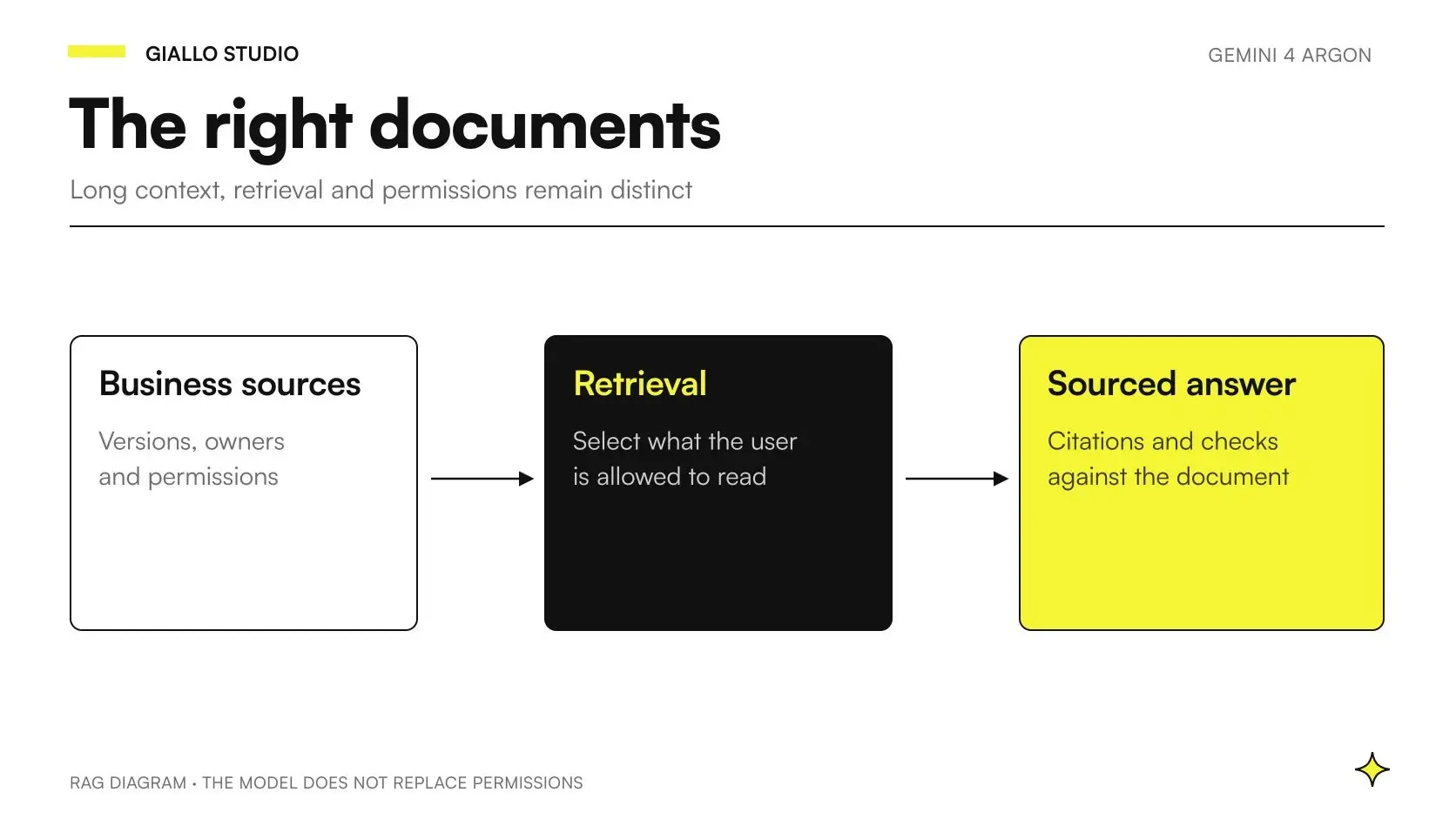
Gemini 4 Argon can formulate responses in a business RAG system, while retrieval selects the sources to use. The official model page includes File Search; this support does not configure the archive, permissions and maintenance by itself. The specifications cited here were verified as of 23 October 2026. Official Gemini 4 Argon model page.
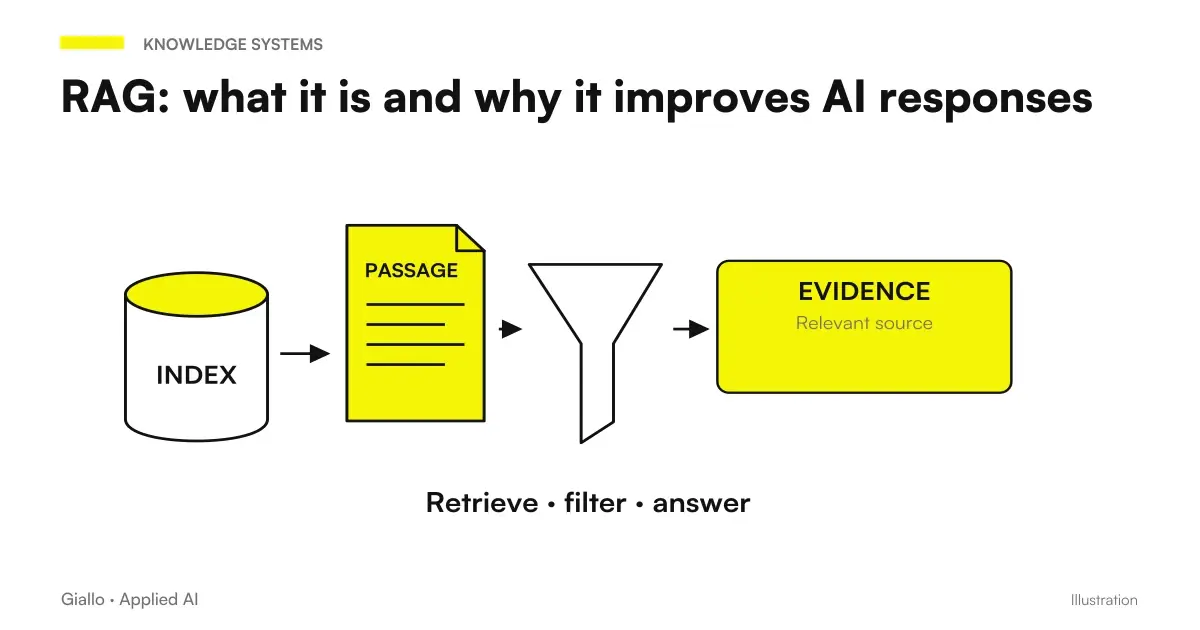
For an SME, the useful question is «can it answer using the right version of the document this person is allowed to read?». That differs from «how many files can I upload?». A document assistant must make missing sources, conflicts and limitations visible. The general RAG guide explains the mechanism; here we turn it into a project with inputs, results and acceptance tests.
In summary
- Long context and document retrieval solve different problems.
- Permissions must restrict sources before they enter the response.
- Every operational conclusion must be checkable in the relevant document.
- Superseded versions, revocations and deletions are part of the archive's lifecycle.
- A response without sufficient evidence must state what is missing.
Why doesn't long context replace RAG?
Context is the material available to the model during a request. Retrieval is the process that searches for useful material for a question. A large window may allow more passages to be compared together, but does not decide which procedures are current, which folders belong to a customer or who is entitled to read them. These are archive and application requirements.
If you need to compare a few approved documents for a single assignment, you can start by providing them directly. You have a defined set, an owner and a bounded result. If the team instead queries a changing archive, the project must manage selection, updates and access for every question. In that case, retrieval can avoid manually rebuilding the source package.
Do not choose between the two techniques just by counting files. A small file set with different permissions can require more attention than a long manual accessible to everyone. A large archive queried infrequently may be managed through an approved manual collection. The guide to Gemini for Companies helps place this choice in the team's work.
| Situation | Initial approach to consider | Requirement that remains necessary |
|---|---|---|
| Occasional comparison of selected documents | Direct context | Completeness and version checks |
| Repeated questions about an updated archive | RAG with search | Source synchronization |
| Files with separate access per project | Filtered retrieval and isolation | Server-enforced authorization |
| Question about recent public information | Web grounding, where appropriate | Source and date assessment |
| Missing or insufficient document | Request for additional information | No answer filled in by assumption |
What does the GraphWalks long-context benchmark measure?
The model card reports GraphWalks results on synthetic breadth-first search problems in a graph. For the range between 256K and 1M tokens, the methodology describes 200 problems and an F1 metric; Google ran the evaluation for all models in the table. These are not accuracy measurements on business PDFs. Google model card, benchmark methodology.
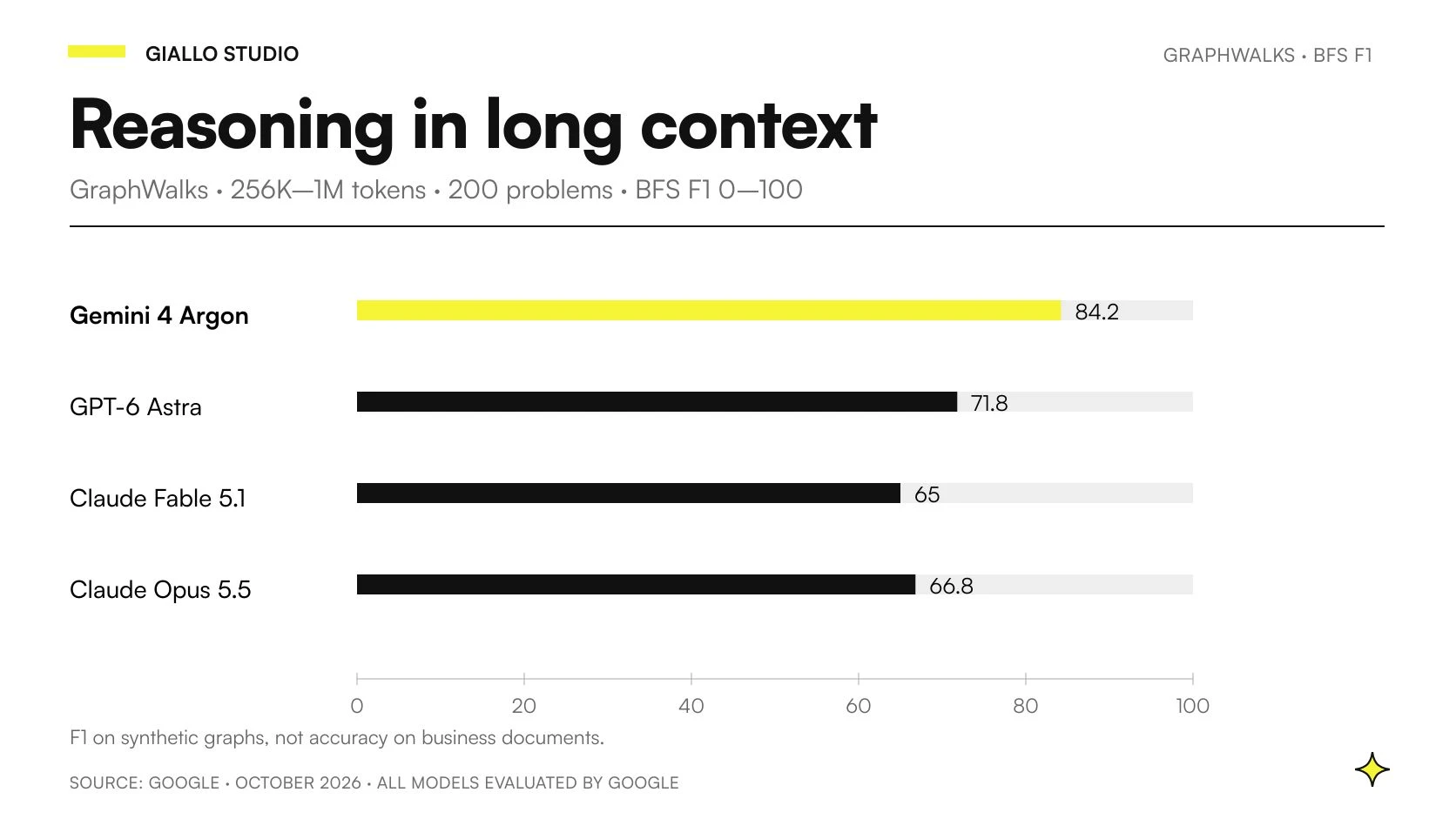
Results published by Google in October 2026, accessed on 23 October. GraphWalks evaluates synthetic graph problems; the chart does not represent a Giallo test on SME documents.
| Model | GraphWalks, BFS F1 in the 256K–1M range |
|---|---|
| Gemini 4 Argon | 84,2% |
| GPT-6 Astra | 71,8% |
| Claude Fable 5.1 | 65,0% |
| Claude Opus 5.5 | 66,8% |
Source of the values: October 2026 model card, with GraphWalks protocol described by Google.
The result is useful as an indication for one specific long-context task. It does not support a claim that Argon will correctly understand 84,2% of your contracts or enforce archive permissions. Business testing must stay separate: retrieving the right source, interpreting the passage, handling exceptions and respecting access rights. The guide to Gemini 4 Argon benchmarks explains how to read different protocols and metrics.
What does File Search do, and what must you design?
Google describes File Search as a tool that imports, chunks and indexes content to retrieve relevant information. The documentation also provides for metadata and filters. These features reduce the work needed to build retrieval, but must be configured for the business use case. Official File Search documentation.
You can consider a managed tool or retrieval controlled by your application. The decision depends on content types, existing integrations, access constraints and the need to verify every stage. Avoid choosing a database or service because it appears in an example: first describe the question, expected source and authorization boundary.
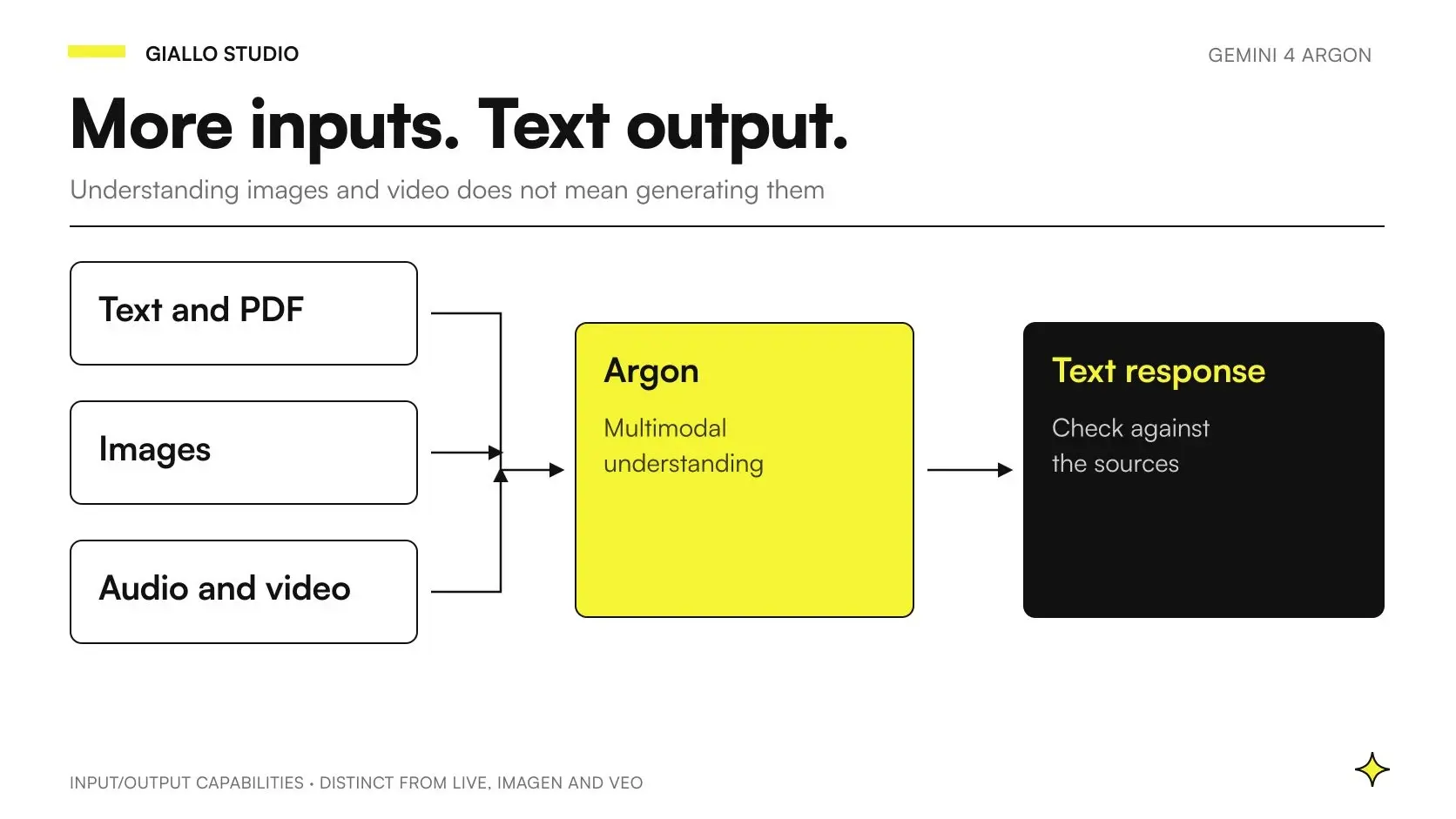
File types must also be checked for the tool. At the 23 October check, File Search documents text embeddings and images or multimodal content through the specified models, but excludes audio and video. This limitation is not the same as the inputs Argon accepts. Content types in File Search. Those media require a separate assessment, covered in the guide to multimodal Argon.
How should you prepare the archive before indexing?
Start with a considered inventory: owner, purpose, version, effective date and authorized audience for each source. A filename is insufficient. «Final procedure» does not clarify whether a newer revision replaces it or whether the attachment applies to every contract. The system must be able to retrieve this information.
Give the document a stable identifier and retain its version identifier separately. This lets you recognize that a new revision replaces the previous one without confusing historical citations. For an updated procedure, establish when the old version stops being searchable and how the owner confirms the change.
Chunking must preserve meaning. A table separated from its legend can change interpretation; a clause split from its exception can produce a wrong answer. The embedding and the vector database help explain retrieval, but do not replace checks on examples from your archive.
Keep references in passages that help users return to the source: section, page where available, identifier and version. Do not promise precise page references if the format or transformation cannot preserve them. The result should state the type of reference available rather than inventing precision it does not have.
Where are knowledge base permissions enforced?
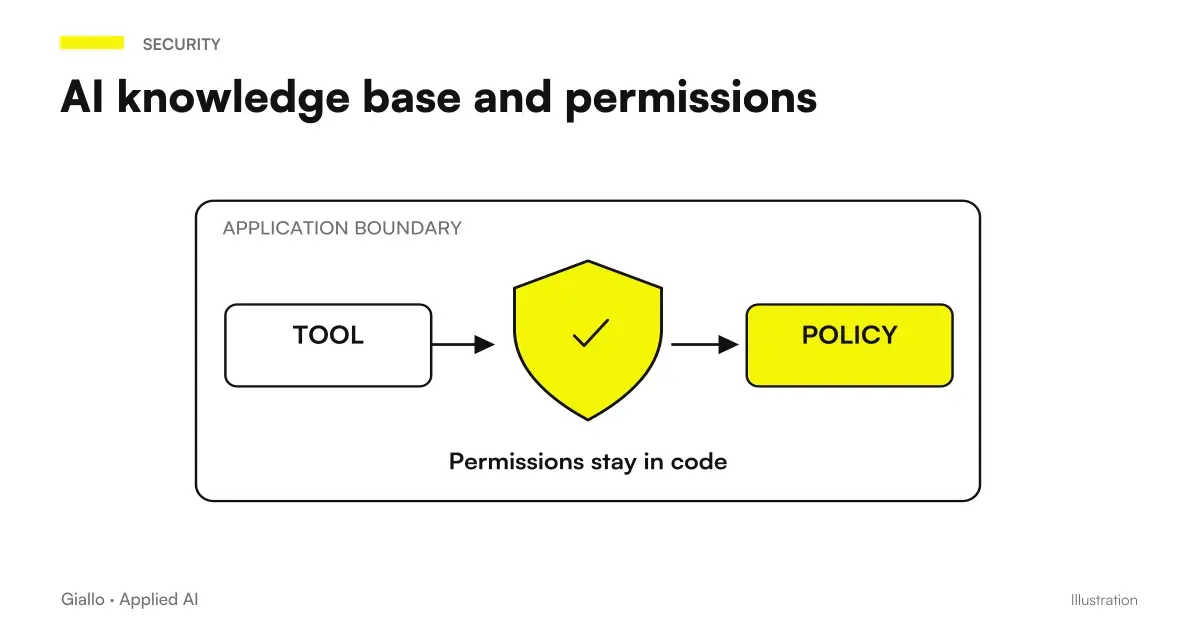
The system receives the question and identifies the user through the application. It then derives their organization, role and permitted projects. These constraints must limit search before content is put into context. Asking the model to ignore a document it has already received is not equivalent to preventing access to it.
A metadata filter can be part of the design, provided that the authorized value is determined by the server. The question text must not be able to freely select the customer or department to query. For archives requiring strong separation, also consider distinct containers and credentials with limited access. These are design options to verify, without automatically attributing isolation to the presence of a filter.
Tests must include indirect questions: requesting a cross-project summary, naming an excluded customer or citing a code found only in an inaccessible file. Check titles, suggestions and error messages too. The guide to AI knowledge bases and permissions explores this separation between useful search and authorized access.
How should responses and citations appear?
A document response can follow a simple contract: conclusion, evidence, limitations and status. Evidence identifies which passages support which claims. Limitations distinguish a missing source, a conflict and interpretive uncertainty. Status can indicate a supported response, required review or insufficient material. This is a proposed application format, not a model guarantee.
A citation does not prove the conclusion is correct. The reviewer must be able to read the passage and determine whether it really supports the claim, refers to the same product and includes omitted conditions. Even retrieving a relevant source can be followed by misinterpretation. The Google model card documents limitations and possible errors: grounding does not justify removing checks.
Also define the difference between a source and an inference. «The procedure specifies this step» can be checked in the document. «It would probably be useful to apply it to this case too» is a hypothesis and must be presented as such, if the process allows it. For operational tasks, you can require unsupported inferences to go directly to review.
What is the difference between internal documents and web grounding?
Grounding with Google Search connects Gemini to web content and can return verifiable sources. It is useful for questions about current public information, but does not replace an authorized business archive. Google Search grounding documentation.
For an internal assistant, first establish which questions allow web use. A company contractual procedure should not be completed with an article found online just because the file set is incomplete. The result must state that the internal source is missing. If you instead request a comparison with public documentation, clearly separate the two sets of evidence.
Combinations have specific constraints: as of 23 October, the File Search guide allows custom functions but excludes Search grounding and URL context in the same request. Combinations supported by File Search. In your project, you can separate internal retrieval and public search into distinct steps with checkable results. Support for individual tools on the model page does not demonstrate support for every combination.
How can you use Argon with a maintenance company's manuals?
Hypothetical scenario: an SME services different equipment models. The assistant must help the technician find the relevant passage in an approved manual. Input includes the question, verified equipment model and user role. The system selects only relevant versions the technician is authorized to consult.
The expected output contains the manual reference, revision, section and passage summary. If the nameplate is unreadable or the model is uncertain, the system asks for confirmation before retrieving specific instructions. It does not infer the model from appearance alone or present another series' procedure as equivalent.
Tests include an answerable question, an ambiguous description, an outdated manual and a request without documentation. The technical owner checks that the system distinguishes these cases and does not omit the procedure's conditions. The acceptance criterion is not an elegant response: it is the ability to trace every instruction to the correct passage within the company's defined service scope.
In this configuration, the assistant supports consultation; execution and safety decisions follow company procedures. A document alert flags «unverified version» or «unidentified model», with a designated owner as recipient. A missing result must not look like confirmation that no constraints exist.
How can an engineering practice keep project specifications separate?
Second hypothetical scenario: a practice compares a specification with project notes. The assigned person can read their allocated project but not the others. Input is a question about the requirement; retrieval receives the project scope and contractual version to consider from the server.
Output has one row per requirement: required wording, evidence in the specification, any subsequent note and a conflict to resolve. An unapproved note must remain identified as such. The system cannot automatically turn an internal comment into a contractual amendment or resolve a conflict by choosing the source with the most assertive wording.
One test places a similar requirement in a different, inaccessible project. Another revokes the user's assignment after an initially successful question. The system must prevent subsequent retrieval and handle any retained results consistently. The owner checks both the quality of permitted answers and the absence of information from the excluded project.
The final criterion requires conflicts and gaps to be visible before preparing the document for the customer. To connect this record to the practice's software, the guide to Argon API integration explores the data contract and error handling.
How do you verify updates, revocations and deletions?
The knowledge base keeps changing after launch. An updated document must reach search; a withdrawn source must stop supporting new responses. Assign an owner and an observable check for both steps. «Synchronization active» is insufficient if nobody checks that the retrieved version is the expected one.
Map copies too: the original archive, index, any extracts, retained results and application cache. A revocation must have a defined effect on each surface. Do not confuse deleting the original file with automatically removing everything derived from it. The Argon privacy assessment helps frame questions about processing through your chosen channel.
For File Search, the documentation distinguishes the temporary file, deleted after 48 hours, from imported content and embeddings, which persist until deletion. File Search data lifecycle. The temporary upload's lifetime is therefore not a retention policy for the entire knowledge base. The project must separately verify how to withdraw a source from the index and handle results already retained.
Open the cases that put a business RAG system to the test
- The right question retrieves the expected document and approved version.
- An unauthorized source stays excluded even if it contains the exact answer.
- A clause with an exception is not cited without that condition.
- Two conflicting sources generate an alert to the owner.
- The withdrawn document stops appearing in new responses.
- Revoking a role changes access without requiring a new instruction to the model.
- A question without evidence produces a statement of insufficiency.
Which mistakes should you avoid before opening the archive to the team?
The costliest mistakes are indexing everything without owners, using the question text as permission, accepting citations without checking their support and keeping incompatible versions searchable. Another mistake is assessing only easy questions for which the model might produce a plausible answer without consulting the archive.
Measure retrieval and response separately. If the expected source is not found, fix search and content. If it is found but misinterpreted, address format and generation. This distinction avoids changing the model when the problem is a misclassified document. Collect examples, rejection reasons and review effort, without attributing savings before observing them.
To start, you need an approved set, sanitized real questions and an owner capable of judging the evidence. Include a question the system must not answer in the pilot too. We build the knowledge base around your team's sources and permissions, so the first decision concerns a verifiable result and an archive someone can maintain.
Giallo Studio guides: methodology and sources
How we apply it in the company
Related resources
 Gemini 4 Argon: what it is, what it does and when to use it in business
 Gemini 4 Argon API: integrating the model into business processes
 Gemini 4 Argon privacy and security: a business guide
 Multimodal Gemini 4 Argon: analyzing images, video and PDFs
 RAG: what it is and why it improves AI responses
 AI knowledge base and permissions: who can read what answer
FAQ
Does Gemini 4 Argon support RAG for business documents?
The official model page includes support for File Search, Gemini's tool for retrieving content from an indexed archive. You can also design application-controlled retrieval and provide the model with authorized passages; permissions and archive quality remain project requirements.
Does Argon's long context remove the need for RAG?
No. Context defines how much material can participate in a request; retrieval decides which sources to fetch for that question. Updates, permissions, versions and verifiability remain necessary even when the documents fit within the model's window.
Do citations make a Gemini response true?
A citation lets you check a source, but does not by itself prove that it supports the conclusion. Testing must compare the claim with the cited passage, the document version and any limitations or exceptions.
Does File Search automatically enforce every employee's permissions?
You should not infer that from support for retrieval or filters. The application must obtain identity and permissions from a trusted source and demonstrate that no excluded document enters the search, context or result.
What is the difference between internal RAG and Google Search grounding?
Internal RAG retrieves material from the archive selected by the company. Grounding with Google Search connects the response to web content: it does not replace controlled access to confidential documents.
What should the system answer when a source is missing?
It must state the limitation and distinguish a missing source from an ambiguous or out-of-scope question. An incomplete but recognizable result is preferable to an invented company rule.
Can File Search index every media type accepted by Argon?
No. As of 23 October 2026, the File Search documentation describes support for text and images or multimodal content through the relevant embeddings, but excludes audio and video formats. Model support for these inputs does not demonstrate support in the search tool.