
Gemini 4 Argon benchmarks: how to read the LLM comparison
Gemini 4 Argon benchmarks: Vals v2.2, DeepSWE and FrontierSWE with sources, protocols and limitations. Decide what to test in your business.
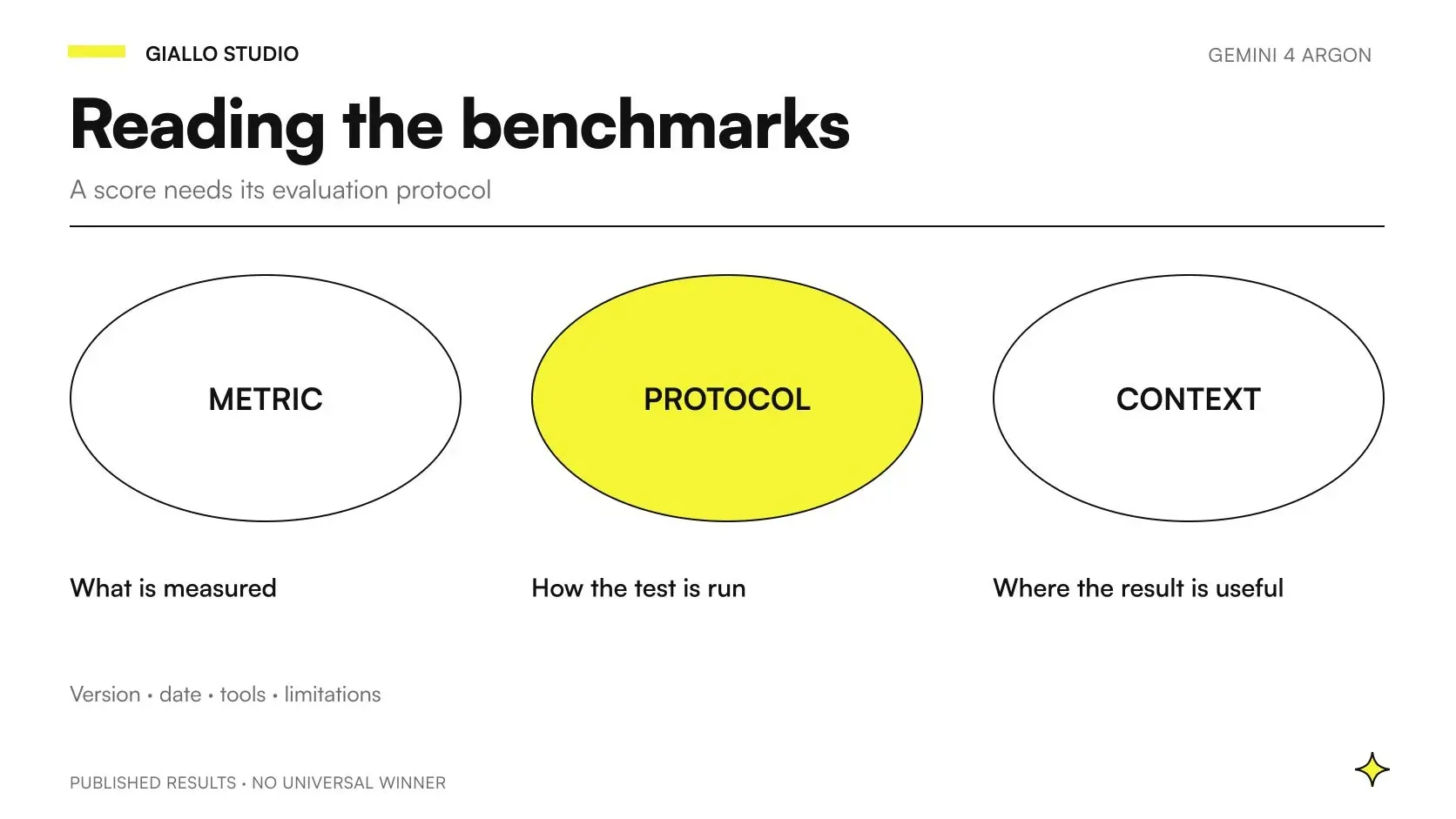
Gemini 4 Argon benchmarks show different strengths and limitations across tasks: they do not establish the model's overall superiority. To compare it with GPT-6 Astra, Claude Fable 5.1 and Claude Opus 5.5, you need to read the score alongside the test version, available tools and origin of the measurement. A number without this information can produce a ranking but offers little help when choosing a business system.
This article captures the sources available as of 23 October 2026. It distinguishes the compilation published by Google in the Argon model card dated 13 October from the Vals Index v2.2 leaderboard updated on 22 October. We have not run the benchmarks or tested the product through an authenticated account: the aim is to turn public evidence into questions you can verify against your own work.
To understand how the model works, start with the guide to Gemini 4 Argon. Here we address a more specific decision: which results deserve attention, which comparisons require caution and how to build a business sample that can confirm or challenge the model's usefulness.
In summary
- A benchmark win applies to that protocol, not to every business activity.
- The Vals v2.2 headline ranking and the ranking that counts refusals as failures produce different orders.
- DeepSWE and FrontierSWE produce different results and should not be averaged.
- GraphWalks measures a synthetic long-context capability, not universal document understanding.
- A useful comparison for an SME includes verified quality, serious errors, waiting times and the cost of accepted results.
What does an AI model benchmark measure?
A benchmark defines a set of problems and a rule for scoring responses. It may require a short answer, a software patch or a sequence of actions using tools. Even when the result is expressed as a percentage, its meaning varies: accuracy, task success and F1 describe different things.
The protocol includes what surrounds the model: instructions, tools, conversation memory, reasoning budget, timeouts and the verifier. In coding, for example, the system that enables file exploration and test execution is often decisive. Applying the score to a chat without those tools changes what we are evaluating.
The Google's Argon methodology, accessed on 23 October, states that, with exceptions, Argon is evaluated at pass@1 with the highest available reasoning setting. Much of the competitors' data instead comes from their providers' publications or leaderboards. This compilation is informative, but it is not a single experiment controlling every variable in the same environment.
Which sources are we comparing?
It helps to distinguish the model's developer from the benchmark's maintainer. Google's model card compiles results and explains their origins; some measurements are computed by Google, while others are taken from public sources. Vals publishes its own index and methodology. Neither source directly measures your company's processes.
| Source accessed on 23 October 2026 | Snapshot used | Origin of the measurement | Limitation to remember |
|---|---|---|---|
| Google model card | Table labelled October 2026, published on 13 October | Vendor compilation, with origins specified for each benchmark | Environments and sources are not uniform |
| Google methodology | Document accompanying Argon | Details of harnesses, inputs and settings | Exceptions may affect comparability |
| Vals Index | Version 2.2, updated on 22 October | Benchmark author's leaderboard | US weights and fallback handling affect the result |
Keeping the date matters even when the commercial name stays the same. An update to the dataset, protocol or service can change the number. Not every difference between two screenshots documents a model improvement. Before interpreting it, check that what is being measured has remained identical.
Does Gemini 4 Argon rank first in Vals Index v2.2?
In the Vals v2.2 headline ranking dated 22 October 2026, Argon is behind Claude Sonnet 5.5 and Claude Opus 5.5. However, the same page explains that some Claude tasks are served by fallback models after provider refusals. If those cases count as failures, the order changes. The following values come from the Vals benchmark author, not from a Giallo test.
| Model in the leaderboard | Vals v2.2 headline score | Refusals counted as failures |
|---|---|---|
| Claude Sonnet 5.5 | 70,85% | 69,03% |
| Claude Opus 5.5 | 70,18% | 64,16% |
| Gemini 4 Argon | 69,24% | 69,24% |
| GPT-6 Astra | 65,02% | Separate figure not published in the table considered here |
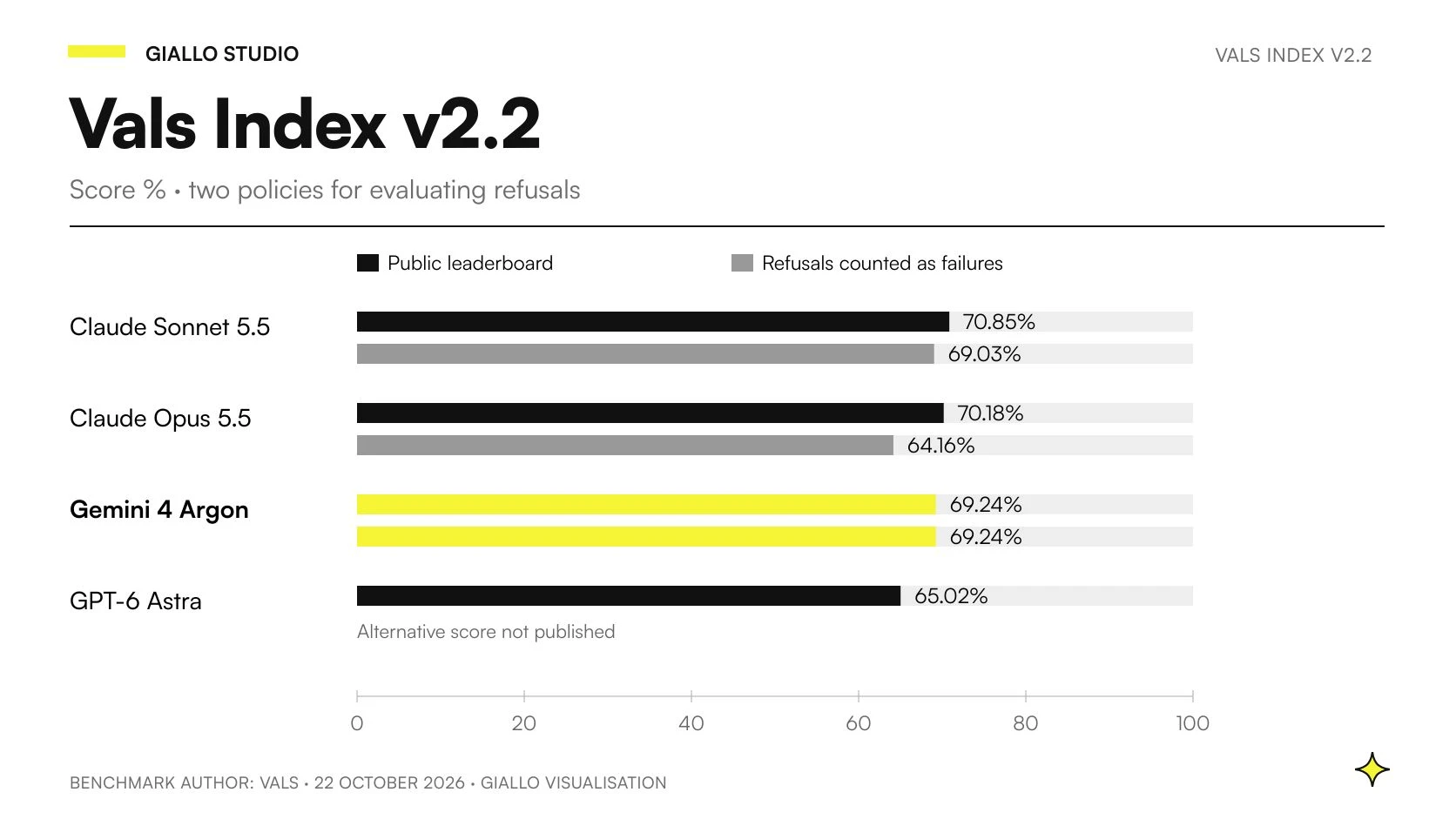
The two interpretations answer different questions. The headline ranking describes the service under the Vals protocol with the stated fallbacks. The second makes the effect of refusals visible if that recovery is not accepted. Selecting one column to support a preference while hiding the other is misleading. An SME may need both perspectives: the quality of the answer obtained and the likelihood that the workflow will stop.
Argon's value in the current table must not be mixed with the 68,9% in the launch snapshot in the Google model card. The current version is a different measurement; comparing those numbers as if they showed growth on the same test would lead to an unsupported conclusion.
Why is Vals Index not a measure of Italian business ROI?
Vals aggregates finance, software development, legal and tax tasks using weights linked to shares of US GDP. That choice makes a particular representation of economic work explicit, but it does not reproduce the mix of activities at a workshop in Lombardy, an Italian professional practice or a distributor. The source and composition are on the Vals Index page.
An accuracy index does not automatically include integration with business software, access control, source retrieval, human review or the consequences of an error. A correct result may arrive too late for the process; an almost correct answer may take longer to fix than completing the task manually. These are quantities to measure in the workflow, not derive from the leaderboard percentage.
The costs shown in an evaluation also need a separate reading. As of 23 October, Vals uses Argon's standard list prices of 4 dollars for input and 20 dollars for output per million tokens, while the Google API pricing page offers promotional rates of 2 and 10 dollars until 30 November 2026. This is not a performance contradiction: the economic assumptions differ. In the guide to Argon costs we examine thinking, retries and when the rates expire.
What do DeepSWE and FrontierSWE say about coding?
In Google's October compilation, Argon leads DeepSWE 1.1, while GPT-6 Astra leads FrontierSWE v2. The change in order is the first reason to avoid saying “best AI for coding” without specifying the test. Both benchmarks concern software tasks, but they are not the same measurement. The numbers come from the model card, with limitations in the accompanying methodology.
| Model | DeepSWE 1.1, pass@1 success | FrontierSWE v2, task success |
|---|---|---|
| Gemini 4 Argon | 77,9% | 55,0% |
| GPT-6 Astra | 74,1% | 65,5% |
| Claude Fable 5.1 | 67,4% | 56,3% |
| Claude Opus 5.5 | 74,2% | 62,3% |
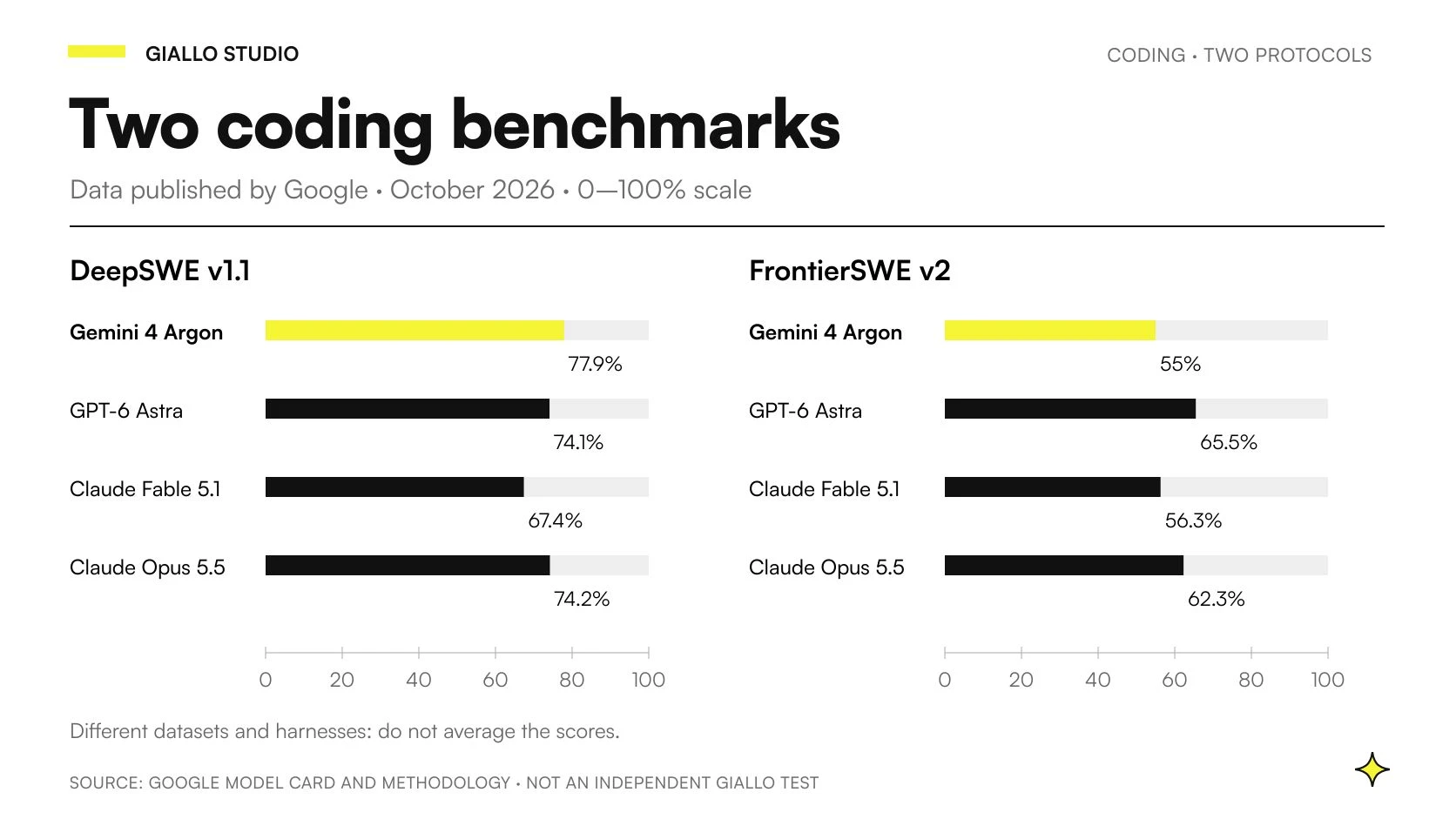
For DeepSWE, Google computes Argon's result using the mini-swe harness; Astra's comes from the public leaderboard and Claude's data from system cards. For FrontierSWE, the methodology attributes the results to the Proximal leaderboard. We do not have an independent replication of each run here: we can report the published evidence while stating its origin.
The practical choice is to take both signals seriously. Argon deserves a comparison on repositories similar to yours; Astra and Opus remain credible candidates when the problems more closely resemble those where they lead. The article on Argon for software development turns this interpretation into a plan for patches and reviews.
Does a million tokens mean reliable understanding?
Context capacity defines how much material can enter a request, not how much will be used correctly. The Argon API specification states 1.048.576 tokens in total across input and output. That shared limit does not promise infallible archive reading, nor allow a million input tokens plus a million response tokens.
On GraphWalks, Google evaluates synthetic breadth-first graph traversal problems. In the 256K to 1M token subset, comprising 200 problems, it reports F1 scores of 84,2 for Argon, 71,8 for Astra, 65,0 for Fable and 66,8 for Opus. Google computes all these values under the Argon methodology; they are not measurements of how many business documents were understood.
| GraphWalks, 256K–1M contexts | BFS F1 reported by Google |
|---|---|
| Gemini 4 Argon | 84,2 |
| GPT-6 Astra | 71,8 |
| Claude Fable 5.1 | 65,0 |
| Claude Opus 5.5 | 66,8 |
F1 combines aspects of response quality for that problem structure. It must not be renamed “PDF accuracy”. A specification may contain scans, conflicting revisions and tables: difficulties that the synthetic graph does not automatically represent. The RAG and business document evaluation therefore needs questions with expected sources, missing documents and permission checks.
Which comparisons are best kept separate?
Some tests are interesting but particularly easy to present misleadingly. On LVBench, for example, Google describes video inputs sampled differently across models. A chart hiding that difference would look like a test with equal information. For OSWorld, Argon's figure concerns an offline subset with partial scoring, whereas combined online and offline results cover a different scope. These exceptions are documented in the Google methodology.
The same source states that Argon's verifier timeout was increased sixfold on Terminal-Bench Science 0.1. Highlighting the exception does not invalidate the result; it prevents it from being presented as a comparison with an identical time budget. A reader automating an urgent procedure needs to know precisely which waiting times were allowed.
For vulnerability remediation, the compilation reports on CWE-bench v1 a pass@1 of 68% for both Argon and Astra, versus 58% for Fable and 67% for Opus. The methodology states that the full ranking may use pass@4 to break ties. A tie in the displayed value remains a tie on that metric, not a certification that generated code is secure.
| CWE-bench v1, Google's October 2026 compilation | Vulnerability remediation pass@1 |
|---|---|
| Gemini 4 Argon | 68% |
| GPT-6 Astra | 68% |
| Claude Fable 5.1 | 58% |
| Claude Opus 5.5 | 67% |
What information makes a comparison verifiable?
An evaluation sheet should let a colleague reconstruct what was requested and what was accepted. Save the model identifier, date, settings, set of cases and assessment rule. If you use tools, record which were available and with what permissions. If these conditions change during testing, separate the results rather than adding them to the same average.
Open the minimum checklist for a business trial
- Describe the task and acceptable result before running it.
- Prepare routine cases, exceptions and cases where the system must abstain.
- Keep the model version, configuration, tools and timeouts.
- Separate content correctness, compliance with authorisations and format quality.
- Measure cost and waiting time for rejected or retried responses too.
- Assign evaluation to someone who can check the sources.
- Record protocol changes and repeat the comparison when they affect the process.
Also decide how to handle refusals. Not answering may be appropriate for an unauthorised request and a failure for a legitimate question. The “failure” category must be defined in relation to the task. Vals teaches precisely the importance of making this policy visible, rather than letting the system reward or penalise different cases under a single label.
How would an Italian distributor evaluate Argon?
Hypothetical scenario: a spare parts distributor wants to prepare internal answers about compatibility and sales conditions. The proposed sample includes authorised product sheets, superseded versions and requests that the documents cannot answer. It does not represent a Giallo client and has not been tested: it is a way to connect long-context capabilities to a problem that can be checked.
An acceptable result must give the correct code, cite the sheet version and state when compatibility cannot be verified. An elegant sentence without a source is rejected. Even accurate information taken from a price list reserved for another group is a problem, because quality and authorisation are separate requirements.
Argon and its competitors receive the same permitted material, the same requested format and comparable retrieval capabilities. The reviewer records omissions, contradictions and necessary interventions. Only after this check do you measure whether the process reduces total work. The public ranking selects candidates; the business trial decides whether one is usable.
How would the trial change at a software company?
Hypothetical scenario: a small software company wants to fix regressions in business management software. Prepare bounded tasks with a reproduction of the defect, acceptance criteria and relevant tests. The sample needs no production credentials. The environment must prevent automatic publication: the expected result is a reviewable patch, not an autonomous release.
The comparison separates resolved tasks, patches that introduce regressions and responses that stop without completing the work. Also record reviewer time and requests for clarification. A model may produce more patches that pass the available tests while forcing the team to inspect unnecessarily broad changes: this cost must appear in the evaluation.
Before comparing Argon with a DeepSWE result, check which tools you are actually providing. A simple chat window and an agent that can read repositories and run commands are not the same product. The Argon, ChatGPT and Claude comparison clarifies this distinction between the model, application and working environment.
Which mistakes turn benchmarks into a bad decision?
The first mistake is mixing versions: a launch figure and an updated figure do not automatically belong to the same historical series. The second is hiding the conditions that produced a score: fallbacks, timeouts and tools change the service observed. The third is combining F1, accuracy and task success into one average and then assigning it an unvalidated business meaning.
A fourth mistake is treating the benchmark as a contractual guarantee. The model card notes hallucinations and limitations: a good result does not eliminate them. The fifth is ignoring a serious error because the average looks good. For a quotation, inventing a commercial condition may matter more than many correct classifications; the company must decide this asymmetry before testing.
Finally, avoid changing the prompt or sample until your preferred candidate wins. You can improve the system, but distinguish the set used to develop it from the set used to assess it. Keeping new cases lets you check whether improvement extends beyond examples already seen.
How should you handle waiting times, retries and uncertain judgements?
Response time must be considered against when the result is needed. Overnight classification can tolerate waits that would interrupt an operator on the phone. In the proposed protocol, record start, finish, any timeout and the time needed for review. Do not compare only the best run: keep interrupted cases too, because they are part of the operational experience.
A retry may recover an answer, but it consumes resources and changes the method. Establish beforehand whether it is allowed, with which instructions and how many times. If a candidate receives extra information during recovery, report it separately from the initial comparison. This makes the difference between first-response quality and whole-system reliability clear.
Human judgement can also be uncertain. An answer might be correct under an internal procedure and wrong under an outdated document. Rather than forcing the reviewer to decide immediately, keep a “needs clarification” category and assign the case to the source owner. The result then reveals an archive problem, not necessarily a model problem. Resolving these contradictions before automation improves the process even if you ultimately keep the work manual.
Which business decision should you start with?
Start with a question that allows an operational answer: “Does this system prepare a verifiable draft with less total work?” is more useful than “Which model is more intelligent?”. Choose the process, set the requirements and use benchmarks to build a shortlist. The Argon migration and evaluation pathway helps formalise the transition without replacing everything at once.
If you need to decide on an experiment, bring a sanitised collection of cases and a list of errors that would prevent use. Through AI consulting of Giallo we can turn those materials into a repeatable comparison, with sources, acceptance criteria and process costs visible before extending it to real data.
Giallo Studio guides: methodology and sources
How we apply it in the company
Related resources
 Gemini 4 Argon: what it is, what it does and when to use it in business
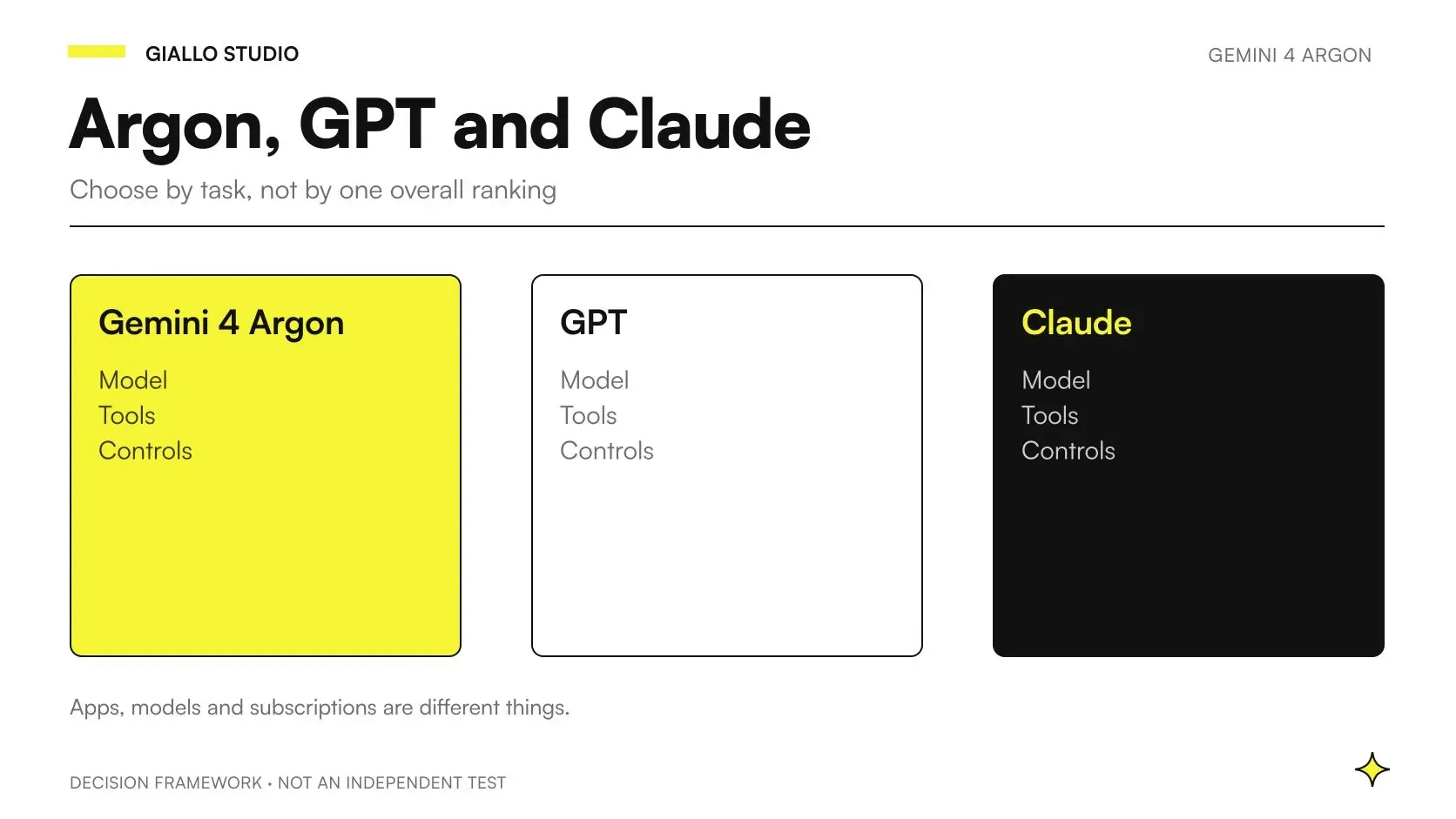 Gemini 4 Argon vs ChatGPT and Claude: which should you choose?
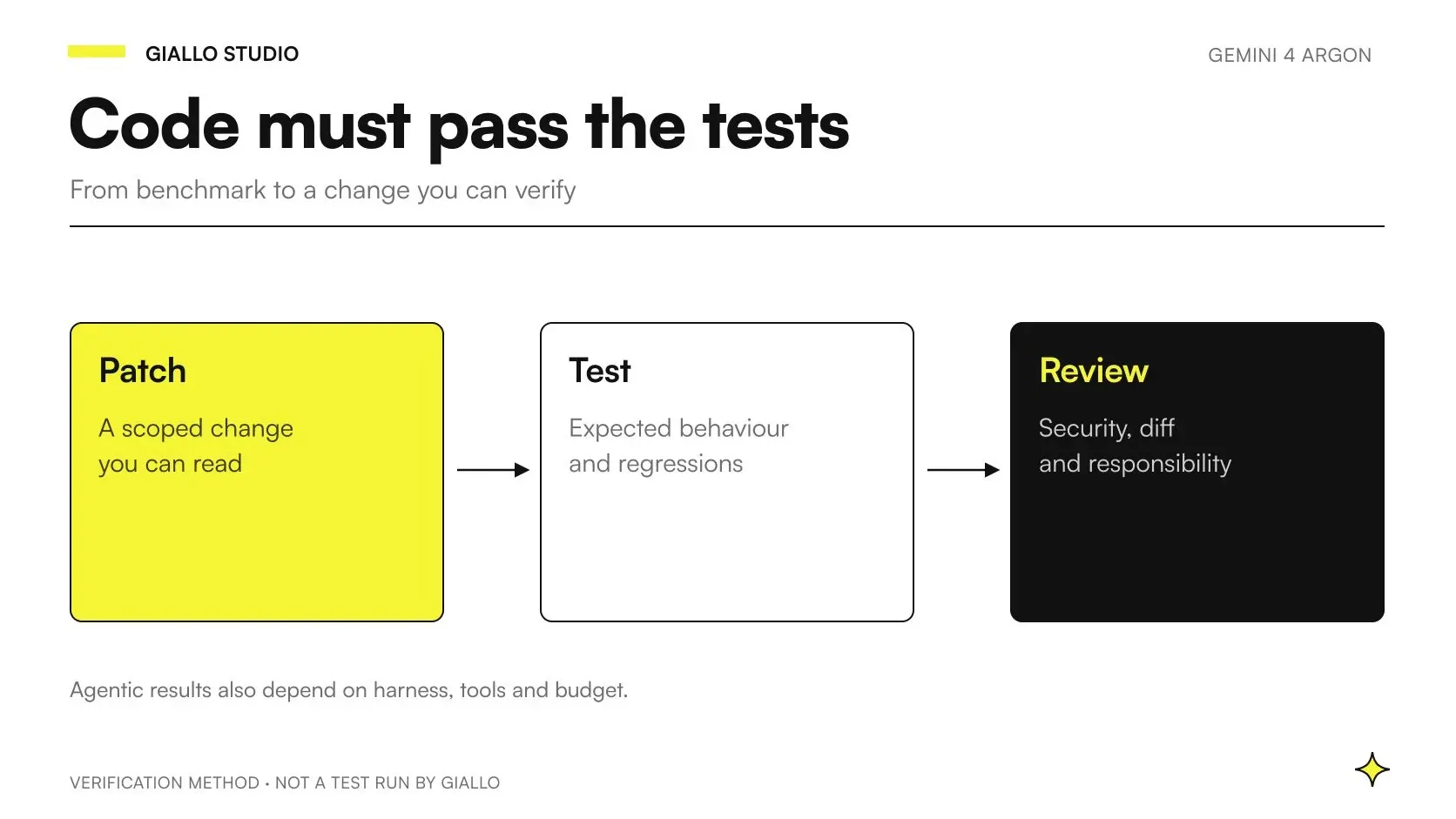 Gemini 4 Argon coding: how to assess it for software development
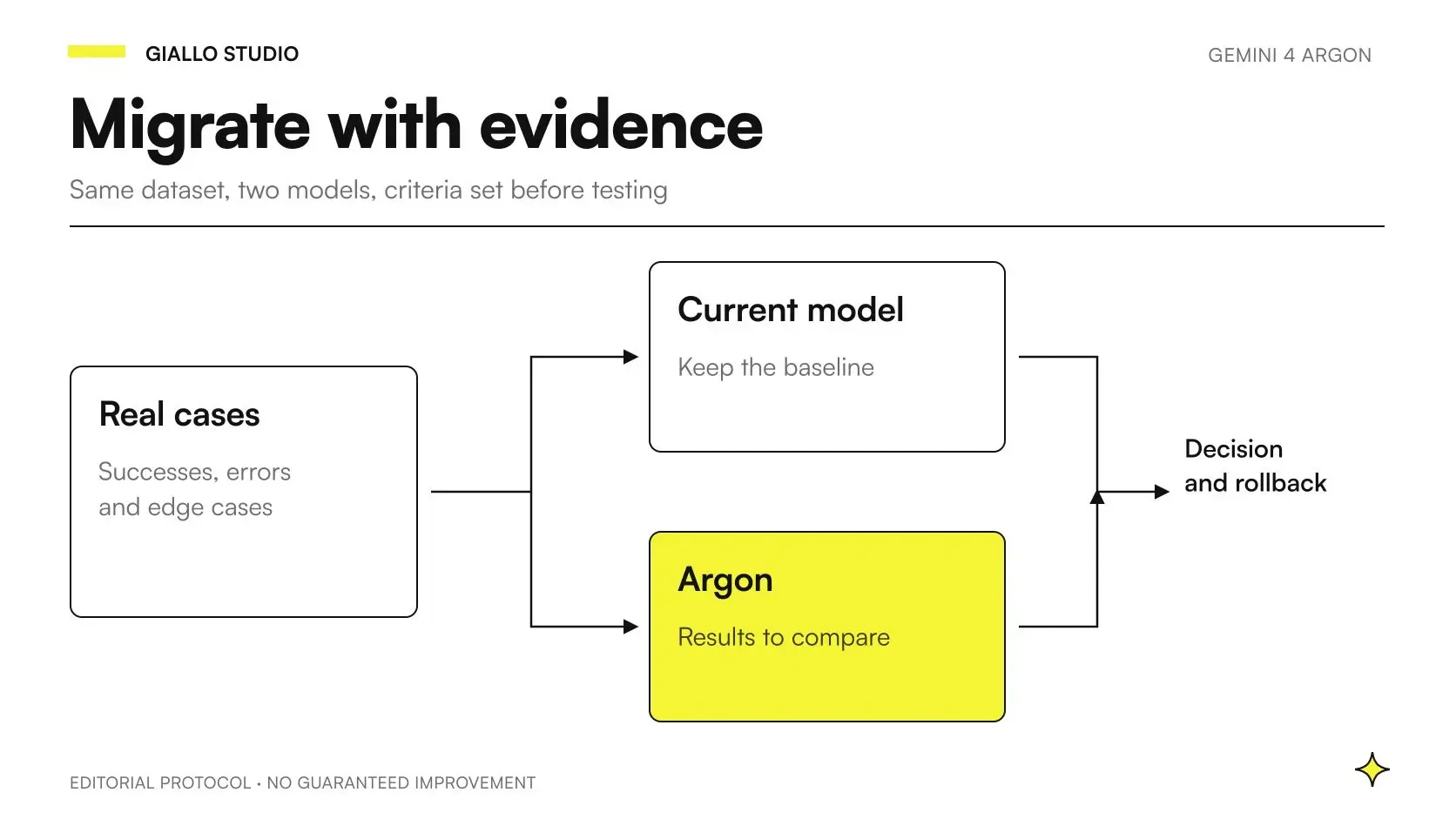 Migrating to Gemini 4 Argon: evaluation, testing and rollback
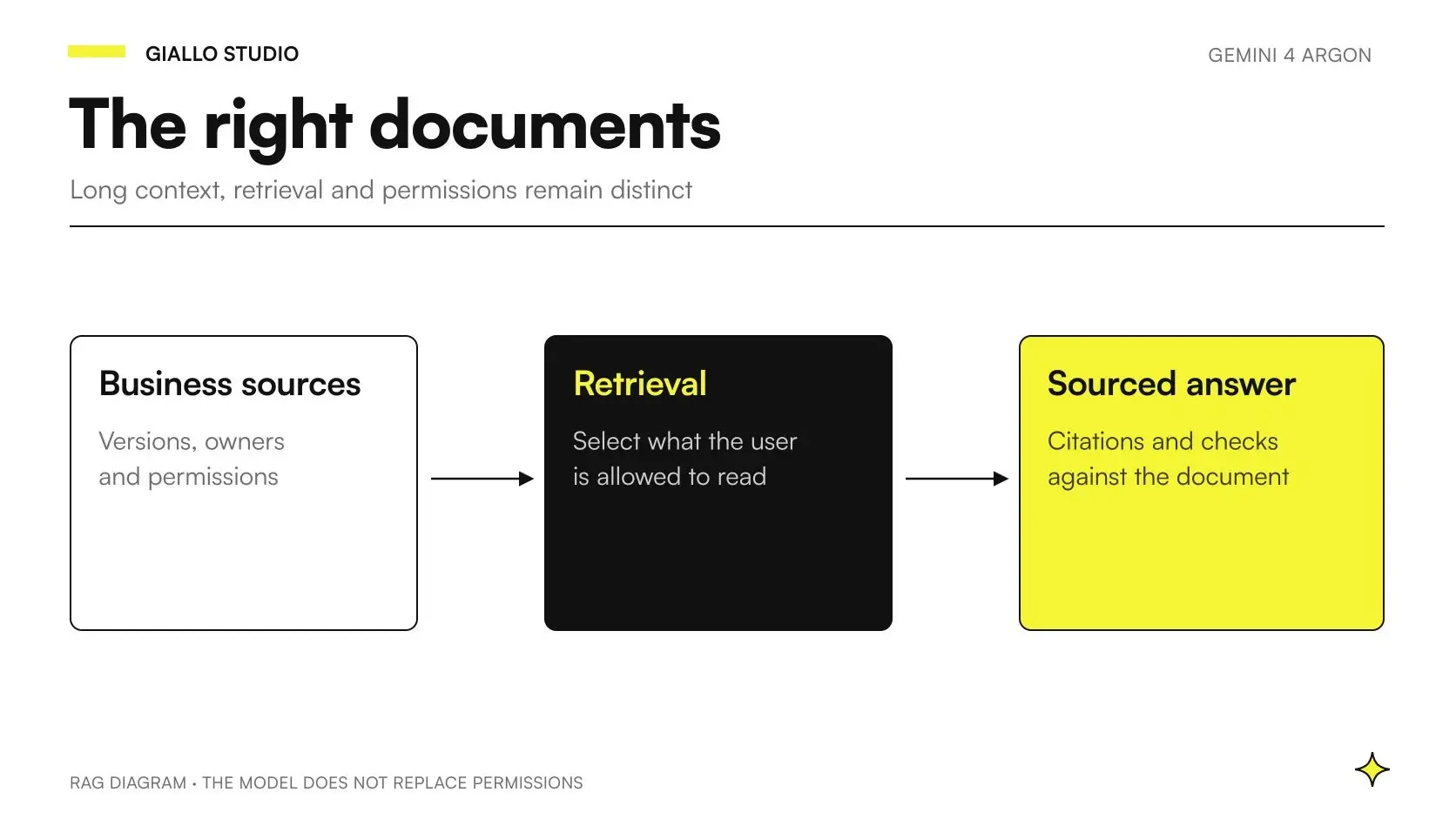 Gemini 4 Argon for RAG and business documents: sources and permissions
 Gemini 4 Argon: API pricing and business cost calculations
 ChatGPT vs Grok
 Mistral vs Llama: comparison between the two open weight models
FAQ
Does Gemini 4 Argon rank first on every benchmark?
No. In Google's October 2026 compilation, Argon outperforms GPT-6 Astra on DeepSWE 1.1 but scores lower on FrontierSWE v2. Rankings also depend on the version, tools, reasoning settings and handling of refusals.
What is Argon's result in the updated Vals Index?
In Vals Index v2.2, updated on 22 October 2026, Argon scores 69,24%, behind Sonnet 5.5 and Opus 5.5 in the headline ranking. When Claude cases resolved through fallbacks are counted as failures, Argon ranks ahead of those two models instead. The protocol must be stated alongside the score.
Does the Vals score of 69,24% indicate how much business work can be automated?
No. It is an aggregate accuracy measure across finance, coding, legal and tax tasks, weighted by US GDP. It does not measure productivity, ROI or correctness under Italian law.
Can DeepSWE and FrontierSWE scores be added together?
No. They are different benchmarks with different tasks and protocols. An editorial average would create a new index without validation to justify its interpretation.
Does GraphWalks prove that Argon understands any long document?
No. The cited test measures F1 on synthetic graph traversal problems. It helps identify a candidate for long-context testing but does not replace checks on PDFs, tables and business access permissions.
Has Giallo run these benchmarks?
No. The article analyses results published by Google and the Vals benchmark author's leaderboard, accessed on 23 October 2026. The business evaluation plan is an operational proposal, not a report of a completed test.