
Migrating to Gemini 4 Argon: evaluation, testing and rollback
How to evaluate Gemini 4 Argon before migration: test cases, quality criteria, cost per result, gradual rollout and returning to the previous model.
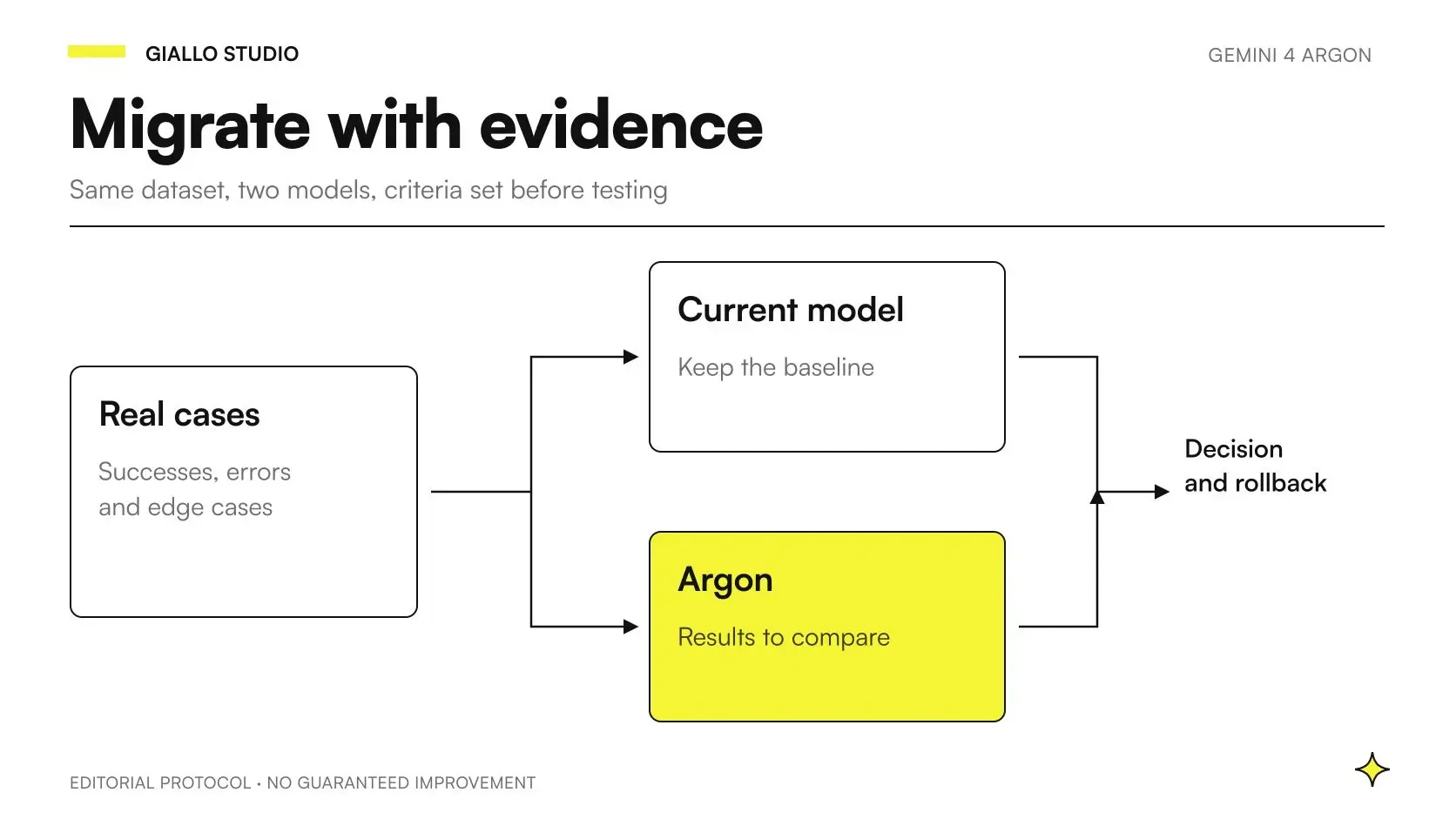
Migrating to Gemini 4 Argon requires verifying that the new model improves a concrete process without introducing unacceptable errors or costs. A sound transition includes comparison with the current system, criteria decided before testing and a practical way back. Changing an API identifier is only part of the work.
This guide proposes a Giallo protocol for an SME, professional practice or software team. Scenarios, thresholds and quantities in the examples are hypothetical: they represent neither tests we have performed nor guaranteed Argon improvements. For the model’s features, see the guide to Gemini 4 Argon; here, the aim is to make the decision verifiable.
In summary
- Migration is evaluated across the whole process, from material received to approved result.
- Comparison requires the same cases and acceptance criteria written before seeing the responses.
- A critical error cannot be offset by a better average on less important tasks.
- Prompts, tools, parameters and model version are part of the configuration to record.
- Rollout can advance only when returning to the previous configuration is practical.
What does migrating to Gemini 4 Argon actually mean?
First distinguish three situations. A person can change the model selected in an app; an administrator can change the product provided to the team; a developer can replace the model called by an integration. These three operations have different effects. A trial performed in the first situation does not automatically validate the others.
In the app, context includes the conversation, attachments, settings and features available to the account. In an API system, it also includes instructions, document retrieval, tools, controls and code interpreting the response. If a model prepares a draft in business management software, you therefore also need to evaluate what that software accepts and shows to the person.
In the Gemini Developer API channel, the documented stable identifier is gemini-4-argon. The official Argon technical specification, checked on 23 October 2026, is the reference for model features and availability. Access through another product or platform must be verified on that channel.
This distinction avoids basing a migration on a feature observed elsewhere. The date matters too: an alias, an identified version and product availability must be recorded separately. For technical work, the guide to Argon API integration addresses the choice of access point.
Which documented technical differences should be checked before testing?
Google’s migration guide states a default thinking level of medium; the parameters temperature, top_p and top_k are ignored. If the previous system used them to control behaviour, leaving them in the code can give a false impression of continuity. Google also documents only implicit caching, enabled for prompts of at least 4.096 tokens: an explicit-cache configuration designed for other models must not be carried over to Argon. Source: what is new and migration guidance for Gemini 4 Argon, checked on 23 October 2026.
The same guide calls for attention to long processing: extended responses use background execution and continuation, while Google recommends a client timeout of at least fifteen minutes for difficult prompts. This is technical guidance from the provider, not an expected duration for every request. Testing must check that the app shows an understandable status, can handle the wait and does not automatically duplicate work already started. Thinking is included in billed output: changing that parameter can therefore also affect observed cost. Google guide, checked on 23 October 2026.
Which business problem should the comparison start from?
A useful reason is specific: the current system confuses the terms of two offers, requires too many product-code corrections or produces a format the software cannot use. “The new model has just launched” can justify an initial investigation, but does not define a migration objective.
Write a short brief stating the process, its owner and the required result. For example: “prepare a summary of support requests, separating the reported fault, checks performed and missing information”. The brief must also state excluded activities: in this example, deciding warranty coverage or communicating a cost to the customer.
Next, describe the starting position. Which errors occur? Which are caught? Which reach the user? Without this picture, problems caused by outdated documents or contradictory instructions may be attributed to the model. The method for choosing an AI model helps separate provider selection from defining the need.
There is no need to invent a savings forecast. The first decision concerns whether a useful difference can be measured. If nobody can establish what makes the current result correct, that criterion must be built before comparing models.
How do you build a test set that represents the work?
The evaluation set must include the process’s variety. If work arrives through email, PDFs and forms, a test consisting only of orderly requests risks being too favourable. Include incomplete requests if they occur. If a rare category has important consequences, it deserves a dedicated check.
A hypothetical initial set might include forty cases: twenty ordinary, ten incomplete, five with conflicting sources and five derived from previously observed errors. These numbers illustrate an approach, not a statistically sufficient size for every business. Expand the sample when it fails to cover a relevant variation or results remain uncertain.
Each case must have an expected answer or a rubric. In a technical intervention summary, for example, you might require the system to preserve the machine code, avoid inventing the fault’s cause and flag a missing date. Identical wording is unnecessary: verifiable content is what matters.
Keep some examples separate from improvement attempts. Correcting the prompt after every error on the same set eventually adapts instructions to examples already seen. Checking held-out cases helps determine whether the change holds beyond local corrections.
Which criteria should you use to accept or reject a response?
Distinguish errors that block use from those requiring a limited correction. Awkward wording and an incorrect amount do not carry the same weight. The following table is an operational proposal to adapt, not an official Google classification.
| Evaluation dimension | Review question | Example of an outcome to block | Evidence to retain |
|---|---|---|---|
| Data fidelity | Are all important facts supported? | Attributing a condition to a different offer | Source passage and generated statement |
| Completeness | Are the elements needed for the next task present? | Missing code required to open the case | List of expected fields |
| Uncertainty | Does the system make missing information visible? | Inventing a date to complete a summary | Incomplete document and response |
| Format | Can the interface use the result? | Required field missing from structured data | Automated check outcome |
| Authorisations | Does the system use only permitted information? | Reference to a document outside the permitted scope | Identifiers of authorised sources |
| Review | Can the responsible person verify the result? | Summary concealing provenance and conflicts | Corrections and observed review time |
Blocking conditions are defined before testing. If a response alters a contractual commitment, the accuracy of the remaining text does not make it acceptable. An overall average can describe the sample; it must not erase a defect that makes the process unfit for use.
How do you compare Argon with the current model without distorting the result?
The first comparison holds as much as possible constant: documents, instructions, required format and tools. It observes what happens when the model is replaced in the current configuration. The second comparison can use a configuration adapted to the new model, but must be recorded as a separate test.
This separation has a practical consequence. If Argon works well only after document retrieval and the request format have changed, the improvement belongs to the entire updated system. Attributing it entirely to the model is incorrect. It is still a useful result, provided it is described accurately.
To limit expectations and preferences, responses can be presented to the reviewer without the model’s name. The evaluator needs to know the case and sources, not which product you hope to adopt. In doubtful cases, a second review with written reasoning is useful, especially if the two results meet different criteria.
Public rankings remain a preliminary input. The guide to Gemini 4 Argon benchmarks explains how to interpret external tests. In the business protocol, the decisive result concerns your own documents, Italian-language work and review workflow.
Hypothetical scenario: a distributor compares supplier offers
A components distributor receives offers with prices, minimum quantities, shipping and validity in different parts of the document. The system prepares a comparison sheet that an employee checks before negotiating. The current model sometimes places the correct price beside the wrong quantity.
The test includes ordinary offers and revised versions of the same offer. Each row requires a code, quantity, price, unit and source reference. If an item is missing, the result must flag it. The critical criterion is correctly associating the product with its commercial terms; summary fluency comes later.
The comparison may show that the new model preserves the association better, or that both fail when the PDF is poorly extracted. In the latter case, document acquisition needs correcting. Migrating without distinguishing causes would move the problem while retaining the risk.
Before operational use, the sheet still goes to the purchasing owner. The example demonstrates how to construct the test; it does not claim that Argon achieved a particular result on this process.
Hypothetical scenario: a practice prepares case summaries
A condominium management practice wants to summarise a request’s status: communications received, decisions already made and missing documents. The result is internal, intended for the case owner. It must not automatically become a communication to a resident.
The sample includes requests with similar names, outdated attachments and proposed but unconfirmed dates. A case is correct only if it distinguishes an approved decision from an unresolved suggestion. The test must also check that documents from different cases are not mixed.
If the workflow retrieves material from an archive, the model is only part of the chain. You must check which documents were selected and with which permissions, as described in the guide to Argon and RAG for business documents. An incorrect summary may stem from the retrieved source even before generation.
What does it cost to obtain a genuinely usable result?
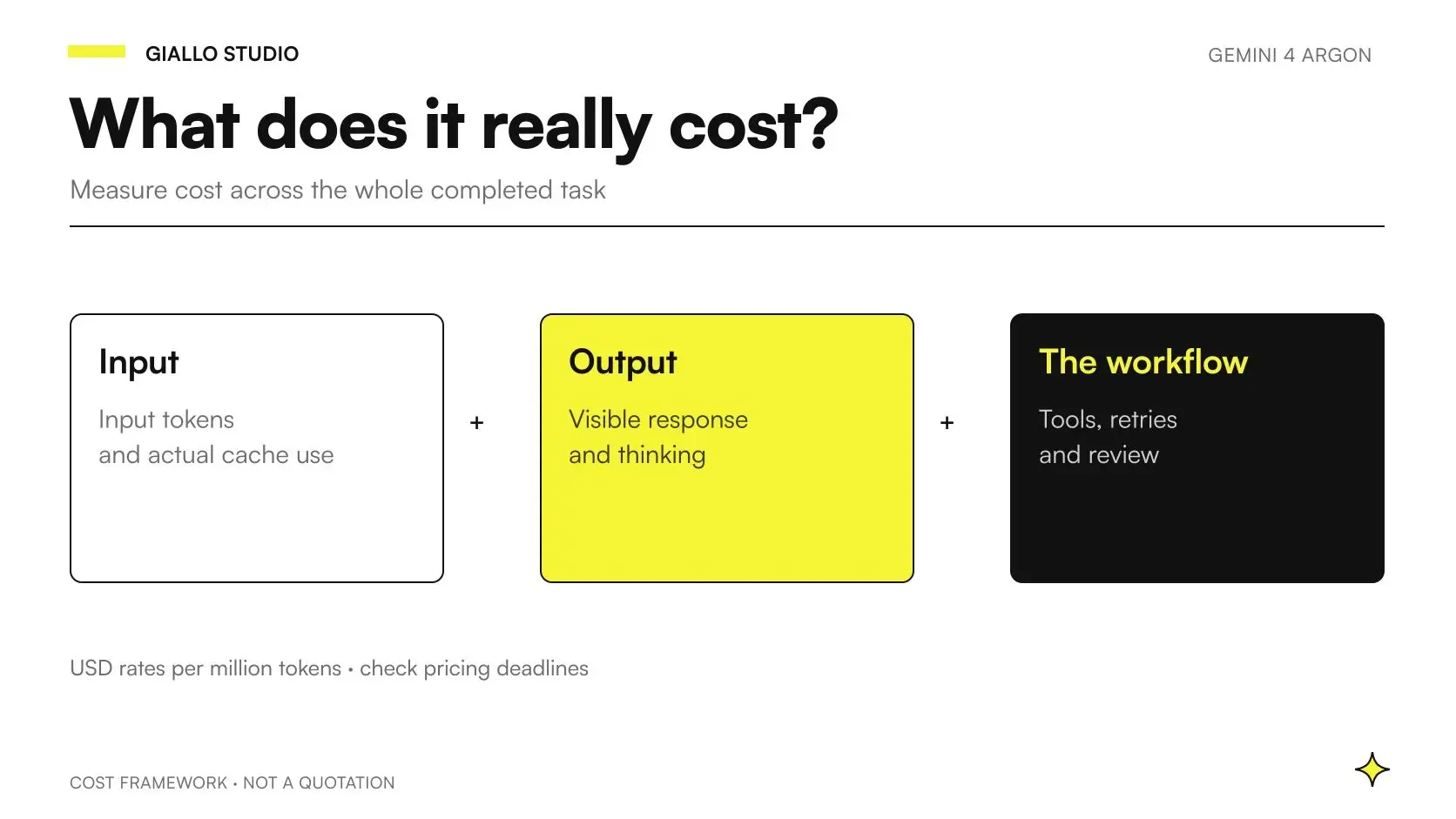
The cost to compare includes model requests, tools, additional attempts and review work. If a result is discarded and regenerated, the first attempt remains a cost. If a response requires lengthy checking, the API price alone does not describe the team’s effort.
In a purely hypothetical example, two configurations process one hundred cases. The first produces eighty accepted results with twelve euros of consumption; the second produces ninety with eighteen euros. The technical cost per accepted result is 0,15 and 0,20 euros respectively. These values are invented to illustrate the calculation, not Argon rates or measured results. Human review is still missing: including it could change the choice.
Actual rates must come from the channel used and the relevant version. The official Gemini API pricing page, consulted on 23 October 2026, is the developer channel’s reference; it does not replace other services’ price lists. The guide to Gemini 4 Argon costs provides a worksheet for organising items without confusing subscription and consumption.
How do you prepare a gradual rollout and a return to the previous system?
Before release, save a reproducible configuration of the current system. It includes the model, prompts, parameters, tools, result schema and version of the code interpreting them. Keeping only the model’s name is insufficient to reconstruct previous behaviour.
Testing can begin with historical cases, then continue with current requests processed in parallel without affecting operations. Only afterwards is some real work assigned to the new configuration, retaining controls suited to the process. This sequence is a design proposal, not an automatic feature guaranteed by Argon.
Open the release worksheet to complete before migration
- Scope: which requests will use the new configuration?
- Exclusions: which cases remain on the previously verified path?
- Responsible: who can suspend the rollout?
- Stop signals: which errors, costs or delays require a check?
- Rollback: how are new requests routed to the previous configuration?
- Work in progress: how are cases already started handled?
- Test: when was rollback verified, and with what outcome?
Compatibility of previously saved results must also be checked. If the new configuration changes field names or the meaning of statuses, routing traffic back to the old model may not be enough. The contract between generation and software must remain understandable, or require an explicit, verified conversion.
Which mistakes undermine the reliability of a migration decision?
The first is choosing examples after seeing where the new model performs best. The sample must represent the work and its risks. The second is extensively optimising only one configuration and comparing it with a neglected current system: the test would also measure the difference in preparation.
The third is ignoring rejected cases. A process that produces impressive results on easy cases but stalls on exceptions may require more intervention than before. The fourth is immediately extending tool permissions. Evaluating text quality and authorising action require separate decisions, especially in agents and automations with Argon.
Finally, do not postpone checking data processing. Changing the usage channel may also change the terms to examine. The guide to Argon privacy and security in business outlines the relevant questions before operational documents are used.
Which document should close the evaluation?
The useful outcome is a short decision with evidence attached: which process was evaluated, with which configurations, where the result improved and where it remains insufficient. Critical cases, observed costs and conditions for continuing must be included. “Adopt only for these requests” can be a more precise conclusion than a general yes.
If the evidence is insufficient, state which check is missing. If no concrete benefit emerges, retaining the current system is a valid decision. The protocol reduces uncertainty without turning a new product into an obligation to replace the existing one.
Giallo Studio guides: methodology and sources
How we apply it in the company
Related resources
 Gemini 4 Argon: what it is, what it does and when to use it in business
 Gemini 4 Argon API: integrating the model into business processes
 Gemini 4 Argon: API pricing and business cost calculations
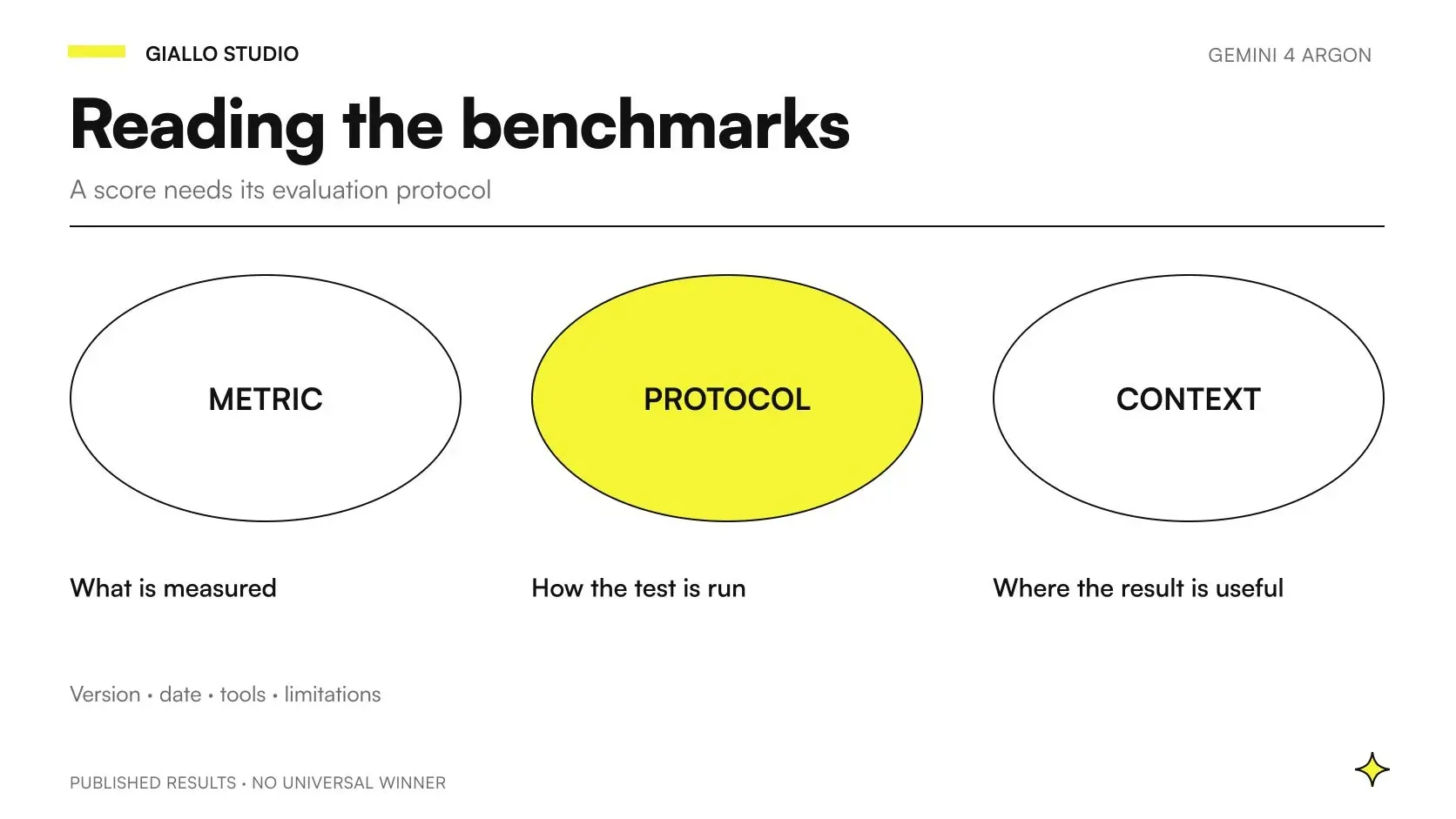 Gemini 4 Argon benchmarks: how to read the LLM comparison
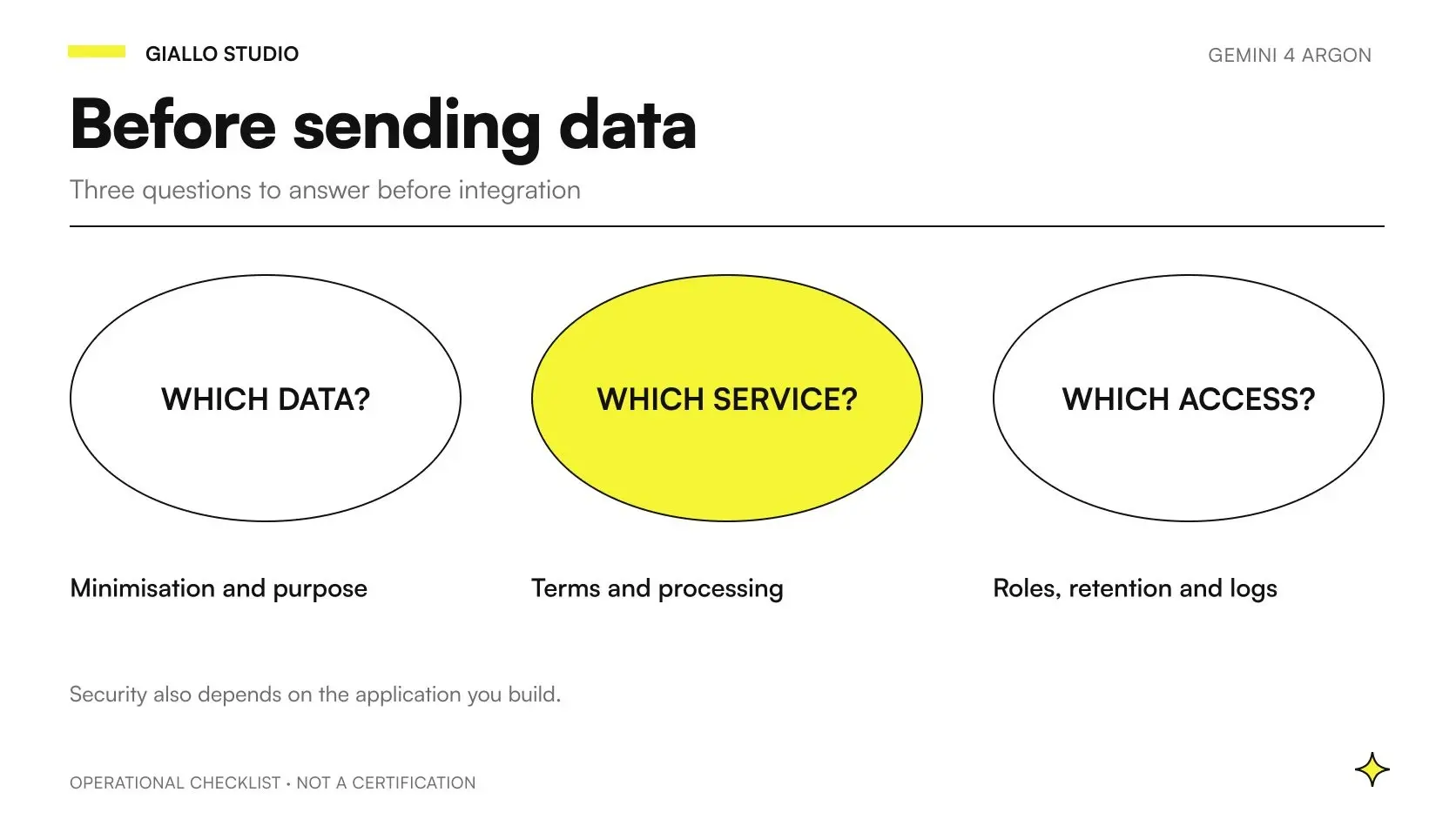 Gemini 4 Argon privacy and security: a business guide
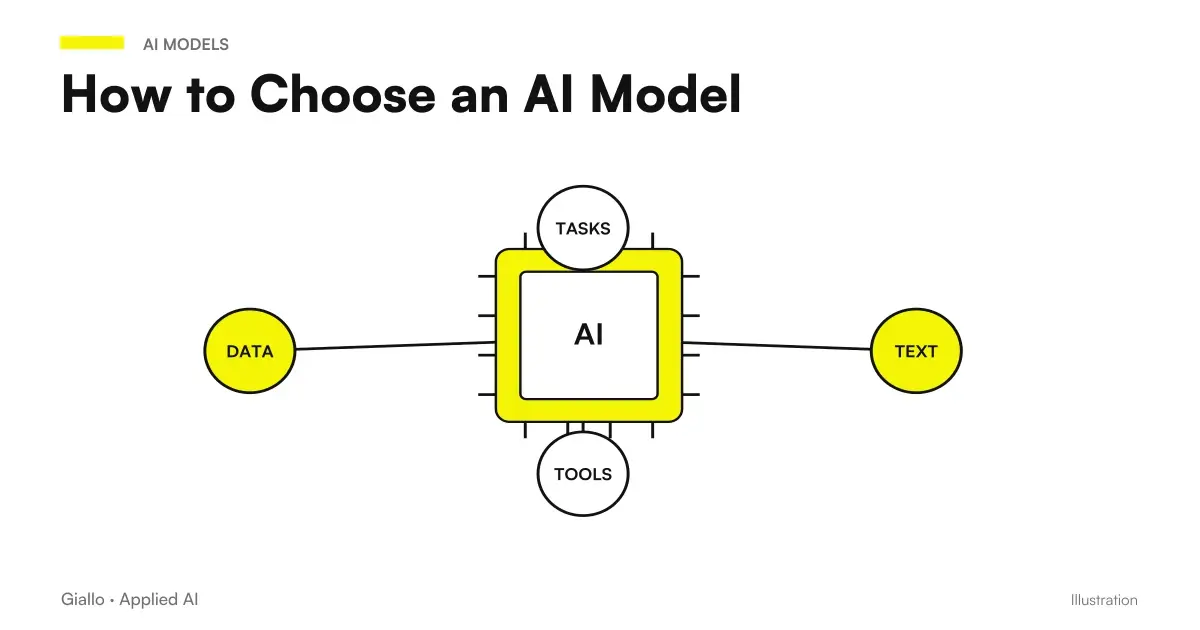 How to Choose an AI Model
 ChatGPT vs Gemini: which subscription is worthwhile in October 2026?
FAQ
Should you migrate to Gemini 4 Argon straight away?
Evaluate it on a specific process before replacing the model already in use. The decision depends on verified quality, critical errors, cost per accepted result and the chosen channel’s requirements.
Is changing the model name in the API call enough?
No. Even when the integration accepts the new identifier, parameters, tools, formats, error handling and behaviour on business cases must be checked. A technically valid response can still make the process worse.
Which cases should a migration test include?
Include ordinary cases, incomplete cases, contradictory documents and examples that caused errors in the past. Each case must have acceptance criteria defined before results are compared.
How do you compare costs between two models?
Compare the cost of the entire workflow needed to obtain an accepted result, including requests, tools, attempts and review. Price per token alone does not describe the process’s operational cost.
What does rollback mean in an AI migration?
It is the ability to route new requests back to the previous model and configuration. It must include prompts, parameters, tools and data compatibility, with a procedure verified before release.
Does this protocol prove that Argon improves results?
No. It is an evaluation protocol proposed by Giallo, with hypothetical examples. It produces evidence for deciding whether to adopt Argon in your own context and may also conclude with a decision to retain the current system.