
Gemini 4 Argon coding: how to assess it for software development
Gemini 4 Argon coding: benchmarks, tools and criteria for reliable patches. Plan a repository trial without promising secure code.
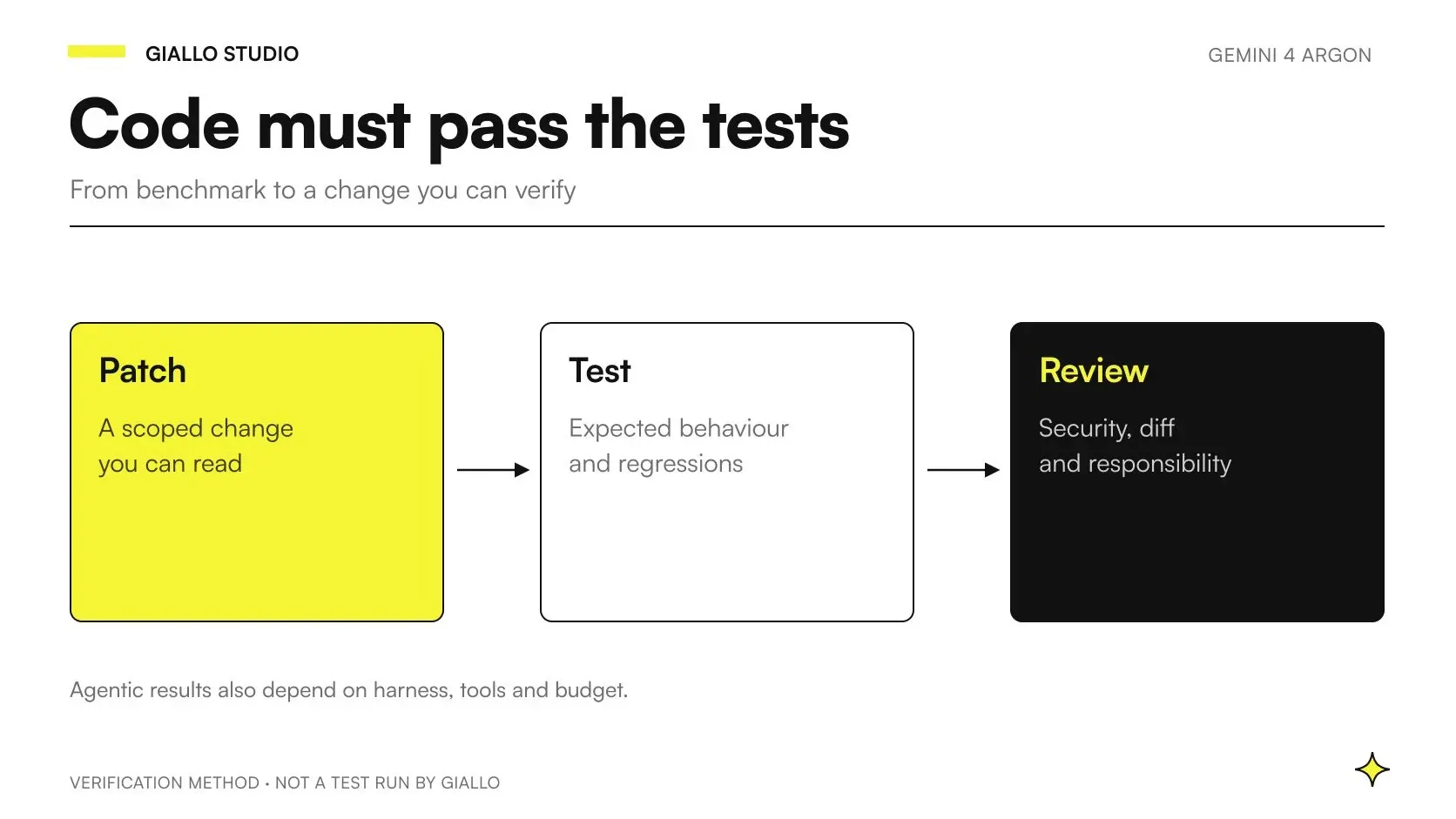
Gemini 4 Argon can be assessed as a component of a development assistant, but its benchmarks do not guarantee the quality of a patch for your software. The result also depends on tools, repository access, instructions and checks. To decide whether to introduce it, prepare reproducible tasks and request small, reviewable changes accompanied by evidence.
As of 23 October 2026, the Google model card shows strong results on some coding evaluations and lower results than competitors on others. We have not run an Argon trial on a customer repository: the examples below are hypothetical and the test plan is a proposal, not a report of observed performance.
The guide to Gemini 4 Argon introduces the model in general. Here we focus on a more useful requirement for developers: turning a request into a reviewable patch, without confusing a plausible response with a verified fix.
In summary
- Argon leads DeepSWE 1.1 in Google's compilation but loses on FrontierSWE v2.
- The model and the agent that explores files, runs commands and applies patches are different components.
- A useful trial starts with reproducible bugs, explicit requirements and relevant tests.
- Permissions, secrets and external consequences must be controlled by the system executing the tools.
- Measure regressions, diff size and review effort as well as tasks solved.
What do coding benchmarks actually tell us?
Google's October compilation compares Gemini 4 Argon, GPT-6 Astra, Claude Fable 5.1 and Claude Opus 5.5. Argon leads on DeepSWE 1.1; on FrontierSWE v2 it trails the other three. The values come from the model card and should be read alongside the methodology, rather than treated as an independent Giallo test.
| Model | DeepSWE 1.1, pass@1 success | FrontierSWE v2, task success |
|---|---|---|
| Gemini 4 Argon | 77,9% | 55,0% |
| GPT-6 Astra | 74,1% | 65,5% |
| Claude Fable 5.1 | 67,4% | 56,3% |
| Claude Opus 5.5 | 74,2% | 62,3% |
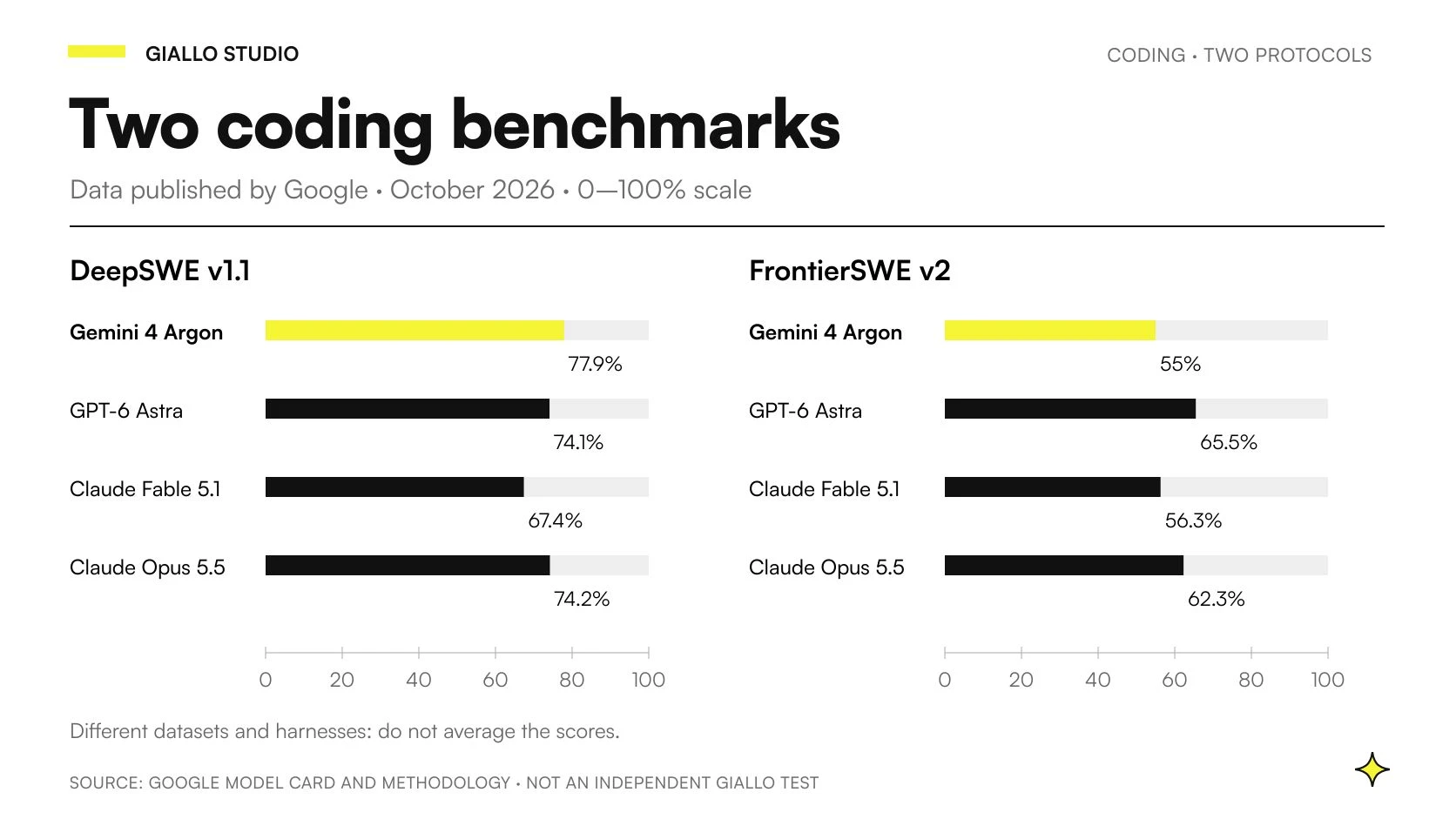
Google calculates Argon's DeepSWE result with mini-swe, while Astra and Claude data comes from the respective public sources cited. The reported reasoning settings are the high settings used in the comparison. For FrontierSWE, the methodology points to the Proximal leaderboard. Different sources and environments limit what we can attribute to the model alone.
The practical conclusion is to select candidates, not proclaim a winner. If your team's repository has different constraints from the benchmark tasks, results may change. In our critical reading of Argon benchmarks we also separate synthetic scores from measures of business productivity.
What is the difference between model, agent and editor?
The model produces text or structured requests. An agent organizes the work cycle: it reads the problem, decides which files to examine, requests tools and uses the results to continue. The editor provides the interface through which the team observes or approves the work. The same model can therefore behave differently within different systems.
The Argon API specification lists support for function calling, code execution and structured outputs. This does not mean a generic call can autonomously access the repository, use the team's credentials or publish a release. Those connections require an integration and precise permissions.
With the official function calling, the application validates and executes the proposed function. The system can therefore provide file reading and tests in a dedicated environment without granting production access. Document those tools before comparing results: otherwise you risk attributing an environment-driven difference to the model.
Which tasks suit the first experiment?
Choose bounded tasks with a verifiable result and a limited scope. A reproducible regression is a good candidate; «improve the architecture» leaves too much room for incomparable interpretations. The task must specify observed behavior, expected behavior and constraints that must not be violated.
Also prepare cases where the correct response is to ask for clarification. If a business rule is missing, the system should not invent it to complete the implementation. This ability matters particularly in business software, where a feature can work technically while applying the wrong policy.
| Proposed task | Evidence to obtain | Reason to reject the patch |
|---|---|---|
| Fix a filter that excludes permitted results | Reproduction of the defect and a test of the correct behavior | Changing access rules to make the data appear |
| Handle an import error | Useful message and retention of previous data | Data discarded without notification |
| Adapt an API call | Valid request and documented error handling | Assumptions about unverified parameters or versions |
| Improve a slow query | Equivalent results and measurement in the test environment | Changing the returned content |
| Prepare a security review | Code reference and a case demonstrating the issue | Generic alarm without a verifiable path |
This table is a proposed plan. It does not state that Argon has solved these tasks. The comparison with ChatGPT and Claude helps select candidates without confusing products and versions.
How do you prepare the repository without granting unnecessary access?
Use a test environment with the code needed for the task, synthetic data and instructions on available commands. Identify files containing secrets or confidential information and prevent access where it is unnecessary. A sentence asking the model to ignore them does not replace a technical boundary.
If the task needs access to an external service, consider a simulation or test account with limited permissions. The initial sample should be able to produce a patch without sending emails, changing real records or triggering payments. Production credentials are not a normal requirement for reproducing a local logic error.
Also make repository rules explicit: stack, verification commands, conventions and system areas the task may involve. A vague request forces the model to fill gaps with assumptions. The Argon privacy and security guide describes how to distinguish content, accounts and copies along this path.
What changes in API integration with Argon?
The official migration guide, read on 23 October, specifies thinking medium as the default and notes that temperature, top_p and top_k are ignored. If a previous integration depends on those parameters, changing the model name is not enough to assume equivalent behavior.
The same guide recommends client timeouts of at least 15 minutes for difficult prompts and distinguishes long requests from the normal synchronous approach. The Argon model page sets the unified input-plus-output limit at 1,048,576 tokens. It is a shared budget, not space to fill indiscriminately with the entire repository.
| API aspect | Official guidance as of 23 October 2026 | Implication for the trial |
|---|---|---|
| Model | Stable identifier gemini-4-argon in the API model page |
Record the identifier actually called |
| Thinking | Default medium in the Migration Guide | State the comparison setting |
| Sampling | Temperature, top_p and top_k ignored in the same guide | Remove assumptions inherited from the old model |
| Timeout for difficult prompts | At least 15 minutes recommended in the guide | Handle waiting, interruption and job status |
| Total context | 1.048.576 input-plus-output tokens in the tab | Reserve room for the result and continuations |
| Cache | Implicit, with an input threshold of 4.096 tokens in the caching documentation | Check actual hits; avoid unsupported explicit caching |
Thinking is included in billed output according to the API Price list. Therefore record actual usage and discarded attempts. The Argon pricing and costs guide explains the difference between token cost and cost per accepted result.
What evidence should you request alongside the patch?
The handover should let a colleague understand the problem without reconstructing the entire conversation. Request a description of the defect, a cause explanation supported by code, the diff and the outcomes of checks performed. Any missing checks must be visible: a phrase such as «it should work» does not document a test.
Review the size of the change. If a bug calls for a local change but the patch reorganizes unrelated modules, verification effort increases. There may be a valid reason, but it must be explained and assessed before accepting that cost. A simple diff is an observable quality, not a limit on the model's ability.
Open the proposed checks for accepting a patch
- The incorrect behavior is reproducible and the expected requirement is explicit.
- The change covers the scope necessary for the task.
- Relevant tests distinguish the original defect from the correct behavior.
- Applicable typecheck, lint and build outcomes are documented.
- Permissions, sensitive data and dependencies have been reexamined where involved.
- The diff has been read and unperformed checks are declared.
- The proposal remains separate from authorization to release to production.
A useful test checks the requirement, not just the shape of the new implementation. If the model changes both code and test expectations to make results match, a green result loses value. Retain the original acceptance criteria and request evidence that also covers relevant edge cases.
How would a business software company test Argon?
Hypothetical scenario: a team maintains software for orders and availability. The proposed bug concerns a filter that hides rows when an optional field is missing. The sample is synthetic and does not represent a Giallo customer. The requirement establishes which rows must remain visible and leaves operator permissions unchanged.
The trial compares the ability to find and fix the cause with a small diff. Include a case with the field present, one with the field missing and one with an unauthorized user. Reject the patch if it displays every record by bypassing access control, even when the visible defect appears to have disappeared.
The reviewer records the time required, clarifications requested and checks to add. If Argon fixes the bug but changes unrelated components, that result needs a different assessment from a local fix. The metric is not just «green tests»: what matters is how much work remains for the team to trust the proposal.
How would the test change for custom e-commerce software?
Hypothetical scenario: a small team fixes a product catalog import. Some rows have incomplete data, and the current procedure stops everything without a useful explanation. The proposed trial uses an invented catalog, no store credentials and a test database.
Before calling the model, the owner decides whether valid rows should be imported or the entire operation should remain suspended. This is a business process decision, not a detail the assistant may invent. If the decision is missing, asking for clarification is the correct result.
Once the rule is defined, the test checks retained data, messages and the ability to repeat the import without duplication. A patch that fixes the message but creates duplicate products fails the requirement. This scenario shows why small but complete tasks teach more than a generic request such as «make the importer robust».
How do you assess security and vulnerabilities without false guarantees?
A model can help identify paths to check, but a report must show the code involved, conditions and consequence. Request an example that distinguishes the vulnerable case from expected behavior. Patches touching authentication, payments or personal data need a specific review of the risk introduced.
In Google's compilation, CWE-bench v1 reports pass@1 of 68% for Argon and Astra, 58% for Fable and 67% for Opus. The methodology attributes the results to the benchmark leaderboard and specifies pass@4 for ties in the full ranking. These measures do not certify a real application's security.
| CWE-bench v1 in Google's compilation | Vulnerability remediation pass@1 |
|---|---|
| Gemini 4 Argon | 68% |
| GPT-6 Astra | 68% |
| Claude Fable 5.1 | 58% |
| Claude Opus 5.5 | 67% |
Do not use model analysis as the only check on dependencies or permissions. A suggested library must be verified against the documentation and project context; a new dependency brings maintenance and additional surface area even when the example code looks convenient.
Which mistakes should you avoid when adopting a coding agent?
The first is requesting broad changes before reproducing the defect. The second is granting production access for convenience. The third is accepting green tests after the requirement has been implicitly changed. The fourth is assessing only the first successful response while hiding timeouts and failed attempts.
Another mistake is changing the model, tools and task structure together: it becomes difficult to understand what improved the result. Maintain a documented comparison and change one element at a time when you want to learn from the experiment. The Argon adoption and migration process should leave a route back to the previous configuration.
If the system is slower or needs more corrections than the team can sustain, keep that result visible. A detailed response does not compensate for a patch that cannot be verified. Benchmarks help identify promising candidates; maintaining your software requires trials in your own environment.
What result should you seek before extending use?
The first goal is a series of patches with clear requirements, repeatable evidence and sustainable review. From there, you can decide which tasks to assign to assistance and which to keep entirely with the team. The model can become useful without taking responsibility for a release or receiving broad access.
If you want to turn a recurring bug or fragile procedure into a concrete trial, the custom software development service from Giallo can start from the repository and acceptance criteria, verifying where Argon actually reduces work and where different tools or checks are needed.
Giallo Studio guides: methodology and sources
How we apply it in the company
Related resources
 Gemini 4 Argon benchmarks: how to read the LLM comparison
 Gemini 4 Argon vs ChatGPT and Claude: which should you choose?
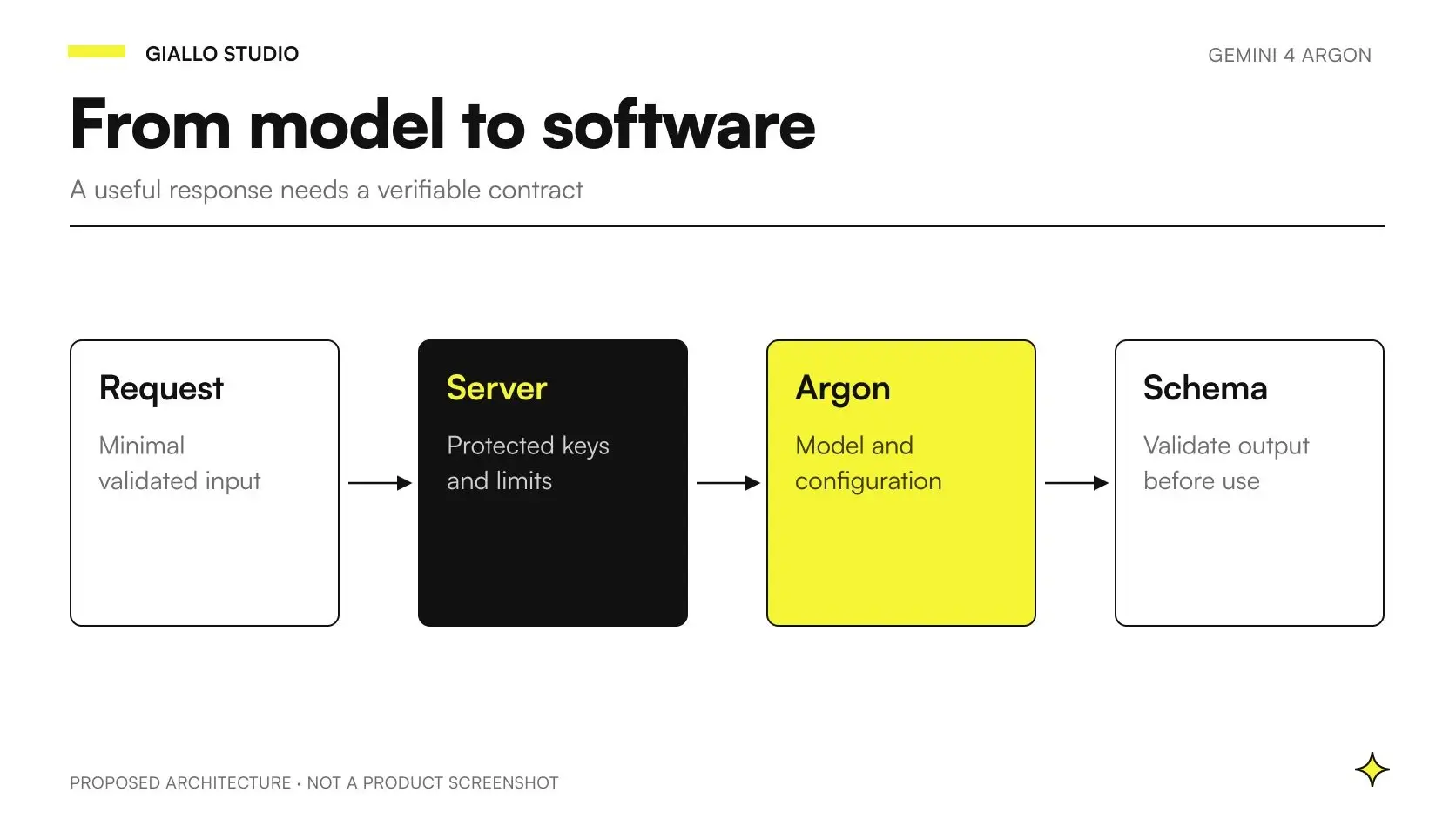 Gemini 4 Argon API: integrating the model into business processes
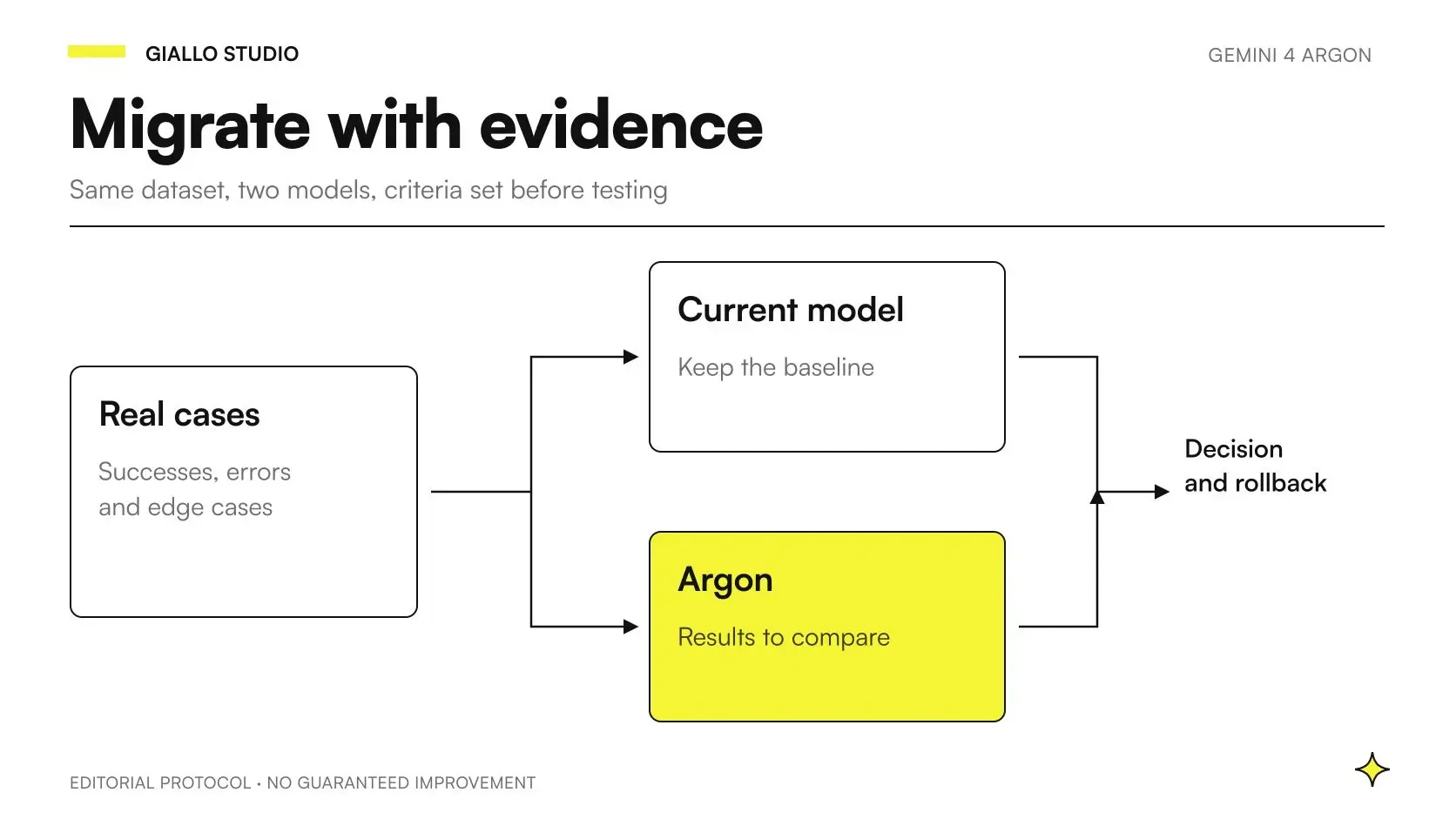 Migrating to Gemini 4 Argon: evaluation, testing and rollback
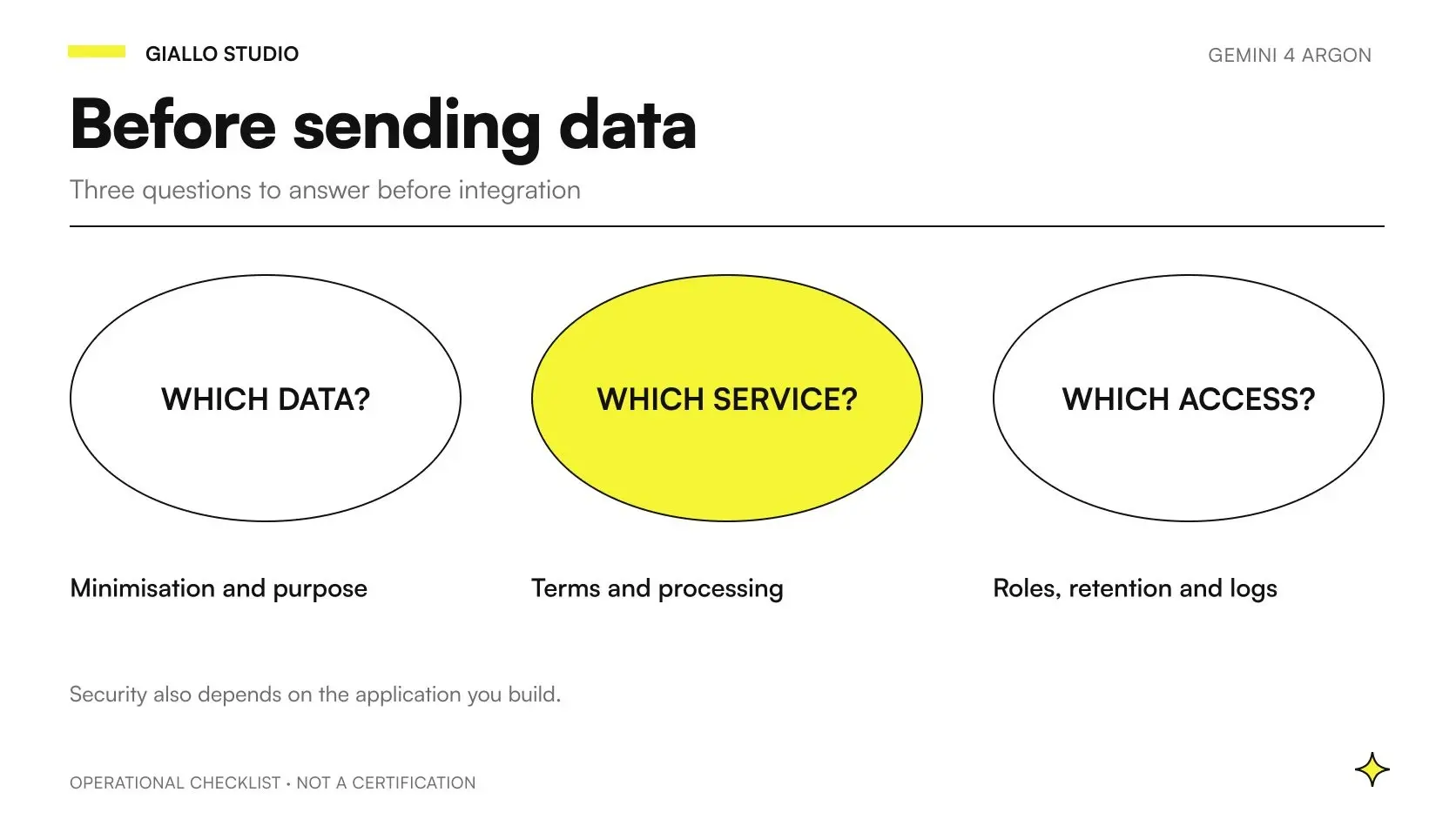 Gemini 4 Argon privacy and security: a business guide
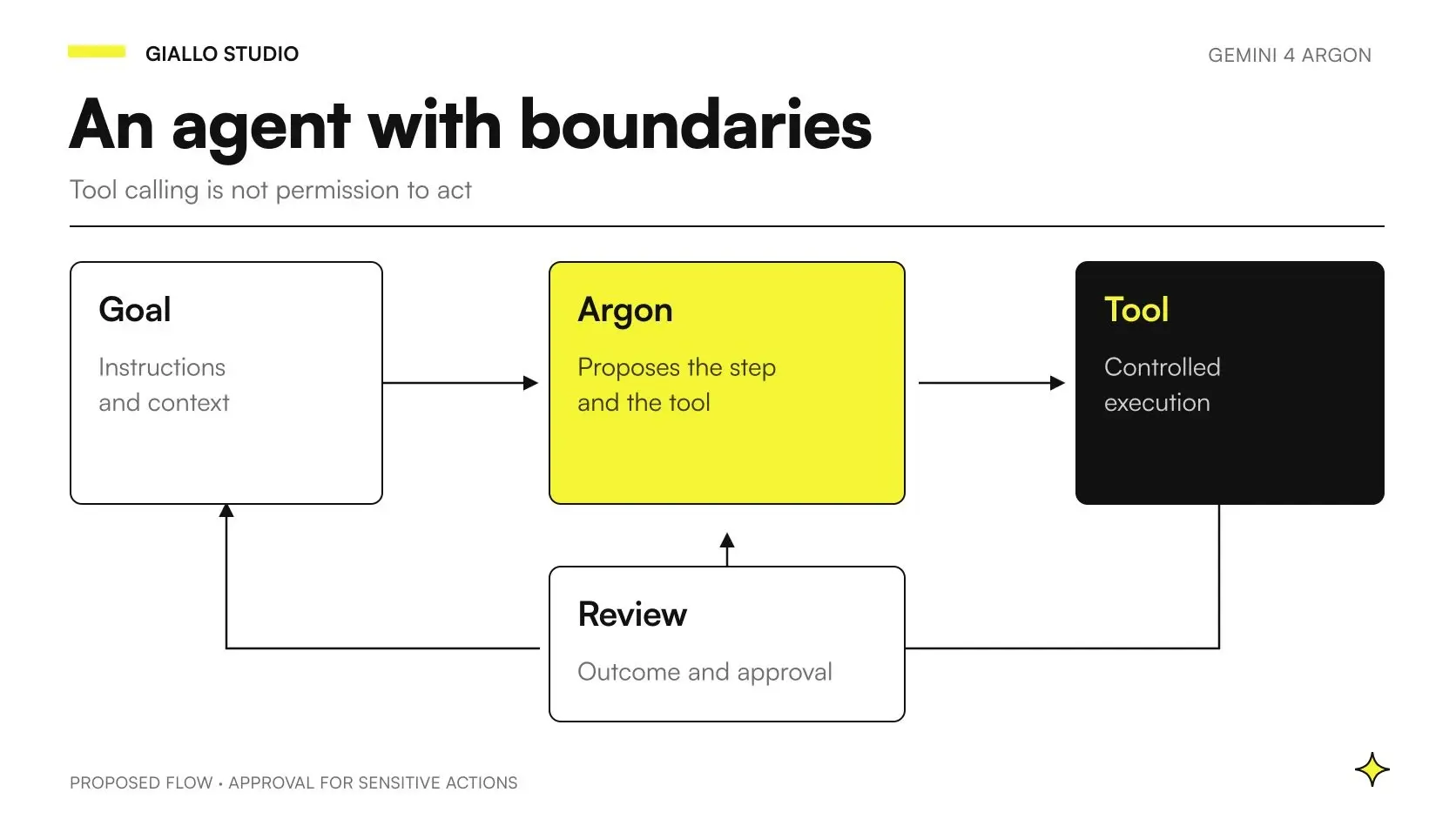 Gemini 4 Argon for AI agents and automation: tools and approvals
FAQ
Is Gemini 4 Argon the best model for programming?
The published data does not demonstrate a universal winner. In Google's October 2026 compilation, Argon leads DeepSWE 1.1 but trails GPT-6 Astra, Claude Fable 5.1 and Claude Opus 5.5 on FrontierSWE v2. You need a trial on the team's tasks and environment.
Does a DeepSWE score describe an ordinary coding chat?
No. The result concerns a system with a specific protocol, tools and settings. For Argon, Google specifies the mini-swe harness and high reasoning. A chat without file access or test execution does not reproduce that system.
Does Argon execute my business software's functions on its own?
With function calling, it proposes the function name and arguments. The application validates them, authorizes the action and executes the code. Access to the repository or business software must be designed separately.
Which parameters change when switching to Argon?
The official guide specifies thinking medium as the default and notes that temperature, top_p and top_k are ignored. Argon supports implicit caching, not explicit caching. Check the version's documentation before adapting an existing integration.
Is a patch that passes tests ready for production?
Available tests verify only the behaviors they cover. You must also reread the diff and check requirements, permissions, dependencies and operational impact. A green result does not certify the absence of vulnerabilities or regressions.
Has Giallo tested Argon on a customer repository?
This article does not report an authenticated test or a customer trial. It analyzes published documentation and benchmarks, accessed on 23 October 2026, and proposes an assessment plan with sanitized tasks and acceptance criteria.