
Mistral vs Llama: comparison between the two open weight models
Mistral vs Llama: usage licences, self-hosting, Italian and when each makes sense. A practical SME guide with no single winner.
Reading time: 11 min
Mistral vs Llama is the comparison between two of the AI model families open weights most used: Mistral, developed by the French company Mistral AI, and Llama, developed by Meta. Both allow you to unload model weights and run it on your own infrastructure, but they differ on a crucial point for those who work: the License of Use. Some Mistral models come out with Apache 2.0 license (free commercial use); Llama uses a proprietary license with restrictions and a threshold of users.
The most common misunderstanding should be clarified immediately: "open weights" does not mean "pure open source". Being able to download the parameters of a model is one thing; having an OSI approved license that guarantees you full freedom of use, modification and redistribution is another. Mistral comes closer to classic open source on some models; Llama remains an open release but under the terms defined by Meta. That's why, before we build anything commercial on it, the first action is always to read the official license of the specific model.
In this guide we compare Mistral and Llama on what really matters for an SME or a professional: licensing, self-hosting, Italian language, real costs and — above all — when agrees with one and when the other, without decreeing an absolute winner.
In summary
- Sia Mistral both Llama are models open weights: you can download and run them on your servers, but with different usage rules.
- "Open weights" is not "pure open source": some Mistral models use the Apache 2.0 license (recognized OSI), Llama uses a proprietary license with restrictions.
- Mistral is European (French): attention to EU languages and, on part of the models, free commercial use. Llama (Meta) has a huge ecosystem and many compatible tools.
- The common advantage is the self-hosting: the data remains in your perimeter, useful for privacy and GDPR. But it needs hardware (GPU) and expertise.
- There is no absolute winner: the choice depends on the required license, data, language and how you use the model (self-hosting vs managed provider).
- Golden rule: verify the official license of the exact pattern before any commercial use.
What are Mistral and Llama, in short
Before comparing them you need to know what they are. Both are Language Models (LLM): software trained to predict and generate text. The difference from a model like ChatGPT is not only quality, but the distribution model: Mistral and Llama release weights (the parameters learned during training), so anyone with hardware and skills can run them themselves.
- Mistral is the family of models of the French company Mistral AI, founded in 2023. Publishes both "open" models with permissive license (some with Apache 2.0), as well as more powerful models with commercial licenses or API access. Dedicated deepening: Mistral AI: what is it.
- Llama is the family of models of Meta (Facebook and Instagram company). The weights are downloadable and the ecosystem of compatible tools is very large, but the use is regulated by a proprietary license with specific conditions. Dedicated in-depth: Llama AI: what is it.
Both fall into the broader category of Open Source AI Models — category in which the word "open" must always be verified on a case-by-case basis, as we see now.
"Open weights" is not "pure open source": because it matters
This is the point that separates a conscious choice from an expensive mistake. There are three different levels, often confused with each other.
| Level | What You Can Do | Example |
|---|---|---|
| Pure Open Source (OSI) | Use, modify, redistribute without restriction, even commercially | Mistral models released with Apache License 2.0 |
| Open weights (open weights) | Download and run weights, but under the constraints of a specific license | Llama, under the Meta license with user threshold and conditions of use |
| API only (closed) | Use the model only via supplier service, no weights | Own models accessible only via cloud |
The practical consequence: a "downloadable" model is not automatically free for any commercial use. The Apache 2.0 license (used on part of Mistral models) is a real open source license: it gives you wide freedom. The Llama license, on the other hand, is an open release but owner: allows many uses, but with clauses — for example a threshold of monthly users beyond which a separate agreement with Meta is needed, and some conditions of use. Neither thing is "better" at all: it depends on what you have to do with it.
Mistral vs Llama: the comparison on the criteria that matter
Here is the direct comparison on the factors that really weigh in a business project. Keep in mind that versions and details evolve: the criteria remain, the punctual numbers must be verified.
| Criterion | Mistral | Llama (Meta) |
|---|---|---|
| Who Develops It | Mistral AI (France, EU) | Meta (USA) |
| Release Type | Open weights on part of models; others only via API | Open weights downloadable |
| Licence | Apache 2.0 on some models (open source); others with commercial license | Meta proprietary license with conditions and user threshold |
| Commercial use | Free on Apache 2.0 models; check others | Allowed within the Meta license terms |
| Self-hosting | Yes, on open weight models | Yes |
| Italian language | Good attention to EU languages; test version | Good on recent models; test version |
| Ecosystem/tools | Growing, strong in EU | Very broad and widespread |
| Data residence (EU/GDPR) | EU vendor: advantage if you use managed services | Self-hosting in EU possible; US provider to be evaluated with SCC |
Read like this, the table says one precise thing: There is no "better", there is a "best for your main constraint". If the constraint is freedom of license, Mistral with Apache 2.0 has a margin. If the constraint is the breadth of the ecosystem and the availability of ready-made tools, Llama is very convenient. If the constraint is the Data privacy, counts more the how run it (self-hosting vs API) than the model itself.
Commercial Use Licenses: Where to Be Careful
The concrete question is not "is it open?", but "Can I build my product on it and sell it?".
- With a model Mistral under Apache 2.0, the answer tends to full yes: you can use it, modify it and integrate it into a commercial service respecting the (simple) terms of the license.
- With Llama, you can use it commercially, but within the conditions of Meta: in particular the clause related to threshold of users (beyond a certain number a separate agreement is needed) and some restrictions of use. For most SMEs that threshold is not a problem, but it needs to be verified.
In both cases the same sentence applies: verify the official license of the specific model, because it changes between releases.
When to choose Mistral and when Llama
Better Mistral when
- Do you want a model with Apache License 2.0, free for commercial use without special clauses.
- You weigh the given residence and prefer a European supplier for managed services.
- You work a lot in Italian and EU languages and you want a vendor that paid attention to us.
- You want efficient models, even small ones, to be run with contained resources.
Better Llama when
- You need the wider ecosystem: many tools, tutorials and integrations ready.
- You want a very community-tested open-weight model.
- The threshold of users of the Meta license does not concern you (SMEs with internal use).
- Points on a range of different sizes to balance hardware quality and cost.
The Honest Truth: In Many Cases SMEs both work. The difference makes it the priority constraint (license, language, ecosystem, privacy), not an abstract score of "quality". If you have doubts about how to weigh these criteria, the guide how to choose an AI model proposes a step-by-step method.
Self-hosting: the real reason to choose an open weight model
The common advantage of Mistral and Llama over API-only models is the self-hosting: you can run the model on the yours infrastructure, so the data doesn't come out of your perimeter. It is the main reason why a company with sensitive data looks at these models instead of a cloud service. For the full picture, see Local AI models: when they agree.
What it really takes to self-host a model (open)
Self-hosting is not free: "downloadable" does not mean "at no cost". You need at least these items.
- Hardware: GPUs that fit the size of the model. Large models require expensive cards; small ones run even on more contained hardware.
- Skills: someone who knows how to install, update, secure, and monitor the system.
- Maintenance: security patches, backup, load peak management.
- Compliance: the privacy advantage is real only if the infrastructure is configured well (access, log, encryption).
For many SMEs the middle way is a EU managed provider which houses the open weight model: less control, but no hardware to buy and no teams to form.
The operational choice, therefore, is often a triangle:
- Full self-hosting. Maximum control and privacy, maximum cost and responsibility. It makes sense with very sensitive data and high volumes.
- Managed provider (preferably EU). Run Mistral or Llama through a cloud service that hosts them. Good compromise between control and simplicity.
- Official supplier API. The simplest; assess where the data and training terms end.
Practical examples
Two realistic scenarios of Italian SMEs, to make the choice between Mistral and Llama concrete.
1. Professional study — assistant on internal documents, confidential data. A studio wants an assistant who answers questions about their documents (contracts, practices) without those texts leaving the company. Here the constraint is the privacy: the choice falls on an open weight model self-hosted or on EU provider. Between Mistral and Llama, if you need maximum freedom of license to integrate it into your own tool, a Mistral model with Apache 2.0 simplifies the legal aspects. The model often combines with a type system RAG to search the documents.
2. E-commerce — generation product descriptions on large volume. An online store must generate thousands of descriptions. The constraint is the cost per volume and the availability of ready-made tools. Llama, with its wide ecosystem and the many sizes available, allows you to choose a "good enough" and cheap model to run. Alternatively, a small and efficient Mistral model does the same work with contained resources. The final choice is made testing both on the same sample of products.
In both cases the method is the same: start from the priority constraint, try the two models on your real data, then decide with the numbers in front.
Mistakes to Avoid
- Confusing "open weights" with "free and unconstrained". You can download the weights, but the license decides what you can do with them. On Llama there is a threshold of users; on some Mistrals no. Read the text, not the title of the communiqué.
- Choosing the model before the problem. "We use Llama because everyone uses it" is not a strategy. First the use case and the constraint (privacy? license? cost?), then the model.
- Underestimating the cost of self-hosting. The model is downloadable, but GPUs, skills and maintenance cost. Sometimes an EU managed provider pays more.
- To take Italian for granted. Both handle Italian, but with differences between versions. Don't trust a generic benchmark: test on your text.
- Ignoring the GDPR on US providers. An open-weight model may be in the EU, but if you use it via a U.S. provider it values SCC and residence data. Local AI Models.
How to apply it in the company
Choosing between Mistral and Llama is not a "feel-good" decision: it is a short and verifiable path.
- Define the Priority constraint: data privacy, freedom of license, cost per volume or language.
- Verify the Official License of the exact model you want to use (not of the "family" in general).
- Decide on the how: self-hosting, EU managed provider or API. Often this counts more than the model name.
- Make a A/B testing on a real sample of your data (same prompts, same task) and compare the results.
- Measure cost, quality and timing before extending: no decisions without a "before" and a "after".
This work tradurretranslating a business constraint (privacy, budget, compliance) into the right technical choice and an integration that works —is exactly what a good AI Consulting. If you want to see prototypes and concrete experiments on open weight models, take a look at the The Lab.
Conclusion
In comparison Mistral vs Llama there is no absolute winner: there are two excellent model families open weights with different philosophies. Mistral, European, shines when you need a really free license (Apache 2.0 on part of the models) and an EU provider attentive to privacy and languages. Llama, by Meta, wins over the breadth of the ecosystem and the amount of ready tools, as long as you accept the terms of its proprietary license. Remember the principle that unites them: "open weights" not is "pure open source", so the first move is always verify the official license of the exact model. To orient yourself, deepen with how to choose an AI model and with an overview of the Open Source AI Models.
If you want to go from testing with ChatGPT to an AI system integrated into business processes, Giallo Studio design custom-made agents and automations — choosing with you the right open weight model and the best way to perform it.
Giallo Studio guides: methodology and sources
How we apply it in the company
Related resources
 Mistral AI: What It Is and Why It Matters
 Llama AI: what is the open source model of Meta
 Open Source AI Models: Complete Guide
 Local AI models: when they make sense
 How to Choose an AI Model
 Invoice automation with AI: what can be automated?
 Best AI for Translations: Tools and Comparison
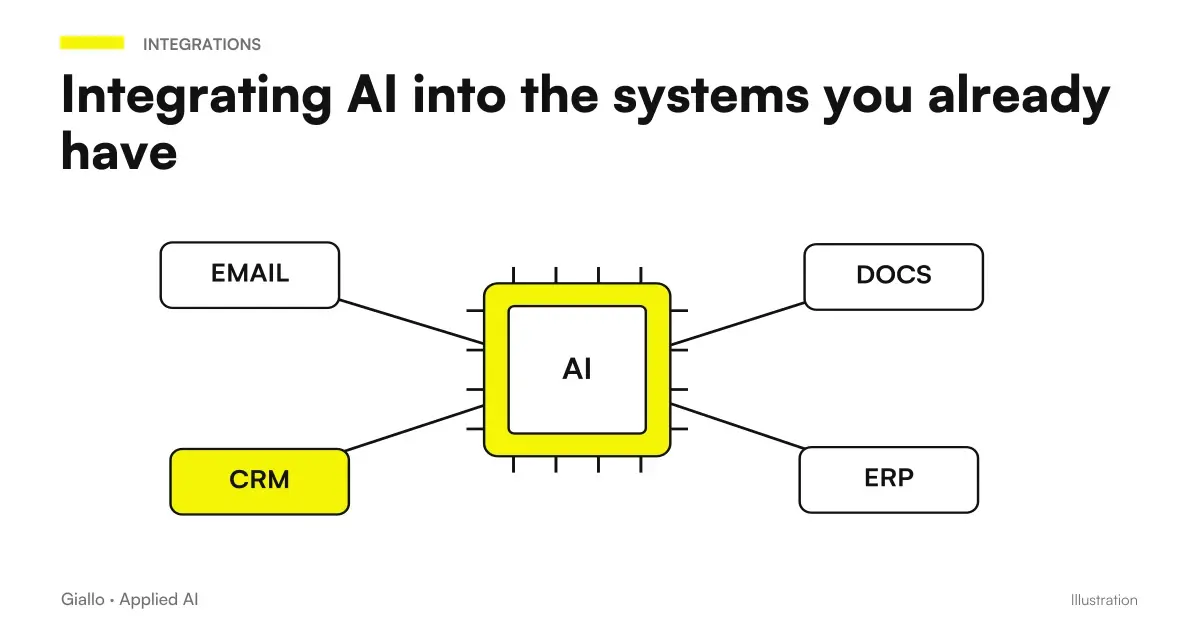 Integrating AI into the systems you already have
Other direct comparisons
The same criteria applied to other model pairs.
- Copilot Chat and Microsoft 365 Copilot: What Changes
- Claude Opus 5 vs Fable 5.1
- Make vs Zapier vs n8n: which one to choose for your company
- Claude Opus 5 vs Gemini 3.1 Pro
- Kimi AI vs Claude: documents, code and costs
- Claude Opus 5 vs GPT-6 Astra
- Kimi AI vs ChatGPT: which to choose for work?
- Claude Opus 5 vs Sonnet 5
- Jev AI vs LLM: how to choose the right model
- Perplexity vs Google: response with sources or link list
- Claude Haiku 4.5 vs GPT-5.6 Luna
- Custom business PWA: when it makes sense over off-the-shelf software
FAQ
What is the main difference between Mistral and Llama?
Mistral is a family of models developed by the French company Mistral AI: some models are released under Apache 2.0 license (free commercial use), others with more restrictive licenses. Llama is the family of Meta: the weights are downloadable, but the license has conditions of use and a threshold of users beyond which a specific agreement with Meta is needed. Both are 'open weights', but with different rules of use: always verify the official license of the specific model.
Are Mistral and Llama open source?
Not in the full sense of the term. They are called 'open-weight' because you can download and use the model's parameters, but 'open weights' is not equivalent to 'fully open source' (OSI definition). Some Mistral models use Apache 2.0, a recognised open-source licence; Llama uses a proprietary licence with restrictions. Always check the licence text for serious commercial use.
Can I use Mistral and Llama on my servers (self-hosting)?
Yes, both families offer models with downloadable weights that you can run on your own infrastructure or in a private cloud, within the terms of their respective licences. This is the key advantage over API-only models: data stays within your environment. However, you need suitable hardware (GPUs) and expertise in management, security and updates.
Are Mistral or Llama better in Italian?
It depends on the model and the version. Mistral, being European, has paid attention to European languages, including Italian; even the most recent Llama models manage Italian well. There is no valid answer forever: the models are updated continuously, so it is better to test both of them on your real case before deciding.
Which offers better value for an Italian SME?
There is no absolute winner. If you need unrestricted commercial use, consider a Mistral model licensed under Apache 2.0. If you want a widely used ecosystem and many compatible tools, Llama is a solid choice, but you must accept its licence terms. In many cases, an SME does not self-host: it uses these models through managed providers, and cost, data residency and integrations then matter.
Are these free models?
Weights are downloadable at no license fee for many of these models, but 'free download' does not mean 'at no cost'. Running a model requires hardware, power, maintenance, or paying for a provider that hosts it for you. The real cost depends on how you use it: self-hosting, managed API or cloud service. Always check your license and official listing.