
Claude vs DeepSeek: Which to Choose
Claude vs DeepSeek: compare writing quality, context, costs and open weights. Practical criteria for business use, with privacy and GDPR considerations.
Reading time: 10 min
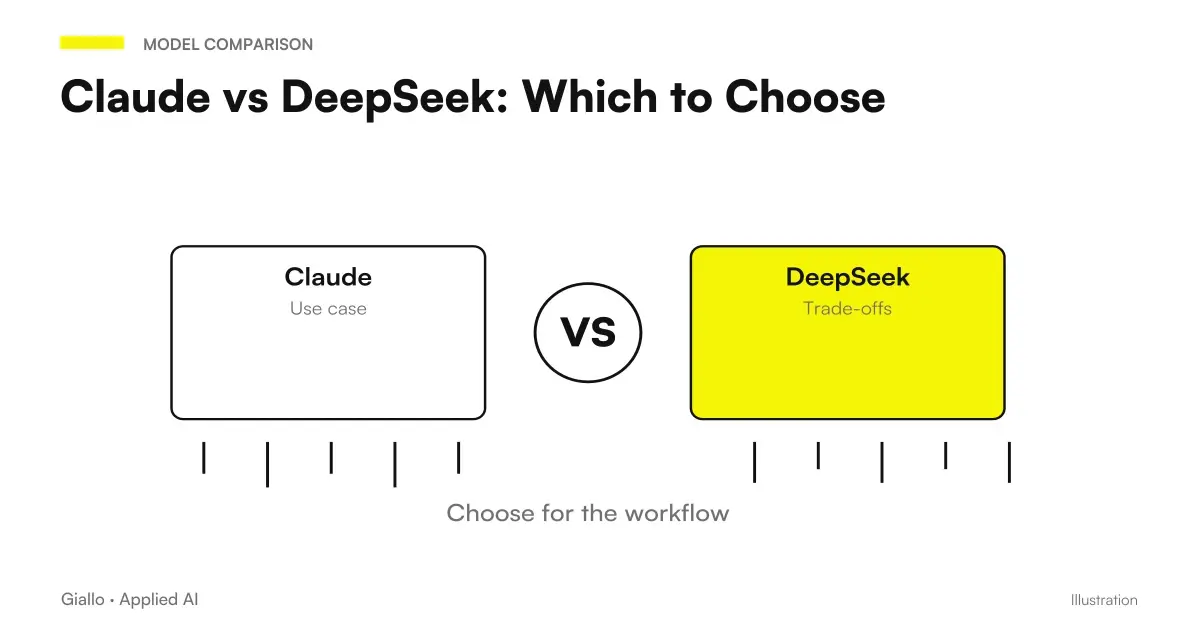
Claude and DeepSeek are two AI models that respond to two opposing priorities: Claude focuses on quality of writing, reasoning and broad context with data on Western infrastructure; DeepSeek focuses on very low cost and open weights downloadable, but it is a Chinese service with implications of privacy and residence of data. There is no absolute winner: the choice depends on what matters most to you, quality and guarantees or budget and infrastructure control.
In practice, if your yardstick is text care, consistency over long documents, and peace of mind about data processing, Claude is the natural choice. If instead the driver is the cost per token or the possibility of install the model on its own, DeepSeek becomes interesting, as long as you manage the data theme with method. In this guide we compare the two on the criteria that really matter for an SME or a professional: quality on the task, Italian, context, privacy/GDPR, integrations and cost.
A method premise: names, versions, and prices change quickly. The benchmark numbers you read today can be exceeded tomorrow. That's why we avoid absolute rankings here and tell you, where you need it, to always check the official page.
In summary
- Claude (Anthropic) is chosen for quality writing, accurate reasoning and very long document management, with data on Western infrastructure.
- DeepSeek is a Chinese model with among the lowest costs in the market and versions a Open Weights downloadable and installable on their own.
- On GDPR Attention: using DeepSeek's official app or API data can end up on servers in China, outside the European protection perimeter.
- Open weights does not mean pure open source: the license and conditions of use should be read on a case-by-case basis.
- No overall winner: Claude for quality and guarantees, DeepSeek for cost and infrastructure control. The choice is for use case.
Claude and DeepSeek: what they are in brief
Claude is the family of language models of Anthropic, an American company. It is a model Commercial and Closed: you use it via web chat, app or AI API, but you can't download and install it on your servers. It is appreciated for the quality of the writing, the accuracy in reasoning and the ability to work on very large, useful context windows with long documents. If you want a complete picture, start with the guide Claude AI: what it is and when to use it.
DeepSeek is a model developed by a Chinese company, which became known for two reasons: very low token costs and the release of some models to Open Weights, that is, downloadable and installable on their own. This brings them closer to the world of Open Source AI Models, although with the cautions we will see. For the full context there is the guide DeepSeek: what it is and why it's being talked about.
The underlying difference is here: Claude sells a high quality managed service; DeepSeek offers low cost and the ability to take the weights and do whatever you want. Two different philosophies, two different risk profiles.
Claude vs DeepSeek: the comparison on the criteria that matter
Comparing two models only makes sense on the criteria you would really use to decide. The table below summarizes the practical differences. Keep in mind that details about versions and prices change: use it as a compass, not as a list.
| Criterion | Claude | DeepSeek |
|---|---|---|
| Writing quality | Very high, nice and consistent tone, great for lyrics and content | Good, but usually requires more revision |
| Italian | Natural and reliable | Discreet; may slip towards casts or inaccuracies |
| Reasoning | Accurate, strong on analysis and synthesis | Competitive, with specialized variants in reasoning |
| Long Background | Strength: Manages long documents | Adequate, but generally inferior on very broad contexts |
| Cost per token | Premium band | Among the lowest in the market |
| Open Weights | No, closed model | Yes, some downloadable and self-hostable versions |
| Privacy / residence data | Western Infrastructure | Chinese service: data potentially on servers in China |
| Self-hosting | Not possible | Possible with open weights |
Read like this, the table tells a simple story: Claude wins on quality, context and data guarantees; DeepSeek wins on cost and freedom of installation. You almost never find a strong model on everything: choose according to the column that weighs the most in your case.
When to Choose Claude and When to DeepSeek
The most honest way to respond to "which is better" is to flip it into "better for what". Here are the two choice profiles.
Choose Claude when
- The quality of writing in Italian is the number one criterion.
- Work on long documents: contracts, reports, specifications, manuals.
- It treats data from European customers and you want to keep the privacy risk low.
- You prefer a reliable managed service without having to administer servers.
Choose DeepSeek when
- The cost per token is the main constraint and the volumes are high.
- You want to install the model on your own to control where the data ends.
- You have technical skills for self-hosting or a partner who has them.
- The task tolerates a human review on the output.
Note that the point on the data appears in both columns, but with the opposite sign: with Claude you rely on a managed Western infrastructure; with DeepSeek Tranquility comes only if you do self-hosting of open weights on your own servers. Using the Chinese cloud API with sensitive data is the choice to avoid.
Privacy and GDPR: the critical point of DeepSeek
This is the node that changes the decision for many Italian companies. The GDPR does not prohibit the use of a non-EU provider, but imposes precise guarantees on the transfer of data outside the European Economic Area. With a Chinese service these guarantees are more difficult to prove than with a Western provider.
Specifically, for an SME or professional it means asking yourself three questions before sending any data to DeepSeek:
- Does the data I submit contain personal or confidential customer information? If so, stop and rate.
- Am I using the official cloud or a self-hosted version of open weights? It changes everything.
- Do I have a policy and legal basis covering this processing? Check it out before, not after.
The clean way to use DeepSeek with sensitive data in Europe is the self-hosting: download the open weights and run them on your servers (also European), so the data does not leave your infrastructure. It requires technical expertise, but it solves the problem of data residency at its root. It is a topic worth addressing with a dedicated consultancy before putting real data into production.
With Claude the framework is easier to manage: the infrastructure is western and Anthropic offers conditions also designed for business use. However, it remains good practice not to send unnecessary personal data to any model, western or not.
Open weights doesn't mean open source: what to check
There is a widespread misunderstanding to clarify. To say that DeepSeek has Open Weights means you can download the model and run it on your own. But this does not equate to "pure open source" in the full sense of the term.
Why Distinction Matters (click to expand)
A truly open source model should make weights, code, training data and a permissive and transparent license available. With open weight models you often get the weights and a license of use, but not the entire dataset nor all the freedoms that the term "open source" evokes. The license may set limits on commercial, geographical, or liability use.
The practical consequence: Before you build a product or business process on it, read the specific license of the version you intend to use. Don't assume that "open" means "you can do anything with it."
By comparison, Claude is a closed model: do not download it and do not modify it, but in return you have a managed service and clear conditions of use. If self-hosting and total infrastructure control is a requirement for you, DeepSeek and others open source models are the direction; if you want quality and zero management, Claude is consistent with that goal.
Practical examples
Two realistic scenarios to understand how choice changes with context.
1. Professional study — analysis of confidential documents. A law firm or accountant must have contracts and acts that contain customers' personal data analyzed. Here the dominant criterion is confidentiality, not cost. The sensible choice is Claude for quality on the analysis of long documents and for Western infrastructure. Sending those same documents to DeepSeek's Chinese cloud would be reckless; at most, a self-hosted version on the studio's servers.
2. E-commerce — massive generation of product descriptions. A catalog of thousands of articles requires lots of short descriptions, on non-confidential content and with final human review. Here volumes and cost per token matter a lot. DeepSeek becomes interesting to cut costs, especially if self-hosted; the team reviews and publishes. If instead the text care is priority on the price, Claude remains more reliable on the first draft. In many real cases the answer is "both", on different tasks.
In both scenarios the rule is the same: First the data and the risk, then the model. The question "which data can come out of my company?" comes before "which AI is better?".
Mistakes to Avoid
- Choosing only on the price. The very low cost per token of DeepSeek is worth nothing if it then violates the GDPR with customer data. The apparent savings can be very expensive.
- Confusing open and open source weights. "Open" does not mean "without constraints": read the specific version license before building a product on it.
- Sending sensitive data to the Chinese cloud. Using the official DeepSeek API with European personal data without a privacy rating is the most risky mistake. Evaluate self-hosting.
- Trusting benchmarks as if they were eternal truths. Rankings change with each new version. Try the two models on your actual task instead of relying on an online read number.
- Looking for the "best model ever". It doesn't exist. There is the right model for that task, with that data, with that budget. Reason by use case.
How to apply it in the company
Translating "Claude or DeepSeek" into an operational decision is a short and repeatable path.
- Classify process data. What information comes in? Is there personal or confidential data? This decides half the choice before even looking at the models.
- Define the dominant criterion. Does it matter more the quality of the text, the long context, the cost or the control of the infrastructure? One only guides the choice.
- Map the criterion to the model. Quality and Sensitive Data → Claude. High-volume cost and self-hosting → DeepSeek. They often live together on different tasks.
- Test on the real task. Same input, output of the two models, evaluate you or the team. No theory: measure on your case.
- Put rules on data. Define in writing what can come out of the company and which service. Especially if you value DeepSeek in the cloud.
This is exactly the kind of work for which there is a AI Consulting: choose the right model for the use case, manage privacy risk and link it all to real processes, instead of adopting a tool for fashion. If you want to experiment with comparisons between models on concrete tasks, you will also find hints in the The Lab.
Conclusion
Between Claude and DeepSeek There is no absolute winner, there are two different priorities. Claude is the choice when they count qualities of writing, reasoning, broad context and data guarantees with Western infrastructure. DeepSeek is the choice when counting the cost per token and the possibility of install the model on its own with its open weights, as long as it manages the theme of Privacy and GDPR, because it is a Chinese service. The right question is not "which is the best?", but "which data are drawn and which criterion weighs the most?". From here you can continue with how to choose an AI model and with the comparison ChatGPT vs DeepSeek to widen the picture.
Do you want to understand what processes in your company can be automated with AI? Giallo Studio can help you turn the problem into a real workflow.
Giallo Studio guides: methodology and sources
How we apply it in the company
Related resources
 Claude AI: what it is and when to use it
 DeepSeek: what it is and why it's being talked about
 ChatGPT vs DeepSeek: Which to Choose
 Open Source AI Models: Complete Guide
 How to Choose an AI Model
 AI quote automation: save hours on every offer
 AI document analysis prompts: contracts, reports and PDFs
 Claude prompts: examples for better answers
Other direct comparisons
The same criteria applied to other model pairs.
- ChatGPT vs Perplexity: Research or Generation
- Claude vs Gemini: Which to Use
- ChatGPT vs Grok
- Claude vs Perplexity
- ChatGPT vs Gemini: practical differences
- Claude Fable 5.1 vs Sonnet 5
- ChatGPT vs DeepSeek: Which to Choose
- Gemini 3.6 Flash vs 3.5 Flash
- ChatGPT vs Copilot: which to use in business?
- ChatGPT vs Gemini: which subscription is worthwhile in October 2026?
- ChatGPT vs Claude: which one to choose
- Gemini vs Copilot: Which to Choose
FAQ
What is the main difference between Claude and DeepSeek?
Claude is a commercial model of Anthropic, chosen mainly for quality writing, reasoning and long document management, with data hosted on Western infrastructure. DeepSeek is a very low cost Chinese model, with open weight versions that can be downloaded and installed on their own. In short: Claude focuses on quality and guarantees, DeepSeek on cost and openness.
Is DeepSeek secure for business data in Europe?
Used through the official app or API, DeepSeek is a Chinese service and data can be processed on servers in China, outside the scope of GDPR protection. For personal or confidential data of European customers caution is needed: either you avoid sending them, or you use a self-hosted version of the open weights on controlled infrastructure. Always check the official updated privacy policy.
Claude or DeepSeek to write professional texts?
For polished Italian texts, emails, reports and content where tone and consistency count, Claude is generally the most reliable choice. DeepSeek does a reasonable job but the result requires more revision. If writing quality is the main criterion, start with Claude.
Is DeepSeek really open source?
DeepSeek releases some open weight models, i.e. downloadable and installable, which is different from closed models like Claude. But open weights does not equate to pure open source: licensing, training data and conditions of use should be read on a case-by-case basis. It is however much more open than Claude, which is not downloadable.
How much do Claude and DeepSeek cost?
DeepSeek is known for cost per token among the lowest on the market, while Claude ranks on a premium band justified by quality. Price lists often change: don't trust numbers read in an article, check prices on the official Anthropic and DeepSeek pages before deciding.
Can I use DeepSeek in a company without GDPR risks?
You can, but under precise conditions: do not send personal or confidential data to the Chinese cloud service, or use a self-hosted version of the weights on European servers under your control. For a compliant use it is best to define first which data can come out and which cannot, with a dedicated privacy assessment.