
Gemini 4 Argon: API pricing and business cost calculations
Gemini 4 Argon pricing, the promotion through 30 November 2026, thinking, caching and tools. Worked examples for estimating a business budget.
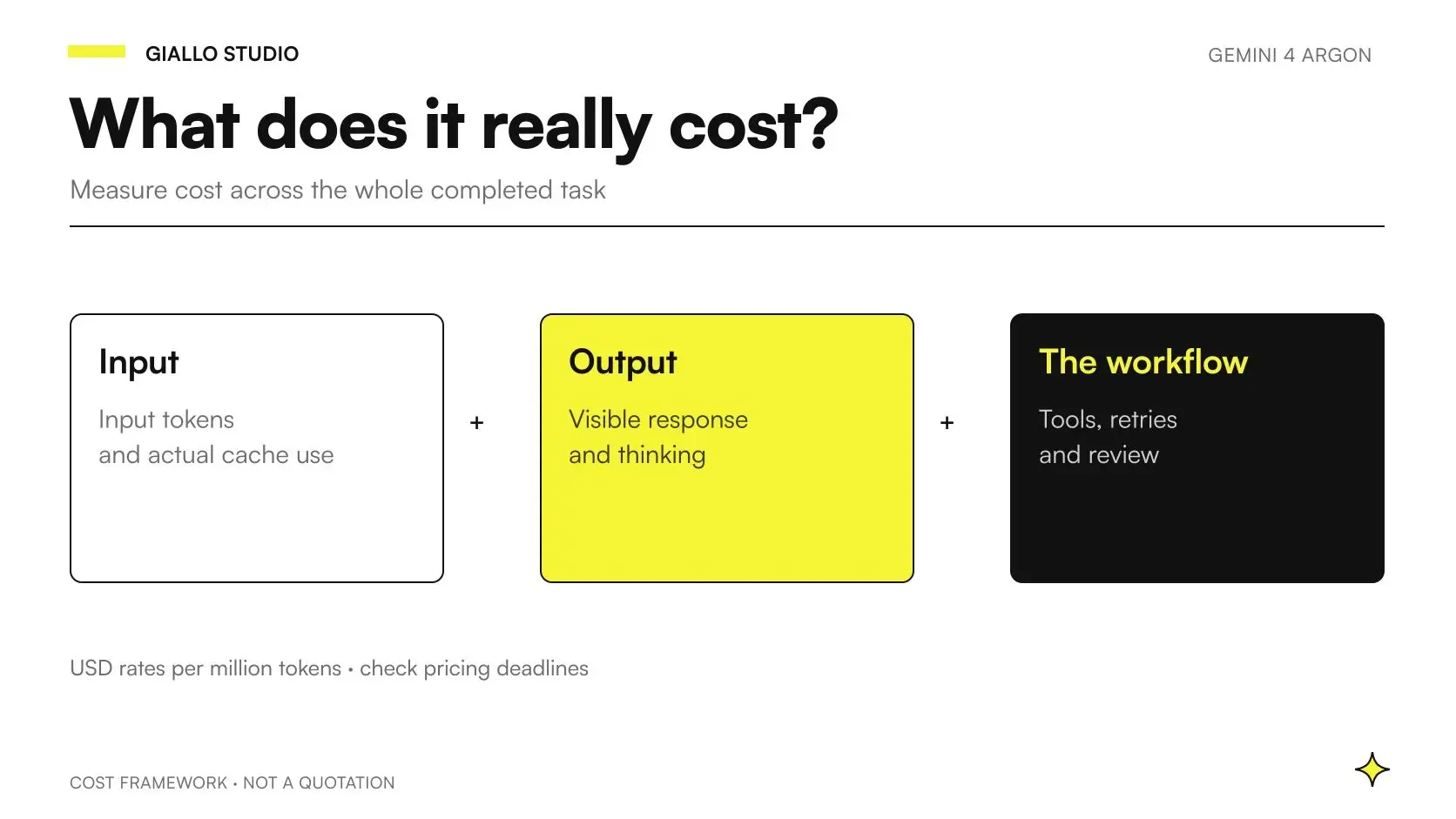
Gemini 4 Argon pricing through the Gemini Developer API, as of 23 October 2026, starts at 2 dollars per million input tokens and 10 dollars per million output tokens in Standard mode. These are promotional rates through 30 November 2026: from 1 December, the documented prices rise to 4 and 20 dollars respectively. Billed output includes thinking. The source is the official Gemini API price list, checked on 23 October 2026.
For a business, the estimate does not end there. Request length, the amount of reasoning produced, tool use and the number of attempts needed before a result becomes usable all matter. This guide separates documented rates from budget examples, which are hypothetical calculations rather than consumption measured by Giallo.
In summary
- The API price list and the price of a Google AI app subscription describe different products.
- The Argon promotion expires on 30 November 2026: an ongoing budget must also include subsequent pricing.
- Input, cached input and output have different rates; thinking is part of billed output.
- A useful estimate includes tools, repeated attempts and the cost of reviewing results.
- The figure to monitor in the process is cost per accepted result, alongside quality.
Which Argon price are we comparing: app, API or Cloud platform?
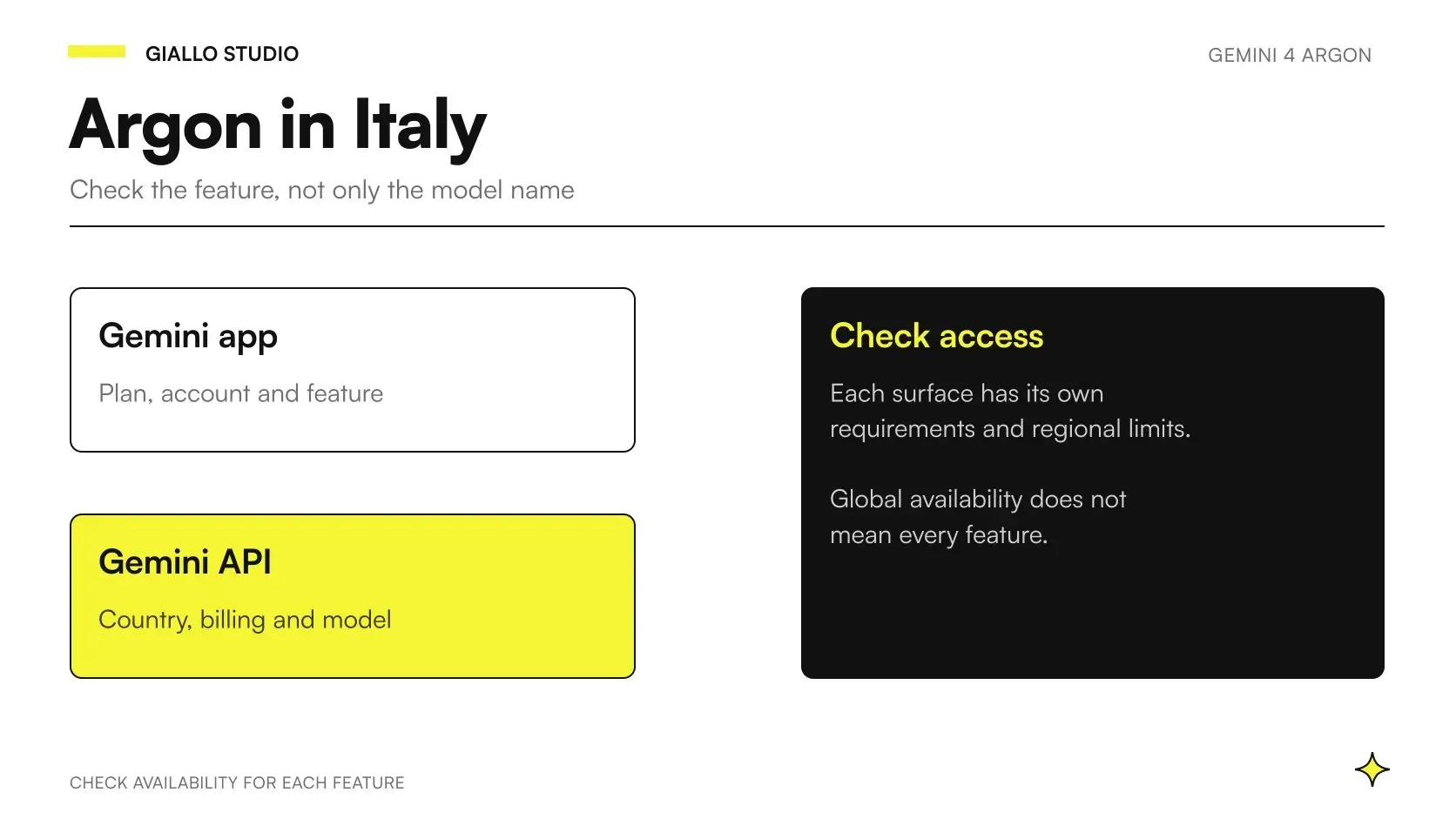
Gemini is a name used for a family of models and for products people interact with. Gemini 4 Argon identifies the model; the Gemini Developer API is a channel for integrating it into software. The Gemini app and a Cloud platform add their own terms, features and billing methods. The general guide to Argon clarifies these layers.
The table on this page concerns only the Gemini Developer API. It should not automatically be applied to another service’s bill, a Google One plan or a business platform. When comparing two offers, record the channel’s name and currency, not just the model’s name.
For the app, Google’s announcement presents access through Pro and Ultra plans; requirements and features must be checked in the updated support pages. This does not equate to an API token allowance to spend in business management software. Sources: announcement of access to Argon in the Gemini app and Google AI Pro support, checked on 23 October 2026. We do not give a consumer price in euros because the localised price must be checked for the relevant offer.
What API rates are documented as of 23 October 2026?
All figures in the table are US dollars per one million tokens. The actual cost depends on tokens counted by the service. Input and output are separate items; the cache row concerns the portion of input recognised as cached input.
| Mode and item | Through 30 November 2026 | From 1 December 2026 | What to measure |
|---|---|---|---|
| Standard, ordinary input | 2 USD | 4 USD | Input tokens not billed as cached |
| Standard, cached input | 0,10 USD | 0,20 USD | Tokens for which the service records cache reuse |
| Standard, output | 10 USD | 20 USD | Billed output, including thinking |
| Batch, input | 1 USD | 2 USD | Tokens from requests executed in Batch mode |
| Batch, output | 5 USD | 10 USD | Billed output from Batch requests |
| Flex, input | 1 USD | 2 USD | Tokens from requests executed in Flex mode |
| Flex, output | 5 USD | 10 USD | Billed output from Flex requests |
| Priority, input | 3,60 USD | 7,20 USD | Tokens from requests executed in Priority mode |
| Priority, output | 18 USD | 36 USD | Billed output from Priority requests |
Source for all rates: Gemini Developer API pricing, checked on 23 October 2026. The table does not assign a cache rate to modes for which it has not been verified here. Operational conditions must also be checked before changing modes: different pricing does not make execution paths interchangeable.
The promotional expiry date must appear in the budget. A project evaluated only at October prices risks an incorrect December forecast even with unchanged usage. This is not an assumed change: these are the two periods published in the consulted price list.
How is consumption calculated from tokens?
The basic formula is input tokens divided by one million, multiplied by the input rate, plus output tokens divided by one million, multiplied by the output rate. If some input is recognised as cached, that portion uses the cache rate. Any tools are added according to their respective terms.
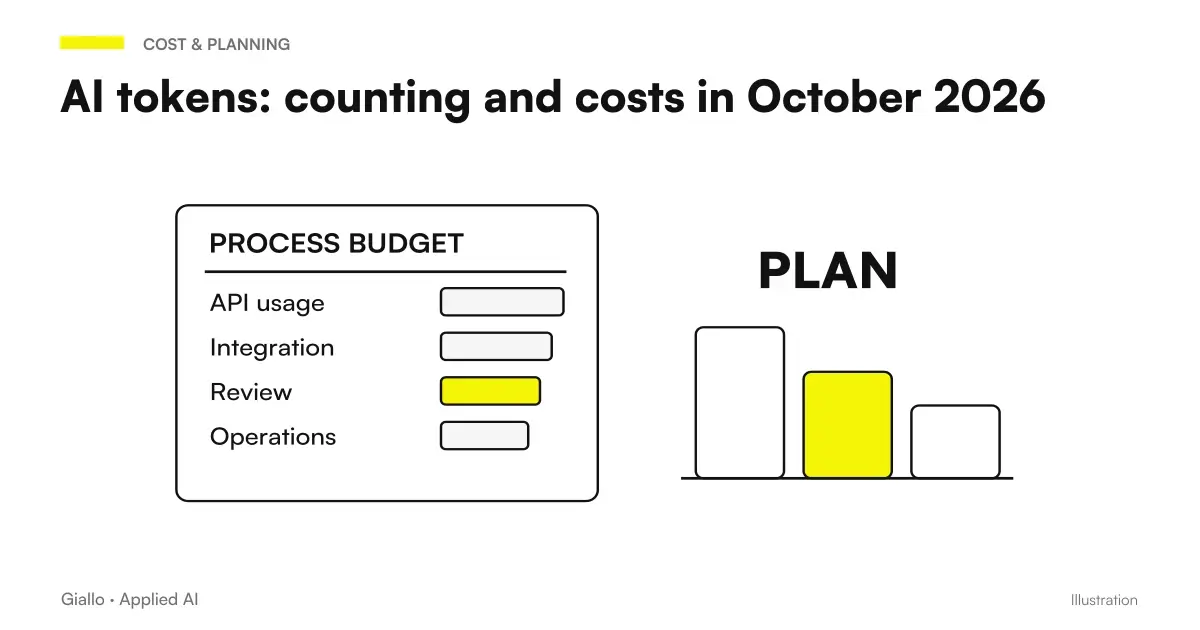
A token does not always equal a word. Attachments, instructions, history and multimodal content affect the amount processed according to the service’s rules. For an accessible explanation, see the guide to tokens in AI; an operational estimate then requires counting the actual workflow.
The most convenient unit of measurement is often an individual task: a product sheet, case summary or support request. Observe how many steps the task requires and add up consumption. A conversation that calls the model several times should not be estimated as one request simply because the person sees a single final result.
Budget example: preparing entries for a technical catalogue
Imagine a distributor preparing six thousand entries per month. For the calculation, assume six thousand input tokens and twelve hundred billed output tokens per entry, including thinking. These are invented quantities to demonstrate the method, not a forecast of Argon’s performance or a conversion from word counts.
Monthly input would be 36 million tokens; output, 7,2 million. In Standard, without caching or other costs, the promotion gives an estimate of 72 dollars for input plus 72 for output, or 144 dollars. From 1 December, the same quantities would correspond to 288 dollars. The calculation applies the rates from the official pricing, checked on 23 October 2026.
The budget does not demonstrate that the entries are correct. The responsible person must check codes, specifications and units before use. If the system produces a second version for rejected entries, that consumption also enters the bill. If external research is needed, the relevant item must be added separately.
The example supports a concrete question for the provider: how many tokens are assumed, and how many come from measuring the sample? This is more useful than asking “how much does a text cost?”, because texts of the same length may require different contexts and checks.
Does thinking change the cost even when the answer is short?
Yes, because Argon includes thinking in billed output. Google’s guide documents the levels low, medium and high, with medium as the default setting. This information comes from the guide to what is new in Argon, checked on 23 October 2026. The length of the text shown to the person is therefore insufficient to reconstruct the bill.
A correct estimate uses an output quantity that already includes thinking, or distinguishes the components and adds them only once. In the catalogue example, the twelve hundred tokens were stated as total billed output: adding another generic reasoning allowance would double-count it.
The level must be evaluated against the task. Simple classification and a check involving contradictory sources do not necessarily require the same configuration. However, there is no basis for promising that reducing thinking will preserve quality: representative examples must be tested. The Argon migration and evaluation protocol proposes how to compare cost and outcome together.
When does caching actually reduce spending?
Argon supports implicit caching rather than explicit caching. The documented prompt threshold is at least 4.096 tokens. Exceeding that threshold does not justify assuming every repeated token will necessarily be recognised as cached: the budget must use observed reuse or label it as an assumption. Source: Google’s guide to Argon, checked on 23 October 2026.
Return to the hypothetical example of six thousand entries, each with six thousand input tokens. Assume the service accounts for twelve of the 36 million monthly tokens as cached input and the remaining twenty-four as ordinary input. With promotional Standard pricing, the bill becomes 48 dollars for ordinary input, 1,20 for cached input and 72 for output: 121,20 dollars. From 1 December, with the same quantities, it becomes 242,40 dollars. Quantities and reuse are assumptions; rates come from the official pricing page, checked on 23 October 2026.
Do not add unnecessary input to chase the discount. A longer context may be redundant, increase data exposure and complicate review. Selecting relevant material comes first, followed by consumption optimisation. For document collections, this is explored further in the guide to Argon with RAG and business documents.
Which tools can add other items to the bill?
For Google Search grounding, the price list documents an allowance of five thousand free monthly requests shared across Gemini 3 and later models; beyond that allowance, the stated rate is 14 dollars per thousand requests. This is a tool-related item, separate from token consumption. Source: Gemini API Pricing, checked on 23 October 2026.
An estimate therefore requires more than multiplying the number of cases by the model’s price. You need to understand when the workflow runs a search, which requests share the allowance and how consumption is reported. A new free allowance should not be assigned to every automation without checking its scope.
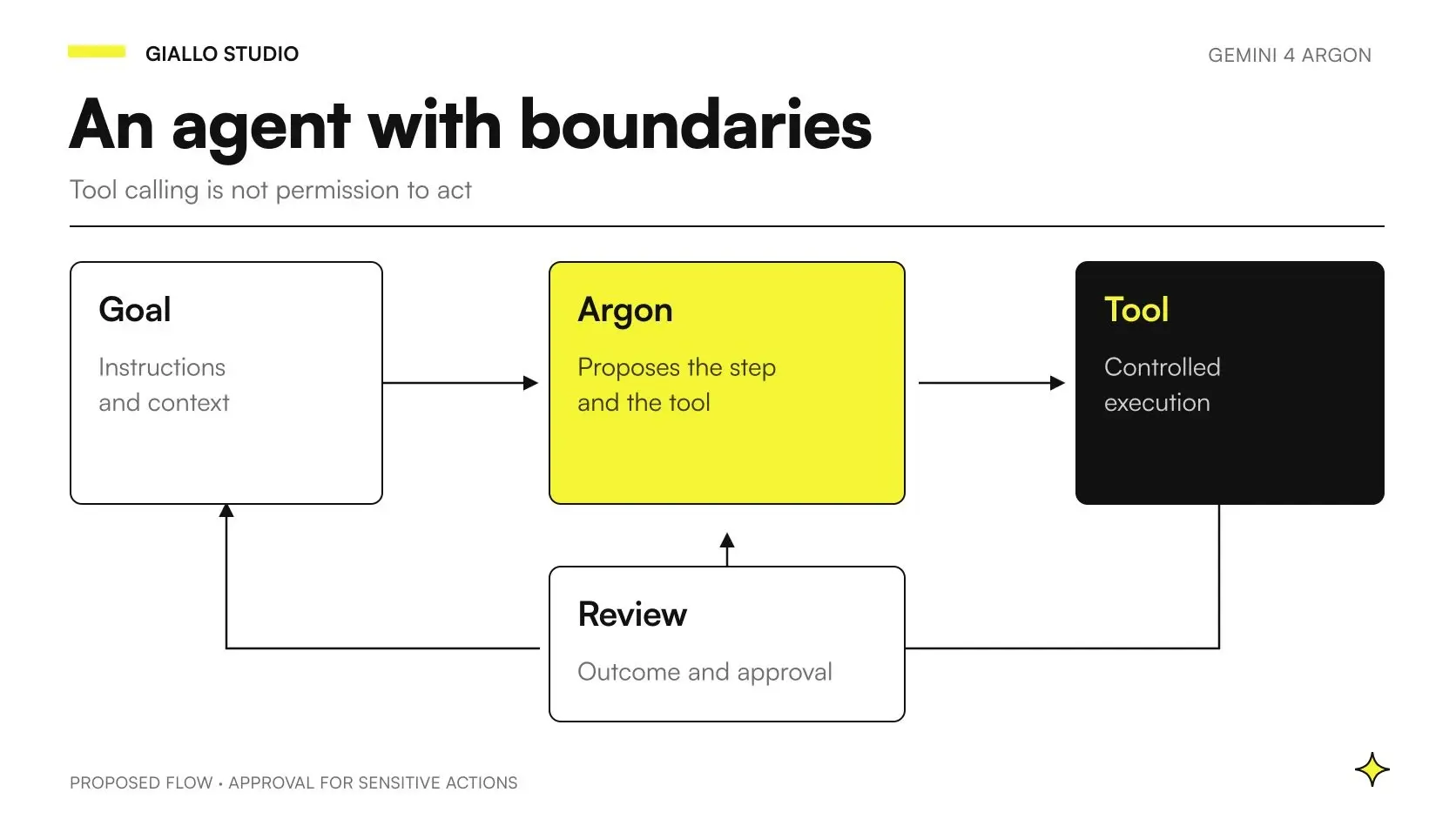
An agent may also call other services, execute multiple steps or repeat a task after an error. The number of assignments given by a person and the number of technical calls may differ. The guide to AI agents with Gemini 4 Argon addresses these steps from the process perspective.
Hypothetical scenario: estimating a support department’s budget
An equipment supplier wants to prepare drafts for requests received by customer service. Some require only classification of the question; others require retrieving the manual; others still require up-to-date research. A single average price chosen before distinguishing these paths would hide the most variable part of spending.
The budget worksheet can separate three categories. For each, record expected frequency, required documents, number of steps and review method. Requests with insufficient information must end with a clarification question, rather than continuing to generate attempts to fill in missing data.
Then measure a sample and compare the estimate with recorded consumption. If complex cases need many searches, the correction may concern the archive or document selection. Buying a different plan is not necessarily the remedy. The financial choice must be considered alongside the API integration architecture.
How do you avoid a budget that looks precise but is not?
The first mistake is applying the promotional price to the entire year without noting its end. The second is confusing visible output tokens with billed output and overlooking thinking. The third is assuming a guaranteed cache hit for every repeated request, even without observed data.
The fourth is comparing an API rate with a personal subscription as though they offered the same service. The fifth is excluding rejected requests from the bill. A system that is inexpensive per attempt can become expensive per completed case if it requires frequent regeneration and correction.
Finally, do not mistake a technical quota or rate limit for a spending cap. Before release, the team must check which consumption controls are actually available on its account and how the software responds when the internal budget is reached. An alert is useful only if someone receives it and knows what action to take.
Open the minimum worksheet for a verifiable Argon estimate
- Product: channel used, exact model and execution mode.
- Period: applicable rates before and after the promotion expires.
- Volume: expected tasks and technical steps for each task.
- Consumption: ordinary input, cached input and billed output.
- Extras: tools, connected services, attempts and error handling.
- Quality: accepted results and necessary review work.
- Control: budget owner and procedure for deviations.
Which figure should guide the final decision?
Cost per accepted result connects the technical bill to actual work. Divide the workflow’s cost by the number of results meeting the process criteria; show human review separately. This is not a promise of financial return: it is a way to avoid mistaking request volume for productivity.
A well-constructed estimate states assumptions, measured quantities and unresolved variables. The availability of Argon in Italy and the channel’s requirements must be checked before purchasing, while the evaluation sample allows the estimate to be updated without relying on a generic price per text.
Giallo Studio guides: methodology and sources
How we apply it in the company
Related resources
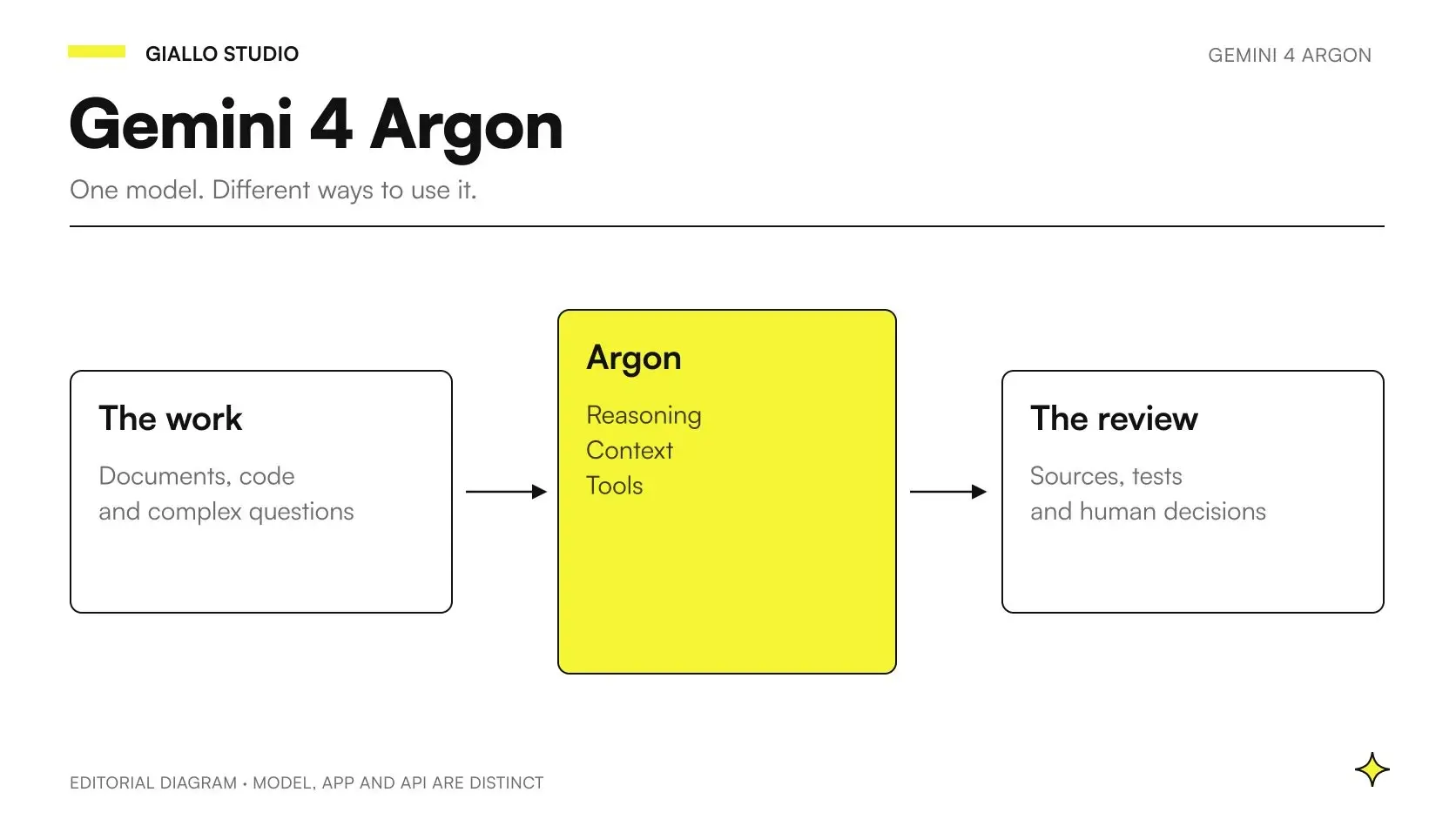 Gemini 4 Argon: what it is, what it does and when to use it in business
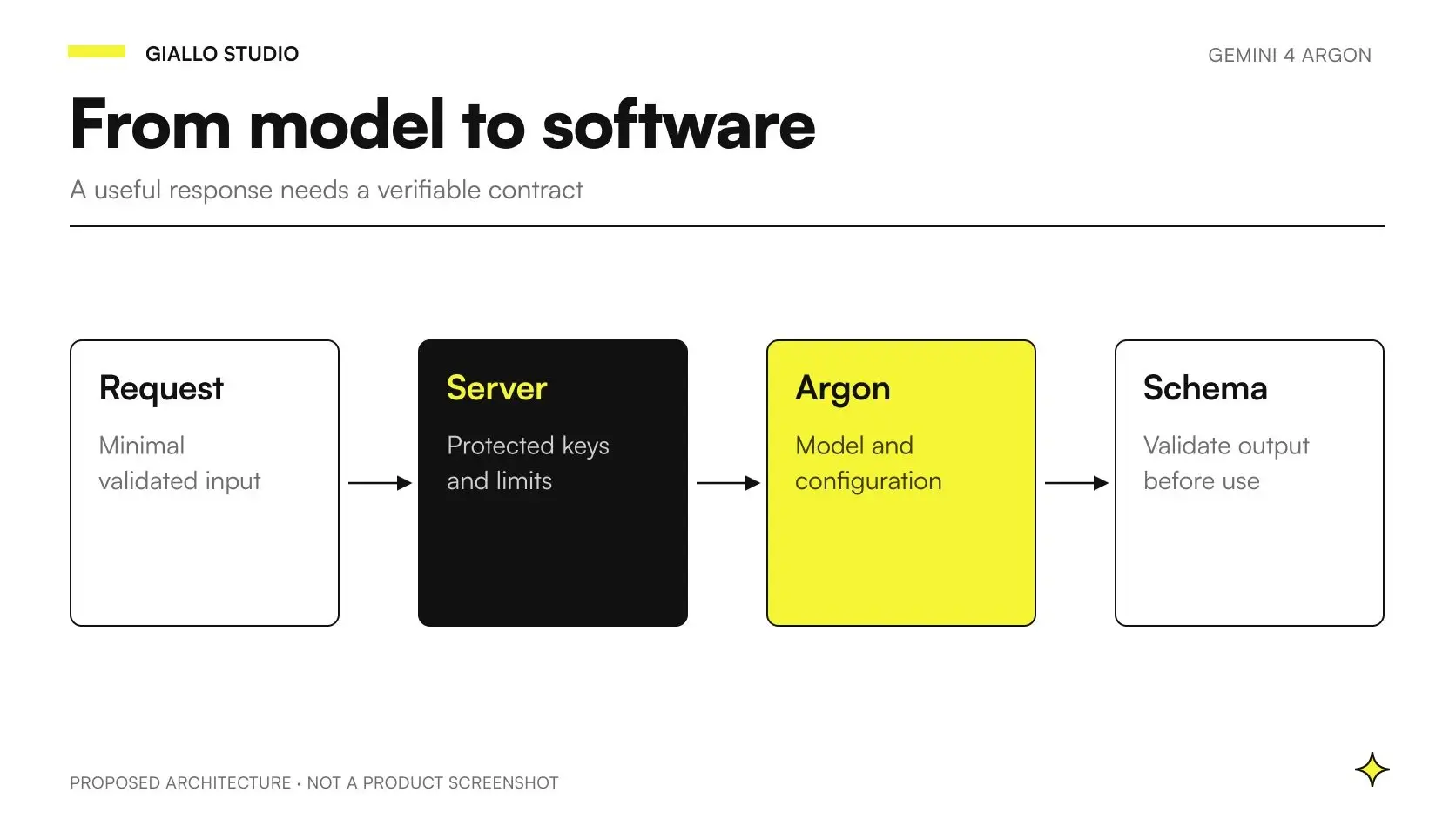 Gemini 4 Argon API: integrating the model into business processes
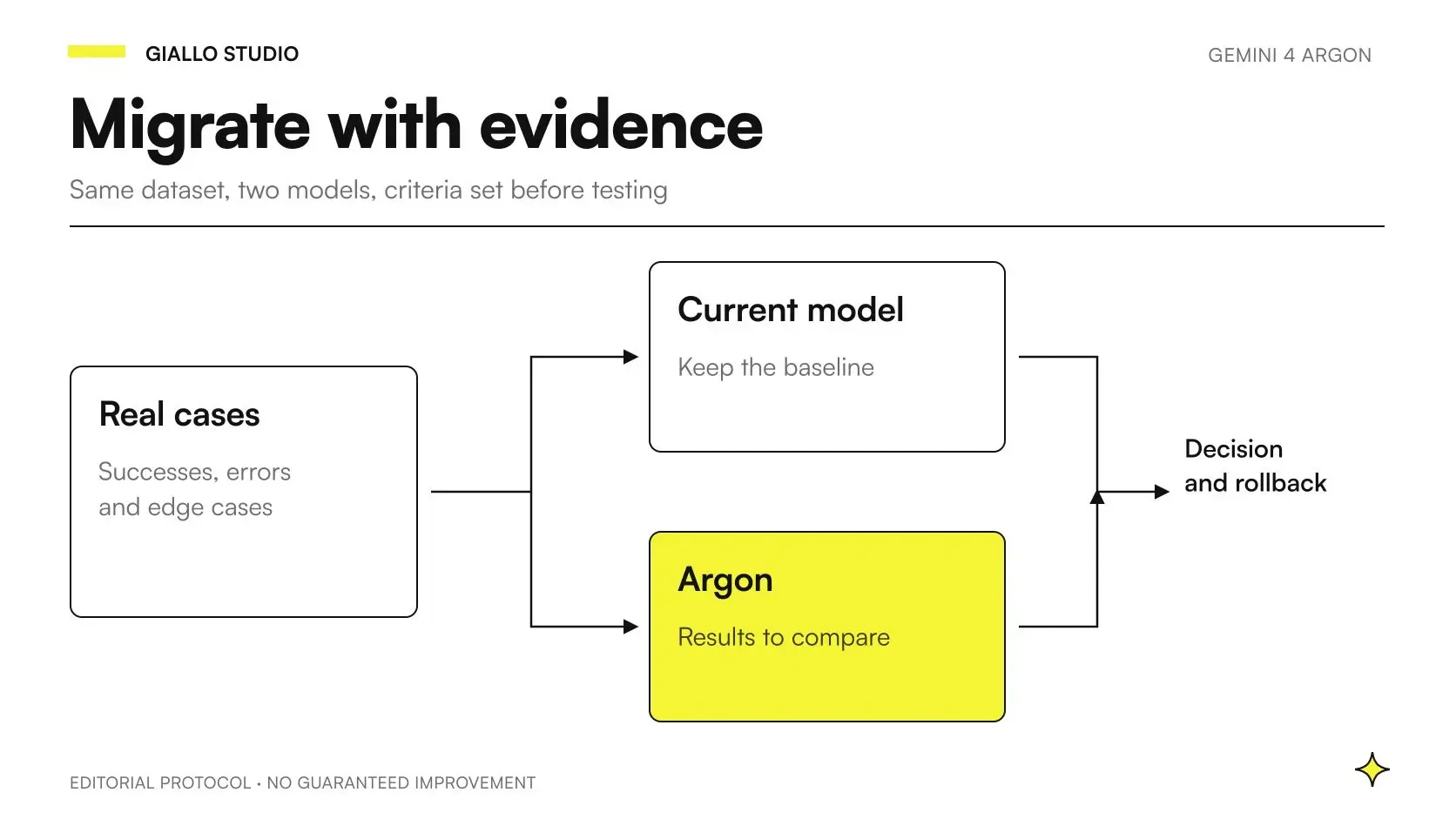 Migrating to Gemini 4 Argon: evaluation, testing and rollback
 Gemini 4 Argon in Italy: access and getting started
 Gemini 4 Argon for AI agents and automation: tools and approvals
 AI tokens: how they are counted and priced in October 2026
 Gemini prompts: useful examples for Google AI
FAQ
How much does Gemini 4 Argon cost through the API?
As of 23 October 2026, Gemini Developer API Standard pricing is 2 dollars per million input tokens and 10 dollars per million output tokens, including thinking. The promotion ends on 30 November 2026; from 1 December, the documented rates become 4 and 20 dollars.
Does Gemini 4 Argon have a free API tier?
The Gemini Developer API price list consulted on 23 October 2026 does not include Argon in the Free tier. Free access to other models or products should not be confused with the price of this model.
Is thinking charged separately?
Thinking tokens are included in billed output. When preparing an estimate, include them in the output quantity and avoid adding them again if the measured total already includes them.
How much does Argon’s cached input cost?
The price list states 0,10 dollars per million cached input tokens through 30 November 2026 and 0,20 from 1 December. Argon supports implicit caching, with a documented prompt threshold of at least 4.096 tokens; assuming a cache hit for every request is incorrect.
Does a Google AI Pro subscription include an API budget?
API rates and app usage plans are separate items. Before buying, establish which product is needed: personal access in the app or consumption by a software integration. API credit cannot be inferred from the subscription’s name alone.
How can I estimate an automation’s monthly cost?
Estimate requests, input and output tokens, tools and additional attempts, applying the chosen channel’s price list. Then compare the estimate with observed consumption and the number of results actually accepted by the process.