
Gemini 4 Argon API: integrating the model into business processes
Integrate Gemini 4 Argon API with business software: REST calls, structured outputs, timing, errors and controls for a verifiable project.
Integrating Gemini 4 Argon API means connecting the model to an application through a controlled service, with authorized data going in and verified results coming out. The stable code is gemini-4-argon; the official model page documents API support. Check this page before implementation: the references in this article were checked as of 23 October 2026. Google's model page.
The first call checks the connection. The actual project must also establish who can initiate it, how long it can take, how to recognize an incomplete result and what happens when the service does not respond. For an SME, these decisions make the integration usable in everyday work. The Gemini 4 Argon overview explains the product; here we follow the path from business software to an accepted result.
In summary
- The model call goes through a server that enforces authentication, permissions and limits.
- The response format and data accuracy require separate checks.
- A long request needs a status, an identifier and a recovery mechanism.
- A retry must not create two orders or two updates in the business software.
- Cost includes usage, checks, exceptions and process maintenance.
Where do you start with Gemini 4 Argon API?
Choose a task with a recognizable result. «Putting AI into the business software» is too broad; «extracting the lines from a request and preparing a record for review» lets you define inputs, outputs and responsibilities. The model is useful where text or documents need interpreting. Comparing two already normalized codes can remain a software rule.
Then choose the channel through which the project will use the model. The Gemini app, Google AI Studio and a business service connected via API have different usage methods and configurations. Check the API project's terms in the relevant account. To navigate these routes, use the guide to Gemini 4 Argon in Italy, without inferring API access from the subscription you use for chat.
Prepare a test environment with synthetic or sanitized data and an agreed spending limit. The test needs a precise question: does the system interpret those documents correctly and indicate when it cannot? Adding all master data immediately makes it harder to understand where an error originates.
What does a REST call to the stable model look like?
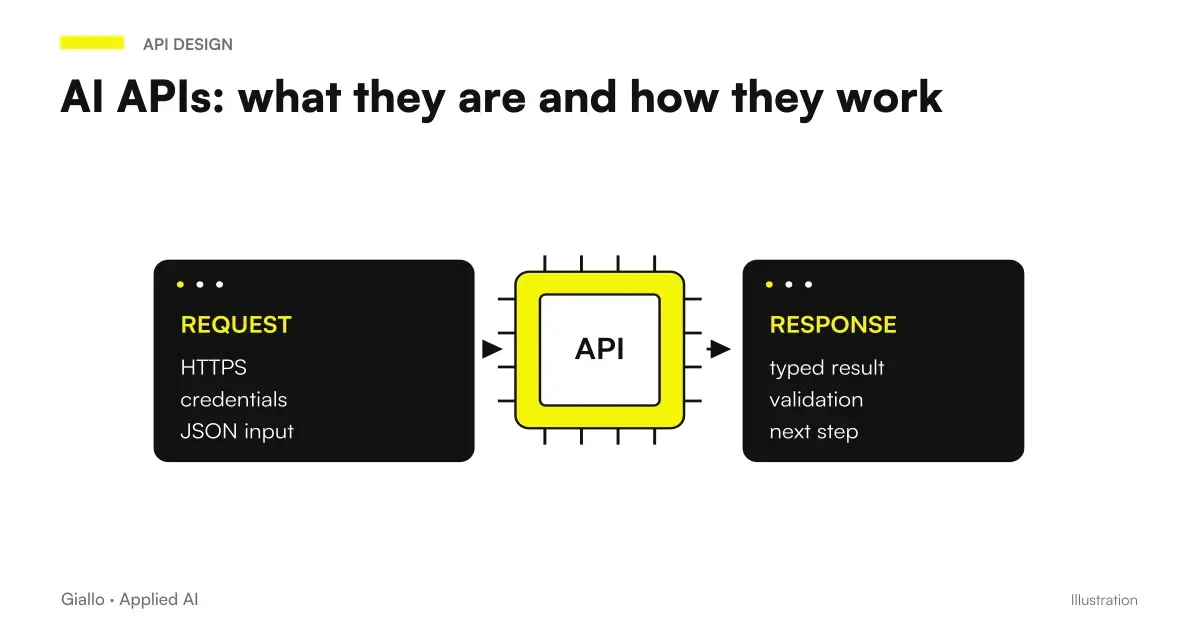
The current official guide uses the Interactions endpoint. This minimal call follows the REST format documented for Argon and generates a text response; it does not yet configure the business workflow. The environment variable contains a key already configured in the server environment, and the text uses only invented data. Official Argon quickstart.
curl "https://generativelanguage.googleapis.com/v1beta/interactions" \
  -H "x-goog-api-key: $GEMINI_API_KEY" \
  -H 'Content-Type: application/json' \
  -X POST \
  -d '{
    "model": "gemini-4-argon",
    "input": "Classifica questa richiesta sintetica: vorrei un preventivo per 12 confezioni del prodotto DEMO-A. Restituisci una breve descrizione dei dati presenti e mancanti."
  }'
The snippet illustrates transport, without demonstrating quality on your use case. Do not put real keys in the file, shared examples or code sent to the browser. Add error handling, outcome checks and result validation to the application. A command succeeding on the developer's computer does not yet verify these requirements.
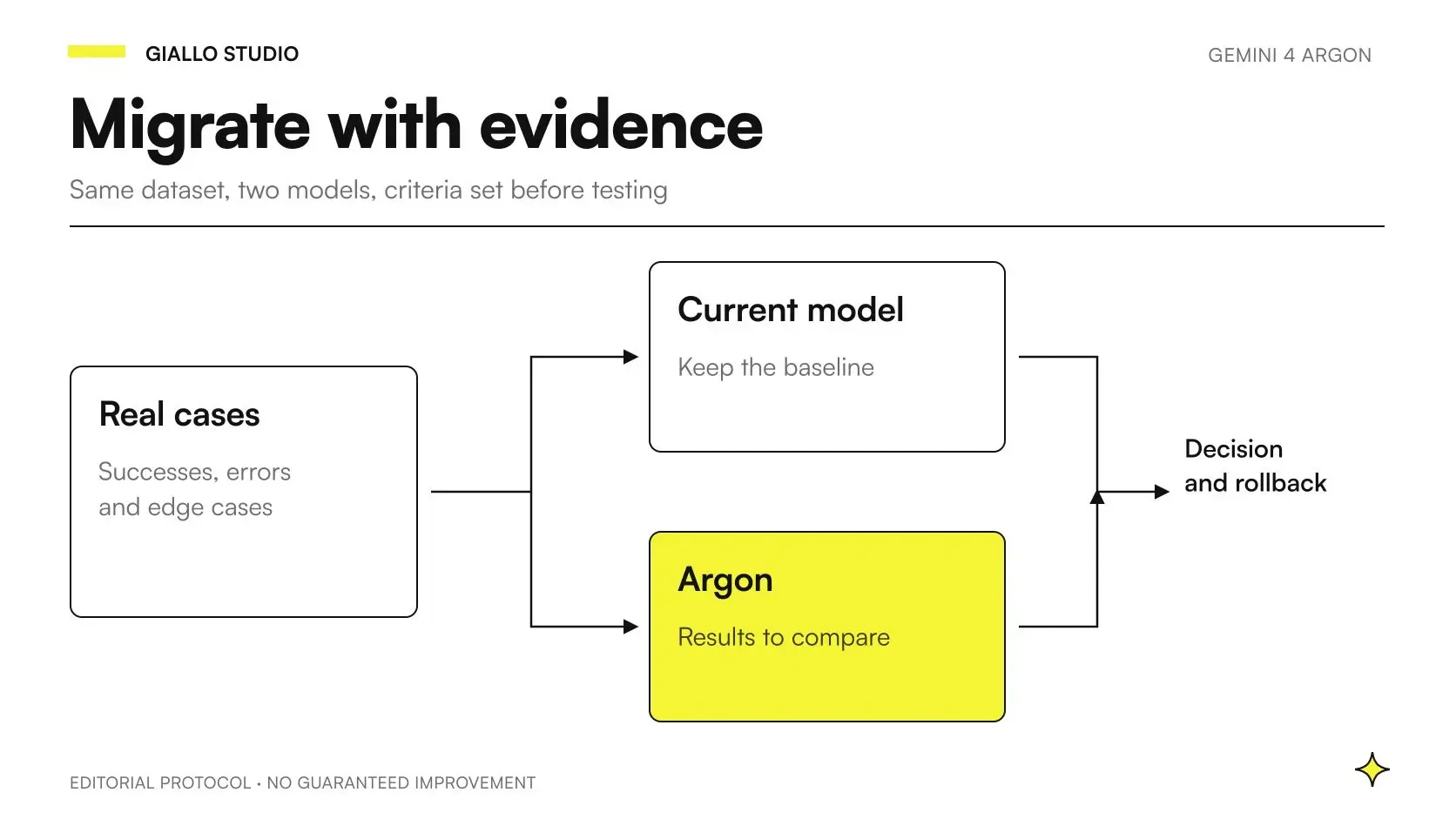
Also retain the actual configuration alongside the process version: model, instructions, schema and checks applied. If quality changes, this record lets you reconstruct which combination produced the result. The guide to migrating to Gemini 4 Argon covers comparison with a previous integration.
Where should keys, data and permissions go?
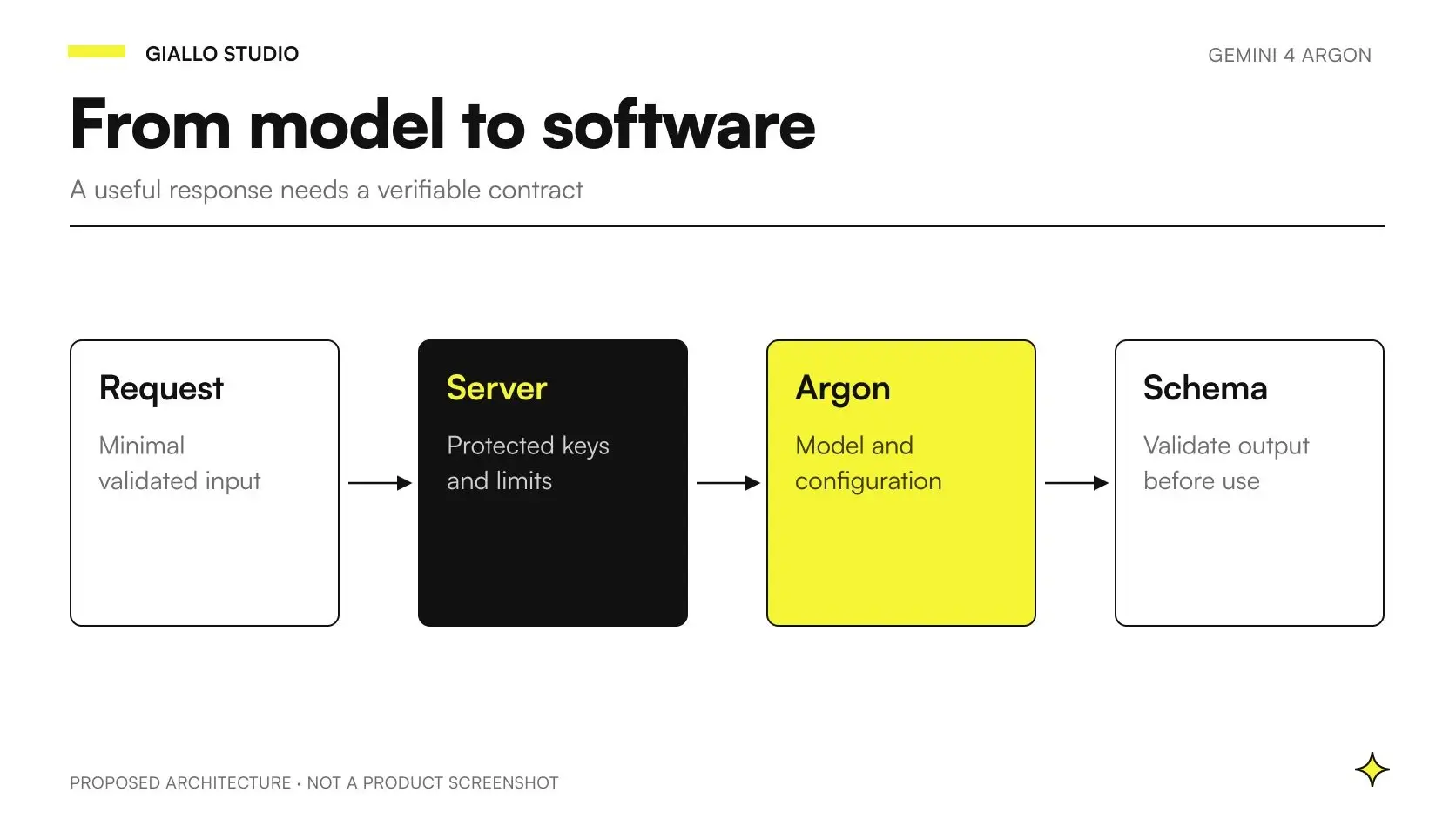
The browser sends the request to your service. The service identifies the user, checks their right to use those documents, prepares the minimum material and calls Google. On return, it checks the response before displaying it or passing it to the business software. This is a proposed architecture to adapt to the company's tools; it is not an authorization feature automatically supplied by the model.
The provider key does not replace the business user's identity. Two colleagues can use the same integration while being authorized for different customers. The server must know this distinction before collecting sources. Hiding an interface section does not prevent an endpoint from receiving a differently constructed request.
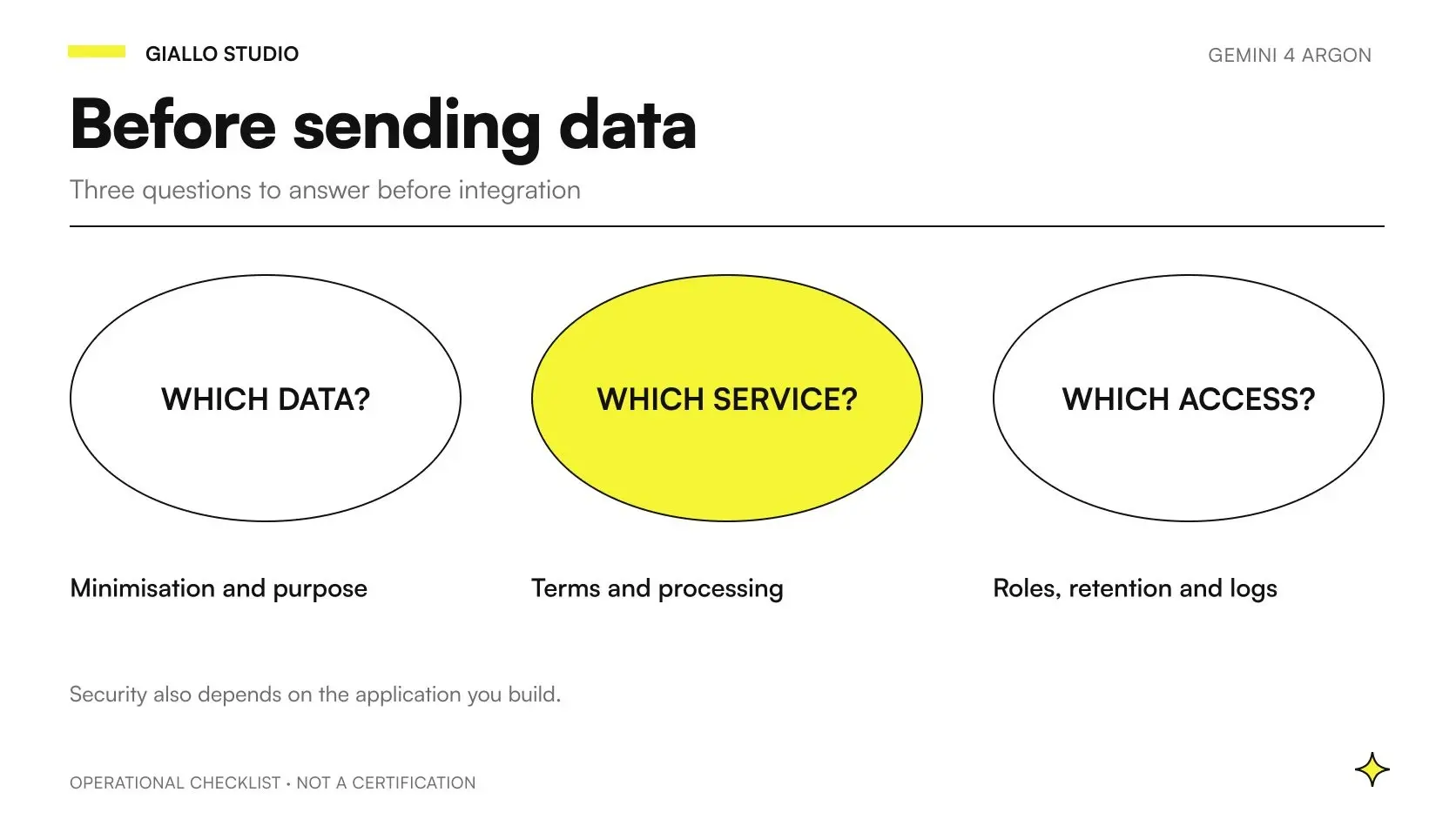
Logs also require a decision. A job identifier, version, input size, duration and reason for rejection are often enough to locate an error. Automatically recording every attachment and response creates new copies to manage. For more on terms, data and channels, see Gemini 4 Argon privacy and security.
What contract should the model's output follow?
A reliable integration must distinguish «missing field» from «field present but uncertain». If the requested quantity is missing, returning zero confuses an unknown value with an actual quantity. Allow null values, review reasons and references to the source material. The application's contract should also be readable by the process owner.
Google documents structured outputs based on JSON Schema. This support constrains the format; checking meaning remains the application's responsibility. A correctly formatted date can still refer to the wrong deadline. Structured outputs documentation.
Here is a possible result from our demonstration process. It is a proposed business data structure, not the mandatory body of Google's response:
{
  "request_id": "DEMO-104",
  "status": "needs_review",
  "items": [
    {
      "source_label": "prodotto DEMO-A",
      "catalog_id": null,
      "quantity": 12,
      "unit": "confezioni"
    }
  ],
  "missing_fields": ["identificativo_catalogo_verificato"],
  "review_reason": "Descrizione da confrontare con il catalogo autorizzato"
}
The software checks that the status belongs to the allowed list, that the quantity is acceptable and that any identifier exists in the accessible catalog. The product match should not be approved because the text «looks right». It needs a verified match or a review. When a field fails a check, the process stops in a recognizable state.
Prepare boundary cases before enabling writes: a negative quantity, an unknown unit, a code from another customer's catalog and two descriptions referring to the same line. Write the expected behavior for each. The checks must demonstrate rejections too: a correctly rejected result is a useful test outcome. If someone corrects a field, retain the origin of that correction without confusing it with the initial extraction. You can then distinguish model errors from the salesperson's subsequent decisions and understand which part of the process needs attention.
How should you handle long processing times and interrupted responses?
The Argon guide specifies a window shared between input, thinking and output, and a background approach for generations beyond the normal synchronous limit. It also notes that the output limit includes thinking. Do not size the system around visible text alone. Technical guide to context and long decode.
For users, a frozen screen is a process defect even when the model is working. Provide understandable statuses: received, processing, needs review, completed, failed. Link each to an identifier that lets users reopen the result. Do not force the salesperson to keep the same tab open until completion.
A connection timeout does not prove the remote job failed. Before repeating a long request, check what information the channel provides about the previous job's status. If you cannot retrieve it, your design must at least recognize a late result and avoid applying it twice. Test this decision by deliberately interrupting the connection in the test environment.
Which errors need to stay separate?
Handling improves when the message describes the problem category. An unreadable file needs new input; a missing permission needs an owner; a temporarily unavailable service may allow a retry. Repeating the same call without distinguishing these cases consumes resources and leaves users without useful guidance.
| Event | Proposed application behavior | Check to test |
|---|---|---|
| Unauthorized document | Block before the call | No content reaches the model |
| Incomplete input | Request the required field | No data is filled in by assumption |
| Response outside the contract | Reject the automatic step | The status indicates review |
| Service unavailable | Apply limited retries or a manual route | Retry exhaustion is visible |
| Connection interrupted | Recover or reconcile the status | Only one result is applied |
| Correctly formatted but nonexistent data | Check against the business software | No invented code is recorded |
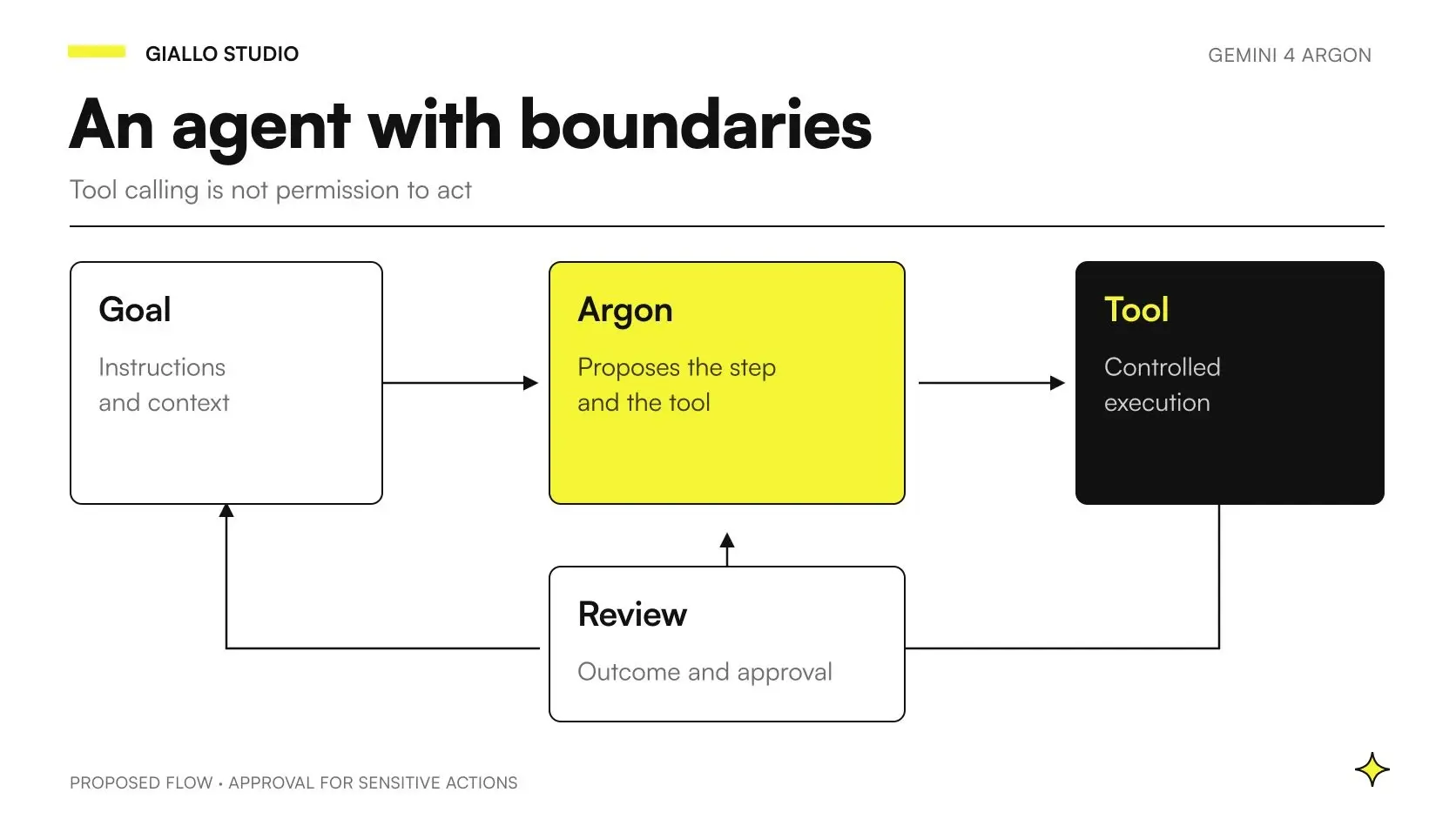
For updates, use an operation identifier chosen by the application. Resubmitting the same job must not create a second order. This property, called idempotency, concerns your software and the connected systems: it is not achieved by asking the model to remember that it has already performed the action. For workflows with tools, read Argon for agents and automation.
How can you integrate a distributor's requests?
Hypothetical scenario: a technical supplies distributor receives free-text requests. The pilot must prepare an internal record. Input includes the sanitized message, an identifier and the authorized portion of the catalog needed for comparison. Confidential prices and the customer's full history stay out if they are not needed for classification.
Output contains requested lines, quantities, units, catalog candidates and missing fields. The server checks that codes exist; the salesperson confirms the match. A similar alternative remains a separate proposal, without silently replacing the requested item. The model does not modify price lists or send quotes within the initial scope.
Difficult cases include «two boxes» without specifying the contents of a box, descriptions of discontinued products and a message correcting a previous request. The software must link that last message to the correct case, without relying only on textual similarity. If the link is uncertain, the job goes to review.
The acceptance criterion is precise: every displayed line must be traceable to the request, ambiguities must be visible and no final commercial data may be written without the required checks. The catalog owner evaluates the sample. We attribute no observed savings or results to this example: it describes a project to be measured.
How can you connect a support portal without broadening access?
Second hypothetical scenario: a maintenance company prepares tickets from customer messages. The input is a report with a site code; the required output contains category, summary, missing data and the reason for the proposed priority. Technician availability and the applicable contract come from authorized systems, not the model's memory.
The portal derives the customer's identity from the authenticated session and checks that the site belongs to them. The message text cannot change this constraint: writing another company's name does not authorize reading its tickets. An attachment containing unrelated instructions must also be treated as material to analyze, without giving it the power to change application rules.
One test case presents a nonexistent site; another describes an urgent issue without enough information. An acceptable result flags the exception and indicates the route set by company procedure. The example does not replace emergency coverage. Portal users must see that classification is proposed and which responsible person confirms it.
How do you assess cost and quality after the first connection?
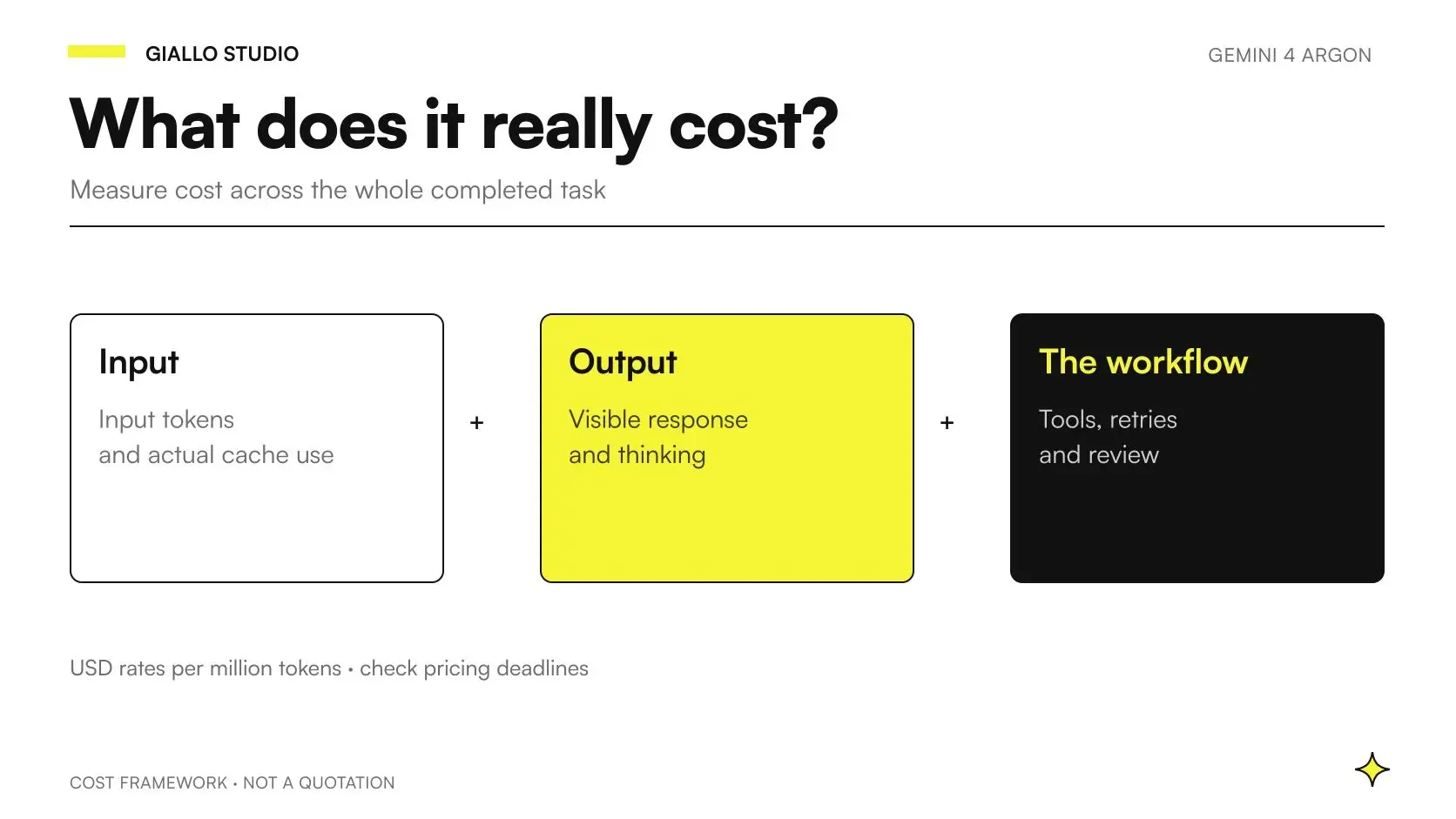
The price list distinguishes input and output, with thinking included in billed output. As of 23 October 2026, an introductory rate has an expiry date: the project estimate must retain its date and units, without treating it as a permanent cost. Official Gemini API pricing. The guide to Gemini 4 Argon costs explains the calculation in more detail.
During the pilot, record usage per job, repeated requests, accepted results, reviews and total duration. Split results by input type: mixing short messages with complex attachments makes the average hard to interpret. Include the time needed to correct output, because integration costs continue after the API responds.
Common mistakes include exposing the key to the browser, trusting JSON just because it is valid, repeating operations without reconciliation and enabling the entire archive before you have a verified sample. Another mistake is changing the model, instructions and checks together: if results worsen, you cannot tell which change caused it.
Open the acceptance criteria for the first business connection
- Every job has an identifier and a viewable status.
- The server checks identity, permissions and input size.
- The contract distinguishes missing fields, uncertainty and technical errors.
- An invalid result does not update the business software.
- Connection interruption and duplicate submission have been tested.
- The owner has examples that were accepted, rejected and sent for review.
- Spending limits, maintenance and the manual procedure have an owner.
What decision to make at the end of the pilot?
The pilot should support a choice between extending, correcting or stopping the connection. An appealing demonstration is not enough; you need examples showing where results are reliable and where intervention is required. Start with one internal operation, approve the checks and extend only the scope already verified.
If you need to connect documents and permissions, continue with Argon for RAG and business documents. If the main challenge is deciding which steps require interpretation, the guide to AI API helps clarify the model's role. To turn a request from your business software into a verifiable contract, we design the software integration around a sanitized example.
Giallo Studio guides: methodology and sources
How we apply it in the company
Related resources
 Gemini 4 Argon: what it is, what it does and when to use it in business
 Gemini 4 Argon: API pricing and business cost calculations
 Migrating to Gemini 4 Argon: evaluation, testing and rollback
 Gemini 4 Argon for AI agents and automation: tools and approvals
 Gemini 4 Argon privacy and security: a business guide
 AI APIs: what they are and how they work
FAQ
What is the stable identifier for Gemini 4 Argon API?
The identifier documented as of 23 October 2026 is gemini-4-argon. Check the official model page before configuring an integration or changing the model in production.
Does a Gemini subscription include API usage?
Access to the app and API integration are separate routes. For a software project, check the project, billing, terms and availability of your chosen API channel; an app plan does not demonstrate that calls from your business software are included.
Can I put the Gemini key in my website's code?
A key intended for server calls must stay on the server, outside the browser and repository. The application must authenticate the user and check data and limits before sending the request to the provider.
Do structured outputs make every response correct?
No. A schema makes the response format checkable, but does not prove that a product code, quantity or date is correct. You need checks against business data and an explicit process for uncertain fields.
Is the entire million-token window available for input?
Argon's window is shared between input, thinking and output. The unified limit is 1.048.576 tokens: the project must leave room for reasoning and the response rather than filling the whole window with documents.
How should you handle an API request that takes too long?
The application must show a processing status and retain a job identifier. For lengthy tasks, consider the documented background approach, distinguishing a connection timeout from the actual outcome of the job.
When is a Gemini integration ready for business software?
When it passes ordinary and exceptional cases against predefined criteria, enforces permissions and does not duplicate actions when an error occurs. Spending limits, monitoring and a procedure for continuing without the model are also needed.