
ChatGPT to create content
ChatGPT for blogs, social posts, product descriptions and newsletters: ready-to-use prompts, format-specific tips and how to avoid generic content.
Reading time: 11 min
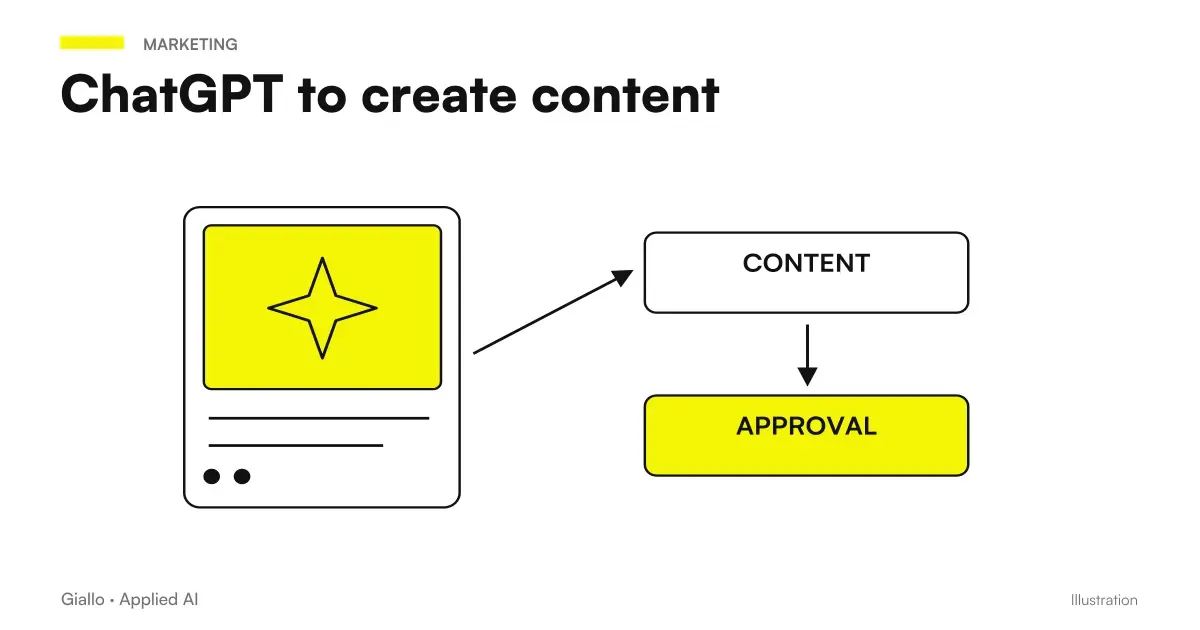
ChatGPT for content it serves one thing precisely: to produce faster the first draft of a text — an article, a post, a product sheet, a newsletter. starting from a brief that you give him. It is not an author who replaces the writer: it is a tool that reduces the time of the blank page and manages the repetitive part, leaving the person the work that really matters, i.e. giving entry and truth to the text.
The distinction to keep in mind is this: there is a huge difference between a useful content and a generic AI content. The second is what you recognize to the eye —full of empty adjectives ("innovative solution", "unique experience"), unverified statements and phrases that could stand on the site of any competitor. The first is born when the AI does the drafting and a competent person puts real examples, controlled data and a point of view. ChatGPT, by itself, produces the first type. With the right method, it helps you produce the second.
In this guide we see what content ChatGPT is really useful for, how to write the right prompts for content type, where its honest limits are and how to integrate it into the work of an SME without filling the web with empty text.
In summary
- ChatGPT makes first draft, human gives voice and truth: Speed up drafting, but do not know your company or the real facts of your industry.
- The difference between Useful content and generic AI content is in the review: true examples, verified data and a point of view that AI does not have.
- Each type of content (blog, social, product cards, newsletters) has its own prompt and its arrangements: there is no single prompt that goes well for everything.
- ChatGPT can inventing data, statistics and quotes (hallucinations): use it for form, never as a source of facts.
- Google does not penalize AI content as such, but those generic and valueless: quality matters more than the instrument.
What content ChatGPT is really useful for
ChatGPT is not equally good with all types of text. It works best where the content is repetitive, high-volume and with a predictable structure; it works worse where an original point of view or demonstrated authority is needed. Knowing this difference keeps you from wasting time where AI doesn't help.
The four most solid cases for an SME or professional are these: blog articles (where AI structure and you put expertise), social content (where volume and variants are needed), Product Descriptions (where there is a data sheet to be transformed into text) and Newsletter (where there is a message to pack well). In all, the model is the same: AI accelerates the form, you guarantee the content.
ChatGPT is one of the most well-known applications of Generative AI, the family of models that creates text predicting the next most likely word. Understanding this mechanism also helps to understand its limit: it does not "know" things, it reconstructs them in a plausible way. If you want a bigger picture of what it is and how it works, start from What is ChatGPT.
Useful Content vs Generic AI Content
It is the central distinction of the whole article, so it is worth seeing it clear. A generic AI content is grammatically correct but empty: it makes statements that no one can verify, uses superlatives instead of facts and says nothing that the reader did not already know. A useful content It answers a real question, brings a concrete example, cites a verifiable data and has a recognizable voice.
Useful content
- It answers a specific question that the reader really has.
- Bring real examples, verified numbers and concrete cases.
- He has a point of view: he says what to do and what to avoid.
- It sounds like your company, not like all the others.
Generic AI content
- It fills with adjectives and superlatives instead of facts.
- It makes claims that no one can verify ("the industry leader").
- Stay on the surface: this applies to any company in any industry.
- It sounds "clean" but anonymous: anyone could have written it.
The practical point: ChatGPT, on first request, almost always produces the right column. Moving it to the left is your job of reviewing, and that's where you decide if the content serves anything.
How to write the right prompts for each type of content
There is no universal "perfect prompt". Each type of content has a different goal, a different reader and different devices. The table below puts together the four most common cases with a starting prompt and the wit that makes the difference. For the general method on how to build an effective prompt, the guide on how to get started with prompt engineering goes into detail.
| Content Type | Starting Prompt | Accomplishment That Makes a Difference |
|---|---|---|
| Blog Article | "You are an expert in [sector]. Write the track + first draft of an article on [topic] for [reader]. Structure with H2/H3, concrete tone, no invented adjectives." | Give it 3 real facts of your industry to include. Without, fills with genericity. |
| Social Post | "Generate 5 variations of a LinkedIn post on [theme], maximum 80 words, first line that makes the scroll stop, only one idea per post." | Ask more variants and you choose: AI is great at generating options, bad at choosing one. |
| Product description | "Transform this data sheet into a 60-word description. Use only the real features below, no adjectives not supported by the data: [tab]." | Paste the Real Data Sheet. If you don't give it to him, he invents benefits. |
| Newsletter | "Write a 200-word newsletter about [news]. One message, one call to action. Tone: [example of your style]." | Attach your previous text as an example of voice, so it does not write "from AI". |
The common thread of all four: The more real context you give, the less AI invents. A vague prompt produces a vague text. A prompt with facts, data sheet, voice examples and explicit constraints produces a draft much closer to publishable.
The three rules of a content prompt
- Give a role and a reader. "Write an article" produces genericity. "You're a tax consultant writing for small business owners" narrows the field and immediately improves the register.
- It bans empty adjectives. Always add a line like "no superlatives, no words like innovative, unique, leading, cutting edge: just concrete facts and benefits". It's the single constraint that raises quality the most.
- Provide real raw material. Facts, data, data sheet, examples of your style. AI is good at reworking what you give it, not knowing things you haven't told it.
Practical examples
Three concrete scenarios of Italian SMEs and professionals, to see the method at work.
1. E-commerce — product descriptions at scale. An online store with 600 items must rewrite the cards. The holder pastes into ChatGPT the actual data sheet of each product and asks for a 60-word description based only on those data, with no invented adjectives. AI produces the draft; one person rereads it, corrects the two or three points where it exaggerated and publishes. The time per card drops from about ten minutes to a couple. The same work done well also helps positioning: see ChatGPT for SEO for how to write descriptions that also work on search engines.
2. Professional study — industry blog. An accountant wants to publish one article a month to be found. On his own, he doesn't have time to write from scratch. Prepare a five-line brief with the topic and three key facts (a deadline, a threshold, a regulatory novelty), pass them to ChatGPT and get track and first draft. Then he puts his own: a real example of a client (anonymous), his point of view, the official sources. AI has taken away the fatigue of the structure; competence remains its own.
3. Service SMEs — social and newsletter. The marketing manager must produce four posts a week plus a monthly newsletter. Use ChatGPT to generate variants of each post (five at a time, choose the best one) and to package the newsletter starting from the points that tell it by voice. The tone remains consistent because it gave AI two examples of its past texts. Result: it goes from "I don't have time to write" to "I choose and correct", which is much more sustainable.
In all three cases, the same sentence applies: AI makes first draft, human decides and signs. Nobody publishes the raw output.
A marketing project with sources and review
To move from a single draft to a continuous work, the guide to Dots for SME marketing proposes a perimeter with approved sources, editorial responsibility and review. A content plan does not alone authorize publication or sending to customers; checking claims remains part of the job.
Mistakes to Avoid
- Publishing the first answer. It is almost always the most generic. The real work starts later: add facts, cut adjectives, give voice. Skipping this step is the quickest way to fill the empty text site.
- Trusting the facts he invents. ChatGPT can generate plausible but false statistics, quotes, and dates (the AI Hallucinations). Any number or factual statement must be verified on a real source before publishing.
- Pursuing volume instead of quality. A hundred generic articles are not worth ten useful articles. Google rewards content that really helps the reader, not quantity. The risk of "so much is free, I make a thousand" is just that.
- Leaving the voice to AI. If you don't give examples of your style and don't rewrite anonymous phrases, the text will sound like everyone else's. Voice is what sets your content apart: don't delegate it.
- Putting sensitive data in prompts. Pasting customer information, contracts, or personal data into a public tool can violate the GDPR. Define first what you can and cannot share.
How to apply it in the company
Getting ChatGPT into content production without lowering quality is a matter of process, not tool. The stream that works is short and repeatable.
- Start with the brief, not the prompt. First you decide topic, reader and three real facts to include. The prompt comes next.
- Keep a prompt library. A proven prompt by type of content (blog, social, product, newsletter), with your tone and your words banned already inside.
- Always add an example of your voice. Two or three texts that you have already written, to be pasted in the prompt, so the output is born near your register.
- Sets a mandatory revision. No AI content comes out without a person verifying facts, cutting the generic, and signing.
- Measure what works. What content is read, shared, converted. AI gives you volume; data tells you where it's worth pushing.
When this stream becomes stable and repeatable, you can also take it one step further: connect ChatGPT (or an API model) to business tools, so that drafts are already born within the CMS, product management software or email marketing platform. It is the leap from manual use to content automation, where the first draft generates itself and the person is left only with the revision. If you want the contents to live on a site designed to publish continuously, even the website creation can be set from the start for this stream.
Should I tell readers that the content is written with AI?
There is no general obligation to declare it for normal marketing content, but transparency helps trust. The real point is not the label: it is the quality. A revised, accurate and signed content by a person is honest regardless of how the first draft was born. Different is the case of reviews, testimonials or content that fake a personal experience that has not been there: there the AI should not be used to simulate truth.
Conclusion
ChatGPT for content It is a powerful tool on one condition: that it be clear who does what. AI makes the first draft — structure, reformulates, generates variants, removes the fatigue of the blank page. The person does the rest, and it is the rest that counts: the true examples, the verified data, the voice, the point of view. It is this division of labor that separates useful content from generic AI content, and decides whether what you publish serves someone or just adds noise. From here you can continue with ChatGPT to write emails, where the same method applies to everyday communication.
AI becomes useful when it enters processes. Giallo Studio helps SMEs and teams build concrete, measurable and sustainable automations. including for content production.
Giallo Studio guides: methodology and sources
How we apply it in the company
Related resources
 ChatGPT: what it is and how to use it
 Prompt engineering: what it is and how to get started
 ChatGPT for SEO
 Generative AI: What It Is and Why It Matters
 ChatGPT to write emails
 AI workflow builder: tools to create automations without code
 Best AI for social media: tools for content and management
 AI customer support prompts: ready-to-use examples
FAQ
Can ChatGPT write content for me?
It can write the first draft, not the finished article. ChatGPT is good at structuring, rewording and speeding up drafting, but it doesn't know your company, your customers or the real facts of your industry. You add value during review: voice, real examples, verified data. The practical rule is: AI creates the first draft; the person adds a voice and factual accuracy.
Does Google penalise content written with ChatGPT?
Google does not penalize content because it is written with AI, but because it is generic, inaccurate or valueless. Its guidelines reward useful and reliable content (E-E-A-T), regardless of how it is produced. An AI text reviewed by a competent person, with real examples and sources, can rank well; an AI text published without review usually does not.
What is the most common error with ChatGPT and content?
Accepting the first answer and publishing it. The initial output is almost always the most generic: full of empty adjectives, unverified claims, and sentences that any company could have written. The real work begins after the first draft, with a precise prompt, real examples, and a review that removes unnecessary material.
How do I make content sound like my company and not like AI?
Give ChatGPT examples of your style (two or three texts you have already written), explicit rules on what to avoid (adjectives, superlatives, forbidden words) and the context of the customer you speak to. Then, during review, cut every sentence that could be on a competitor's site. The voice comes from the constraints you give, not from the model itself.
For which content is ChatGPT more useful and for which less?
It is very useful for repetitive, high-volume text with a known structure: product descriptions, variations of social posts, summaries, and first drafts of newsletters. It is less useful where an original point of view, exclusive data, or authority is needed (industry analysis, case studies, content that must demonstrate real expertise). There, AI only helps with structure; it does not replace that expertise.
Can ChatGPT invent information in content?
Yes. ChatGPT generates the most likely response, not a verified one, so it can invent data, statistics, citations or names (so-called hallucinations). Never use it as a source of facts: use it for wording, and check every number, date or factual claim against real sources before publishing.