
AI for opticians: prescriptions, collections, contact lenses and recalls
AI for opticians: an in-store assistant supporting prescriptions, glasses collection and contact lens reorders within regulatory requirements.
Reading time: 11 min
The AI for opticians serves in the moments of waiting that every optical store knows: the customer who asks where the glasses are, the one who has to pick them up and has not yet passed, the one who will finish the contact lenses in a few days without knowing it. An assistant attached to the agenda, work envelopes, and shopping history responds, alerts, and remembers. Measurements, centering, mounting and application of contact lenses remain at the enabled optician.
Optics has rules that a generic chatbot does not know. A 1928 regulation still in force decides when a pair of glasses needs a doctor's prescription, the Ministry of Health makes clear that those who wear corrective glasses are not a manufacturer of custom-made devices, and when a safety notice comes out on lenses or maintenance liquids it is better to quickly find those who bought them. A useful assistant starts with these rules.
In summary
- In an optical shop the AI handles order status, withdrawal notices, contact lens reorders and reservations; technical work on the lenses remains at the optician.
- Royal Decree 1334/1928 allows the optician to sell without a prescription only protective or corrective glasses of myopia and simple presbyopia.
- The same rule allows you to repeat the sale based on previous prescriptions stored in the store: an orderly archive is worth gold.
- For the Ministry of Health the optician that mounts and adapts corrective glasses is not a manufacturer of custom-made devices.
- Withdrawal notices are service messages; offers via WhatsApp or SMS require the customer's consent.
What the royal decree of 1928 says and why the assistant must know
The optician is one of the auxiliary arts of the health professions: the Royal Decree 31 May 1928, No. 1334 provides for a separate licence to exercise it. Article 12, in the text that Normattiva reports as in force, states that opticians can pack and sell glasses and lenses only on prescription of the doctor, unless they are protective or corrective glasses of the simple defects of myopia and presbyopia, with the exclusion of hyperopia, astigmatism and aphachia.
The same article opens two avenues that matter in everyday work. The optician can provide and repair lenses and glasses without a prescription when the customer brings the lenses to be replaced or repaired. And it can repeat the sale based on previous medical prescriptions, stored in the store or exhibited by the customer.
For an AI assistant, this becomes a set of practical rules. If a customer writes "I have astigmatism, can you make me new glasses?", the system makes no promises: it asks whether they have a recent prescription or looks for the one on file, and offers an appointment. If they write "I would like the same glasses as last year", it retrieves the record containing the prescription and latest order so the shop is prepared. Software does not decide how borderline cases should be interpreted: that requires your trade association or consultant.
Are eyeglasses custom-made medical devices?
The Ministry of Health FAQ on custom-made devices They answer no: the activities of opticians who mount and adapt corrective eyeglasses do not fall within the definition of manufacturer of devices tailored to the requirements of Regulation (EU) 2017/745, because these are series devices adapted to the needs of the patient. For this reason, the optician is not required to register in the custom-made manufacturers database. The Ministry refers to Article 16 of the Regulation and to the European guideline MDCG 2021-3.
There is a practical consequence to AI-generated texts: if you ask a model to write your services page, check that no formulas such as "certified tailored medical device" appear. A well-written text describes what you really do: measurements, choice of lenses, assembly, final control.
From prescription to withdrawal: where an assistant takes away phone calls and forgets
A pair of eyeglasses passes through many hands before returning to the customer, and each step generates a question. The path below shows where the assistant can work and where the optician is needed.
- The request. The client writes on WhatsApp or calls. The assistant understands if he wants a sight check, a repair, a reordering of contact lenses or news of an order, and sorts accordingly.
- The prescription. If you need the doctor's, he asks you in advance, otherwise he retrieves the one in the archive. He does not read or interpret the values: the optician looks at them.
- The date. It proposes a time for measurements and choice of frame, taking into account how long a progressive lens test lasts compared to a withdrawal.
- The order at the lab. When the supplier makes the order status available, the assistant responds to "where are my glasses?" on its own.
- Assembly and control. Centration, assembly and final verification are the work of the optician, and no automatic message starts before its go-ahead.
- The retreat. Start the notice with the store hours; if the glasses remain in the drawer, a second kind message and then a phone call.
- The adaptation. After a few days a message asks how it goes with the new lenses, especially with the progressives. If the customer reports annoyances, the assistant fixes a check in the store.
The last two steps are the ones that most often skip when the store is full, and are the easiest to automate. For the technical part of the messages is worth what is valid for any store: the channel (WhatsApp Automated Business or SMS), the approved message patterns, the logic of automatic follow-up. The specific part of optics is knowing when an eyewear is really ready, and that information has to come from management software, not an estimate.
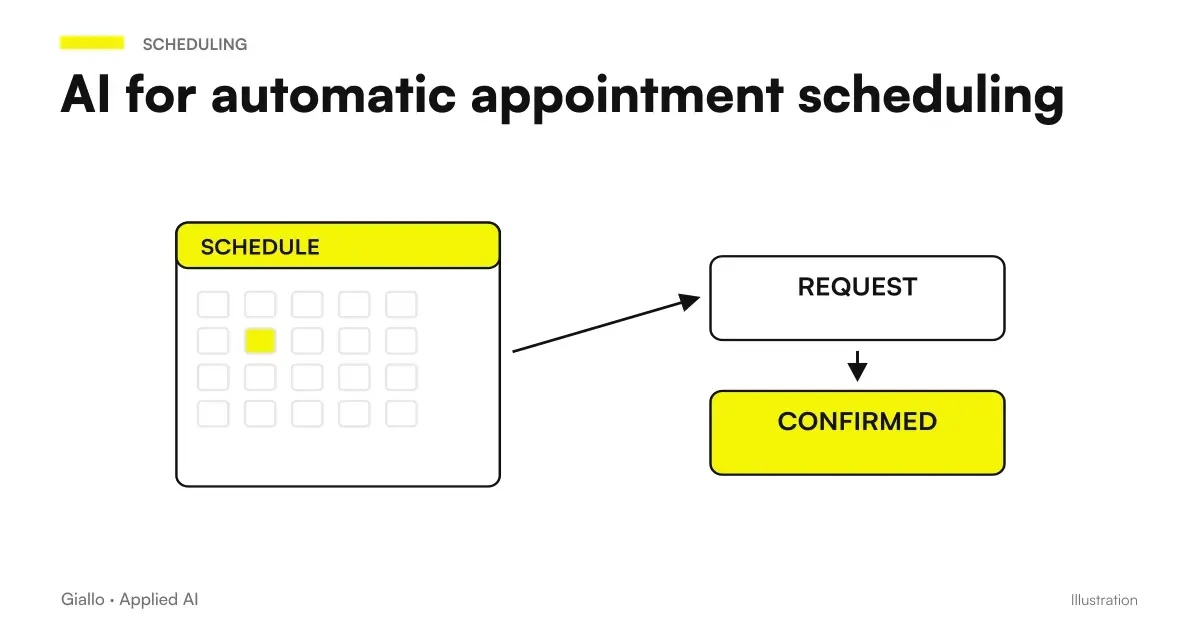
For reservations of measures and controls, a system that proposes free times and sends confirmation works as in other shops with agenda: find the details in the guide to Automatic appointments with AI.
Contact lenses: reorders, stocks and batch safety alerts
Contact lenses are the ground where AI makes the most in an optics store, because the rate of purchase is predictable. With the type of spare indicated on the product (daily, fortnightly, monthly) and the quantity bought, the system knows when the customer's stock is about to finish and can propose the reorder before it remains without. At the same time it tells you how many packs of each parameter you will need in the coming weeks.
The reorder message should be written carefully. It must speak of the escort, not the eye: no diopter, warp rays or diagnosis in the text, because those values are Health Data and a preview on the phone screen shows them to anyone. If the customer responds by reporting an annoyance, the assistant does not recommend eye drops or pauses: he fixes a check and alerts the optician.
Then there are the safety notices. The Ministry of Health publishes the letters of security information that manufacturers send in case of withdrawal from the market or other corrective action, and specifies that publication is not the only channel or a complete archive. If a notice is about a product you sell, for example a contact lens solution, the question is only one: who bought it? A sales log that keeps the lot allows the assistant to cross-check the notice with the purchases and prepare the list of customers to be notified, with the text indicated by the manufacturer.
What automatic message, to whom and with what data
Not all messages from an optics store have the same rules. Article 130 of the Privacy Code requires consent for commercial communications sent with emails, SMS, MMS and "other" messages; the exception for customers who have already purchased concerns only email coordinates and similar products or services. A withdrawal notice is a service message, a promotion on sunglasses is a commercial communication.
| Moment | Type Message | Data you need | To know |
|---|---|---|---|
| Glasses ready | "Your glasses are ready, come by whenever you want in the shop hours" | Envelope number, phone | Service message: starts only after final check |
| Glasses not withdrawn | Second notice, then phone call | Date of first notice | Nice tone, no pressure |
| New Lenses | "How do you find yourself with the new glasses?" | Lens type, delivery date | If there are annoyances you fix a check, no advice via chat |
| Stock of contact lenses | "Your escort is coming to an end, do you want us to order it?" | Type of spare, quantity, date of purchase | No visual parameter in text |
| New view control | Invitation to book | Date of last check | Treat it as commercial communication and collect consent |
| Sale and sunglasses | Period offer | Marketing Consent | Art. 130 of the Privacy Code |
| Security Notice | Lot information and manufacturer's instructions | Lot and buyer | Text agreed with the supplier, no reassurance invented |
The line of the new control is the one that is discussed the most. An invitation to return to the store may seem like a service, but it serves to sell: prudence wants me to send it to those who have agreed to receive commercial communications. If you have doubts about the legal basis, talk to your privacy advisor and read the guide on corporate privacy and AI tools.
Two shops, two priorities: the optical center with laboratory and the provincial shop
The optical center with internal laboratory. Get a store in town with three people at the counter and a lab in the back. The bottleneck is the phone: customers asking if the glasses are ready while the lab works. The assistant reads the status of the work envelopes, responds alone, sends the withdrawal notice when the optician closes the final check and, a few days after the delivery of the progressives, asks how it goes. Staff stop interrupting measures to answer the phone.
The provincial shop that lives on contact lenses. Here the owner works almost alone and a large part of the turnover comes from customers loyal to the same lenses for years. In our example the problem is the opposite: nobody forgets their glasses, but many customers finish their lenses and buy them online. The assistant calculates the deadlines of the stocks, proposes the reorganization a few days in advance, prepares the order to the supplier by grouping the requests. And if a notice comes out about a solution, the holder knows who to write to in an instant.
Keep these two cases as examples, not as result promises: how much time you recover depends on how many requests you receive today, and you only measure it by counting them before and after.
Prescriptions read from a photo and other typical errors in optics
- Read a prescription from a photo and propose lenses. A model can mistranscribe one value or exchange one eye for the other. The assistant collects the document, the optician reads it.
- Promise glasses that the norm reserves for prescription. If the customer declares astigmatism or hypermetropia, the automatic response asks for the prescription instead of immediately fixing the delivery.
- Advertising texts that exaggerate. Formulas such as "tailor-made certificate" or promises about eye health do not describe the optician's work and should be removed in review.
- Visual parameters in previews. A message with diopters or curves appears on the customer's locked phone.
- Offers to those who didn't ask for them. WhatsApp and promotional SMS without consent are the quickest way to get reported.
- Lotless sales log. When a security alert arrives, reconstructing purchases by heart takes days. Registering the lot at the sale costs a few seconds.
The first stream to automate, shop by shop
If you have an internal lab and the phone won't stop ringing
Start with the status of the work envelopes. Connect the assistant to the read-only management system, automatically answer timing questions, and start pick-up alerts only after the final check. After a month, compare the phone calls received with those from before.
If you mainly sell contact lenses
Start with the reorders. You need type of spare, quantity and date of the last purchase of each customer, plus the batch registered at the sale. With these data the assistant proposes reorders and prepares orders to the supplier, and the customer card in CRM stay updated without recopying anything.
If the problem is reservations for checks and measures
Start with the agenda. Define the duration of each type of appointment, the days when there are those who do the checks and the questions to be asked first, such as the doctor's prescription when needed. The rest of the store you can plug in later, one at a time. For the sales side at the counter you can find other ideas in the article on the AI for retail stores.
An optics store earns money when the assistant knows three things: where each work envelope is at, when each contact lens carrier's supply ends, and what messages it can send without consent. If you want to figure out which of these flows to start from, see how we work with stores on the AI page for retail and, if you need to connect management software, lab and WhatsApp, switch to our process automation.
Giallo Studio guides: methodology and sources
How we apply it in the company
Related resources
 AI for shops: customer messages, stock by size, returns and loyalty cards
 AI follow-ups: keep track of every contact
 AI WhatsApp Business automation: replies without touching your phone
 AI for automatic appointment scheduling
 AI for pharmacies: customers, service bookings and loyalty
 AI for wellness centres and spas: admissions, gift vouchers and packages
AI by sector
The same reasoning, applied to the other areas we follow.
- AI for customer onboarding: automate the first moment that matters
- AI for gyms and sports centres: class bookings, medical certificates and memberships
- AI for car workshops: quotes, appointments and customers
- AI for hairdressers and beauty salons: bookings and fewer schedule gaps
- AI for notaries and notarial firms: case files, documents and clients
- AI for SMEs: a practical guide to really getting started
- AI for shops: customer messages, stock by size, returns and loyalty cards
- AI for phone bookings
- AI for stock and inventory management
- AI for cleaning companies: specifications, shifts, DUVRI and safety data sheets
- AI for Logistics and Shipping
- AI for customer callbacks
FAQ
Can an optician sell glasses for astigmatism without a doctor's prescription?
Royal Decree 1334 of 1928, still in force, permits opticians to sell only protective glasses or glasses correcting simple myopia and presbyopia without a prescription, excluding hyperopia, astigmatism and aphakia. However, it permits repeat sales based on previous prescriptions kept in the shop or brought by the customer. For uncertain cases, ask your trade association.
Does the optician have to register with the database of manufacturers of custom-made devices?
No, according to the Ministry of Health’s FAQs: people who assemble and adapt corrective prescription glasses work with mass-produced devices adapted to the client, so they do not fall within the definition of a custom-made device manufacturer under Regulation (EU) 2017/745. They therefore do not have to register in that database.
Can the AI assistant tell the customer when to change contact lenses?
It can remind the customer that their supply is about to run out, calculating this from the replacement schedule indicated on the product and the quantity purchased. It does not assess the condition of their eyes or change parameters: discomfort, redness, or questions go to the optician and, if necessary, the doctor.
Can I send offers on sunglasses on WhatsApp to customers?
Only to those who have given consent. Article 130 of the Privacy Code requires consent for commercial communications via email, SMS, MMS and other messages; the exception for customers already acquired concerns only email addresses and similar products or services. Collection notices, on the other hand, are service messages.
What do I do if a safety alert comes out on a batch of lenses or contact lens liquids?
The Ministry of Health publishes the safety notices that manufacturers send in case of withdrawal from the market or corrective actions. If your sales register keeps the lot, you can find in a few minutes the customers who bought it and inform them following the manufacturer's instructions.
Do I need to change my business management software to use AI in an optician’s shop?
Not always. The assistant needs to read agenda, order status, prescription archive and purchase history: if the business management system you use allows you to export or link this data, you start from there. If it does not allow this, it is better to evaluate it before any other expenses.