
AI and corporate privacy: what happens to your data in AI tools
What happens to company data entered in ChatGPT, Claude, Gemini. Training, opt-out, enterprise plans, data residency: practical guide for SMEs.
Reading time: 9 min
Every time you paste a contract, a customer email, or an internal document into an AI tool, you are transferring that data to an external server. Where are they going? Who reads them? Can they be used to train the model?
These questions are not theoretical: they concern your company, your customers and your responsibilities as a data controller. Yet most SMEs use AI tools daily without ever having read a line of terms of service.
This article is not legal advice — for regulatory obligations GDPR laws AI and GDPR: What a company needs to know, for technical safety AI and enterprise data security. Here we focus on a more concrete question: what really happens to business data when you put it in an AI tool, and how to handle it responsibly.
What you find in this article
- The real flow of data: from the input to the provider's server
- Difference Between Free, Pro, and Enterprise Privacy Plans
- How the opt-out from training works and when it is available
- Data residency and extra-EU transfer for Italian SMEs
- Practical rules to give to employees
- How to choose an AI tool suitable for business data
What happens to the data you enter in an AI tool
When you write something in ChatGPT, Claude, Gemini, or Copilot, the text you send —whether it's a paragraph, document, or a question about a customer.is transmitted via HTTPS to the provider's servers. There it is processed by the model, which generates an answer.
The critical point is not the processing itself, but what happens after:
1. Temporary storage. The conversation is saved on the provider's servers for a variable period (hours, days, months) depending on the configuration and plan. This allows for "memory" between sessions, chat history, and the ability to do internal audits to the provider.
2. Human review. Some providers provide the possibility that human operators —typically security teams or quality assurance —can access conversations. It is usually limited to specific cases (reports of abuse, security audits, model improvement), but it exists.
3. Use for training. This is the most debated issue. AI providers collect data to improve their models over time. In some plans and configurations, your conversations can contribute to this training. In others, no — but the opt-out is not always active by default.
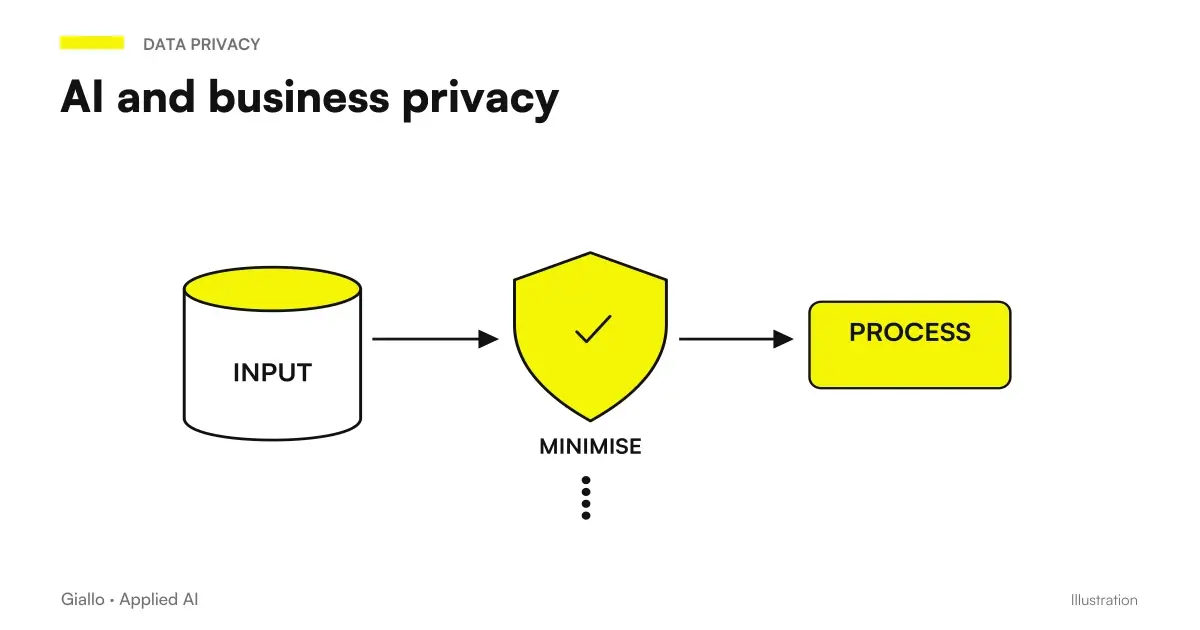
The complete flow is therefore: input → Secure Transmission (HTTPS) → processing on server → storage → possible use for training. Each step has different implications depending on the type of data entered and the plan used.
For an SME working with customer data, contracts, bank statements or medical information, even just temporary storage can have legal and reputational consequences. Analyzing Business Documents with AI Tools safely, the dedicated article covers practical cases.
The difference between free, pro and enterprise plan
Not all plans are the same on the privacy front. The general rule is simple: Free plans are not designed for confidential business data. But the real differences between levels vary from supplier to supplier.
| Plan | Use in training | DPA available | Data Residence | Suitable for business data? |
|---|---|---|---|---|
| Free / Consumer | Often yes (by default) | No | Uncontrollable | No |
| Pro / Plus | Depends on the settings | Rarely | Uncontrollable | Only with caution |
| Team / Business | No by default | Yes (usually) | Often configurable | Yes, with signed DPA |
| Enterprise | No by default | Yes, mandatory | Choice of region | Yes, for sensitive data |
| Direct API | No by default | Yes | Depends on configuration | Yes, with agreements in order |
This table is indicative: each supplier has their own policies and updates them frequently. Before choosing a plan for business use, always check the supplier's official page and, if there are any doubts, contact their sales or support team.
An often underestimated item: even with an individual pro plan, if the account is personal and not business, the provider may not offer a signatureable DPA. Without DPA, as a data controller you cannot prove that you have complied with the GDPR responsibilities on data transfer to third parties.
Opt-out from training: how it works and when it is available
Opting out of training is the ability to exclude your conversations from use for model training. Not all providers offer it, and it is not always active by default.
How it works in practice:
On some tools the opt-out is found in account settings, often under "Privacy" or "Data controls". On others it is automatically active for business plans and not available for free plans. On still others, the opt-out only applies to new conversations — previous ones may already have been processed.
Attention to these points:
- The opt-out does not necessarily erase the data already sent: it prevents future use for training, but the data already transmitted may have been processed in the meantime.
- Some vendors distinguish between "product enhancement" and "model training": disabling one does not disable the other.
- With API or enterprise plans, opt-out from training is typically contractually guaranteed in the DPA, which offers more certainty than just setting up the account.
The practical recommendation: for any non-public business data, only use tools where the opt-out from training is guaranteed by contract (i.e. in the DPA), not only available as a setting. Settings may change; contracts may not, except renegotiation.
Data residency and extra-EU transfer: what it means for Italian SMEs
Most major AI providers are American: OpenAI, Anthropic, Google, Microsoft. This means that, unless you have specific configuration, the data you submit is processed on servers in the United States.
For Italian and European companies, this creates a specific GDPR issue: the Transfer of personal data outside the EU is subject to precise requirements. It is not prohibited at all, but requires that adequate safeguards exist — typically the Standard Contractual Clauses (SCC), a contractual mechanism approved by the European Commission.
What it means in practice:
- If you use an American AI provider with a plan that includes DPA, check whether the DPA includes SCCs for EU data transfer→USA.
- If there is no signatureable DPA, transferring personal data from European customers can be problematic from a GDPR point of view.
- Some vendors offer choice of processing region — e.g. EU servers. This option is almost always only available in enterprise plans.
Not all the data you enter in an AI tool is "personal data" under the GDPR. A purely internal document with no reference to identifiable natural persons is different from an email with a customer's name, surname and contacts. But the distinction is not always clear, and the risk of mis-entering personal data into an inadequately configured tool is real.
To understand how to manage this theme in a structured way, read AI and GDPR for Italian companies — a specific article on regulatory obligations. For operational advice, our page services describes how we support SMEs in introducing AI in a compliant manner.
Practical Rules for Employees
Corporate policies on the use of AI tools are still rare in Italian SMEs. Yet a few clear rules are enough to significantly reduce risk.
- Never enter customer personal data in free or unapproved AI tools. First name, last name, email, phone number, health data, financial data — out of consumer tools.
- Do not paste contracts, NDAs, or confidential documents into unapproved tools. If the document is confidential to the client, so is the AI tool that receives it.
- Use only company-approved tools, with a DPA signed between the company and the supplier. Approval must be explicit, not implied.
- Do not share login credentials or API key. The AI account is personal or business — never shared between multiple people without an access management system.
- Do not enter non-anonymous financial data (account extracts, transaction details, payroll data) without having verified the supplier's policies and obtained approval.
- If in doubt about what you can insert, ask before doing so. A minute of verification is worth more than a week of handling a potential breach.
- Report now any accidental insertion of confidential data into unapproved tools la timeliness is critical to limiting damage.
These rules do not replace a formal corporate policy on the use of AI tools, but represent a concrete starting point that you can communicate to your team this week. If you're introducing AI to the company in a more structured way, Our Practical Guide for SMEs It also covers the decision-making framework to choose the right tools.
How to Choose a Secure AI Tool for Business Data
For an evaluation of the individual supplier, Kimi AI and privacy keeps the conditions of the app separate from those of the API. If the project provides tools and actions, also read how to define Responsibilities and controls for Kimi agents. For a specific service it is necessary to verify documentation and path of the chosen data; privacy and business data with JEV AI proposes an initial test with minimized information and explicit language criteria.
There is no universally secure AI tool for all types of data. Security depends on the combination of instrument, plan, configuration, and data type. That said, there are criteria you can use to evaluate any supplier.
Criteria to be verified:
1. DPA available and signable. The provider must offer a Data Processing Agreement that you can sign as a company. Without DPA, you cannot prove that you have complied with GDPR responsibilities as a data controller.
2. Opt-out from contractually guaranteed training. It is not enough that there is a setting —it must be written in the DPA that your data is not used to train models.
3. Data residence. Where is the data processed and saved? Preferably EU, or with explicit SCC for EU transfer→USA.
4. Data isolation per tenant. In an enterprise plan, are your data logically separate from other customers'? This reduces the risk of cross-contamination.
5. Supplier security history. Has the supplier suffered a breach in the past? How did it communicate and manage it? Transparency in the event of an accident is an indicator of maturity.
6. Certifications and audits. SOC 2 Type II, ISO 27001 and similar certifications indicate that the supplier has third-party verified security processes.
Don't just rely on marketing. AI vendor product pages tend to emphasize functionality and minimize privacy limitations. Read the terms of service, the DPA, and if necessary involve a legal advisor for evaluation — especially if you treat particular categories of data (health data, financial data, child data).
Practical examples — two SME scenarios
Scenario 1: the firm of accountants
An accountant uses ChatGPT in the free version to analyze financial statements and prepare reports. Upload documents with company name, turnovers, bank details and tax information.
The problem: the free plan does not guarantee opt-out from training by default, does not include a DPA and does not offer control over the residence of data. Customer data — which is confidential business data and in some cases personal data — is transmitted to US servers without the contractual guarantees required by the GDPR.
The practical solution: switch to an API or enterprise plan with signed DPA, or use an AI tool with available EU and DPA servers. Before choosing, check with your privacy advisor if the treatment is compliant. To learn more about the specific use of AI in accountants, see our section AI for accountants.
Scenario 2: The HR manager who uses AI for CVs
An HR manager uses a consumer AI tool to skim hundreds of resumes: paste CVs directly into the chat to get a synthetic evaluation.
The problem: CVs contain personal data (name, surname, date of birth, address, health information if indicated, nationality). Inserting them into a tool without DPA violates the GDPR on first use. The candidate did not consent to the transfer of his/her data to a third party AI provider.
The practical solution: use HR-specific tools with integrated DPA, or integrate AI directly into the enterprise ATS system via API, where data processing is contractually defined. Alternatively, anonymize CVs before entering them — removing name, contacts, and any identifying data — before using them as input for the AI tool.
These two scenarios are representative of situations that we often see in Italian SMEs. These are not limit cases: they are the norm. If you want to understand how to structure the use of AI in a compliant manner in your company, Contact Us for an initial assessment.
The main AI providers: where do they process the data?
This information is indicative and subject to change. Always check the supplier's official page for up-to-date information.
OpenAI (ChatGPT, API)
Servers mainly in the US. Plan Enterprise offers DPA, opt-out from training by default, and in some cases region choice. Free plan and Plus: opt-out available in settings but not contractually guaranteed. Verification: openai.com/policies
Anthropic (Claude)
Servers in the USA. Claude for Work plan (Team/Enterprise) includes DPA and opt-out from training by default. Free plan: use of data for product improvement by default. Verification: anthropic.com/privacy
Google (Gemini, Workspace AI)
US and global servers. Google Workspace Business and Enterprise include DPA (via the terms Google Cloud) and data residency guarantees. Gemini consumer: Google standard policy. Verification: workspace.google.com/terms
Microsoft (Copilot, Azure OpenAI)
US and EU servers (configurable). Microsoft 365 Copilot for enterprise includes DPA and GDPR guarantees through the terms Microsoft Online Services. Copilot consumer (Bing): standard policy. Azure OpenAI Service offers choice of EU region. Verification: microsoft.com/trust-center
For law firms that process sensitive data, see also our section AI for law firms — a use case where data residency and DPA are not optional.
Mistakes to Avoid
Assuming that "HTTPS = safe for any data". HTTPS protects data in transit, establishes nothing about how it is stored or used after it is received.
Using free plans for confidential business data with the logic that "so much is just a test". Tests with real data transfer real data.
Confusing "the supplier is serious" with "the plan I use is adequate". OpenAI, Google, and Microsoft are serious companies — but their free plans don't include the same guarantees as enterprise plans.
Not updating internal policies when adopting new tools. Every new AI tool used in the company should be evaluated, approved and added to the GDPR processing register.
Relying on privacy settings without DPA. The settings may change with an update of the terms of service. The DPA is a contractual commitment with legal value.
Not training employees. Most privacy incidents arise not from external attacks, but from internal unintentional behavior. Few clear rules to communicate well are worth more than a 30-page policy that no one reads.
To understand how to avoid even the AI hallucinations that can create operational and legal problems, the dedicated article addresses the topic with practical examples. And if you want to build a solid foundation on what are the AI tools you are evaluating, What are AI Agents It's a good place to start.
How to apply it in the company
First step: inventory of tools in use. Before you make any policy, find out which AI tools are already being used by employees — often unofficially. An anonymous internal survey gives more accurate results than any formal audit.
Step two: classify the data you process. Define internally which types of data are "reserved" (customer personal data, financial data, contracts, corporate IP) and which are "public" or "non-sensitive". This classification determines which AI tools can be used for which tasks.
Third step: to approve the appropriate instruments. For each data category, define which tools are approved — with signed DPA and verified configuration. Not a list of "prohibited instruments" (impossible to enforce) but a list of "tools approved by data category".
Step four: Communicate the rules in a simple way. An internal page with concrete examples ("you can use X to make Y, you can't use X to make Z") is more effective than a legal-style document. Employees don't read policies — they read examples.
Step Five: Periodic Review. Vendor policies change, tools change, use cases in the company change. Schedule a six-month review of approved tools.
If you're evaluating an AI consultancy for your company, the governance on the use of tools is one of the first issues we face — because introducing AI without a minimum framework of rules creates risks that then cost more than the benefit.
Conclusion
The data you enter in an AI tool does not disappear after you have received the response. They are transmitted, processed, stored — and in some cases used to train the model. Knowing exactly what happens depends on the supplier, the plan and the configuration.
The good news is that most of the problems described in this article have concrete solutions: choose the right plan, sign a DPA, activate the opt-out from training, define clear rules for employees. It does not require large technical investments — it requires conscious decision-making before adopting a tool.
For Italian SMEs who want to use AI responsibly, the starting point is not technology: it is to understand what data you work with and what guarantees you require from the tools you adopt.
Read more:
- AI and GDPR: what an Italian company needs to know — specific regulatory obligations
- AI and enterprise data security — technical protective measures
- AI for the business knowledge base — how to structure a secure internal AI system
Do you have doubts about how to manage data privacy in your company with the use of AI tools? Contact Us va let's evaluate the situation together without commitment.
Giallo Studio guides: methodology and sources
How we apply it in the company
Related resources
 AI and GDPR: What a company needs to know before using AI
 AI and data security: concrete risks and how to manage them
 AI for business document analysis: a practical guide
 AI for SMEs: a practical guide to really getting started
 AI consulting for companies: what it is and when it is needed
 AI for craftspeople: custom quotes, job orders and electronic invoicing
 AI for car rental: renter fines, contracts and return damage
 AI for plumbers: quotes, on-site jobs and customers
FAQ
Are the data I enter in ChatGPT used to train the model?
It depends on the plan and settings. In the free version of ChatGPT, by default conversations can be used to improve models (with opt-out available in settings). With ChatGPT Team, Enterprise or API, data is not used for training by default. Always check your account settings and the provider’s official page, which can update policies.
How do free and enterprise plans differ in terms of privacy?
Enterprise plans usually offer: no data use for training by default, DPA available to sign, choice of data processing region, more control over security settings. The free plan is designed for personal use and not for confidential business or professional data.
Where is data processed when I use an AI tool?
It depends on the provider and configuration. The main American providers (OpenAI, Anthropic, Google, Microsoft) process data on their own servers, often in the US. For EU businesses, this raises GDPR issues around transfers outside the EU: check whether the provider has SCCs (Standard Contractual Clauses) and a DPA that can be signed.
What rules should employees follow when using AI tools?
The basic rules: do not enter customers’ personal data into free/consumer tools, do not paste confidential contracts, and do not share credentials or financial information that has not been anonymised. Use only company-approved tools with a compliant DPA. Any doubt about what may be entered → ask before doing it.
How do you choose an AI tool that respects corporate privacy?
Check whether a DPA is available and can be signed, where the data is processed (preferably in the EU or with SCCs), whether business plans opt out of training by default, whether data remains isolated by tenant, and whether the company has experienced data breaches in the past. Do not rely only on the provider’s marketing.