
AI for notaries and notarial firms: case files, documents and clients
AI for notaries: automate preparation for due diligence, registry extract comparison and missing documents, while keeping decisions with the notary.
Reading time: 11 min
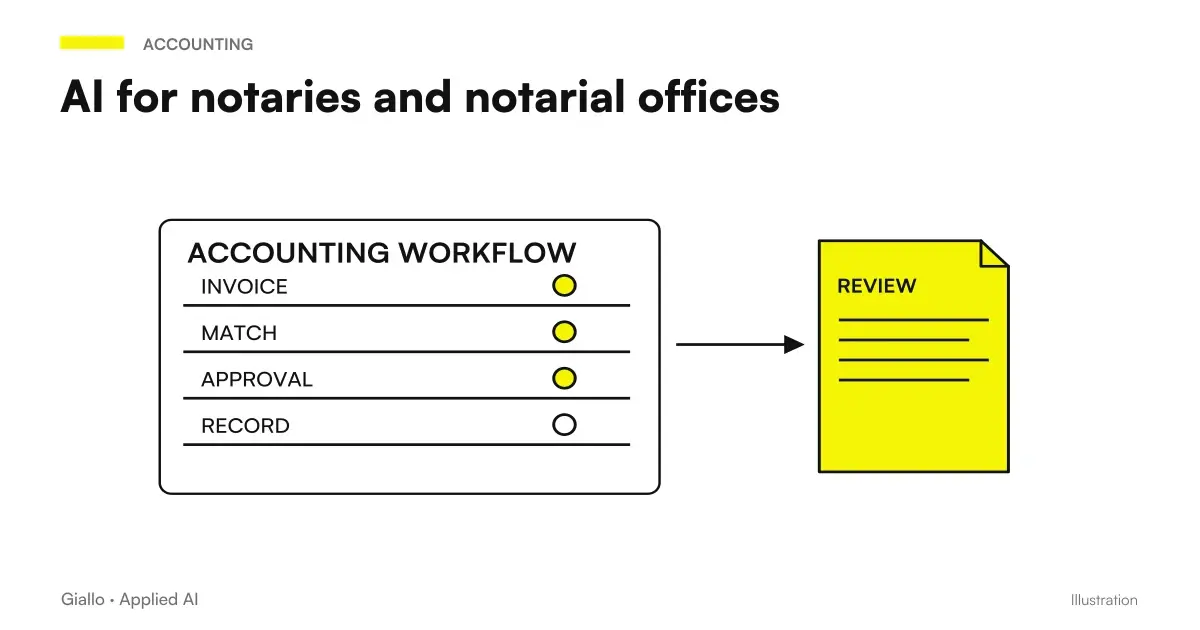
In the notarial study the AI for Notaries makes more before the stipulation: sort the emails that come from parties, real estate agencies and banks, prepares the file of the appropriate anti-money laundering verification, compares security and deed of provenance and keeps updated the list of documents that are missing. It stops where the law calls into question the notary himself. L'Article 47 of the Notary Law entrusts him with the investigation of the will of the parties and the complete compilation of the act "under his own direction and responsibility".
Two more recent texts draw the same boundary. The Law 132/2025 on Artificial Intelligence, in Article 13, admits AI in the intellectual professions only for instrumental and supportive activities, with prevalence of the intellectual work of the professional. principles of professional deontology of notaries, in the text in force from 25 May 2026, reserve to the notary the identification of the parties, the investigation of the will, the direction of the compilation also of the digital act, the reading and custody of the digital signature.
Here you will find the practice followed step by step: what can be prepared automatically, what remains on the notary's desk and what checks are needed for customers' documents to remain inside the perimeter of professional secrecy.
In summary
- In the notarial study the AI renders more in the investigation: classify incoming documents, fill out master records, report what is missing for that type of act.
- For proper anti-money laundering verification can reconstruct from a camaraderie the chain of control of a company, but the risk assessment and any reporting remains of the notary.
- Before transferring a building the notary must identify the cadastral owners and verify their compliance with the real estate registers: the AI prepares the comparison, the check remains his.
- An assistant who responds to customers must not have access to anything that involves reports of suspicious transactions: the law prohibits communicating them to the customer or to third parties.
- No customer documents should be pasted into a free chatbot: they need a contract with the provider, data in a known perimeter and written rules for collaborators.
A phase-by-phase notary practice: what is being prepared and what the notary signs
A mutual buy and sell brings papers from at least three directions to the studio. The real estate agency sends the preliminary and the contact details of the parties, the bank decides to mortgage with its requests, the customers personal documents, often one piece at a time between emails and WhatsApp. To these are added the visures and inspections that the study makes on its own.
The recurring work is always the same: understanding which case an attachment belongs to, copying its data into the business management software, and telling the customer what is missing. The table sets out the stages; its last column states what notarial law, anti-money laundering legislation and professional ethics assign to the notary.
| Stage of practice | What comes or is produced | What Automation Can Prepare | What Remains to the Notary |
|---|---|---|---|
| First Contact | Agency emails, phone calls, quote requests | Open the practice, classify attachments, summarize the request | Accept the assignment and define the fee |
| Appropriate verification | Identity Documents, Camera Visures, Customer Statements | Extracting data, reconstructing the chain of control, listing gaps | Identify the parties, assess the risk, decide whether to report |
| Sights and provenances | Land registry, mortgage inspections, deed of provenance | Comparing data and marking differences | Checking the letterheads, deciding how to heal the discrepancies |
| Draft and stipulation | Preliminary, mortgage resolution, payment data | Precompiling registry and cadastral description in the study model | Investigate the will, direct the compilation, read and sign |
| After signing | Recording, transcription, voltura, copies | Internal reminders and progress | Check the formalities personally |
The first saving comes from the third column, i.e. from the work of grading and recopying. It is the same theme as the Analyzing Business Documents with AI, with a difference that weighs: here any data extracted can end up in a public act. For this reason, each precompiled field must indicate the document and the page from which it comes, so the collaborator checks it without reopening the entire file.
The law firms have close but different needs, related to litigation and procedural terms: you can find them on the page dedicated to the AI for law firms.
Adequate Anti-Money Laundering Verification: File Prepared, Evaluation Not
The d.lgs. 231/2007, in Article 3, paragraph 4, letter c), includes notaries among obliged professionals when assisting clients in transactions such as the transfer of real rights to real estate or the establishment and management of companies. L'Article 18 explains what the appropriate verification consists of: identifying the customer and verifying their identity, identifying the beneficial owner, collecting information on the purpose and nature of the performance, keeping the relationship under control over time. As a rule, identification and verification are made before the assignment is given; paragraph 3 allows a postponement of verification only in the presence of low risk.
On collecting work the AI lends a concrete hand. It reads identity card and tax code and fills out the registry card. From a camaraderie visura he obtains partners, shares and directors; if the partner is in turn a company, he follows the chain until he arrives at natural persons, and if he interrupts he says where. Prepare the questionnaire on the purpose of the operation with the questions chosen by the study and return to the collaborator the list of what is missing.
Some steps remain out of automation. The verification of the identity of the parties, for Article 41 of the principles of ethics, is the sole responsibility of the notary, even if a software has already read the document. The risk assessment is his, and so is the decision to report a suspicious operation: a score calculated by a model can at most draw his attention to a file.
The file must be kept for 10 years from the end of the service, as provided for in the Article 31 of the Decree. If the tool creates working copies on an external service, you need to know where they are, who can read them and when they are deleted.
Land registry and real estate registers: the comparison before the deed
For transfers of existing buildings, the Article 29, paragraph 1-bis, of Law 52/1985 requests that the act contain, under penalty of nullity, the cadastral identification, the reference to the plans deposited in the cadastre and the declaration of the holders on compliance with the deed, replaceable by the attestation of a qualified technician. The same rule assigns the notary a precise task: before the stipulation it identifies the cadastral holders and verifies that they coincide with the results of the real estate registers.
It is a comparison of documents born at different times, and this is where automatic reading saves more time. A well-set system reads cadastral visa, notes of transcription and deed of provenance, puts in column names, quotas, rights and identifiers and marks the lines that do not return. If you have to choose the tool, the comparison on the best AI model for extracting data from documents explain how to test them on your files.
The discrepancies are familiar to every member of staff: a deceased registered owner for whom the ownership record has never been updated, a co-ownership share that differs between the land register and the deed, or an identifier changed after an update. Older title deeds are often scans of typewritten copies, and reading errors are more frequent on these: the system must mark uncertain fields rather than fill them in by intuition. Deciding whether a discrepancy prevents execution of the deed, and what to ask the parties for, remains the notary’s judgment.
Professional secrecy: the questions to ask before uploading a document
The notarial secret also has procedural protection. The Article 200 of the Code of Criminal Procedure places notaries among those who cannot be obliged to testify on what they have known for the reason of the profession, except in cases where there is an obligation to report it to the judicial authority. Article 43 of the principles of deontology extends confidentiality to persons who turn to the study, the content of the performance and all that the notary learns, and asks him to enforce it to employees, collaborators, practitioners and trainees.
On study day the useful question is about the path of the document, not the AI in the abstract. Before adopting an instrument, check these points:
- The provider signs a contract that appoints him as data processor and indicates in which countries servers and backup copies are located.
- The contract excludes in writing the use of study documents to train models.
- Each employee enters with a registered user and the operations remain registered.
- You know after how long uploaded files, transcripts, and conversation history are deleted.
- There is a written rule, shared with contributors, about what tools to use and what to never upload to personal accounts.
To write the internal rule you can start from the guide to corporate policy on the use of AI; the clauses to be read before signing are in the article on contract with an AI provider. For the most delicate practices there is also the road of the Local AI Models, installed on machines of the studio.
Then there is a limit regarding the after stipulation. Article 42 of the principles of ethics asks the notary to personally check the formalities dependent on the act, even when the material preparation is entrusted to the collaborators, and does not allow to outsource those obligations. If a provider proposes to deal with recordings and voltures instead of the firm, talk to your notary board first.
Two example practices, from the first email to the signature
Buy sale with mortgage in a studio with two collaborators
Think of a provincial study that receives an apartment preliminary from the agency. The system opens the practice, attaches the preliminary, extracts parts and immobile and prepares the list of documents to be asked for that type of act. When the visura arrives, the comparison signals a red line: in the preliminary the seller is only one person, in the cadastre result he and his father, who died for years, because after the succession no one asked for the voltura.
The collaborator brings the card to the notary, who decides what to ask the parties before setting the date. Meanwhile, the bank writes to know where the practice is: the answer proposed by the system contains the expected date and the documents still expected, nothing more. In this example the AI did not decide anything; it brought out the discrepancy at the opening of the file instead of on the eve of the deed.
Sale of shares with a partner who is a company
A family business sells a share to a holding company. From the holding company's chamber view the system derives that the majority shareholder is a foreign company and that there the chain stops: it signals that documents are missing to trace back to the actual holder and prepares the request to the customer, along with the questionnaire on the purpose of the transaction.
The notary reads the file, assesses whether the information is enough and whether the operation deserves further investigation. None of this evaluation appears among the data accessed by the assistant writing to customers. The collaborator avoided reconstructing the company chain by hand; the decision remained where the law puts it.
What an AI Assistant Doesn't Have to Tell Studio Clients
The first limit concerns tax and legal responses. Facilitations, tax regimes and consequences of a choice depend on the facts of the individual practice, and the rules change: on Normative, for example, the Article 13 of Presidential Decree 131/1986 is repealed from 1 January 2027 as a result of the new single text of the register tax (d.lgs. 123/2025). A model that responds to memory does not know, and produces precisely the hallucinations that a notarial firm cannot afford.
If you want an assistant for recurring questions, have them answered only by texts approved by the study, with the technique described in the guide to RAG: lists of documents by act type, times, appointment mode. Everything else passes to one person.
Then there is transparency. From August 2, 2026 the Article 50 of the AI Act calls for systems designed to converse with people to be built so that they know they are writing to an AI. Law 132/2025 adds that the professional communicates to the client which AI systems he uses, in understandable words: a sentence in the information or in the letter of assignment is the starting point.
At the level of the category, the president of the National Council of the notary, Vito Pace, in a editorial published by Notartel in September 2025 defined AI as a resource on which to start deepening and training, specifying that it will not be able to replace the public function of the notary.
From which step of the practice to start
It is advisable to start from the internal work, which does not talk to customers: classification of incoming attachments and list of documents by type of act. It is the lowest risk point and immediately makes visible how much time goes into recopying. The file of the appropriate verification comes after, built on the modules that the firm already uses; the assistant for customers last, with the limits described above.
To see if it works it measures three things before and after: how many practices come complete when setting the date, how many integration requests start to customers and banks, how long employees spend copying data from one document to another. If the numbers do not move, the problem usually lies in the way the documents arrive, more than in the chosen model.
If you want to understand which steps of your investigation can be prepared automatically without customers' documents leaving the perimeter of the studio, the starting point is a audit of processes done on your actual practices.
Giallo Studio guides: methodology and sources
How we apply it in the company
Related resources
 Best AI model for extracting data from documents
 Contract with an AI provider: what to check
 Local AI models: when they make sense
 Corporate policy on the use of AI: how to write it
 AI Hallucinations: What They Are and How to Avoid Them
 AI for restaurants: reservations, allergens and responses to reviews
AI by sector
The same reasoning, applied to the other areas we follow.
- AI for shops: customer messages, stock by size, returns and loyalty cards
- AI for car workshops: quotes, appointments and customers
- AI for stock and inventory management
- AI for customer onboarding: automate the first moment that matters
- AI for Logistics and Shipping
- AI for opticians: prescriptions, collections, contact lenses and recalls
- AI for business knowledge bases: find the information you need
- AI for gyms and sports centres: class bookings, medical certificates and memberships
- AI for estate agencies: leads, viewings, listings and documents
- AI for hairdressers and beauty salons: bookings and fewer schedule gaps
- AI for plumbers: quotes, on-site jobs and customers
- AI for SMEs: a practical guide to really getting started
FAQ
Can I paste a registry extract or ownership deed into a free chatbot to have it summarised?
It is better not to. A notary’s professional confidentiality also covers case contents, and with a free or personal account you cannot be certain where the data ends up or whether it is used to train models. Use a tool with a contract appointing the provider as data processor, and recheck extracted data before it enters a deed.
Can AI carry out anti-money laundering customer due diligence instead of staff?
It can prepare the file: extract data from documents, reconstruct a company’s chain of control from a company register extract, and list what is missing. Identifying the parties, assessing risk, and deciding whether to file a report remain the notary’s responsibility, as required by Legislative Decree 231/2007 and the principles of notarial professional ethics.
Do I have to tell clients that the firm uses artificial intelligence tools?
Yes. Article 13 of Law 132/2025 requires intellectual professionals to tell the client which AI systems they use in clear, simple, and comprehensive language. An understandable sentence in the privacy notice or engagement letter is the starting point; if an assistant also converses with clients, it must make clear that it is an automated system.
Can an AI assistant tell a client the status of their case?
It can provide organisational information, such as documents still awaited or the scheduled signing date. It must not have access to internal anti-money laundering notes, because the law prohibits telling the client or third parties that a report has been filed or further investigations are underway. Keep the data the assistant can use to answer separate.
Can AI draft a deed from the preliminary agreement?
It can prefill repetitive parts of the practice’s template, such as personal details and the cadastral description, identifying the document from which each item of data was taken. Establishing the parties’ intentions and directing the drafting are the notary’s responsibilities under notarial law and professional ethics, even when the deed is digital.
Has the National Council of Notaries given guidance on the use of AI?
In a 2025 editorial, president Vito Pace discussed a period of further study and training, making clear that AI cannot replace the notary’s public function. The practice’s concrete reference remains the principles of professional ethics, which reserve identification of the parties, establishing their intentions, directing the deed, and confidentiality to the notary. For specific questions, contact your district notarial council.