
Kimi AI vs ChatGPT: which to choose for work?
Kimi AI vs ChatGPT for documents, Excel, presentations and research. Compare features and controls according to the work you need to complete.
Reading time: 11 min
Kimi AI vs ChatGPT is a comparison between products, not just between models. The choice depends on what you have to deliver: a documented note, a sheet analysis, a presentation or a search. Both document activities on files and information; these descriptions do not prove a universal winner.
The Kimi Mode Guide describes models, tools and editable files. OpenAI documents summary, comparison and analysis of attachments in the ChatGPT upload guide. Actual availability should be checked in the plan and account settings.
This comparison uses official documentation consulted on 9 October 2026. It does not have independent benchmarks, generative tests carried out or quality measures of Italian. It proposes criteria to choose on real work, keeping separate documented skills and results to be verified.
In summary
- Compare Kimi and ChatGPT on the same task, with equal sources and criteria.
- For documents, traceability counts; for sheets, rules and reconciliation of numbers count.
- An editable file should be opened and checked in the target program.
- In-depth research and quotations do not guarantee correct sources or a complete picture.
- Accounts, settings, allowed data and review are part of the product choice.
What job do you want to entrust to Kimi or ChatGPT?
Before comparing interfaces, write the expected result. "I need an AI for the office" is too wide. "I need a table that compares conditions present in public offerings and signals those absent" delimits sources, transformation and acceptance criteria.
The Guide to Kimi AI distinguishes apps, models, Codes and APIs. The Guide to ChatGPT Helps frame the assistant. To compare products, write down the actually used mode, available materials, and accessible functions. A difference in the plan can affect the result without demonstrating a general difference between models.
If your goal is to write a draft, evaluate clarity and loyalty to information. If you need to process data, evaluate rules and numbers. If you need to update a management system, the choice requires an integration with permissions and verifications: manual chat is only a possible trial phase.
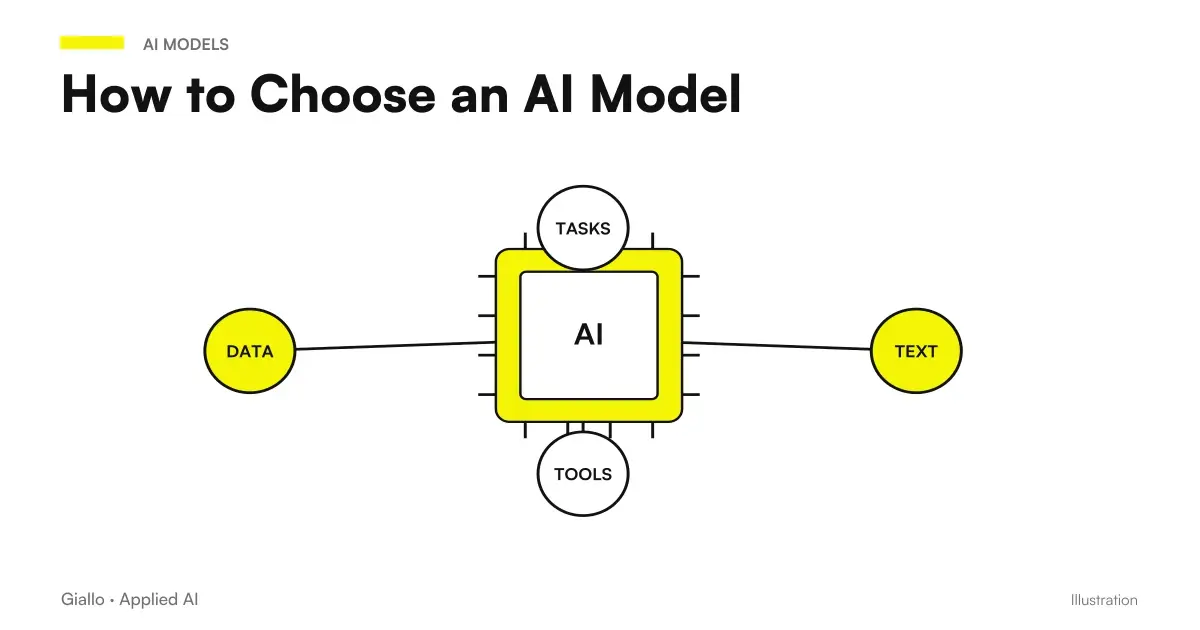
The Guide to choosing an AI model helps structure the reasoning. You don't have to assign a vote to everything: choose the criteria that affect the concrete delivery.
What do the two products document for file and search?
The table summarises capabilities described in the official sources: Kimi Mode, ChatGPT uploads, Deep Research Kimi and Deep Research ChatGPT. It does not assign judgments of accuracy or speed.
| Task | Kimi: documented capability | ChatGPT: documented capability | Criterion for your test |
|---|---|---|---|
| Documents | Upload and work on materials | Synthesis, comparison and extraction from attachments | Correct references and visible omissions |
| Sheets | Work on XLSX data and production with K3 | Analysis of loaded sheets | Totals, filters, and missing data management |
| Presentations | PPTX production modifiable with K3 | Work on uploaded presentation content | Loyalty to sources and usability of the artifact |
| In-depth research | Report with quotations and exports | Report with sources, plan and perimeter control | Relevant, up-to-date and traceable sources |
| Continuity of work | Project and memory documented in help | Projects with chat, files and instructions | Separation of contexts and correct versions |
For the last line, the references are the Kimi App Capability and the OpenAI Projects documentation. This table is not an exhaustive inventory: an unquoted function should not be considered automatically absent.
Kimi or ChatGPT to analyze PDFs and documents?
The first distinction is between summary and extraction. A summary chooses what to keep; an extraction must report fields, references, and absences. If you judge the two products only by the readability of the text, you could reward the one that best hides the missing details.
For a document comparison, prepare a grid of conditions and ask both of them to associate each value with the source step. Check one source for each important conclusion. If a bid does not show a guarantee, the correct response must show the absence, without completing it using industry practice.
The method described in Kimi for PDFs and documents can be applied to the comparative test. The guide to ChatGPT for document analysis tackles the work on attachments. Uses the same files, preserving versions and dates.
For scans, graphics, and complex layouts, check the actual treatment in the product and plan. The successful upload does not prove that every item has been read. If the task depends on a difficult table, the first test must be about that very table, not just the introductory text.
Which one to choose for Excel and data analysis?
Define first what each column means. An amount may be net or gross, an order may have multiple rows and a date may refer to issue or delivery. If these rules remain implicit, two different analyses may seem plausible and both prove unnecessary.
The test must include a total already checked and cases that test the rules: duplicate lines, missing values, credit notes or overlapping periods. Ask to describe filters and transformations. A clear graph does not count as data reconciliation.
Kimi documents production of XLSX with K3 in app mode; ChatGPT documents sheet analysis and visualizations in the upload guide. These capabilities do not guarantee the correct application of your business rules.
The comparison between Kimi for Excel and ChatGPT for Excel must then arrive at the actual file or analysis. Checks if formulas are present where required, if references work, and if a data change updates the result as expected. Do not infer these properties from the file extension.
What product to evaluate for a presentation?
For Kimi the production of modifiable PPTX is explicitly documented in the mode guide. For ChatGPT the upload documentation describes the work on presentations and attached content; we do not use that page as proof of any possible export function.
A production capacity can be relevant if your assignment requires an editable artifact. The comparison must, however, arrive at the open presentation in the destination program. Check for titles, charts, sources and visible text. If you have to redo the message from scratch, the delivered file has not solved the job.
Prepare the approved structure first and then the visual appearance. If AI adds data to make the story more compelling, the review must delete or verify it. A prompt must specify which messages are mandatory and which statements cannot be introduced.
The Guide to presentations with Kimi enters into the distinction between narrative and layout. To choose the product consider the final format and team revisions, not just the appearance of a single slide in the chat.
How can you compare deep research without counting citations?
Kimi documents reports with quotations and exports in the Deep Research Guide. ChatGPT documents a search with editable plan, selection of sources and reports with references in the Deep Research OpenAI Guide. Availability and use depend on account conditions.
It uses a circumscribed demand and the same rules: Italian market, defined period and priority to primary sources. Ask to distinguish data, supplier statements, and interpretations. The number of links does not alone measure reliability: repeated or irrelevant sources can increase the appearance of depth.
Open the references supporting the main conclusions. An official page may be dated or relate to another offer. Ask to report contradictions instead of turning them into a uniform synthesis. Research work is useful when it makes visible what remains uncertain.
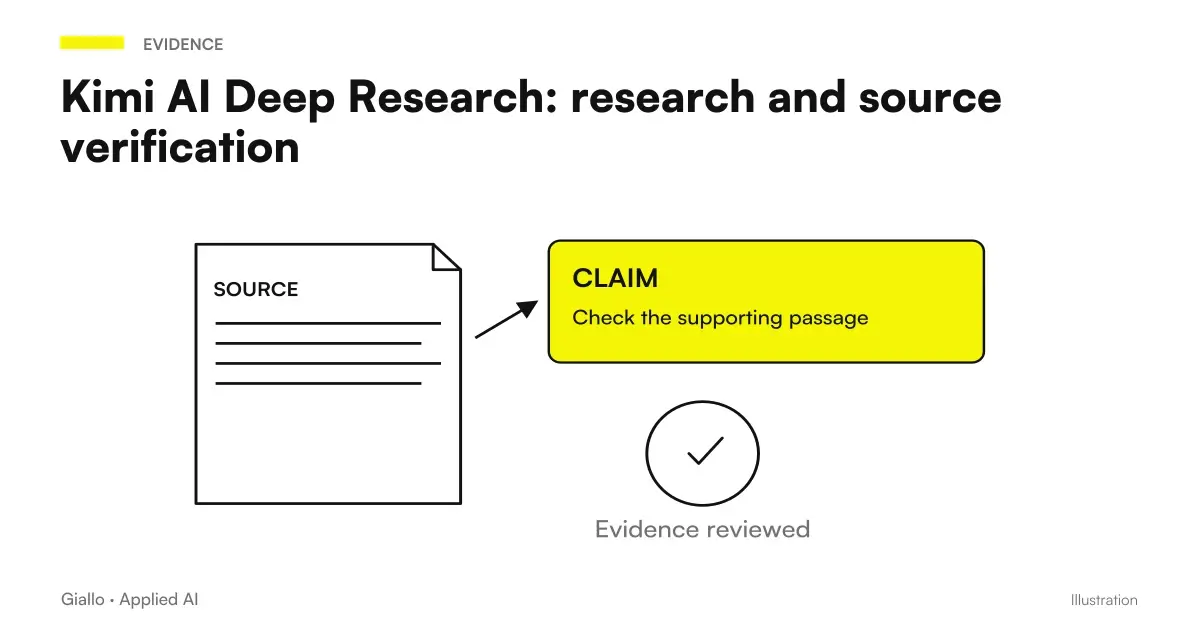
The route on Kimi Deep Research deepens these controls. For the comparative test do not assume times or quality equal to statistics published by the supplier: observe the executions allowed and declare their perimeter.
How important is how the team retains context?
OpenAI documents Projects as spaces that bring together chats, files and instructions, with conditions of memory and sharing in the Official Guide. Kimi documents Project and Memory in help on skills. They are not sufficient reasons to declare behaviors identical.
If the work is recurring, check how to separate stable instructions and data from the individual assignment. The editorial tone may remain; prices, periods, and versions must change. The chosen product must allow the team to recognize which sources are current and which have been superseded.
The useful proof includes an update: replace a source with a new version and see if the result uses the correct one. It also controls who can access the materials. A comfortable but ungoverned context can transfer information between activities that were to remain separate.
How to compare privacy and costs without mixing offers?
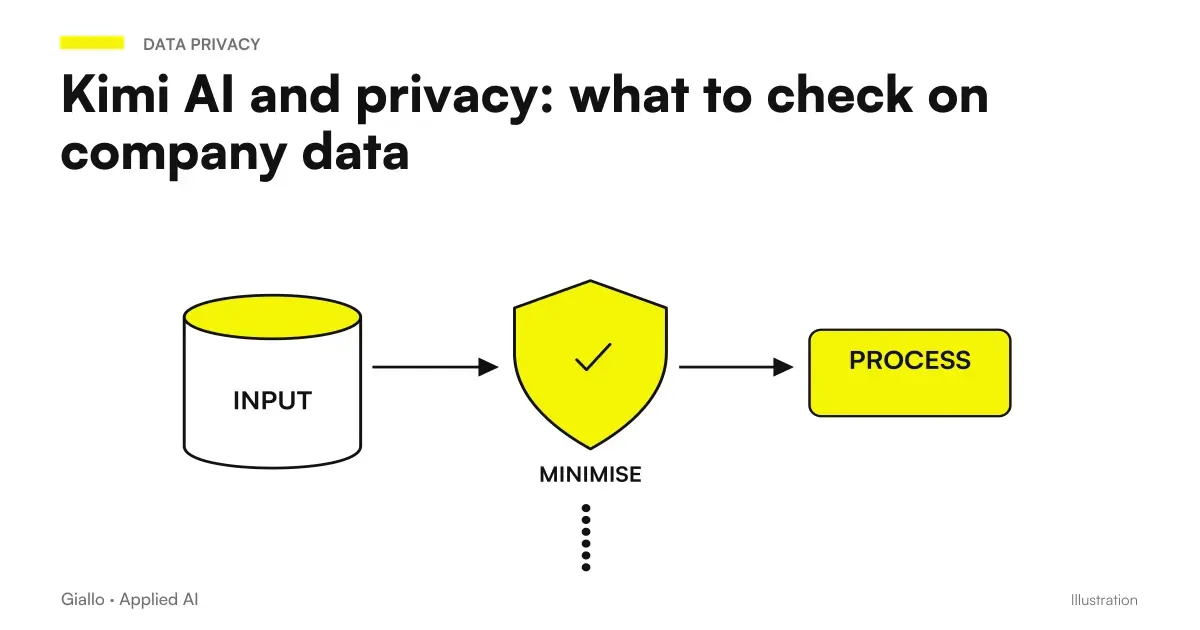
For Kimi, the Global App Policy contemplates content and uses for improvement and training. The guide to Kimi and privacy distinguishes apps and APIs. For ChatGPT, OpenAI documents training controls and different conditions for personal and business workspaces in the Data Controls Guide.
Deactivating training does not mean eliminating any treatment or storage. Evaluate contract, settings, allowed data, and access before trial. Use public or authorized material, especially if the team is still choosing the product.
On the cost, compare the offers actually available to your account and the necessary function. The Kimi Price list separate membership and API. Don't turn a function comparison into an economic comparison if you don't have up-to-date amounts, periodicities, and conditions for both. Also consider the necessary corrections to arrive at the approved result.
What results should be noted in the comparative test?
For each run it stores sources, instructions, modes and outputs. Write down incorrect data, omissions, irrelevant references, and necessary changes. Open the artifacts and verify their use in the target program. If the products have different functions or quotas, write it in the tab: the test must describe what you compared, without generalizing it to each account.
How would you choose a small shipping business?
Hypothetical scenario: shipper to Genoa. The office must compare public service conditions and prepare an internal note. It provides both products with the same documents and requires a table with field, value and reference. It does not use customer data for this initial test.
The controller controls supplements, exclusions and validity of the conditions. It rewards the ability to quickly find the source, not the most elegant text. If one instrument clearly reports absences and the other completes them with assumptions, this difference is relevant to the assignment.
The team can choose the product that requires fewer fixes on multiple representative materials, or change the prompt if the problem repeats. It does not declare a general superiority: it concludes which experience is best suited to that note and those conditions of access.
How would you choose a study that prepares visual proposals?
Hypothetical scenario: architectural studio in Bari. It must turn a non-confidential brief into a presentation proposal. First compare the narrative structures produced; then verify the artifact available in the product and plan. Require that no unconfirmed surfaces, prices or permissions be introduced.
The referent checks that slides maintain brief priorities and constraints. One result can be useful for the structure and still require visual work; another can provide a convenient file but a message to be corrected. The decision depends on the work the firm is willing to complete internally.
How to decide when the results look equivalent?
If both produce a usable first answer, try a typical review of your work: an updated source, an added constraint, or a question about an omitted detail. See if the change keeps the references correct and if it introduces any unsolicited changes. It is a proof of the review process, distinct from the quality of the initial draft.
Then consider handing it over to the colleague who has to use the result. It must be able to recognize source, version and parts yet to be approved without rebuilding the whole chat. An output that requires additional explanations may be less practical than one with visible uncertainties.
If these tests are also equivalent, choose according to availability in the team, data conditions and observed operating cost. You don't need to force a technical difference that your assignment hasn't shown.
When should you keep one product and when should you try the other?
Avoid choosing from a brilliant response, out-of-context benchmark, or larger share. Do not attribute a plane limit to the model and do not deduce a function from an extension named in the text. Compare approved deliveries and real checks.
If the current tool produces verifiable results and the team knows how to use them, evaluate the alternative on the issue that has remained open. If, on the other hand, no product passes the controls, correct first sources and process. To set up a consistent comparative test, Giallo Studio defines criteria and materials in AI consulting, so the choice arises from the assignment and necessary revisions.
Giallo Studio guides: methodology and sources
How we apply it in the company
Related resources
 Kimi AI: what it is, what it does and when to use it
 Kimi AI for PDFs and documents: analysis to verify
 Kimi AI for Excel: Data Analysis and Controls
 Kimi AI Deep Research: research and source verification
 Kimi AI and privacy: what to check on company data
 ChatGPT: what it is and how to use it
 How to Choose an AI Model
 How to create the first Dot in ChatGPT and assign it a project
Other direct comparisons
The same criteria applied to other model pairs.
- Jev AI vs LLM: how to choose the right model
- Kimi AI vs Claude: documents, code and costs
- Claude Haiku 4.5 vs GPT-5.6 Luna
- Make vs Zapier vs n8n: which one to choose for your company
- Claude Haiku 4.5 vs Gemini Flash-Lite
- Copilot Chat and Microsoft 365 Copilot: What Changes
- GPT-6 Sol vs Luna: which one to choose and for which jobs
- Mistral vs Llama: comparison between the two open weight models
- GPT-6 Sol vs Claude Opus 5.5: the official numbers and when to use which
- Claude Opus 5 vs Fable 5.1
- GPT-6 Astra vs GPT-5.6 Sol
- Claude Opus 5 vs Gemini 3.1 Pro
FAQ
Is Kimi AI better than ChatGPT?
There is no answer that applies to every job. Both document work with information and files, but features, modes and terms depend on the product and account. Compare them on the same assignment, measuring correctness, reviews and the usability of the result.
Is Kimi an alternative to ChatGPT for documents?
It may be an alternative worth evaluating: Kimi documents uploads and work on files, while ChatGPT documents summarising, comparing and analysing attachments. The availability of a feature does not establish that it is more accurate on your documents. Use the same sources and check the passages supporting each conclusion.
Which should you choose for Excel, Kimi or ChatGPT?
First, establish the result you need: an analysis, chart, formula or editable file. Both document work on spreadsheets under specific conditions. Compare totals, filters, missing values and formulas in the file actually produced.
Can Kimi and ChatGPT do research with sources?
Both document deep research features with reports and citations. Sources must still be opened and checked against the question and the date. Availability and quotas depend on the account’s terms.
Can I compare them using confidential company data?
Do not start with confidential data for an informal test. Assess the chosen product's policy, contract, settings and permissions; use public or authorised material first. App and API terms are separate, and disabling training does not resolve every aspect of data processing.
Do you need to pay both to make a comparison?
Define the task and check which features are available to your account before purchasing. A test can be performed using permitted access, disclosing any differences in mode. Do not compare a plan lacking a feature as though this measured the model.