
Kimi AI Deep Research: research and source verification
Kimi AI Deep Research for market research and sourced reports. Define the question, check citations and turn the summary into decisions.
Reading time: 11 min
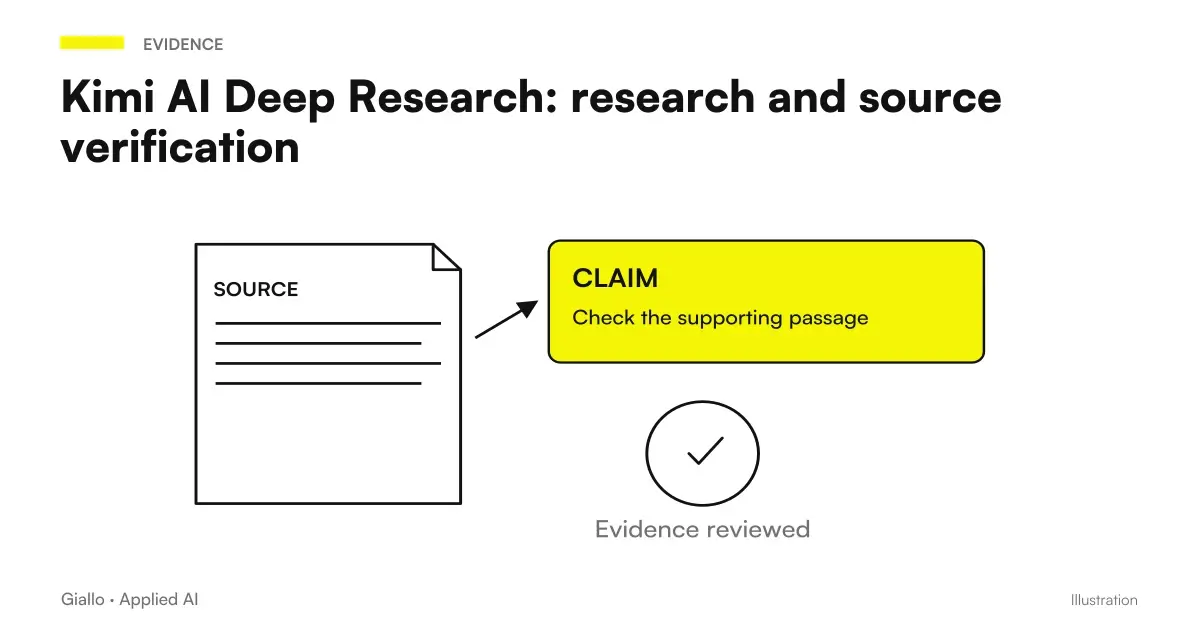
Kimi AI Deep Research is an in-depth research feature that plans the question, searches for sources, and builds a report with quotations. It can help an SME prepare a market comparison or a selection of tools; the conclusions become usable only when they are verifiable in the original sources.
The Official Deep Research Guide, accessed October 9, 2026, describes asynchronous execution, textual and HTML visual reports, with PDF or Word downloads. It is not enough for the document to be long or well laid out: it must respond to the initial decision and declare what remains uncertain. To know the product start from Guide to Kimi AI.
In summary
- Good research starts from a decision and a geographical, temporal and thematic perimeter.
- Quotations must support the precise claim, not just relate to the same topic.
- Verified data, inferences and missing information must remain distinguishable.
- Research on the web does not certify the operation of a product in your environment.
- The final report must include questions still open and necessary checks before the action.
When to use Kimi's in-depth research?
Deep Research serves when the answer requires more sources and comparisons. For example, select markets to be deepened, reconstruct the public offering of a category of software or synthesize documents distributed between different entities. A simple and stable question can be answered with a targeted search: not every question requires an articulated report.
The work is different from the analysis of an annex. In the PDF you have a set of materials chosen from the start; on the web you must also check the selection, authority and updating of sources. If you combine internal documents and external sources, ask to distinguish the origins. The Guide to Kimi AI for PDF It deals with the document path.
The dedicated documentation calls the Kimi-Researcher system, while the Current guide to app models includes Deep Research among the agents' tasks. These descriptions are not enough to attribute each input of the function to a single technical model. For the user it counts to verify available mode, required result and conditions of their access.
A search is also useful when it does not find a definitive answer. It can show that public data does not distinguish the required segment or that a provider does not publish an important requirement. Making this limit visible avoids making decisions with a precision that sources do not allow.
How to write a research question that produces a useful report?
Start with the decision, then write down the questions you need to support it. "Analyze the tourism market" is too broad for an SME to decide where to sell a specific service. “Which public channels and local partners should we look into in order to offer this service to structures of this category?” Instead, it links the report to concrete action.
Define territory and period. A world data does not automatically describe Italy; a national data does not describe a province. It also indicates the level of detail needed and the criterion for accepting a source. If you want current information, ask to report the date of the source and period to which the data refers, which may be different.
A demonstration prompt can be: "Prepare a dossier to decide which two European markets to deepen for this product. It uses only public sources; it privileges official statistics and sites of the mentioned subjects. Distinguish facts, inferences, and gaps. Do not estimate turnover or demand of our product without data. Conclude with questions to be verified in the field." It is not a search already performed.
It also specifies the expected result. A memo with comparable criteria may be more useful than many descriptive pages. Ask for a table of decisive claims and a short list of items that would change the recommendation. The report must allow the person in charge to understand why a road is being proposed and what might disprove it.
How to evaluate sources found by Kimi Deep Research?
A primary source directly supports part of the work: producer documentation for a function, entity statistics for a given, authority text for a rule. A review may help you find a theme, but it does not replace the competent source when the decision depends on a price, requirement or limit.
Open the links that support the main conclusions. Check author, date, context, and cited passage. A page may be authoritative but not relevant to the claim: an overall sector statistic does not automatically measure a narrower segment. The period must also coincide; a recent article can comment on an old dataset.
Check the independence of the sources. Different sites may repeat the same press release without adding observations of their own. Counting citations as independent evidence inflates confidence. In the final dossier, trace them back to the origin and flag when multiple pages depend on the same provider claim.
To compare the method with other products you can start from which AI to use for research and from the guide to Perplexity for Searches. The criterion remains the quality of the evidence retrieved for your question, without a universal winner based on the number of sources.
| Report item | Verification to be done | How to bring it back to management |
|---|---|---|
| Software Price or Requirement | Current official page and precise plan | Dated fact, with conditions and links |
| Market data | Definition, territory and period of the dataset | Perimeter indicator, without implicit extensions |
| Manufacturer's Claim | Origin and absence of independent evidence | Supplier's statement |
| Conclusion between multiple data | Logical steps and assumptions needed | Inference with explicit limits |
| Information not available | Where it was searched and what is missing | Open question, without filling it with an estimate |
| Practical compatibility | Trial in the real process and environment | To be tested, even if documented on paper |
How to handle discordant data and missing information?
When two sources do not coincide, ask to compare definitions and periods before choosing a value. One may include discontinued businesses and the other only active businesses; one may describe revenues and the other volumes. Do not average between data measuring different objects: the result would have a numerical appearance without a clear meaning.
If the deciding figure is not public, leave it open. The report can propose how to recover it: request to the supplier, consultation of the complete document or interview to those who know the process. The source of the missing data should not be replaced by a plausible sentence constructed from the general context.
Ask that the inferences be recognizable. "Public offering includes this channel" is a documentable fact; "this channel may be suitable for our product" requires assumptions. They are both useful content, as long as they are not presented at the same level of certainty. Management needs to know which parts it can use and which ones it needs to validate.
Keep the record of relevant attempts. "Not Found" is most useful when it indicates which official sources were consulted and what information was missing. It does not prove that data does not exist everywhere, but defines the limit of the research carried out. This log makes it easier for the team to follow up.
For every shortcoming, ask how much it weighs on the decision. An accessory feature may remain open during a first selection; an indispensable requirement must block the choice until it is verified. The report should therefore distinguish questions to be deepened and conditions necessary to proceed. This priority avoids spending the same time on all uncertainties and allows the manager to assign concrete verifications, with a source or interlocutor to be reached.
What reports and files does Deep Research produce?
The official guide describes text reports with citations and visual HTML reports, as well as PDF or Word downloads. Times, average lengths and source counts published by the provider describe the service; they are not guaranteed requirements for every task. Use the Deep Research overview to verify the current offer without turning promotional averages into delivery deadlines.
The file intended for management must retain references and limits. If you reduce a report to a few pages, do not delete the conditions that qualify a conclusion. You can move the source log to the appendix, keeping the links of the decisive claims in the text. The goal is to reduce reading work without taking away the possibility of verification.
A presentation requires a further step: select messages and decisions for the audience. The method of Kimi AI for presentations start right from approved sources. Don't treat a search HTML page as equivalent to a PPTX ready for a meeting or commercial offer.
How to Review a Long Report Without Controlling Each Sentence the Same
First identify the claims that support the decision: exclusion criteria, prices, requirements, and market data. Open all their sources and verify perimeter and date. Then check for inferences built on this data. Finally, it verifies a sample of the descriptive parts and all reported gaps. If a decisive claim falls, review the recommendation before finishing the document.
Can a food SME use Kimi to prepare a market research?
Consider one hypothetical scenario: a food producer from Modena wants to choose European markets to deepen. The dossier must describe channels, public requirements and possible interlocutors. It must not estimate future sales or attribute interest to the product without field research.
The manager provides non-confidential category and features. It asks for public sources, equal criteria for each market and distinction between sector statistics and data referring to its niche. If the statistical categories are too broad, the report must say so, rather than presenting the total of the sector as a directly attainable market.
The useful result is a motivated list of insights: what requirements to verify, what subjects to contact and what data to obtain before investing. The comparison does not authorize purchases or agreements. The business decision remains subsequent, supported by information that the manager can update and discuss with competent consultants.
How to use Deep Research to choose a management software?
One second hypothetical scenario concerns a service company in Milan that compares management software. The question includes publicly documented functions, data import, permits, and economic conditions. Search materials are sites and vendor documentation, with no credentials or business databases.
Kimi can construct a matrix of requirements and indicate where each function is documented. An "unverified" cell remains unverified when the supplier does not describe the behavior. A search for public pages is not equivalent to an interface test: Doesn't prove that the team's import, filters, or process works in the real environment.
The group uses the dossier to prepare separate demonstrations and tests, with representative cases. Before changing software verification migration, permissions and integrations required. Research reduces generic questions, but does not replace testing the steps that will have to support daily activity.
How much does a search cost and when does the API serve?
For the app see the Kimi Global Membership: Tasks share consumption rules and benefits of the plan. Do not estimate the cost of each search solely by its length nor attribute unlimited use to a subscription. The guide to Kimi AI prices distinguishes access channels.
The API is a different decision, useful for integrating your own stream. The official WebSearch Pricing page indicates the disposal of the legacy tool $web_search on October 20, 2026 and directs to the new REST interfaces. It is an API information, not a closing date of Deep Research in the app; a new project should not start from the legacy tutorial.
For a recurring process, however, define permissible sources, controls, errors, and approval. Kimi API treats integration. A search endpoint does not deliver the editorial method and evidence log described here on its own.
What mistakes to avoid before using search to decide?
The first is to formulate a question that already contains the desired conclusion. The second is to consider the quantity of sources as proof of quality. The third is to treat prices, capacity and availability as permanent facts: it records the date of verification and returns to the source before the concrete choice.
The fourth mistake is to turn the absence of information into a definite negative response. The fifth is to send or publish the report without checking the main claims. The Kimi Global Terms they do not guarantee the accuracy of the output; control of the sources remains part of the process.
To build a dossier that really helps a choice of market or tools, Giallo Studio can define questions, sources and verification criteria together with your team. The useful report is the one that shows which decisions are supported by the data and which still require proof.
Giallo Studio guides: methodology and sources
How we apply it in the company
Related resources
FAQ
What is Kimi AI Deep Research?
It is the in-depth research feature described by Kimi for planning an enquiry, searching for information and producing a report with citations. Sources and conclusions must be verified before guiding a business decision.
Is Deep Research different from uploading a PDF to Kimi?
Yes: a web search searches for and compares external sources, while a document analysis works mainly on the attachments provided. If you combine the two jobs, ask to distinguish internal information and data retrieved online.
What files can I get from Kimi Deep Research?
The official guide describes a text report, a visual HTML report and PDF or Word downloads. Do not treat an editable presentation as equivalent to the report: it requires a separate synthesis task.
How long does in-depth research take?
Kimi describes asynchronous execution and publishes indicative times in its guide. These do not guarantee completion: they depend on the task and service, so avoid setting delivery deadlines solely on that estimate.
Can Kimi Deep Research citations be wrong?
They should be checked, even when the link exists. The page must support the statement with correct date, market and definition; a source relevant to the theme may still not prove the number reported.
Can Deep Research certify that software works?
A search for documentation and public pages does not amount to an interface test or verification of your process. For compatibility and real behavior, specific tests are needed, separate from the source synthesis.