
Is Kimi AI free? Prices and plans to choose
Kimi AI pricing: global USD rates, monthly and annual plans, shared quotas and extra costs. Distinguish membership, Kimi Code and API access.
Reading time: 11 min
The Kimi AI prices depend on the product: app membership, access to Kimi Code and pay-as-you-go API usage are not the same expense item. For global membership, the price list consulted on 9 October 2026 indicates monthly plans from 19 to 199 USD. Values and benefits are published in Global Official Price list.
For the question "Is Kimi AI free?" the operational answer is to verify the functions available to your account without a subscription. There is no documented universal free quota that can be described as unlimited. Before paying, identify the function you need, the workload, and the cost of corrections.
The lowest price does not necessarily coincide with the useful plan, and the highest price does not guarantee correct output. A sensible purchase starts from a circumscribed test: what job do you want to complete and what limit prevents you from doing so with current access?
In summary
- The price list compared here is the global one in USD, verified on October 9, 2026.
- The annual payment should be distinguished from its monthly equivalent: the economic commitment is different.
- Membership functions share consumption; a simple task and an articulated project do not necessarily weigh in the same way.
- API and membership are separate: an app subscription is not an API budget.
- Wider quotas and parallelism do not eliminate revision, errors or process costs.
What is the global price list of Kimi AI?
The table shows the USD prices of the official membership page, accessed October 9, 2026. The annual monthly equivalent comes from the annual total divided by twelve. The figure does not mean that the annual plan is charged each month.
| Global Plan | Monthly payment | Annual payment | Monthly equivalent on annual | Documented Competitors Task Agent |
|---|---|---|---|---|
| Moderate | 19 USD | 180 USD | USD 15 | 2 |
| Allegretto | 39 USD | 372 USD | 31 USD | 2 |
| Allegro | 99 USD | 948 USD | 79 USD | 4 |
| Vivace | 199 USD | 1,908 USD | 159 USD | 4 |
The numbers are published pricing references, not a conversion into euros or a simulation of the Italian checkout. Assess the billing currency, any tax conditions and billing details during the purchase process. The public documentation consulted does not replace checking the final amount for your account.
The yuan list on other regional pages should not be mixed with this table. Names and benefits may differ: comparing a global price with a regional plan creates an apparent savings that may not be affordable under the same conditions. To orient yourself in the products before the list, start from Guide to Kimi AI.
How much is saved by choosing the annual?
A mathematical example on the price list, not a custom price: twelve Moderate payments from 19 USD add 228 USD; the annual plan is indicated at 180 USD. The arithmetic difference is 48 USD. For Allegretto, twelve months add up to 468 USD versus 372 USD annually, with a difference of 96 USD. The source of the prices is the global price list.
The same comparison, always arithmetic, produces 1,188 USD against 948 USD for Allegro and 2,388 USD against 1,908 USD for Vivace: differences of 240 and 480 USD respectively, based on the same official page. These differences do not quantify the value obtained from the work nor any additional costs.
The annual makes sense when you already know the utility of the product and expect continued use. Before making the commitment check renewal, cancellation and applicable conditions. If you are still testing whether the team can use the output, a lower monthly equivalent alone does not solve the uncertainty.
An unused plan remains an expense even when discounted. A monthly test may be a reversible choice for gathering information about real work; it is not an automatic buying advice for those who have not yet defined a task.
What functions of Kimi are available without paying?
The documentation consulted does not prove that there is a stable free allowance that is identical for everyone. Check the available models, any limits and behaviour when the allowance runs out in the app. A feature appearing in the menu may have conditions different from the continuous use your project needs.
For a first evaluation, look for a task that does not require confidential data or capabilities that are not yet accessible. A public card to be synthesized or a text to be rewritten can show the method. An articulated search with multiple files and tools, on the other hand, can consume different resources: do not use it to deduce how many tasks you can complete in any month.
In the guide on How to use Kimi find a setting based on sources, format, and control. The useful test answers concrete questions: is the result verifiable? What corrections does it require? Does the current limit block the work or is there still a clear delivery?
If the problem is the quality of the input, buying a top floor can simply allow you to repeat an ill-defined task more often. Improve materials and instructions first; then assess the limit you have actually encountered.
How do shared quotas and consumption work?
The membership documents a consumption pool measured in tokens shared between functions. The equivalences in tasks shown in the price list are indicative: they do not guarantee the same number of executions regardless of complexity. The reference is membership price page.
A short summary and a multi-step search can use different amounts of resources. The same goes for a generated file and its revision: asking for more iterations can change the consumption of the project. The name of the task is not enough to estimate the budget.
When evaluating a quota, write down the materials used, the required result and the necessary repetitions. Don't just measure how many requests have left. An incomplete output that forces a restart is part of the operating cost, although every single request seemed small.
The Guide on AI tokens explains why words, files, and tokens are not interchangeable units. For the membership budget use the actual meters and conditions of the product; for the API use the dedicated measures and price list. Avoid translating a shared quota into a fixed number of documents without evidence about your case.
When do you need more context and more activity in parallel?
The price list documents a K3 chat context for Allegro and Vivace up to a million tokens, and distinguishes the parallelism available in the Agent and Swarm functions. They are benefits of membership described in official source, not guarantees of complete understanding of the material.
A broader context serves when the task requires consideration of related information without arbitrarily breaking it. It doesn't mean that uploading an entire archive is always the best choice. If sources contain incompatible versions, increasing the space can also increase the ambiguities to be solved.
Parallelism is useful if activities can proceed independently. For a sequential project, where each phase is awaiting approval from the previous one, a greater share of competition could affect little. The Cluster mode should also be evaluated against the task and plan: the guide to Kimi K3 separates the model from the coordination mode.
Before changing plan then identifies the bottleneck: material that does not enter, activities that wait, consumed quota or insufficient quality. Only the first elements can be directly addressed by specific benefits of the plan; quality also requires method and verification.
Is Kimi Code included in the same budget?
Membership includes Kimi Code and indicates distinct limits with the wording 5-hour / weekly rate limit. It should not be translated into "five total hours of use per week": these are windows and quotas to be checked in the service. The source for the benefit is the membership price list.
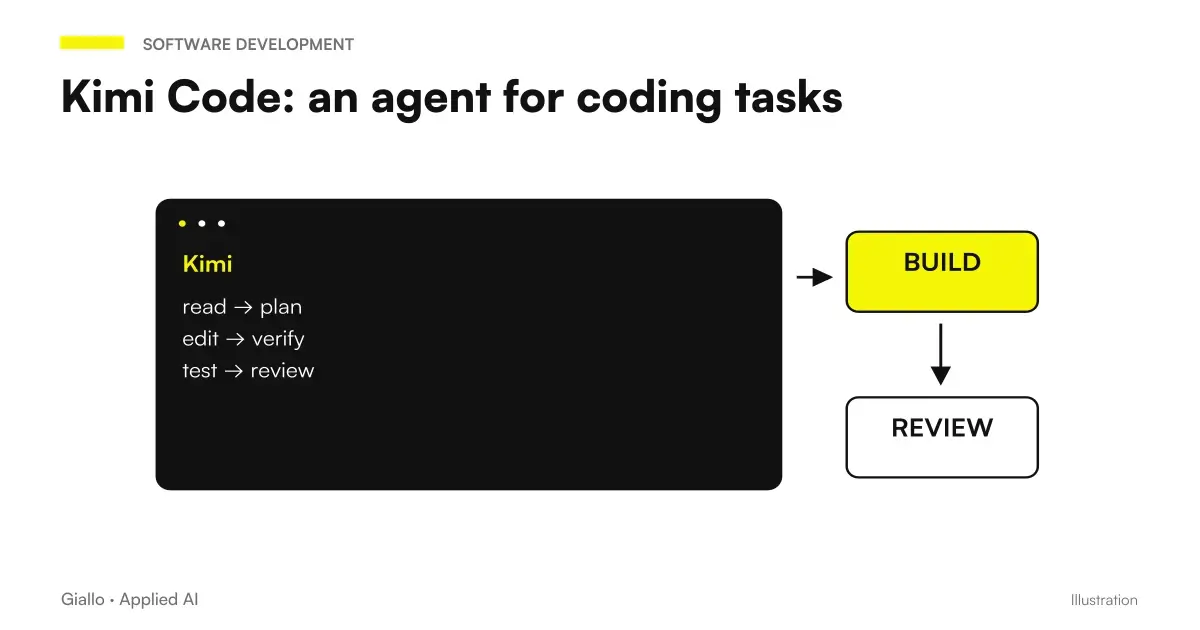
Code is a dedicated code environment, with its own configurations and identifiers. Its Model Documentation also contains references to new and legacy plans; it is not advisable to derive from that page a global price of the app. Kimi Code addresses the operational distinction.
If a small software house evaluates membership, it must observe the work done by the tools, the number of iterations and the review required. Don't equate hours in front of the computer and AI consumption: a short task with many steps can weigh differently from a long read with few requests.
The cost of the team also includes testing and checking changes. The fact that the agent produces code does not make the application verified. Access budgets and development budgets are two measures to be kept together without confusing them.
What expenses may appear in addition to membership?
The price list documents Extra Usage to add consumption and report entries related to Claw hosting and published sites. This does not result in a promise of permanent free hosting or unlimited use. Check the conditions of the function in official price page before publishing or maintaining a project.
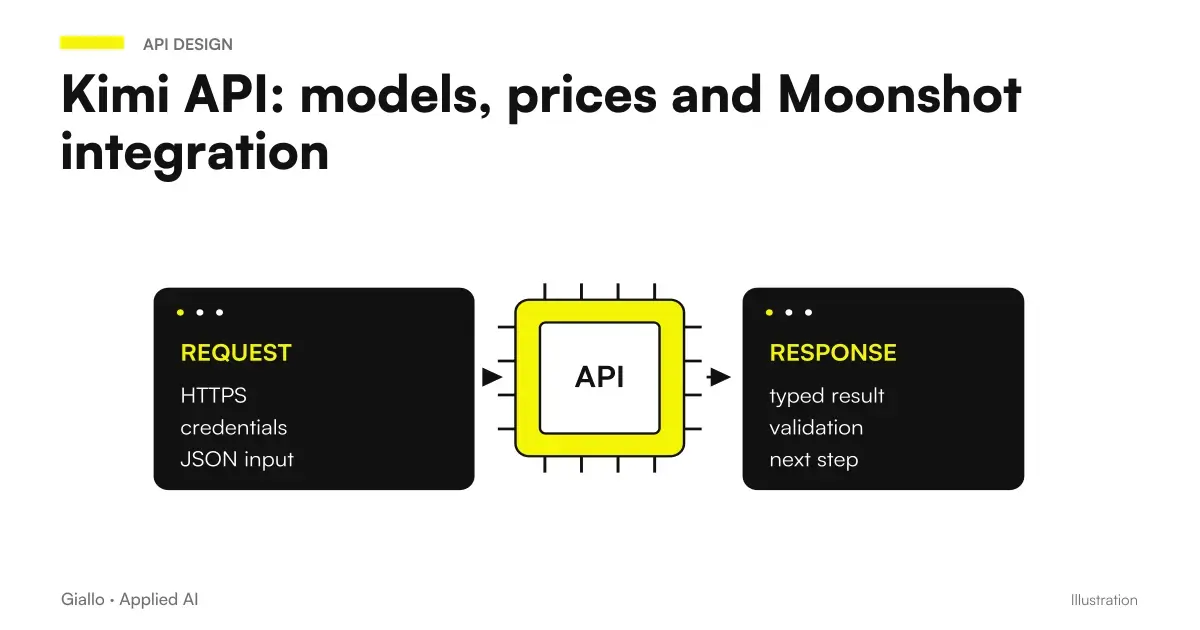
The generalist API is separate and billed on consumption: the reference is the API Inference Price list. For a business workflow you need to estimate input, output, any tools and repetitions. The article on Kimi API It deepens technical voices without transferring them to membership.
There are also internal costs: data preparation, review, team assistance and process maintenance. They are not Kimi tariffs, but they affect convenience. If a document is to be corrected in full, the low generation price does not describe the cost of delivery.
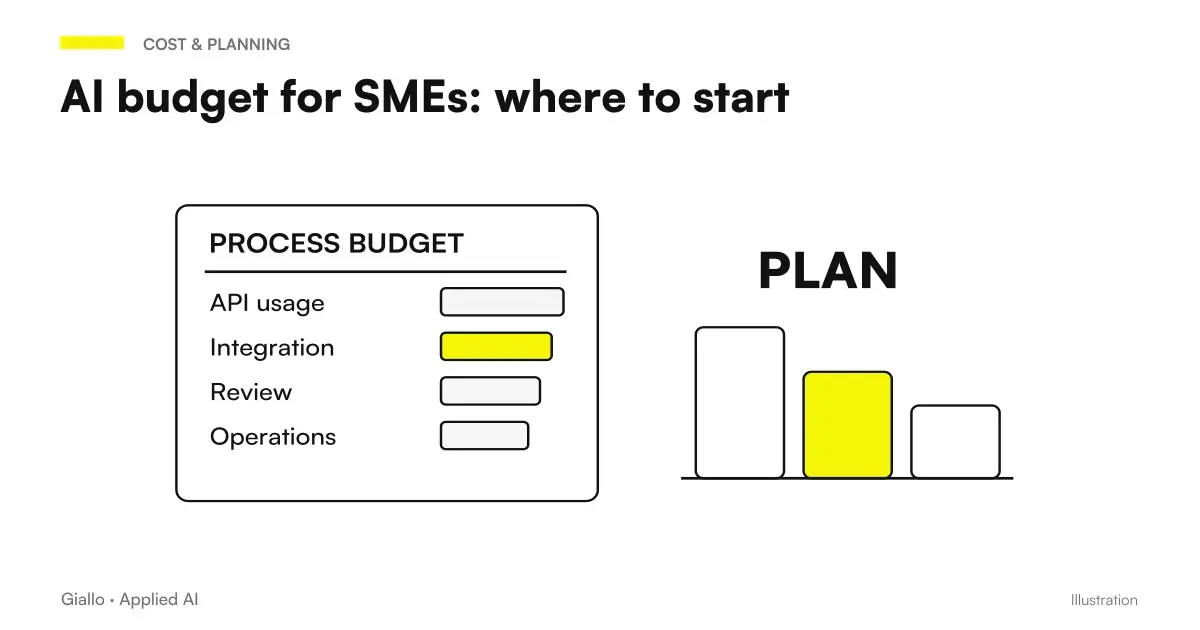
To build a useful prediction, separate a subscription entry, an entry of any extras and an estimate of the observed human work. The AI budget for SMEs helps link spending to a process, avoiding adding tools without a clear responsibility.
Before the purchase: what conditions to check in your account?
Check the currency and final amount, payment frequency, renewal and cancellation. Compare the accessible models, shared usage, concurrency and Code limits with the planned task. Look separately for any top-ups, hosting and APIs. Keep a summary of the applicable conditions: a plan name alone does not describe the entire purchase.
What plan would a document-making professional consider?
Hypothetical scenario: organizational consultant in Turin. He wants to turn public materials into draft reports and presentations. First verify the functions available to your account and test a representative assignment: defined sources, required output and revision. It does not assume that each document consumes the same quota.
If the necessary function requires a membership, compare the plan with the benefits actually useful. A test with monthly periodicity may clarify consumption and corrections before considering an annual commitment. The choice depends on the results of the test, not an automatic preference for the minimum floor.
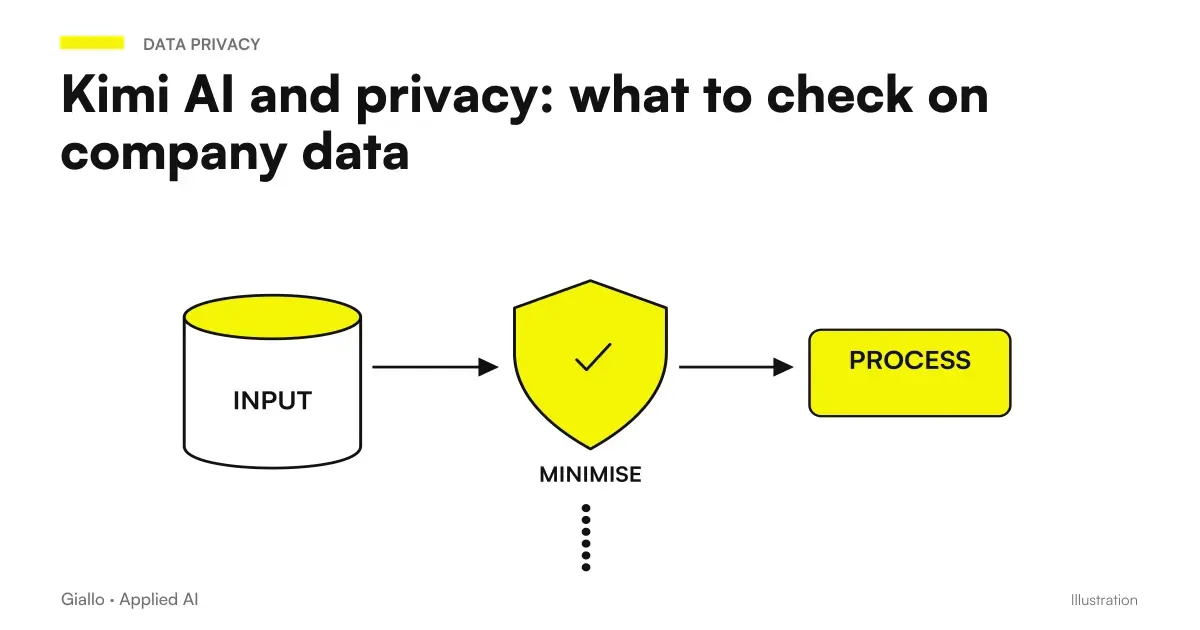
The consultant also verifies the use of customers' materials. A sustainable cost does not make any treatment suitable: before sharing confidential documents consult Kimi and privacy. The initial test can be carried out with public material, preventing a decision on price from preceding that on data.
How would you rate the cost of an SME with more assets?
Hypothetical scenario: industrial distributor in Padua. Several employees prepare comparisons of offers and trade notes. The manager identifies who will use the tool, what accounts and conditions are allowed and how much work can proceed in parallel. It doesn't buy a single plan thinking it automatically has a complete business collaboration environment.
The test records the available quota, completed tasks and revisions. If the observed constraint is concurrency, the team compares that benefit between plans. If the constraint is transferring data from the business management software, membership does not solve the problem: the integration and API need assessment.
The decision then combines product price and process cost. The manager does not invent an economic return: he measures the work before and after, using consistent criteria. Only then can it determine whether to expand the use, change the flow or choose another tool.
How to avoid a subscription that is not needed at work?
The recurring errors are reading the annual equivalent as a monthly installment, assuming that free means unlimited, using a regional listing for a global purchase and confusing membership with API credit. Another mistake is buying more context to solve inconsistent documents.
Prepare a board with task, function needed, limit encountered and result verification. Compare it to the plan available in your account. If there is a concrete limit that hinders work, first it improves the test method.
To decide between memberships, different tools and integration, Giallo Studio can set up an AI budget assessment linked to your assignments and the corrections actually needed, before multiplying subscriptions.
Giallo Studio guides: methodology and sources
How we apply it in the company
Related resources
 Kimi AI: what it is, what it does and when to use it
 How to use Kimi AI in Italian: a practical guide
 Kimi K3: model, reasoning and practical limits
 Kimi API: models, prices and Moonshot integration
 Kimi Code: an agent for coding and development
 Kimi AI and privacy: what to check on company data
 AI budget for SMEs: where to start
 Mods by Claude: what they are and when they are needed in Claude Code
FAQ
How much does Kimi AI cost per month?
The global price list consulted on October 9, 2026 lists Moderato at USD 19, Allegretto at USD 39, Allegro at USD 99 and Vivace at USD 199 per month. These are app membership prices. Check the amount, billing frequency and terms in your account's checkout.
Is Kimi AI free and unlimited?
No universal, stable and unlimited free allowance has been verified. Check in the app which features and usage allowances are available to your account without membership. Free access does not guarantee every mode or the same workload as paid plans.
How much does Kimi AI cost with annual payment?
The global price list gives annual prices of USD 180 for Moderato, USD 372 for Allegretto, USD 948 for Allegro and USD 1,908 for Vivace. The monthly equivalent is calculated from the annual payment, not charged monthly. Check the final terms at checkout.
Does the Kimi subscription include APIs?
Membership and the general-purpose API have separate billing. Do not treat the app's price as credit automatically usable in the APIs. For an integration, assess API pricing and workflow consumption separately.
What does the five-hour limit of Kimi Code mean?
The price list uses the wording 5-hour / weekly rate limit for the Code service. It refers to allowance windows to check in the product, not simply five total hours of use per week. Consumption depends on the work performed and applicable terms.
Does a higher-tier plan always produce better answers?
No: larger allowances, more context or greater parallelism do not guarantee an accurate result. Compare the plan's benefits with a representative task. Reviewing data, sources and files remains necessary even with the most expensive plans.