
Kimi AI vs Claude: documents, code and costs
Kimi AI vs Claude for documents, code and Office files: selection criteria, practical checks and differences between apps, development tools and APIs.
Reading time: 11 min
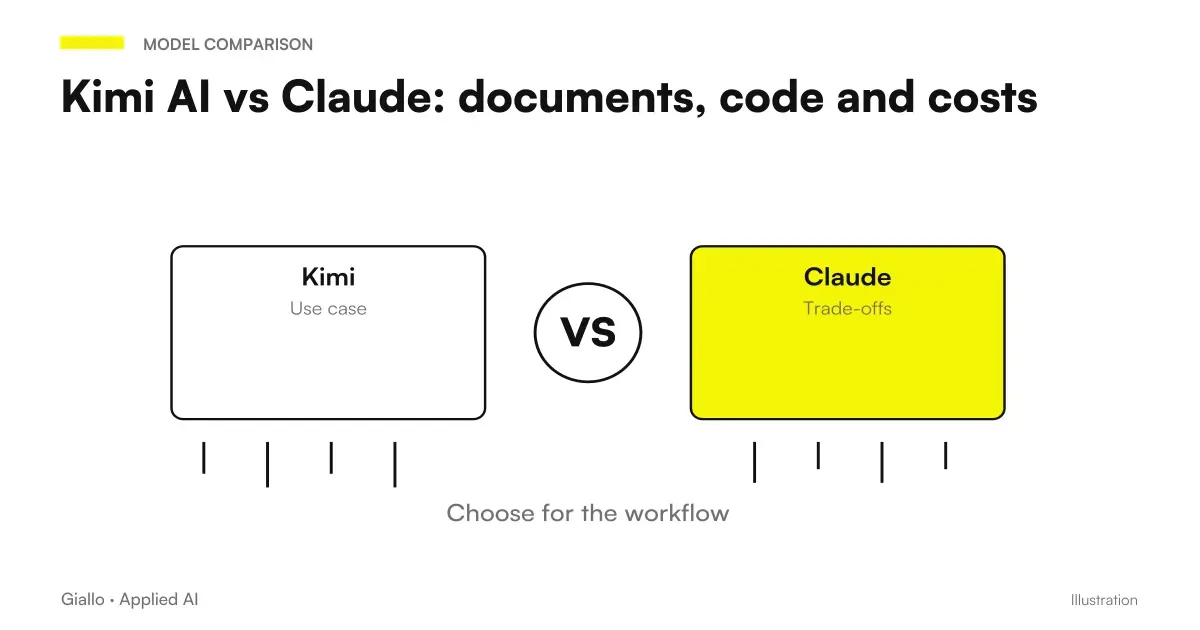
Kimi AI and Claude can both help read documents, write and produce work files. The useful choice depends on the result you need to deliver: a response with references, an editable sheet or a change to the software verified by the tests. The name of the model, by itself, does not decide which tool suits your company.
This comparison, updated on October 9, 2026, separates three often-mixed decisions: assistant in the app, agent to program, and integrated model via API. It describes documented capabilities and a method of assessment; the scenarios are hypothetical, with no results attributed to comparative tests. To orient yourself in the offer start from Guide to Kimi AI.
In summary
- Compare equivalent products: chat with chat, coding agent with coding agent, API with API.
- Office file production is documented by both vendors; the file extension does not certify the quality of the content.
- For documents, the traceability of answers counts, not just the length accepted.
- The cost to be measured includes human correction and control of the result.
- A second tool serves when it solves a distinct need, with clear rules about data.
Kimi or Claude: what product are you comparing?
A chat can explain a programming function without having access to the repository. A coding agent can intervene on files, run tools, and read errors. An API allows a developer to insert the model into an application, but does not automatically deliver the interface and controls present in the chat. These levels require separate comparisons.
In the Kimi app the current guide distinguishes K2.6, K3 and K3 Cluster; it associates with K3 the production of PPTX, DOCX, XLSX and PDF files. K2.6 is described as oriented to textual responses. It's an operational difference when you want a usable attachment, documented in the Official selection of Kimi models.
Claude in turn documents the creation and processing of Excel, PowerPoint, Word and PDF files by code execution. Therefore, “Kimi generates files, Claude only writes text” would be a wrong comparison. Actual availability and settings of your environment should be read in the Claude official file guide.
Before an evaluation annotates the area used, settings and required result. If you change product, model and prompt at the same time, you won't know what difference produced the result. The initial question becomes concrete: which of the two apps returns the document that my group can control and complete?
Who pays for long documents and attachments?
When reading a specification, it matters to distinguish what is written from what the model infers. An elegant summary can omit a penalty; a short answer can be correct if it reproduces the decisive passage. Therefore, ask for the file, section and a short quotation for each extracted obligation. When the reference is absent, the answer should state that.
The attachment format changes the work. A PDF with selectable text, a crooked scan and a sheet exported as an image are different materials. The Claude documentation on uploads distinguishes the processing of PDFs from that of other documents. The Kimi support on files lists accepted formats. None of these indications authorizes you to presume perfect reading of any scan.
Prepare a sample with questions you already know the answer to. Include a clause in the main text, an exception attached, and a question whose answer is missing. This last test is essential: a reliable assistant must recognize the absence of information instead of completing it with a plausible hypothesis. To learn more about retrieval of references see Kimi for PDFs and documents.
The available context helps to bring in more materials, but does not prove that every detail is recovered. A token-only choice overlooks extraction quality, source structure, and demand ambiguity. The Guide to the AI model for long documents explains how to transform this need into observable criteria.
How to compare writing and Office files without just judging the style?
For a business document, writing must respect the recipient, facts and requested decision. Delivering a proposal that sounds good but adds a service that was not agreed is a substantive error. Give both tools the same brief and a list of information that cannot be changed: conditions, names, dates and responsibilities.
For Excel it separates three results: explanation of a formula, applicable formula and complete file. The answer must indicate assumptions, intervals and management of missing values. The final check takes place in the sheet opened by the team: checks formulas, totals, filters and references. The Guide to Kimi AI for Excel describes this path without assuming a native integration within Microsoft Excel.
For presentations, evaluate information hierarchy and review possibilities. An effective slide exposes a decision supported by a source; a weak slide fills the space with generic phrases. Even when both generate a PPTX, it remains to be checked whether charts and texts are editable as needed and whether sources survive export.
| Work to be completed | What to ask Kimi and Claude | What to check before choosing |
|---|---|---|
| Comparison of two contracts | Differences with Pass References | Omissions, exceptions and the distinction between text and interpretation |
| Trade proposal | Draft based on an identical brief | Invented performance, tone and consistency of conditions |
| Analyzing a Sheet | Rules, results, and editable files | Totals, formulas, exclusions and treatment of missing values |
| Directional presentation | Messages, charts and sources | Readability, modifiability and correspondence with data |
| Edit to Software | Circumscribed Diff and Verification | Tests, required permits and impact on nearby parts |
Kimi Code or Claude Code: what matters for a repository?
For code work the relevant comparison is between development agents. Kimi Code documents Desktop, CLI and VS Code clients in the Official Guide to Code Models. Claude Code presents an environment capable of reading the project, editing files and using tools in the official documentation. They are product capabilities, not a promise that every change is correct.
A comparable activity could be to correct a reproducible defect in an isolated function. First establish the expected behavior and the test that proves it; then ask for a minimum change. If an instrument rearranges parts unrelated to the problem, it records the cost of the revision even if the final test passes. More lines changed no longer mean value.
Judgment includes the process: how it interprets repository instructions, whether it reads errors, when it asks for access, and what commands it proposes. Avoid directly assigning irreversible migrations or real data operations during selection. Keep evidence on an isolated branch with materials suitable for experimentation.
To distinguish the dedicated offer from the chat see Kimi Code; for the Anthropic route find Claude for code and development. If the SME only buys writing aid, these features should not guide the purchase of the assistant for the office.
How much does Kimi and Claude really cost in everyday work?
The economic comparison starts from the same type of access. The Kimi Global Membership distinguishes app plans and task consumption; the Claude Price list should be consulted for the plan intended for your group. Prices, taxes and quotas may change: a table copied from a review is not enough to decide on a purchase.
The useful expense is that necessary to complete the process. It counts how many requests it takes to get to an acceptable result, how many times you have to correct, and which checks remain mandatory. Do not assign an economic value to the "saved" time before observing the actual work: quick generation and prompt delivery are different steps.
If the need is an automation, evaluate APIs and integration work separately. Chat does not replace authentication, error management or processing log. The guide to Kimi AI prices It clarifies the separation between membership and API consumption; it uses quotes consistent with the channel that will actually be employed.
Can a technical study use both for specifications?
Consider one hypothetical scenario: a technical study in Brescia compares a chapter revision with the previous version. The required result is a list of changed obligations, not a legal judgment. The test files are free of names and confidential information; the manager prepares the expected solution before opening the chats.
The same prompt asks for a line for variation: argument, previous text, new text, reference and doubt to be clarified. The person responsible checks for omissions, especially in the appendices. It also evaluates the handling of a moved pass: the assistant must distinguish it from a deletion. The test highlights the quality of the comparison, without attributing real results to any product.
If both return a useful list, the study may prefer the one already authorized in its own environment. If one identifies exceptions better but requires multiple format corrections, that compromise must be explicit. Buying two tools only makes sense when separate tasks warrant additional management and controls.
How to choose for an e-commerce with small interventions to the management software?
One second hypothetical scenario is about an e-commerce in Bologna. The office prepares product cards; the developer must correct the import of variants into the management software. Looking for a single winner for both activities would hide two needs: editorial consistency and software correctness.
For tabs, you compare apps on a test catalog, requiring that measurements and materials remain unchanged. For the defect, we compare the coding agents on an isolated repository. The respective evaluation boards have different criteria: attributes invented in the first case, regressions and diff quality in the second.
The manager keeps the organizational decision separate. An assistant for the commercial can be chosen based on the ease of reuse of instructions; an agent for development must comply with the review process already adopted. The result is not a ranking of the brand, but a combination of task and instrument supported by repeatable tests.
What errors distort the comparison between Kimi and Claude?
The first error is to provide more precise instructions to the preferred tool. The second is to choose an easy sample and then extend the result to complex documents. The third is to reward tone security: an assertive response without references may be less useful than a response that correctly signals a limit.
Another mistake is comparing the free level of one product with features available in the other's purchased plan without reporting it. Also choosing an old version from a tutorial alters the rating. Record configuration and test date; use current documentation when checking mode and availability.
When the result changes after a prompt correction, it retains both versions of the test. The first output shows how the tool deals with the initial request; the second shows how much work is needed to guide it towards the goal. Do not silently replace the worst result with the best. This distinction helps to assess the ease of use for those who know the theme well and for those who must apply shared instructions without being able to correct every technical detail.
Finally, do not upload confidential information for convenience. The conditions of the app and those of the API may also differ within the same provider. Before the actual evaluation define the data allowed; the guide Kimi AI and privacy helps to identify contractual questions to be solved.
A simple card to decide after the test
For each activity it records the product used, the date, the material provided and the expected result. Separately mark errors in fact, omissions, file defects, and manual fixes. Preserve outputs with the same names as the original sample. The choice is approved on the completed and controlled work, not on the answer that seems most convincing at first reading.
How to turn comparison into a departmental choice?
Choose a frequent task, a responsible person, and an observable acceptance criterion. Reuse the same sample when changing model or settings, adding new cases only if they represent real work. This small archive avoids changing assistant whenever a novelty appears in the price list.
When a tool covers the process well, introduce it with shared instructions and a proportionate revision to use. If the result remains unstable, narrow down the task: extraction instead of decision, draft instead of sending, code proposal instead of release. Quality increases when it is clear where the assistance ends and team responsibility begins.
To choose between Kimi and Claude on your documentary or technical work, Giallo Studio can set an assessment on permissible materials, acceptance criteria and correction costs. The comparison thus becomes an operational decision that the department can explain and maintain over time.
Giallo Studio guides: methodology and sources
How we apply it in the company
Related resources
 Kimi AI: what it is, what it does and when to use it
 Kimi AI for PDFs and documents: analysis to verify
 Kimi Code: an agent for coding and development
 Is Kimi AI free? Prices and plans to choose
 ChatGPT vs Claude: which one to choose
 Best AI Model for Long Documents
 PreToolUse: Protect files in Claude Code
 SessionStart: restore context after compaction
Other direct comparisons
The same criteria applied to other model pairs.
- Kimi AI vs ChatGPT: which to choose for work?
- Make vs Zapier vs n8n: which one to choose for your company
- Jev AI vs LLM: how to choose the right model
- Copilot Chat and Microsoft 365 Copilot: What Changes
- Claude Haiku 4.5 vs GPT-5.6 Luna
- Mistral vs Llama: comparison between the two open weight models
- Claude Haiku 4.5 vs Gemini Flash-Lite
- Claude Opus 5 vs Fable 5.1
- GPT-6 Sol vs Luna: which one to choose and for which jobs
- Claude Opus 5 vs Gemini 3.1 Pro
- GPT-6 Sol vs Claude Opus 5.5: the official numbers and when to use which
- Claude Opus 5 vs GPT-6 Astra
FAQ
Is Kimi AI better than Claude for work?
There is no winner for every job. Compare the two products on the same document or task, assessing errors, sources, the final file and the work needed to correct it.
Can Kimi and Claude create Excel and PowerPoint files?
Both document the creation of XLSX and PPTX files, as well as DOCX and PDF. For Kimi the current guide associates this capability with K3; a downloadable file should still be opened and verified in the program used by the team.
For programming, should I compare chats or coding agents?
For explanations and small examples, you can compare the chats. To work on a repository, compare Kimi Code and Claude Code, including permissions, tests and review of the changes.
Does a longer context ensure better analysis?
No. The context indicates how much material can get into the work of the model, while the quality also depends on the readability of the files and the ability to retrieve the relevant information.
Does the Kimi subscription include API calls?
App membership, the Code service and the general-purpose API have different rules. Do not treat the chat subscription as API credit: check the product and pricing actually used.
Can I use confidential documents to compare Kimi and Claude?
First verify the permissions, settings and contractual conditions of each product. For a first test use public or anonymized documents and keep the materials provided to the two tools identical.