
Jev AI vs LLM: how to choose the right model
Closed-set decisions, text and reasoning need different roles. A matrix for choosing Jev AI, an LLM or a mixed workflow for SME processes.
Reading time: 11 min
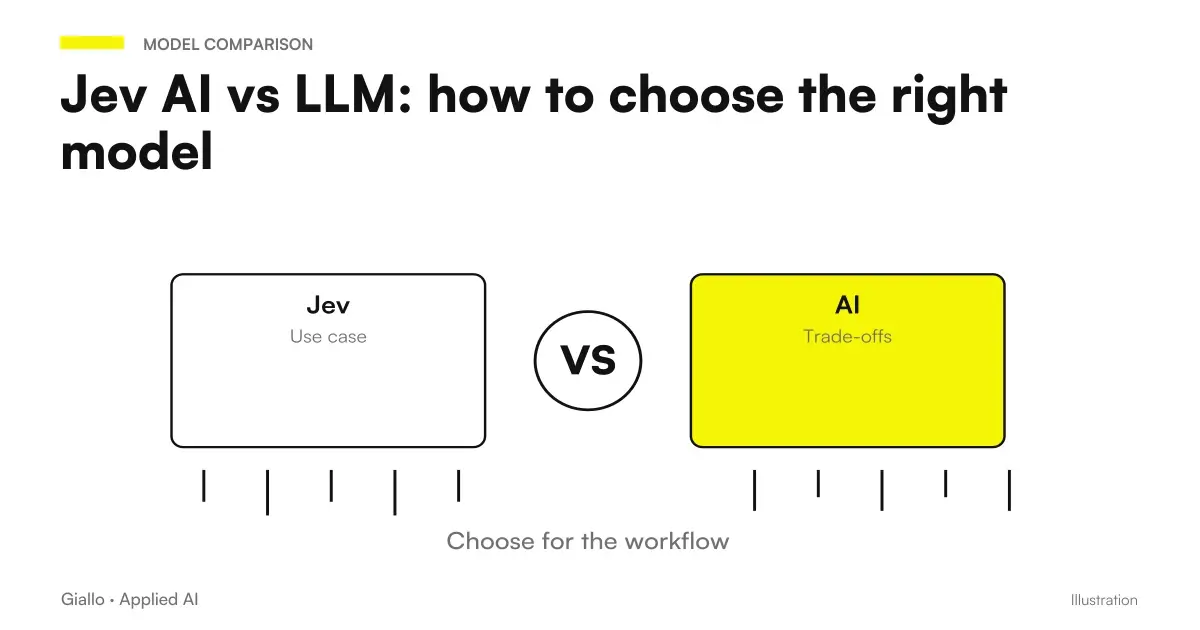
In the Jev AI vs LLM comparison, the choice depends on the job: a delimited decision and the production of a text require different roles. Jev is designed for typed evaluations, while a process that needs to converse, explain, or compose content needs a generative component. The distinction is described in System One documentation.
The useful comparison is not "which AI is smarter?". It is "which component must produce this result, with this data and these consequences?". An SME can use the same request to open a ticket, retrieve an order and prepare a response. They are three tasks, and separating them makes it clearer what to automate and how to verify that it works.
The architectural choice
- First define the subject matter that the process must achieve: category, text, or authorized decision.
- A structured format alone does not prove the correctness of the judgment.
- Add a component only when solving a necessary step.
- Compare alternatives with the same examples and the entire residual work.
- It preserves a human path for ambiguities and relevant consequences.
Starting with the result, instead of the model name
We take a request: «I would like to reorder the March product, but with delivery to the new headquarters». The process may need to distinguish a commercial request from a biographical variation. He may then need to retrieve a previous order and figure out what product the customer means. Finally someone will have to communicate availability and conditions. The first question has a set of destinations; the last one requires contextual text.
Choosing the component becomes easier when the manager describes the desired result. ‘Department code’ is verifiable by comparing it with a procedure. «Clear email with economic proposal» also requires exhibition quality and content control. "Resolve the request" is too broad: it hides more passages and makes it difficult to attribute the error to a cause.
The Getting Started with Jev AI helps identify the decision-making role. The comparison between assistant, chatbot and agent Instead, it clarifies the level of the system: the model is only one of the components, and an application that initiates actions also requires tools, rules and responsibilities.
| Concrete need | Architecture to compare | Proof that it is needed |
|---|---|---|
| Assign a request to a defined queue | Decision component closed | Correct assignments and recoveries needed |
| Preparing a commercial response | Generative component with verified data | Content, commitments and quality of the draft |
| Distinguish relevant sources before writing | Preliminary assessment and separate generation | Quality of selection and final response |
| Apply an exact formula or rule | Code and deterministic validation | Reproducible result on the same data |
| Resolving an Unplanned Exception | Deepening with responsible person | Reasoned and registered decision |
This matrix proposes roles, does not assign a universal winner. The same company can choose a different route for an internal queue and for a communication to the customer. The criterion is the consequence of the result, not the superficial similarity between the messages.
An LLM that returns JSON changes the question, does not delete the test
Many companies already have a stream in which a generative component produces a structured object. In that case, it is not enough to contrast "free text" and "usable data". The comparison must include the existing architecture as it is configured: categories, validation rules, controls, any additional attempts and revision.
If the current system routes requests correctly and the cost is acceptable, there is no automatic reason to replace it. You can try a different component at the same point and measure the difference. This reduces the risk of attributing to the model an improvement actually achieved thanks to clearer categories or better prepared data.
A fair comparison retains the same information available. If one alternative receives a full policy and the other only the message, two different inputs are being compared. The review path must also be comparable: a solution that corrects everything by hand cannot be judged only on the final percentage of correct results.
Our analysis of OpenAI Decisions API offers another point of view on structured decisions. Here the principle of selection remains the same: to verify the single passage and the contract required, without assuming that two services are interchangeable because both can produce a choice.
How to Build a Useful Coexistence
A mixed flow makes sense when the preliminary assessment changes the next work. The request can be assigned to an administrative path that does not require generation, or to a procedure that prepares a draft. The code links the results to the allowed steps. The operator retains the ability to correct the routing and read the original material.
If, on the other hand, both components always make the same classification, it is necessary to explain what adds duplication. A second reading may serve a comparison during the pilot, but it is not automatically an independent quality control. If he uses the same ambiguous criteria, he can repeat the same errors. A useful control looks at a specific property and has a definite consequence.
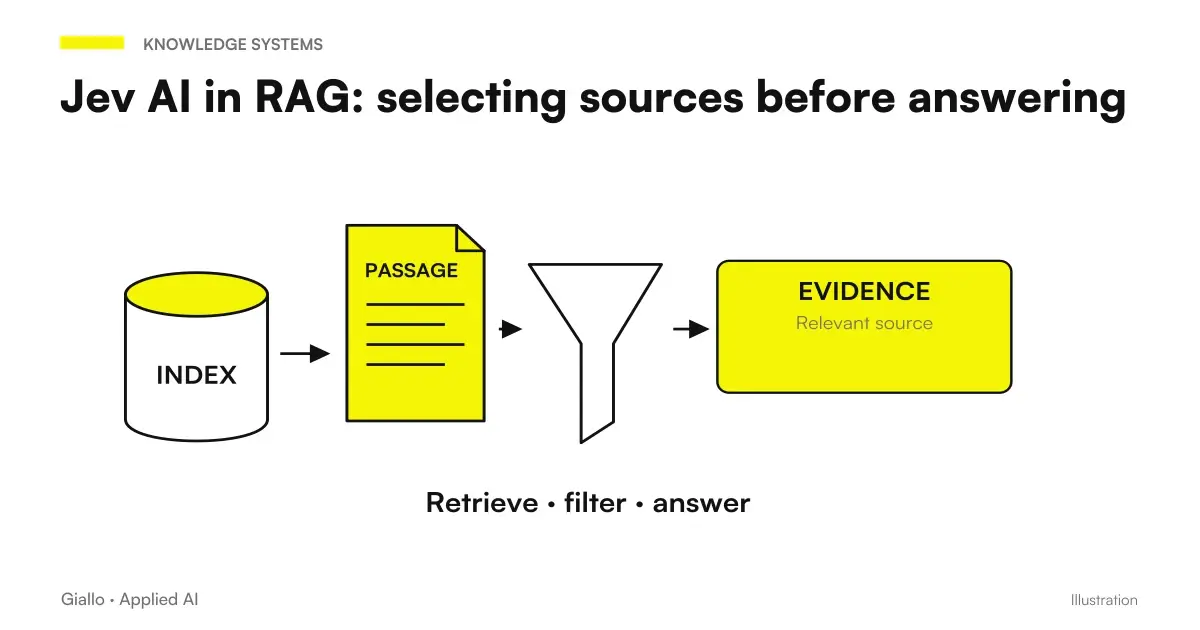
In a knowledge base, for example, you can compare the selection of the steps before asking for the written answer. Jev AI in the RAG distinguishes this work from the generation. After the answer, the citation verification concerns another criterion: the support that the source offers to the statement formulated.
An orderly path also avoids having a draft written that then no one will use. If the message is to be read by the person in charge because it contains a waiver, the review can be opened directly. The generation becomes useful when the process already has enough information and a real recipient, not as a mandatory step inserted to make the flow more impressive.
Two hypothetical cases leading to different choices
Furnishing manufacturer: order category and commercial text
A hypothetical SME from Treviso produces custom-made furnishings. The office receives requests for reordering, changes to quotes and ideas for new projects. The manager would like to lighten the first reading, but does not want the system to promise production times without checking the work plan.
The project splits two results. The first evaluation proposes whether the request concerns an existing order or a new opportunity. When a valid reference exists, the software opens the operating path of the order; when a commercial proposal is needed, a generative component can prepare a draft using the authorized information. The commercial verifies conditions, measurements and delivery before sending.
The critical case is "like the last time, but bigger". The phrase may seem like a rearrangement, but require a new project. In the pilot this type of ambiguity is collected and when to stop is established. The comparison between architectures especially observes the requests that end in the wrong path and the time to retrieve them, not just the speed of the first answer.
For assignment alone you can try a decision component. For commercial writing, it remains a generative role. The person intervenes where information is lacking or where a new commitment could change the margin and production capacity. Automation becomes a sequence of understandable responsibilities.
Service companies: a request that requires interpretation
A hypothetical SME in Milan manages administrative services for other companies. There comes a communication that puts together a deadline, a previous contract and a request for a waiver. There is a "contracts" queue, but correctly assigning the queue does not mean solving the problem.
In this scenario, classification can only be useful as a front door. The manager must reconstruct which agreement applies and which documents are up to date. A generative component can help prepare a summary for reading, but the decision on the derogation remains with those with authority. The project should not compress this rating into a simple ‘approved’ label.
The test includes messages with contradictory conditions and incomplete references. It is checked that the stream asks for in-depth analysis when a premise is missing, instead of producing a plausible text that hides the informational void. The expected result is a well-prepared practice, with elements to verify and an owner, not a definitive answer obtained at any cost.
Here the decision component possibly helps to route; the central work requires reading and reconstruction. Value is measured on the time of the manager and the quality of the material he receives. Shorter architecture can be better than a chain of models if it immediately makes what is missing obvious.
Coding agent and operating model are two distinct roles
The TypeSafe documentation specifies that Jev does not replace the model behind tools such as Claude Code, Cursor, Copilot or Codex. A coding agent can write the software that calls Jev as an evaluator, but this does not turn Jev into the component that converses with the developer or completes the code. Jev with coding agents.
For the client, the distinction avoids a frequent misunderstanding: the tool used to develop does not coincide with the component that will handle the operational data. The estimate should describe the dependencies of the final solution and the controls, regardless of the method by which the code is written.
The technical lead must also prevent automation from expanding through untested examples. The guide to the API integration serves to transform the chosen role into a concrete link. The work remains to be verified on the company's environment: proper documentation does not prove that the management software, credentials and operational queues are ready.
Quality, time and cost: compare whole flow
TypeSafe publishes performance comparisons in its own ad, but they are vendor ratings on specific workflows. They do not show the same difference for an Italian process with different data, controls and revisions. It is the limit to keep when reading the Jev's official announcement.
A business test should record at least four results: path-changing errors, quota of revisions, time from message to take charge, and actual cost of execution. The response time of the individual service is only one part. A faster queue that requires more corrections can move the job without reducing it.
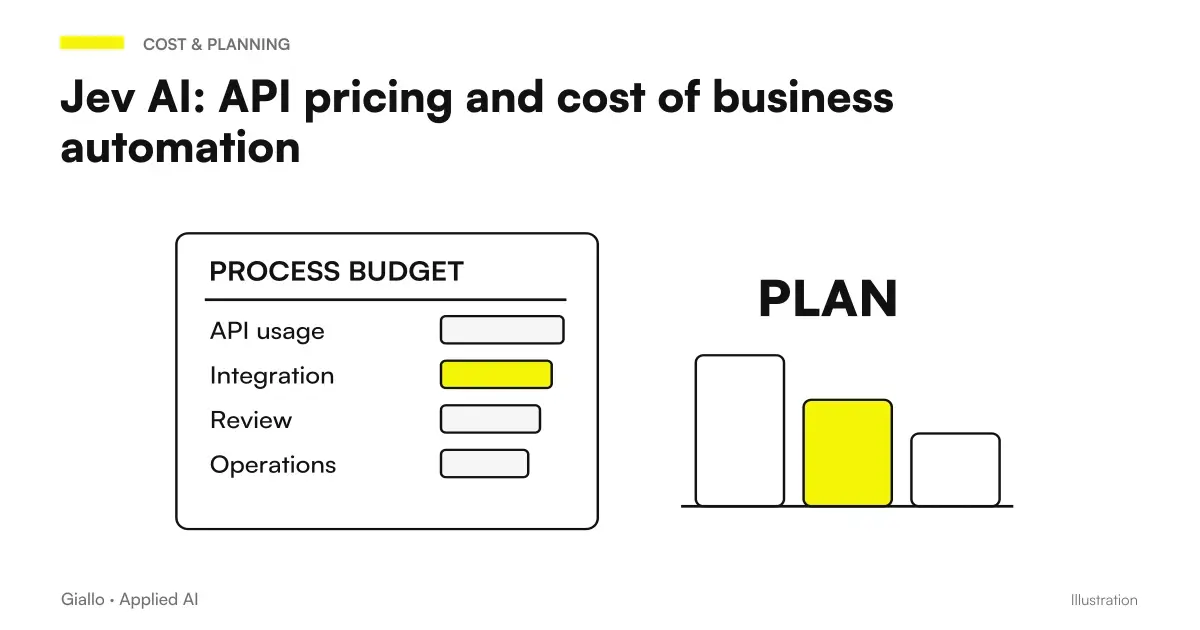
The income statement must also include both complete architectures. The first step can add a call and reduce the next work, or duplicate it. The guide to Jev AI API Pricing and Costs helps to separate tariff, integration and revision. Savings remains a result to be measured, not a property of the diagram.
Maintenance is part of the choice
Before adding a model, ask who will update the criteria when the job changes. A new line of services can make a distinction that used to work ambiguous. A policy change can change the information needed for the draft. The comparison should include the ability to repeat critical cases and figure out which step needs to be updated.
A mixed architecture is manageable when each component retains a stable role. If the same rule appears in the classifier, in the generator and in three branches of the software, the update risks leaving different interpretations. The technical manager should keep the source of the procedure identifiable and verify that subsequent steps use the approved version.
The final choice also includes the exit path: how to return to the previous component or manual management during a change. This agreement does not make the solution more complex for operators; it allows them to continue working while the project is being corrected or expanded.
The evidence leading to a decision
It is better to define first what outcomes would change the choice. If the current component is wrong above all on two overlapping categories, we start with those. If the difficulty is human work on incomplete cases, adding a classifier could affect little. This initial question makes the test shorter and the decision more honest.
A useful sample contains easy cases and cases that put the process in crisis. There is no need to choose only clear texts; there are also requests that operators discuss with each other. Before the comparison, the referent notes the expected result and the path allowed when there is no agreement. Otherwise any subsequent correction risks adapting the judgment to the preferred component.
Check if the next component is needed
- Result: what new data does it produce compared to the steps already present?
- User: which person or rule makes a decision thanks to that data?
- Error: how is it recognized and how much does it cost to recover it?
- Alternative: Could the code or procedure achieve the same result more simply?
- Progress: what evidence allows you to activate the transition into production?
The manager then chooses a solution that can explain to the operators: entry, decision, possible text and revision. Technical complexity must correspond to a concrete need. A project of Business Software may include multiple models, but should maintain only one understandable procedure for those who have to work with the results.
We compare Jev AI and your current solution on a real pass, with verifiable criteria and costs.
Giallo Studio guides: methodology and sources
How we apply it in the company
Related resources
Jev AI in business processes
APIs, Decisions, Data, and Controls: Choose the step that relates to your process.
- Verify chatbot citations with Jev AI
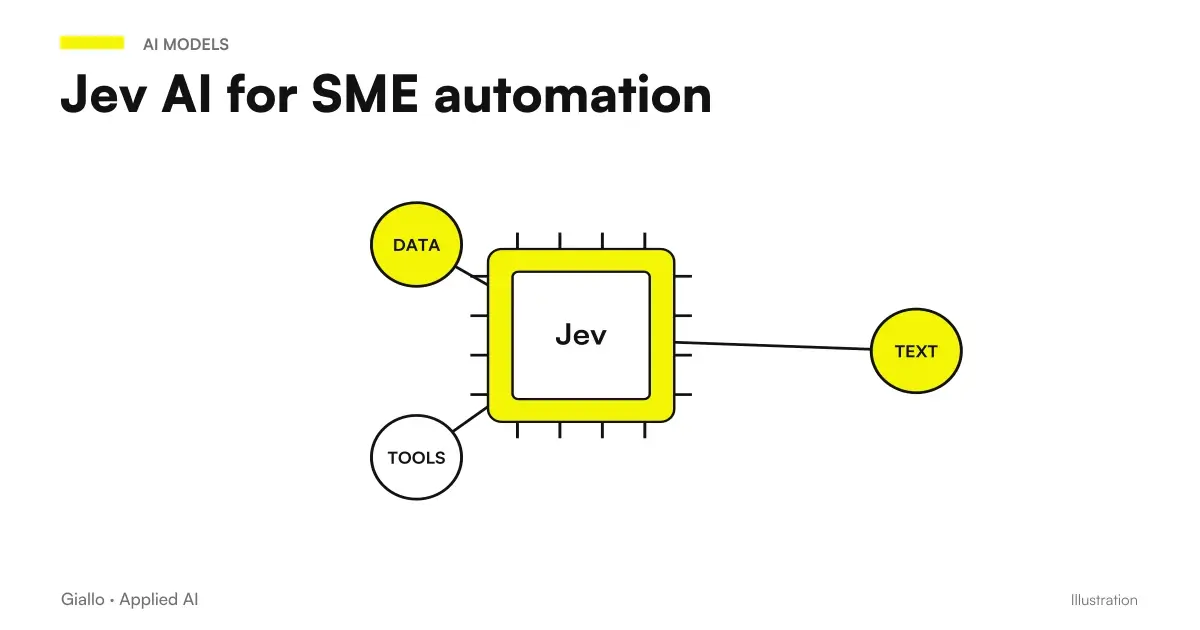
- Jev AI explained: what changes for SME automation
- Jev AI in RAG: choose sources before answering
- Jev AI: API pricing and cost of business automation
- Lead scoring with Jev AI: Prioritizing requests in CRM
- Jev AI for business: privacy, limits and testing on Italian data
- Business chatbot guardrails: where to use Jev AI
- Parallel questions in Jev AI: fewer requests and repetitions
- Jev AI to extract data from emails and invoices: first find, then choose
- Integrate Jev AI through its API: a workflow for n8n and business software
- Deduplication with Jev AI: connecting records without merging the wrong ones
- Route support tickets with Jev AI: department, urgency and review
FAQ
When does it make sense to evaluate Jev AI instead of a generative call?
When the step requires a defined choice and the result must populate a field or feed an operational path. Before deciding, compare quality, remaining work and the consequences of errors on the same set of cases.
Can Jev AI replace the model used by a coding agent?
The TypeSafe documentation presents it as a component that software can call, not as a replacement for the model that converses or writes code. A coding agent can help build integration, but it is a different role.
If an LLM returns JSON, is the comparison already resolved?
No. A usable format is only one criterion: you must assess the correctness of the choice, ambiguous cases and the workflow's cost. If the existing component already meets the requirements, replacing it must offer a verifiable advantage.
Is it better to use both components on each request?
Only if both steps serve a necessary function. Classification may be enough to assign the work; generation is activated when text needs to be produced. The project must also provide a path for cases that require a person.
What is the risk of a workflow with many models?
The number of points to check and possible interpretations of the data increases. Each component should have a clear input, result and owner, so that the origin of an error and how to recover from it can be identified.
How do you compare two architectures without relying on a demo?
Use the same examples, expected result and application checks. Record relevant errors, reviews, total time and observed cost, distinguishing test results from initial assumptions.