
Integrate business software with n8n: APIs, webhooks and HMAC signing
Connect business software to n8n: webhooks, API calls, HMAC signing and endpoint protection. Checks before designing automation.
Reading time: 10 min
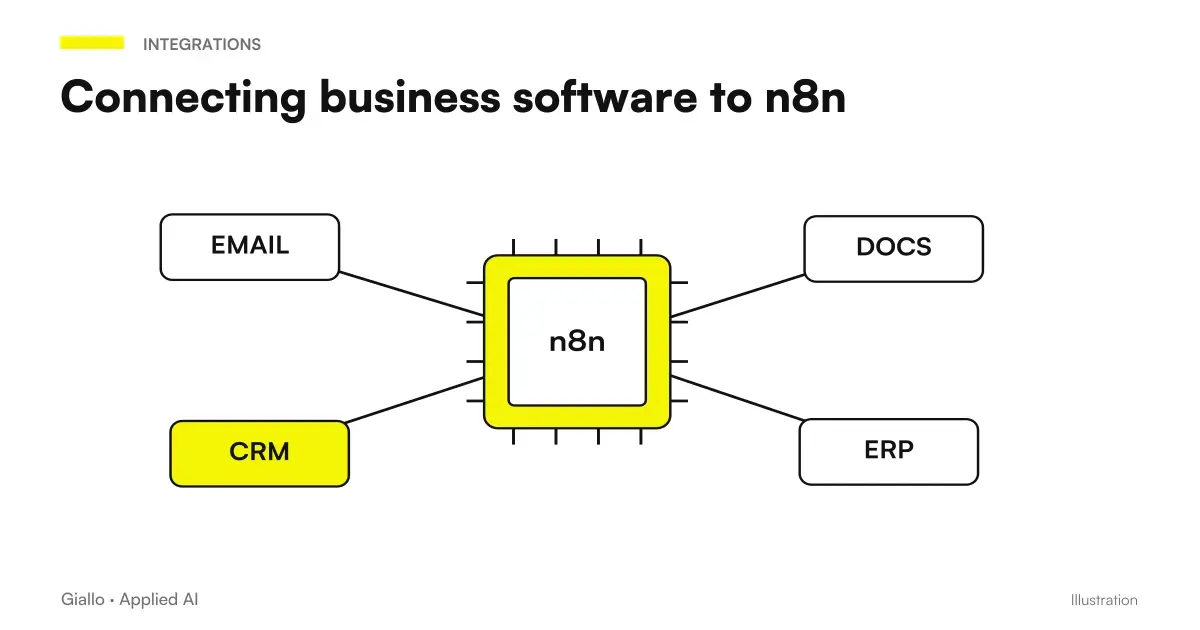
Integrate business software with n8n It means connecting software where business data lives to an engine that uses it to make something happen: send a message, generate a document, update another system. It's the transition that turns an automation from idea to what works.
It is also the point where projects get stuck most often, for a trivial reason: a process that is automatable in theory is not so if the business management software does not make its data accessible. This verification should be done before drawing any stream, not after.
This article collects what we have learned by linking a short rental management software to the engine that sends messages, in the case study made for Rial Estate.
In summary
- The first question is not what tool to use, but what the management system exposes: Without webhooks or APIs, direct integration does not exist.
- Both models are needed: the webhook for immediate events, the scheduled call for what depends on future dates.
- A webhook address is public by nature: it must be protected with a signature, a secret or a validation of the received data.
- The automation engine code node is not a full JavaScript environment: must be verified with a test, not taken for granted.
- A 200 OK doesn't prove anything happened: it always checks that the downstream nodes actually ran.
The two directions of traffic
An integration has two verses, and they almost always serve both.
| Model | Who Begins | When to use it | Example |
|---|---|---|---|
| Webhook | The business management software calls you | Immediate reaction to an event | A new reservation enters: the confirmation starts immediately |
| Scheduled API call | You call the business management software | Logic that depends on future dates | Every morning: which stays start in two days? |
| File Export | The manager deposits a file | When there are no webhooks or APIs | A list loaded every night, read by the stream |
The distinction matters more than it seems. A webhook tells you What just happened; doesn't tell you what will happen in two days. For pre-event communications a periodic check is required that re-reads the full state è this is why in the project of short rents there is a flow to event and one to time, as described in automation check-in.
Protecting the webhook address
A webhook address is a public web address. If anyone finds out, they can call it and start your stream with fabricated data.
In the short-term rental project, this was a concrete risk: the address the business management software called to report a new booking was, in practice, open. Anyone who knew it could have triggered WhatsApp messages at the customer’s expense.
The defenses, in order of robustness:
- Sign HMAC. The sender calculates a code on the content using a shared secret; you recalculate and compare. It's the standard, but it requires management software to support it.
- Secret in a header. The business management software sends an agreed value in a header; you verify it. This is simpler, but the secret travels in plain text within the request.
- Data validation. Verify that what comes is something real: in our case, that the reservation really concerns one of the managed properties. It is the solution adopted, and it is the one that works even when the management software offers neither signature nor custom headers.
The multi-method webhook: a real trap
This deserves a section because it has wasted our time and because it is not clearly documented.
Many managers verify a webhook with a different type of call than they will then use for real data: a GET for initial verification, a POST for events. In the automation engine, a webhook node configured to accept multiple methods expose an output for each method.
Only the output of the verification was connected. Result: real calls received a 200 OK and they didn't touch any nodes downstream. From the outside it seemed all right — the management software received confirmation, the logs showed no errors — and nothing happened at all.
The Lesson: a 200 does not prove that something happened. After connecting a webhook, verify that the downstream nodes actually ran, not that the call answered.
The environment of the code node is not what you believe
The node that allows you to write code inside the stream runs in a limited environment. It is not JavaScript as in a browser or on a normal server: some library functions need to be imported explicitly, others simply are not there.
The symptom is unpleasant: code that works when you try it elsewhere and behaves strangely inside the stream. The practical rule is to check with a minimum test before building on it complex logic, instead of assuming that the environment is standard.
The general operation of the engine is described in automation with n8n; the comparison with alternatives in Make, Zapier and n8n.
If the agent is to reach internal APIs on AWS, the news of AgentCore Gateway for private network and TLS with private CA are related to the link channel. Regional compatibility, agent identity and API permissions remain to be verified.
What to Check Before Designing
In evaluating an AI step you can include Kimi in an n8n workflow. Before linking it to management software, also define the Operational boundaries of Kimi agents, the exceptions and the point where a manager intervenes.
- The management software has webhook? For what events? What exactly does the call contain?
- Ha API reading? With what authentication and what frequency limits?
- The data you need is all there? The classic case: the management software either exposes the reservation but not the telephone number, or exposes it in an unusable format.
- There is a test environment? Testing on real customer data is a risk not worth taking.
- Who owns the credentials and what happens when they expire or change?
This verification takes half a day and prevents most projects from becoming stranded. It is the same logic described in AI workflow: what they are: the feasibility lies in the data, not the tool.
The retry inside a two-way synchronization
Repetition of an event can create duplicates or reactivate the other stream. For synchronize CRM and management software with AI we need the identity of the operation, the origin and the verification of the outcome, together with the authority by field. The guide adds a responsible-readable conflict queue and evidence on timeouts, competing changes, and archived records.
Idempotence: the concept that saves projects
If there is a word to take home from an integration, it is this. A stream is idempotent when running it twice on the same data produces the same result as running it only once.
It sounds like theory, and it's the most practical thing there is. Webhooks are sent back when the sender does not receive confirmation. Scheduled checks can start twice after a restart. A wrong import can duplicate an activation. In all of these cases, a non-idipotent stream sends two messages to the same recipient.
Making an idempotent flow basically means one thing: before acting, check that you have not acted already. We need a place to mark what has already been done — a field on management software, a line in an archive, a mark on the reservation — and a check at the beginning of the flow.
What to do when the call fails
Integrations fail: the management software is in maintenance, the network is not responding, the token has expired. The difference between a fragile automation and a robust one lies in what happens at that moment. An external decision must also retain the identity and status of the practice: integration JEV API in n8n separate call retry and authorization to update the management software.
| Error Type | Sensible Behavior |
|---|---|
| Temporary network error | Try again after a few seconds, a couple of times |
| Overdue or invalid credentials | Stop everything and warn: try again no use |
| Missing or malformed data | Skip that record, continue with the others, record the reason |
| Recipient in error | Isolate that recipient, don't stop the queue |
The last line is the one that cost us the most. In a massive sending, only one recipient in error stopped the execution and all those in the queue were left without a message. Correction is conceptually simple —each recipient must be managed independently of the others —but it must be predicted, because the default behavior of most engines is the opposite.
Practical examples
A management software with full webhook. Send a call to every new booking with all the data in it. The stream reads, valid, acts. It is the best case and also the rarest.
A management software with poor webhook. The call contains only one identifier. The stream must make a second step to ask for details via API. It works, but it doubles the breaking points: if the second call fails, you have one event received and no data.
A management software without API. Scheduled export remains: the manager deposits a file, the stream reads it every night. One loses immediacy but gains simplicity. For many processes èprompts, reports, summaries —it is more than enough, as in AI report automation.
Mistakes to Avoid
Taking it for granted that the data is there. The most frequent case is to discover in the middle of the project that the very field on which all logic revolves is missing.
Leaving the webhook address without any verification. It is an invitation to activate your flows at your expense.
Trusting the response code. A 200 means the call arrived, not that it had an effect. Check the executions.
Importing workflow without counting nodes. Importing from file adds the nodes to the existing ones instead of replacing them: in our case we found ourselves three identical activations and the guests received the same message several times. This and other incidents are in Six errors paid in the field.
Not managing credential expiry. A token that expires silently produces an automation that stops working without anyone noticing.
If integration becomes a function offered to customers, it is necessary to clarify who controls workflows. FAQ n8n on the business use of the Community Edition distinguish this situation from simple internal use or advice on customer flows.
How to apply it in the company
- Inventory what the business management software exposes before drawing any flow. Half a day of verification avoids weeks of wasted work.
- Choose the right model: webhook for the immediate, scheduled call for what depends on dates.
- Protect endpoints with the level of defense proportionate to what they can make happen.
- Test with fake data before linking real customer data.
- Make failures visible. A stream that breaks in silence is worse than one that does not exist, because no one replaces it with manual labor.
On the processing of personal data passing in additions it is worth reading AI and GDPR.
Manage revisions of an order received in PDF
In the connection between mail and management software, a review of the order may arrive before or after the first registration. To avoid duplicate lines and silent edits, you need to distinguish between new document, new version, and variation request. The Guide to import PDF orders into management software describes entry data, validations and transition to operator confirmation.
Conclusion
Integrating management software is the least flashy and most decisive part of an automation project. You don't need the most powerful platform: you need to know in advance what data you can get, how, and what happens when the connection breaks.
The three things we would do from day one: check the code node environment with minimal proof, check that the nodes downstream of a webhook actually perform, and count the nodes after each import.
Do you want to understand what processes in your company can be automated with AI? Giallo Studio can help you turn the problem into a real workflow. If your case requires something that no management software covers, we talk about it in custom software.
Giallo Studio guides: methodology and sources
How we apply it in the company
Related resources
 WhatsApp agent for short-term rentals: the full case study
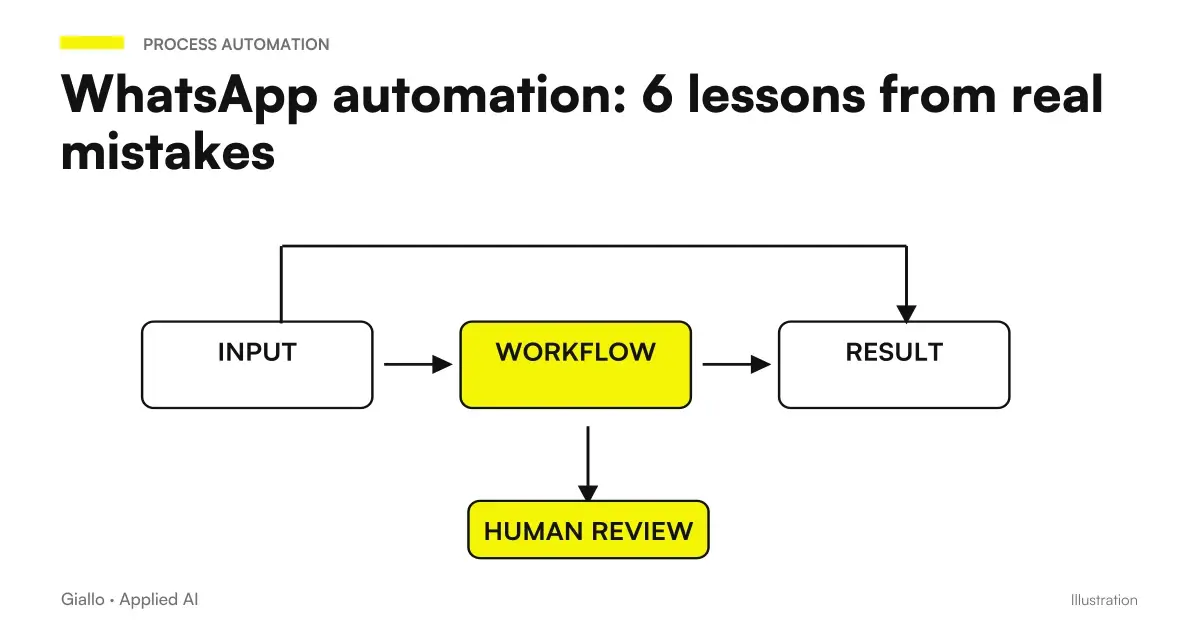 WhatsApp automation: 6 mistakes we learned from in practice
 Automated check-in for short-term rentals: how it works
 n8n explained: how it works and how to use it in business
 WhatsApp Cloud API: how it works and how much it really costs
 AI API costs: how to calculate them
 AI rental management for estate agencies: from enquiry to registration
 Automating business software without APIs: options and limits
FAQ
What does it take to integrate a management system with an automation engine?
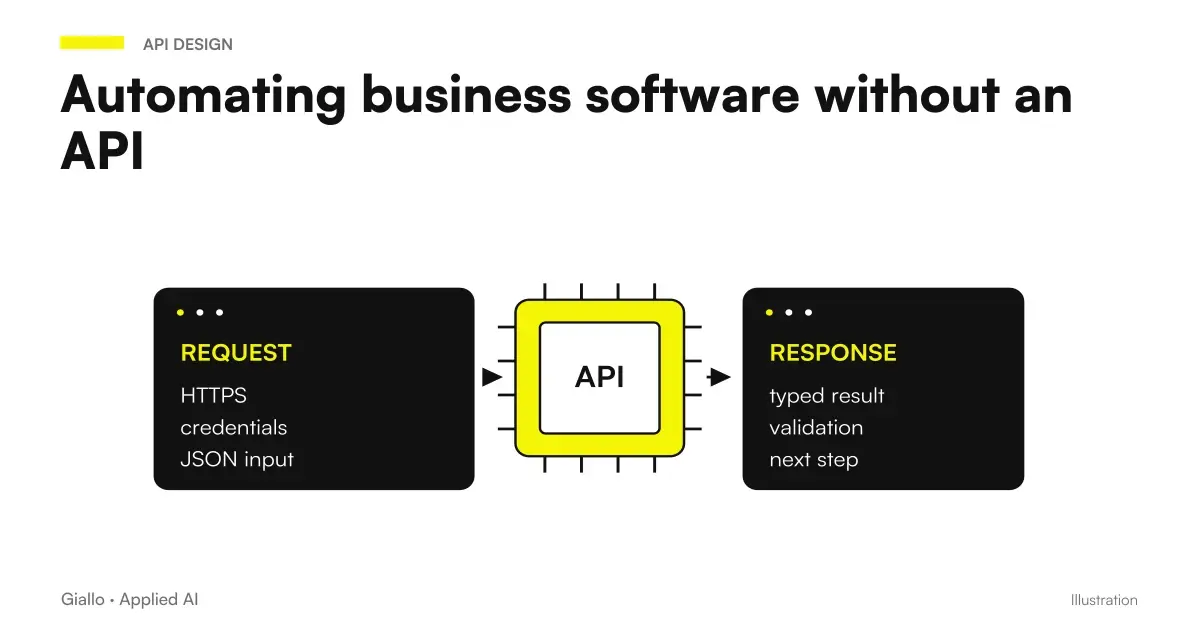
You need two things: the business management system must be able to notify you when something happens (a webhook) or expose data on request (an API), and you must have credentials to access it. If the system offers neither, direct integration is impossible and alternatives such as periodic file exports must be evaluated.
What is the difference between webhook and API call?
With a webhook, the business management system calls you when an event occurs: you react immediately, without querying anything. With an API call, you request the data when you need it. Both are needed: the webhook for what must be immediate, and the scheduled call for what depends on a future date.
Is a webhook address safe?
Not by itself. A webhook address is public: anyone who knows it can call it and start the workflow. Protect it by verifying that the request is legitimate through a shared signature, a secret in the header, or by checking that the received data really corresponds to something of yours.
What is an HMAC signature?
It is a code calculated by the sender from the request's content using a shared secret. The recipient repeats the calculation and compares the results: if they match, the request really comes from its claimed sender and has not been altered. It is the standard way to authenticate webhooks.
Does the n8n code node behave like a normal JavaScript environment?
Not entirely. The execution environment is limited: some library functions must be imported explicitly, others are not available. It is a detail that must be verified with a test, not taken for granted: it is one of the most frequent causes of unexpected behavior.
What should you do if the business management system has no API?
The alternatives, in order of preference, are: scheduled file exports that the workflow reads, structured emails from which data can be extracted, or replacing the business management system if the obstacle is structural. Automation through the graphical interface is a last resort and is fragile.