
n8n Community Edition: the new clarification on business use, customers and SaaS
n8n Community Edition commercial licence: clarification on consulting, predefined automations and workflows editable by external users.
Reading time: 11 min
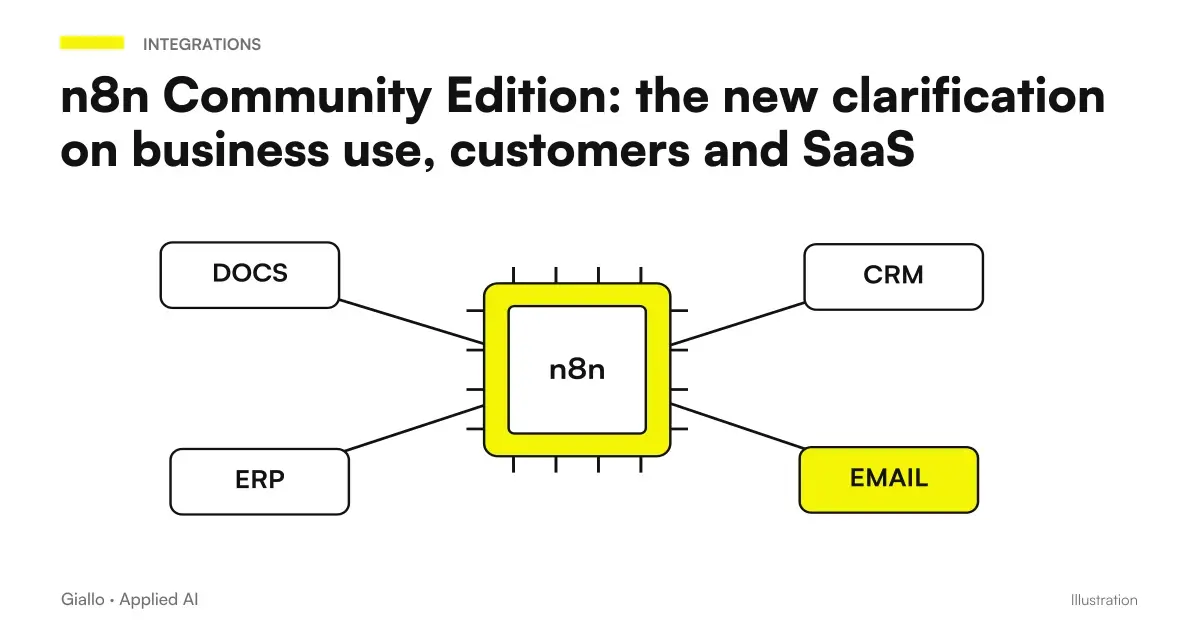
n8n Community Edition may be used in business contexts, but "commercial use" does not mean that any product or service built on top of n8n falls under the same license. The new official clarification insists on who controls the logic of workflows and what external users can create or modify.
The 6 October 2026 n8n has released a new expander for the Community Edition. It is a clarification accompanied by FAQ: it should not be described as proof that the license has changed that day. The reference concerns self-hosted setup; n8n Cloud has its own terms. Announcement in the Official Community and License FAQ.
For an SME or software house, the distinction affects the project: automating an internal process, offering advice to a customer and incorporating a user-modifiable engine are different situations. Before choosing the architecture you need to describe the service that will actually be offered, not just the software installed on the server.
In summary
- The new document clarifies the uses of the Community Edition, without demonstrating a change of license on the date of the announcement.
- Control of workflow logic is a central criterion for distinguishing cases.
- Consultancy and default automations are covered in the FAQs among the allowed uses.
- Making external users create or modify workflows may require a different business agreement.
- Self hosting involves infrastructure, maintenance, and data responsibility.
Why is “free for commercial use” an incomplete question?
The question seems simple because it mixes two floors: the price of the software and the right to use it in a given service. A company can use a tool in its work without selling its access to customers. Another can instead offer a platform where users define their own automations. The licence must be read with respect to the second level, not just the fact that there is a revenue.
The n8n clarification distinguishes these scenarios through the control of workflow logic. Who designs the flow? Who can modify it? The user chooses only parameters of an already defined procedure or can it change what automation does? These are more useful questions than a generic “commercial” label. Official criteria.
The Guide to n8n for automations explains the role of the engine in the process. The new expander, on the other hand, is about how that engine enters the service model. A technically functioning project may require a different contractual arrangement than initially envisioned.
Are customer advice and access to the platform the same?
No. FAQs allow advice for customers and describe products with predefined automations between permitted uses, according to the criteria of the document. This indication should not be turned into a universal authorization to resell any access or functionality of n8n. The concrete project must respect the entire perimeter of the license. FAQ Community License.
Advice may include process analysis, flow configuration, and maintenance on behalf of the client. Instead, a product can expose functionality to end users. The difference doesn't just depend on who pays for the server or what logo appears on the screen: it matters what the service allows you to do.
When the case is ambiguous, it is best to prepare a precise description and compare it with the supplier. There is no need to present an abstract question such as “can I do a SaaS?”: better explain who uses the system, what actions they can take, how the flows change and what n8n components are exposed. This article offers operational guidance, without replacing reading the applicable license.
What happens if the user modifies workflows with an agent?
The criterion is not circumvented by changing interface. The FAQs cover the ability for external users to create or edit workflows through UI, API, MCP, or agent. It is not enough to hide the visual editor if the user can give an assistant instructions that change the logic of automation. Clarification n8n.
This distinction is important in AI products. A command such as "add a pass that sends data to another service" can change the behavior of the workflow, even if the user does not see nodes or code. The project has to evaluate what the agent really allows, not just the shape of the screen.
Parameters also require attention. Choosing a recipient predicted by a default procedure may be different from building a new arbitrary sequence of actions. Where the boundary passes in your product should be checked on the FAQ and, if necessary, with n8n. It is not prudent to attribute an exception to the licence alone that the document does not describe.
How to compare usage patterns?
| Assetto | Determinant question | Verification to be done |
|---|---|---|
| Internal automation | Does workflow serve the organization's work? | License and actual perimeter |
| Advice to the customer | Who keeps and controls the flow? | Conditions described in the FAQ |
| Default function in the product | Does the user use an already designed procedure? | Limits and modalities of integration |
| Editor for external users | Can they create or change logic? | Possible Different Trade Agreement |
| Agent editing workflow | Do requests change automations? | Same criterion, even without visual UI |
The table is an analysis tool, not a contractual authorization for a whole category. A summary description can hide decisive differences. Before approving the architecture it is advisable to document concrete examples of the operations available to the user.
Comparison with other tools must take into account the same process. The guide Make, Zapier and n8n helps to evaluate integrations, maintenance and operating model. A self-hosted setup is not automatically preferable because the initial fee appears different: responsibilities and overall readable costs are needed.
Hypothetical scenario: an agency automates the client's work
Let's imagine an Italian agency that configures for a customer the passage of requests from the site to the management software. The agency designs and maintains the flow; the customer uses it for his own process. Before work, the parts clarify infrastructure, accesses, properties of configurations and assistance modes.
The new expander is useful for evaluating this advisory set-up according to official criteria. However, it does not remove the necessary contracts between the parties nor the responsibility for data processing. The agency must avoid improperly shared credentials and must arrange for a delivery that allows the customer to continue the work.
It's a hypothetical scenario. The conformity of a real project is not certified here. Verification must relate to the service actually offered, including what happens when the relationship ends. The Guide to integrate a management software with n8n helps to translate the process into APIs and technical steps, after clarifying the setup.
Hypothetical scenario: a software house adds automations to SaaS
Consider a software house that develops a management software for artisan companies. A default function prepares a reminder based on the status of a practice. The user chooses expected parameters, but does not freely build new automations. The team compares this function with the FAQ criteria, documenting exactly what is allowed.
In a variant of the same project, the product instead offers a chat where the user asks to create new flows between applications. The agent translates the request into n8n workflow. This variant changes the substance of the service: the absence of a visual editor does not eliminate the user's ability to modify logic.
This example is also hypothetical. Variants are not declared automatically authorized or prohibited without reading the full contract. Their purpose is to show why the architectural decision requires a precise functional description. A possible response from the supplier should be kept together with the project and related to the features really illustrated.
How much does it cost to maintain a self-hosted Community Edition?
The cost does not coincide with the price of the license. The server must be configured, updated, monitored, and protected. We need credential management, backup, recovery and maintenance of integrations. If a linked application changes APIs, the workflow may require interventions even when n8n continues to work.
No universal amounts are given here, because they depend on the architecture and service required. To compare alternatives it is better to estimate infrastructure, technical work and process continuity. The free shares of Logic Apps Automation offer an example of economic conditions to be read in their perimeter, without transferring them to another platform.
Assistance must also be defined. An automation that powers orders or documents requires a manager when it fails. "It's on our server" does not clarify who intervenes or what requests need to be retrieved. Self-hosted choice may offer control, but that control involves work and skills to assign.
What checks are needed on data and accesses?
Installing the software on its own does not automatically produce data compliance. Workflows can send information to external services, use AI models, and store results or logs. The treatment map follows these steps, not just the location of the n8n server.
It is necessary to decide what data they enter, who can consult them and how credentials are managed. Test environments should avoid real data when not needed. The execution log may also contain sensitive information, so access and retention must be proportionate to the process.
If it is necessary to reach a private system, the new AgentCore Gateway with Private TLS illustrates a different linking architecture. It does not replace an evaluation of the n8n license nor does it make that product mandatory: it shows that network, permissions and service model are separate decisions, to be coordinated in the same project.
How to prepare a useful question for the supplier?
Open the tab to describe your n8n trim
Indicates who handles the instance, who uses the product, and who can change the workflows. Describe the actions available via interface, API or agent. Specifies whether the automations are predefined or buildable by external users. Attach functional examples without confidential data and ask for a match referring to that perimeter.
A complete description avoids answers that seem favorable but concern a different case. It is also useful to indicate who owns the credentials of the connected applications and what role the customer has. If the service changes, the verification should be updated: a product born with fixed procedures can evolve into an automation editor.
The announcement of the new expander helps to find the clarification, while the FAQs contain the criteria to read. You should not attribute to the announcement a contractual change that does not prove. Official announcement of the document.
What mistakes to avoid when choosing a license?
The first is confusing accessible code and unlimited freedom to resell its functions. The second is to stop at the label "commercial use". The third is to hide the editor without evaluating what APIs and agents allow users. The fourth is to assume that a published clarification means a change of license on the same date.
Another mistake is choosing the technical setup before describing the service. If the distinctive function of the product is precisely to leave the construction of the flows to the users, the verification of the license cannot come to almost finished project. Better to clarify that point before developing addictions that are difficult to replace.
Migration between platforms also deserves caution. The new path of Zapier Agents in AI by Zapier changes the placement and control of the steps, while the n8n clarification concerns uses and license. The comparison must keep distinct product behavior, operational responsibilities and the right to offer it in its own service.
How to keep verification valid when the product grows?
The initial description should be retained along with the project decisions. When a new function arrives, can the team compare it to that perimeter: does it change only one parameter expected or does it allow the user to build new logic? This question helps to identify when it is necessary to repeat the verification of the applicable conditions.
The service model can also change without a major technical change. An instance used for an internal process could become part of an offer to customers. A consulting activity could evolve into a shared platform. Control must follow the actual service, instead of remaining tied to the description with which the first pilot was born.
The commercial and technical contact person should know the same map as the permitted functions. A promise made in a proposal may introduce a requirement that the architecture or license had not foreseen. Clarifying it before development allows you to choose a consistent set-up and to deliver to the customer a service that can be maintained.
Which decision to start before installing?
Describe the workflow and who can change it. Then it verifies the licensing setup, access ownership, and data path. Only then does it make sense to decide infrastructure and connectors. This order prevents a successful technical test from being mistaken for an already resolved business choice.
The useful result is an understandable map: users, functions, tools, responsibilities, maintenance and applicable conditions. In ambiguous cases, a vendor-specific match is needed, to be preserved with the documentation. It is not an abstract obstacle: it protects the continuity of the service that the company intends to offer.
If you want to use n8n for internal processes or client products, Giallo can help design company automations with a sustainable set-up. The starting point is what users need to be able to do, so license, architecture and maintenance follow the real work.
Giallo Studio guides: methodology and sources
How we apply it in the company
Related resources
 Zapier Agents becomes AI by Zapier: migration, approvals and sources still missing
 Logic Apps Automation: free quotas, AI costs and limits to check
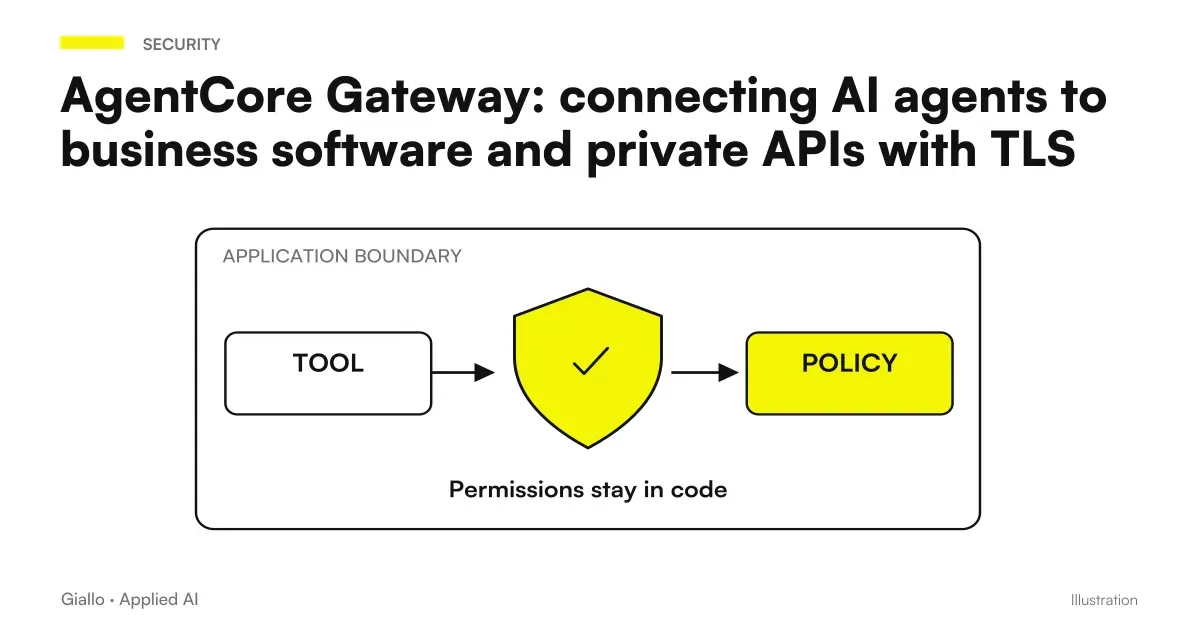 AgentCore Gateway: connect AI agents to business software and private APIs with TLS
 n8n explained: how it works and how to use it in business
 Integrate business software with n8n: APIs, webhooks and HMAC signing
 Make vs Zapier vs n8n: which one to choose for your company
 Kimi AI with n8n: how to design a workflow
 Import email and PDF orders into business software: AI, checks and confirmation
FAQ
Did the n8n licence change with the new explainer?
The announcement presents a clarification and new FAQs. It does not, by itself, demonstrate a change to the licence on the same date.
Can you use n8n Community Edition in your company?
The FAQs address business uses based on control over workflow logic. The actual project must be compared with the full scope of the licence.
Is consulting for clients permitted?
The FAQs describe consulting and predefined automations among the permitted uses under the stated criteria. This is not universal authorisation to resell any access or feature.
Does hiding the editor avoid the limits on workflows?
It is not enough if external users can create or modify the logic through an API, MCP or an agent. What matters is the actual capability offered, rather than just the screen.
Does Self hosting mean zero operating cost?
No, infrastructure, updates, credentials, monitoring and assistance remain. The cost must be assessed on the entire process.
What to do in ambiguous cases?
Describe the users, features and control over workflows, and request a specific response from the provider. The assessment must be updated when the service offered changes.