
Kimi AI Agents for Companies: Roles, Tools, and Controls
Kimi AI for business: Agent Cluster versus API-based agents. Roles, permissions and approvals for integrating the model into SME processes.
Reading time: 10 min
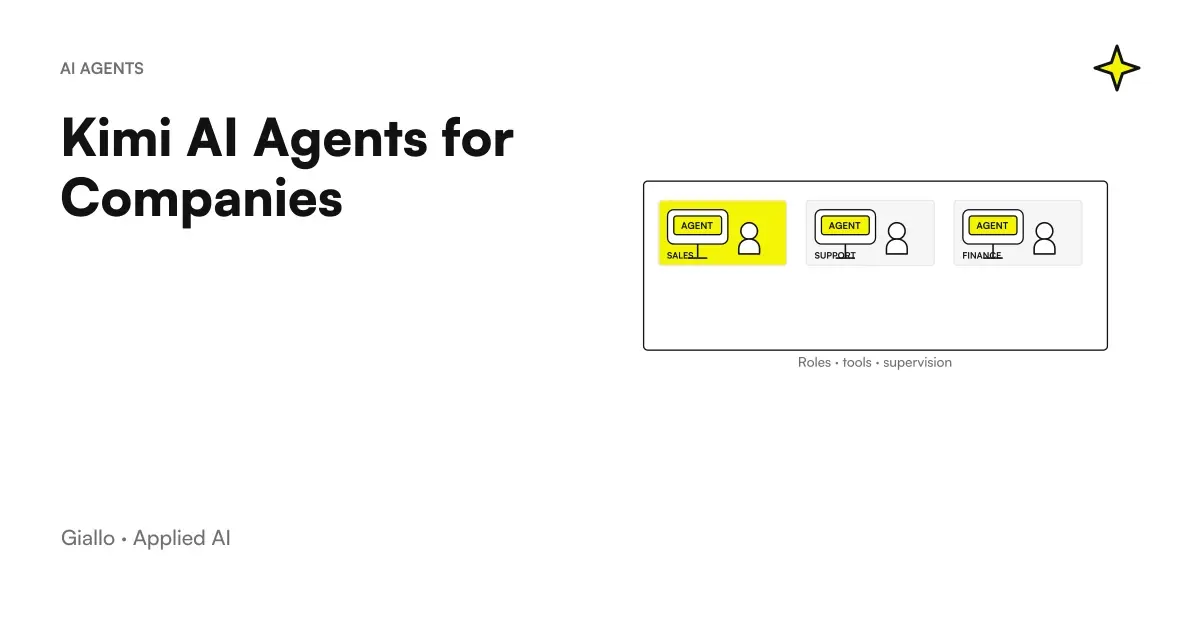
Kimi AI for companies can help perform articulate tasks, but a business agent requires more than one chat. The app documents Agent and K3 Cluster to plan tasks, work on documents, and coordinate tasks in parallel. Linking this capability to CRM, management software or internal procedures is a distinct project, with tools and permissions defined by the company. Official Agent Models and Functions.
The distinction avoids a frequent misunderstanding: a report produced independently does not prove that the system can decide for itself what to send to a customer or modify an order. It can prepare the material; the operational effect depends on the software around it and the rules of the process.
This guide, updated to 9 October 2026, serves to choose between app usage, guided workflow and integrated agent. If you are still evaluating the product, start from Kimi AI: what it is and when to use it. Here we define the roles, the boundary of actions and the necessary evidence before daily use.
In summary
- Agent Cluster in the app and agent built via API are different paths, with control and billing of their own.
- Parallelism is useful when tasks are separable and results can be compared.
- Each business tool must have explicit permissions and verified arguments out of the model.
- A commercial proposal must remain separate from the authorization to send it.
- The pilot must include errors, abstentions and manual recovery, in addition to the ideal case.
What's the difference between Kimi Agent, K3 Cluster and agent via API?
The app's current guide has unified conversation and Agent in the experience of using it: it does not describe the old switch as the only way to activate an agent. The user chooses the pattern and intensity of the reasoning; the product manages the execution of the task. Choice of models and modes.
The supplier attributes to the Cluster up to 300 Subagent and beyond 4,000 calls parallel to instruments. They are declared capabilities of the product, not a guaranteed quota for any account or a measure of the advantage in your company. The benefits of membership and effective competition should be read separately. Description Cluster and benefits membership.
An agent via API is instead born in the software designed for the process. The model proposes the steps; the orchestration prepares the data, performs only the permitted instruments and decides when to interrupt the cycle. K3 supports tool calling, but defining a function does not authorize any possible action on management software. K3 Tool Guide.
For the model find the detail in the guide to Kimi K3. For technical link, the page on Kimi API explains endpoint and configuration. Neither element replaces process design.
| Path | Suitable target | Who controls the flow | Main Verification |
|---|---|---|---|
| App Agent | Prepare a document or analysis to read | Kimi product and user | Deliverable quality and plan conditions |
| Cluster App | Splitting large work into parallel activities | Kimi product and user | Consistency of parties and coverage of sources |
| Workflow with AI Pass | Interpret an input in a fixed sequence | Workflow rules | Output Validation and Exceptions |
| Integrated agent via API | Choose from allowed business tools | Software of the company | Permissions, Arrest, and Authorized Actions |
When is a simple workflow enough?
If the path is always the same, there is no need to invent autonomy. A request comes from the form, is classified and passes to a referent. You can perform this sequence with explicit rules and an AI step limited to interpreting text. The agent who decides each step can add complexity without a proven benefit.
The difference between assistant, chatbot and agent It also concerns the control of action. An assistant helps a person. A workflow coordinates steps already chosen. An agent can select steps and tools based on the situation, within the boundaries of the system.
The route with Kimi AI and n8n is suitable for discussing a delimited flow. Before choosing architecture, write which bifurcations require interpretation and which have a certain business rule. If the management software knows the price or status of the order, the model must consult them: it must not estimate them by the language of the request.
How to assign useful roles to agents?
Assign a role when it produces a controllable result. “Commercial agent” is too broad: it can mean searching for information, preparing a quote, updating your CRM or sending a message. These activities have different risks and permissions.
A first role can collect items from admitted sources. Another can compare them to a definite structure. A verification step looks for inconsistencies and missing material. The responsible person decides whether the result meets the goal. It is not necessary for each role to correspond to a distinct agent: sometimes it is enough to separate instructions and controls in the same flow.
Define for each entry, exit, and ban role. The role that summarizes documents must retain references. The one preparing the proposal must use authorized data and report missing fields. The verification must be able to compare the proposal with the source, without receiving only the summary of the first.
Parallelism is especially convenient when branches are independent: different documents, separate research areas, separate controls. If one outcome depends on the other, starting them all together can generate incompatible assumptions. Then we need a recomposition that eliminates duplicates and contradictions, without arbitrarily choosing the most convincing version.
Is the second agent really an independent auditor?
If he reads only the answer of the first, he can merely confirm it. Provide verification criteria and access to relevant sources. Ask for evidence of inconsistencies, not a generic grade on quality. Keep commercial approval out of its responsibility: a content check does not amount to the company's consent to send it.
What business tools can the agent use?
Start with small, readable tools. "Read order status" is more controllable than "execute database queries". "Create draft response for this practice" is more delimited than "manage the customer". The tool description must explain the required arguments and what it returns.
The backend verifies identity and permissions on every call. If the user can only see customers in their department, the agent must respect the same boundary even when proposing a different identifier. Authorization cannot live only in the prompt phrase ‘do not access other customers’.
It prevents the content consulted from becoming an order. A web page, a supplier's note, or an attachment may contain hostile or simply unrelated instructions to the task. The system must treat them as data and keep the execution rules separate. Giving the model a tool that sends information to any URL makes it harder to protect this boundary.
To get started, limit the tools to reading and creating drafts. Expand permissions when the process has been tried and when the effect is understandable to the operator. The general guide to AI agents helps to read this distinction between model capability and actual autonomy.
Who approves mailings, updates, and business commitments?
The agent must deliver a proposal; the authorization must come from the process. For a quote, show missing price sources, conditions and data. For a change to CRM, show affected records and fields to update. A generic confirmation at the beginning of the conversation should not cover all future actions.
The approval must be linked to the current content. If they change quantities or recipients, the system must request a new confirmation. Do not let a late response carry out an already outdated proposal. Keep a stable reference of the practice to prevent a repeated attempt from producing two effects.
Also define who can stop the work. If the agent finds contradictory data, runs out of budget, or requests additional permission, it must move to a visible state. The phrase "I completed the task" does not replace the verification that the right action took place on the right record.
Two Italian scenarios: suppliers and technical documentation
Hypothetical scenario: metalworking company in Bergamo. The purchasing department has to compare bids for a component. One role extracts conditions from each bid; another builds a table of requirements; one audit reports differences in units, delivery conditions, and missing items.
The system retains references to the source documents. The agent does not complete an absent price using that of another offer and does not order the component. The buyer evaluates the comparability of conditions, corrects any ambiguity and authorizes the next step. The useful result is a documented comparison, not a ranking of suppliers presented as a definite decision.
Hypothetical scenario: technical services company in Bologna. A team prepares documentation for a proposal to a client. Sources are approved service cards, received requirements, and internal business conditions. The system creates a draft and checks that each requirement finds an answer or a question to be clarified.
The technical contact confirms capacity and limits; the commercial confirms conditions and recipient. A client sentence requesting access to external archives does not become an authorization for the agent. The final document is reviewed before sending. Only synthetic or already public material may be used in the pilot to evaluate the method without uploading confidential information.
Both cases are examples of design, not customers or results measured by Giallo. Their utility is to show where a proposal becomes a decision and where the system must stop.
How to control costs, duration and quality of work?
The number of agents is not a productivity metric. It counts how many practices are correct and how much work it takes to verify them. Record fixes, exceptions, lost information, and unnecessary steps. A longer report can increase the cost of review without improving the decision.
In the app, usage depends on the membership benefits and pool. In the API integration, you pay for model and tool usage according to the price list. Do not transfer app quotas to the backend. Kimi Membership and API pricing.
Set execution limits: budget, number of steps, available tools, and stop conditions. If the model keeps looking for why it doesn't find an answer, the system needs to know when to declare the data unavailable. The absence of a source is not resolved by authorizing an endless search.
Compare the pilot with a manual machining of the same type. Use easy cases, ambiguous cases, and cases with incomplete material. It also measures the auditor's time and problems that emerged after confirmation. The advantage must be demonstrated on your process; it is not deduced from a vendor benchmark or the maximum announced parallelism.
What errors block a corporate agent?
The first is a vague goal, such as "optimizes sales". It does not offer a completion criterion and prompts the agent to invent a process. It starts from a verifiable practice and delivery.
The second is to share more data than is needed. More context can mean more confidential treated material, as well as more noise. Apps and APIs have different policies; the eventual Zero Data Retention enterprise requires a specific verification and does not cover each component. ZDR Documentation. The detail is in the guide Kimi AI Privacy.
The third is to use the model as the source of business rules. Pricing, availability, and authorizations must come from approved systems or documents. The fourth is not to have a manual continuity: if the agent stops, the operator must retrieve data and status of the practice.
These problems concern the design of the AI Automation, even when choosing another model. Correcting them before release makes any reasoning skills more useful.
What process to start with Kimi AI in the company?
Choose a frequent activity with a recognisable input, accessible sources and a person responsible who can evaluate the result. Prepare a test dossier: synthetic cases, expected results, permitted tools and stopping conditions. Start with drafts or reading; add writes only when authorisations and exceptions have been checked.
If you want to define the boundary between AI proposal and operator decision in your process, Giallo designs AI agents with explicit roles and tools. The first result to be achieved is a completed practice well, with someone who can explain how and why.
Giallo Studio guides: methodology and sources
How we apply it in the company
Related resources
 Kimi AI: what it is, what it does and when to use it
 Kimi K3: model, reasoning and practical limits
 Kimi API: models, prices and Moonshot integration
 Kimi AI with n8n: how to design a workflow
 Kimi AI and privacy: what to check on company data
 AI agents: what they are and how they work
 AI assistant: difference between assistant, chatbot and agent
 Sorting emails and attachments with AI: a single queue for sales and administration
FAQ
Can Kimi AI be used as an agent in a business?
The app offers Agent and Cluster features for complex tasks. An agent connected to business systems, however, requires an integration that defines tools, permissions, stopping rules and responsibilities.
Is K3 Cluster an automated management system?
No. The product's parallelism helps with complex tasks, but does not establish that it is connected to your business management system with the necessary permissions. Those connections must be designed and verified.
Does every process need multiple agents?
No. A deterministic workflow with an AI step can be easier to maintain. More roles are needed when tasks are separable and outcomes can be compared with clear criteria.
Can an agent send quotes without a person?
Only if the system and company rules explicitly authorize that behavior. In the pilot it is prudent to generate a draft, validate prices and conditions and request approval before sending.
How do I measure if the agent is useful?
Assess cases completed correctly, corrections needed, exceptions and total cost. Compare the result with manual work on the same type of task, without inferring savings from the number of calls.
Who remains responsible for the agent's decisions?
The company must appoint a process owner and define what can be executed automatically. The model does not become the party that approves a commercial condition, a payment or a commitment to the customer.