
Integrate Jev AI through its API: a workflow for n8n and business software
Connect Jev AI through n8n's HTTP Request node: verified payloads, credentials, errors and checks before updating business software.
Reading time: 11 min
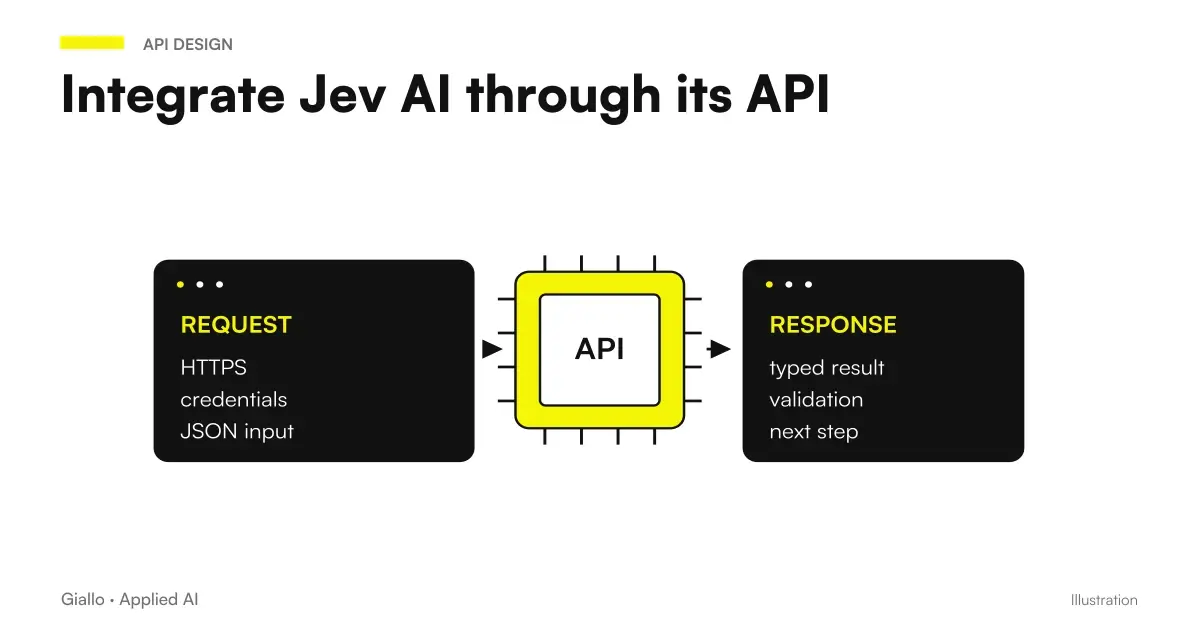
Jev AI can be integrated into n8n through the node HTTP Request, calling the TypeSafe endpoint with a authenticated request and a JSON body. The proposal of this guide uses that core node: a native Jev connector has not been verified. The capabilities of the node are documented in n8n Request HTTP Guide.
However, the project goes beyond the link. Receiving a result and properly updating a practice are two different jobs. The stream must recognize the event, prepare the contents, check the response and decide whether to propose an assignment or write in the management software. The boundary chosen for the pilot also determines what checks are needed.
The link to be designed
- The request uses the official contract, with explicitly proposed business categories.
- The key remains in the credentials of the system that executes the call.
- A received response alone does not authorise a write to the business management software.
- New attempts must not produce duplicate practices.
- The pilot must also check for interruptions, incomplete content and revision.
Choose the first event and the expected result
To start, it is better to choose a restricted entry: a box, a form or a queue of already recognizable requests. The initial result can be a suggested department, recorded next to the practice. There is no need to immediately build a chain that responds to the customer, modifies the order and closes the ticket.
Before the HTTP node, the stream should have a stable event identity and material to evaluate. In the proposal, identity remains a responsibility of the system of origin: it allows to recognize the same request during new attempts or reappearances. The useful text is separated by elements that do not contribute to the choice.
The operational contact person defines which destinations exist and who reads the doubtful cases. The guide to sorting tickets with Jev AI helps build this boundary. For those who must first choose the role of the model, what Jev AI is offers the definition of the component within the process.
The documented HTTP contract
The Quickstart TypeSafe indicates a POST call to https://api.typesafe.ai/v1/systemone, with header Authorization: Bearer and Content-Type: application/json. The key is obtained through the dashboard provided by the provider, with authenticated access; this guide does not verify the availability of a new account. Official Quickstart.
The body uses state, model and questions. The questions are a map with identifiers chosen by the caller; for a Choice, the alternatives lie in criteria, along with type and instructions. The form is shown in official quickstart and defined in API reference. The following Italian content is a design example, not an observed response nor an exported n8n configuration.
{
  "state": "Il ricambio ricevuto non corrisponde al codice ordinato. Vorrei sapere come sostituirlo.",
  "model": "jev-latest",
  "questions": {
    "reparto": {
      "type": "choice",
      "instructions": "Quale reparto deve prendere in carico la richiesta? Scegli lettura_manuale quando il messaggio non consente una destinazione definita.",
      "criteria": {
        "postvendita": "Problemi su prodotti ricevuti o richieste di sostituzione",
        "amministrazione": "Fatture e documentazione contabile",
        "commerciale": "Richieste su nuovi acquisti o preventivi",
        "lettura_manuale": "Richieste non riconducibili alle destinazioni precedenti"
      }
    }
  }
}
Example does not use a field messages nor an alleged compatibility with other APIs. The text, instructions and categories are a proposal for the process; field names follow the documented contract. Changing the criteria requires a new control of the border examples, because "replacement" and "new purchase" can overlap in real language.
In the pilot the system must record what the service returns and compare it with the result expected by the referent. The quickstart documents the collection answers, the actual model and consumption usage; for the Choice show choice, probability and confidence. Example TypeSafe Response.
Proposed HTTP Request Node Configuration
The node sets POST method, official endpoint, and JSON body. A generic header credential is used for authentication, and a JSON response is required. n8n also documents manual configuration and cURL import; in the latter the parameters can become strings, so the final shape of the body must be verified. Node Documentation.
| Part of the flow | Proposed Configuration | Check before pilot |
|---|---|---|
| Entrance | An event with identifier and useful text | The same request is recognized if it reappears |
| HTTP Request | POST to the documented endpoint | The body maintains the intended structure |
| Credential | Header Authorization in the Credential Manager | Key does not appear in shared data |
| Response Control | Expected fields and permitted destinations | Incomplete Outcomes Stop Writing |
| Operational path | Tip, Review, or Assignment | Each branch has a real recipient |
| Management software Writing | Update identified and checked | A new attempt does not create duplicates |
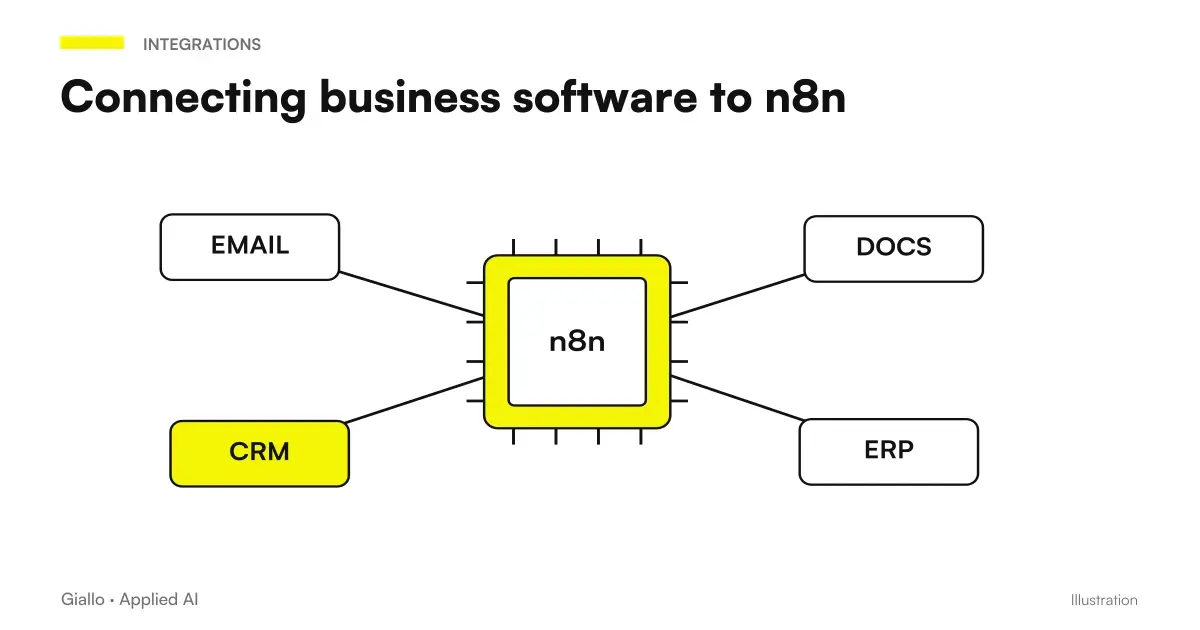
The table describes an architecture to be built, not an integration already tried on an account. For the general mechanisms of the platform, the guide to automation with n8n offers the context. The move towards the application of work deserves instead the verifications illustrated in integrate business management software with n8n.
Credentials and Liaison Responsibility
n8n provides generic credentials for HTTP Request, including header authentication. The credential manager is the intended place to configure access, separating it from the operating content. HTTP Request credentials.
In the project, the technical manager decides who can change the flow and who can see the executions. The test shared with the office should use examples without unnecessary personal information. Screenshots to describe the process do not need the real key or the full content of a customer conversation.
The public value to be shown as a placeholder is TYPESAFE_API_KEY; the real credential remains in the environment running the link. Before connecting an operating box, it checks which data is sent and which is stored by your system. The in-depth study on privacy and business data helps to prepare these questions, which are not solved by authentication alone.
Check before updating the management software
The answer must be associated with the right request and contain the expected results. The proposal checks the identifications of the applications, the expected type and the allowed value before using the result. If a field is missing or an unknown destination arrives, the operational path stops and generates a technical reading, instead of interpreting the data by approximation.
The API documents an answer for each question under its identifier. Choice responses include the choice and distribution of probabilities; this contract should be read exactly, without attributing to all types the same fields. API reference.
Technical control does not resolve semantic correctness. The manager determines which suggestions remain assisted and which may become assignments. The guide to confidence and human review It addresses the meaning of signals: one should not add a chosen threshold to intuition and call it a guarantee.
The writing on the management must then have its own protection. In the proposal, the event identifier is checked before creating or modifying the practice. If the flow restarts after an interruption, it recognizes the work already performed. This measure does not depend on the quality of the classification: it protects the process even when the same assessment is requested several times.
Errors and interruptions are part of the flow
TypeSafe documentation distinguishes 401 for missing or invalid key, 422 for invalid body, 429 by limit of requests and 529 for overload. For the last two indicates new attempts with exponential backoff. Official Error Management.
In the application proposal, a credential error requires technical intervention and not indefinite repetition. An invalid bodysuit requires checking the construction of the request. On the other hand, new attempts for temporary problems have a maximum number and a waiting limit chosen with respect to the company procedure. They are design decisions to be documented in the flow.
It should also be foreseen if the evaluation succeeds but the writing fails. Repeating everything can produce a new result and a duplicate practice; the system should know which stage has been completed. The operating register preserves the outcome of the evaluation and the status of the update with consistent accesses to the content, so that the technician can recover the work without reconstructing an email chain.
Two hypothetical scenarios to test
Packaging in Modena: assisted assignment in the orders office
A hypothetical SME in Modena produces packaging and receives requests for quotations, order changes and disputes. The first n8n flow proposes the destination of the practice and presents it to the operator. It does not update quantities or production dates. The order manager approves the categories and notes cases that require two departments.
In testing, a message reappears twice because the entrance is re-executed. The expected result is not to have two identical classifications, but only one operational practice. A second case simulates an interruption after the evaluation: when shooting, the status of the job is used to complete the update, without opening a duplicate.
The operator also tests a request with incomplete information. It must be able to correct the destination and see the original message. The pilot considers a test concluded only when the practice is readable and recoverable, not when the HTTP node shows successful execution.
Maintenance in Cagliari: continuity of taking charge
A second hypothetical SME, in Cagliari, manages maintenance for businesses. Requests come from a form and must be assigned to the relevant office. The process must continue even when the evaluation service is temporarily unavailable: the entry still records the practice and the manual queue remains active.
Testing simulates a temporary problem and verifies the waiting path. After the set limit, the work moves on to human reading with an understandable reason. The customer must not remain unattended because automation waits for a result. The manager checks that the operators know how to recognize and manage the queue.
Another case contains a technical description and a commercial request in the same text. The proposal can be reviewed without losing the event ID. The success criterion is a consistent take charge, with a responsible person and a recovery path, while any modification of a contract remains outside the first project.
Delivering a stream that operators can read
The delivery should include a short procedure for the three main states: proposal available, practice in review and technical problem. The operator must understand who takes charge of the work and what information to look at. Exposing all the details of the execution in the daily screen can be confusing; hiding the reason why a practice is stopped prevents instead of recovering it.
The technical contact person shall prepare a record of changes to the criteria and links. When a category is added, it is also checked that the corresponding destination exists and that someone reads that queue. A new result cannot become a valid writing just because it appeared in the model configuration. The process must know the next step before activating it.
The proposed monitoring distinguishes technical errors, semantic review and update failures. Three separate queues make it possible to call the right person: the technician for the connection, the operational contact for the criteria and the business system manager for a case that was not written to the system. Using a single "failed" status would require rereading every execution to understand who should intervene.
Finally, a way of returning to manual work is agreed. A change in management software or a new procedure may require you to temporarily suspend automatic assignments, continuing to record inputs. Testing must also verify this transition: the practices received during the suspension remain identifiable and the operators do not lose the reference to the original channel. It is a condition of continuity, not a detail to be added after the first problem.
When to Evaluate an SDK
TypeSafe offers official Python and JavaScript/TypeScript SDKs; documentation presents them with predefined retry types and policies. Direct HTTP remains usable by other environments. SDKs Client.
The JavaScript guide indicates the package @typesafe-ai/sdk, Node.js 20 or higher and the method client.systemOne. JavaScript SDK. That Python document TypeSafeClient and AsyncTypeSafeClient. Python SDK. These references help when the link lives in directly developed software. In n8n the link proposed here remains an HTTP request, with the same input and output contract.
The choice depends on who will keep the solution. A group that already works in n8n may prefer visual flow; an application with its own controls and tests may integrate the client into the code. The operating contract should remain the same, with input data, expected judgment, control and action allowed.
The minimum test before connecting the management software
- Simple content with expected destination and category allowed.
- Ambiguous content that must reach a person.
- Repeated event that must produce only one practice.
- Temporary error with limit to new attempts.
- Interruption after evaluation and before writing.
- Manual correction readable and associated with the original event.
If the same text is to feed multiple evaluations, the parallel questions help design calls. The budget of the API and Automation must also include these tests and maintaining the link. A service of automation of business processes turns the successful request into a path that operators can use.
Giallo Studio guides: methodology and sources
How we apply it in the company
Related resources
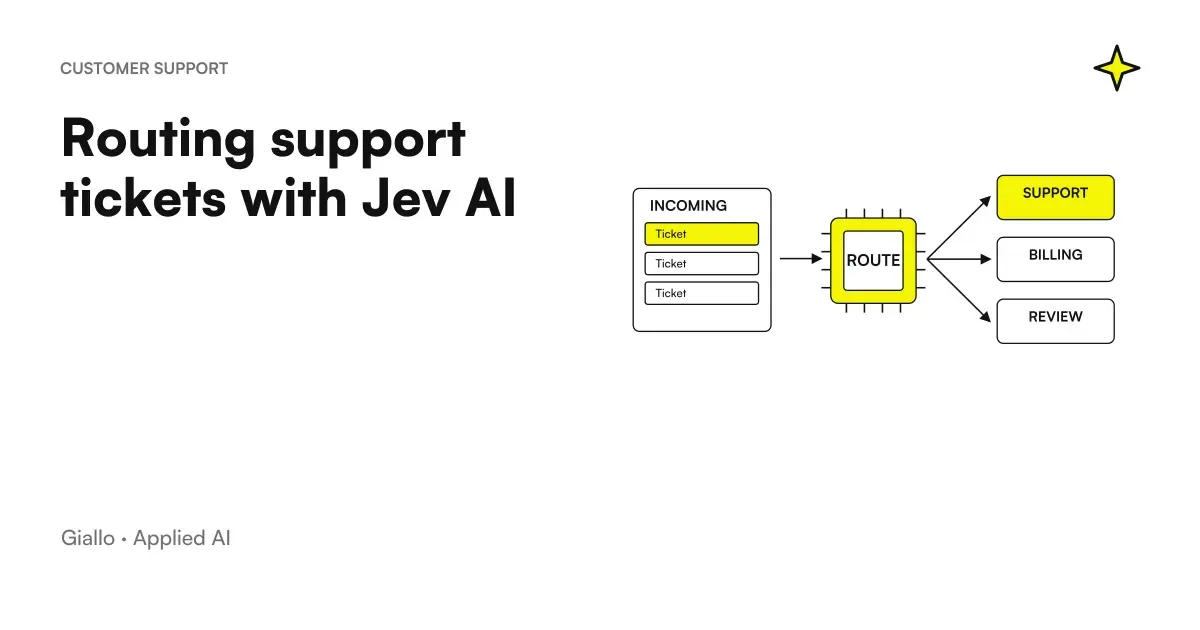 Route support tickets with Jev AI: department, urgency and review
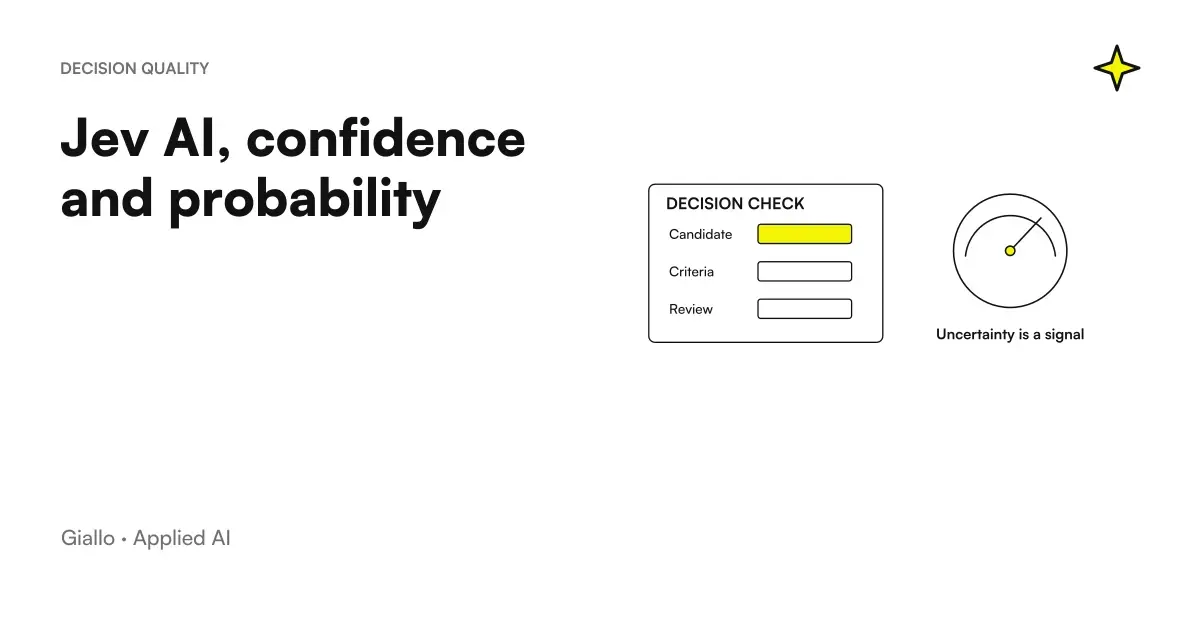 Jev AI, confidence and probability: when to get a person to intervene
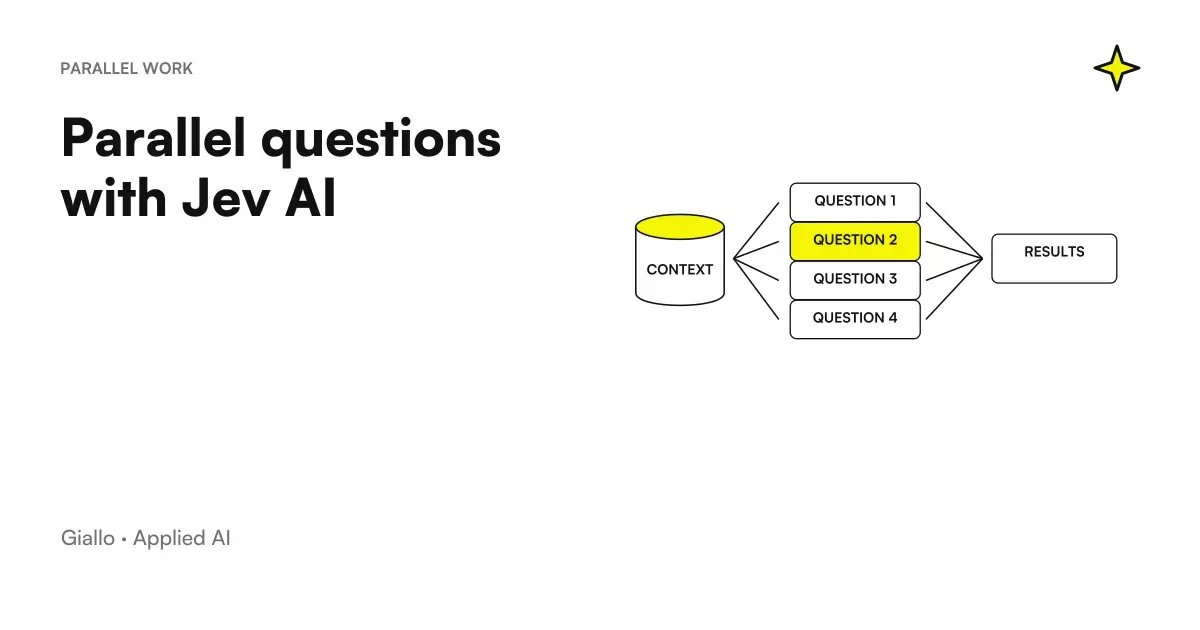 Parallel questions in Jev AI: fewer requests and repetitions
 n8n explained: how it works and how to use it in business
 Integrate business software with n8n: APIs, webhooks and HMAC signing
Jev AI in business processes
APIs, Decisions, Data, and Controls: Choose the step that relates to your process.
- Parallel questions in Jev AI: fewer requests and repetitions
- Route support tickets with Jev AI: department, urgency and review
- Jev AI for business: privacy, limits and testing on Italian data
- Document classification with Jev AI: build reliable categories
- Jev AI: API pricing and cost of business automation
- Jev AI, confidence and probability: when to get a person to intervene
- Jev AI explained: what changes for SME automation
- Deduplication with Jev AI: connecting records without merging the wrong ones
- Jev AI vs LLM: how to choose the right model
- Jev AI to extract data from emails and invoices: first find, then choose
- Verify chatbot citations with Jev AI
- Business chatbot guardrails: where to use Jev AI
FAQ
Is there an official n8n node for Jev AI verified in this guide?
No native Jev node has been verified. The proposal uses the core HTTP Request node and generic credentials to connect to the documented TypeSafe endpoint. The workflow must then be built and tested in your own environment.
What is the body structure for a classification?
The request contains state, model and questions. For a Choice question, the API documents type, instructions and criteria; criteria is the map of alternatives. The example's business categories are a proposal to verify.
Where should the API key be entered in the n8n workflow?
In the credential manager, using the appropriate configuration for the Authorization header. The real key must not appear in the body, shared screenshots or published workflow. Verify the connection using test content without sensitive data.
Can a successful HTTP response update the management system immediately?
First, checks are needed on expected keys, permitted values and the event's identity. The project then decides which outcomes can become updates and which require review, using tested criteria.
How should you handle a repeated request after an interruption?
The workflow retains an event identifier and checks it before writing to the business management system. A new evaluation attempt must not automatically become a second case or assignment. This protection belongs to the integration.
Is it better to use direct HTTP or an SDK?
HTTP Request is a natural approach for the n8n workflow described. In custom-developed software, an official SDK can help manage types and requests. The choice depends on the environment and who will maintain the connection.