
Gemini 4 Carbon vs Argon: Differences and Is It Worth Waiting?
Gemini 4 Carbon vs Argon: point gap across 17 benchmarks, pricing, access and whether to wait. How to prepare the switch today, as of 28 October 2026.
In the Gemini 4 Carbon vs Argon comparison, Carbon scores better than Argon on all 17 rows of Google's official table, but as of 28 October 2026 only Argon can be used through the API by businesses and developers. Carbon was announced on 28 October 2026, two weeks after Argon, on which it is based, and Google has not given a date for general access. The practical question is not “which of the two is stronger” but “what do we do in the meantime”.
This guide sets the numbers side by side with the gap in points, separates what Google measured from what it states from internal tests, and proposes a way to start with Argon without being locked into it. Giallo has not tested Carbon and has not rerun the benchmarks: the figures come from the Google announcement and from the model evaluation, while the calculated differences and the recommendations are ours.
In summary
- Gemini 4 Carbon beats Gemini 4 Argon on all 17 rows of Google's table, with gaps from +0.9 to +12.8 points.
- The introductory price is identical: $2 per million input tokens and $10 per million output tokens, then $4 and $20.
- As of 28 October 2026, Argon is available through the Gemini API and Carbon is not: there is no general release date.
- For projects that are needed now, waiting is not worth it: start with Argon.
- Prepare a reusable test set and keep the model in configuration, so that switching to Carbon will be a change, not a rebuild.
Gemini 4 Carbon vs Argon: what are the differences in the results?
Gemini 4 Carbon beats Gemini 4 Argon on each of the 17 rows of the “as of October, 2026” table that Google publishes in the model evaluation. The “Difference” column is Carbon minus Argon, calculated by us: percentage points for percentages, index points for the AA Index, dollars for Vending-Bench 2.
| Area | Benchmark | Carbon | Argon | Difference |
|---|---|---|---|---|
| General capabilities | AA Index v5.0 | 59 | 50 | +9 |
| General capabilities | Vals Index v2.2 | 70,4% | 69,2% | +1,2 |
| Agentic coding | SWE-sweep | 9,6% | 4,3% | +5,3 |
| Agentic coding | FrontierSWE 2 | 61,2% | 55,0% | +6,2 |
| Agentic coding | Terminal-Bench 4.0 (AA) | 65,2% | 57,1% | +8,1 |
| Computer use | Agents' Last Exam v1.1 | 77,4% | 69,0% | +8,4 |
| Computer use | OSWorld-2.1 (offline subset) | 81,5% | 74,7% | +6,8 |
| Office work | AutomationBench (Zapier) | 53,9% | 51,3% | +2,6 |
| Office work | Vending-Bench 2 (balance in $) | 16.484 $ | 13.718 $ | +2.766 $ |
| Multimodal | Chartography | 72,5% | 71,6% | +0,9 |
| Multimodal | Blueprint-Bench 2 | 58,6% | 54,4% | +4,2 |
| Long Background | GraphWalks (256k–1M tokens) | 96,2% | 84,2% | +12,0 |
| Science and math | RiemannBench | 80,0% | 76,0% | +4,0 |
| Science and math | Terminal-Bench-Science 0.1 (AA) | 64,8% | 52,9% | +11,9 |
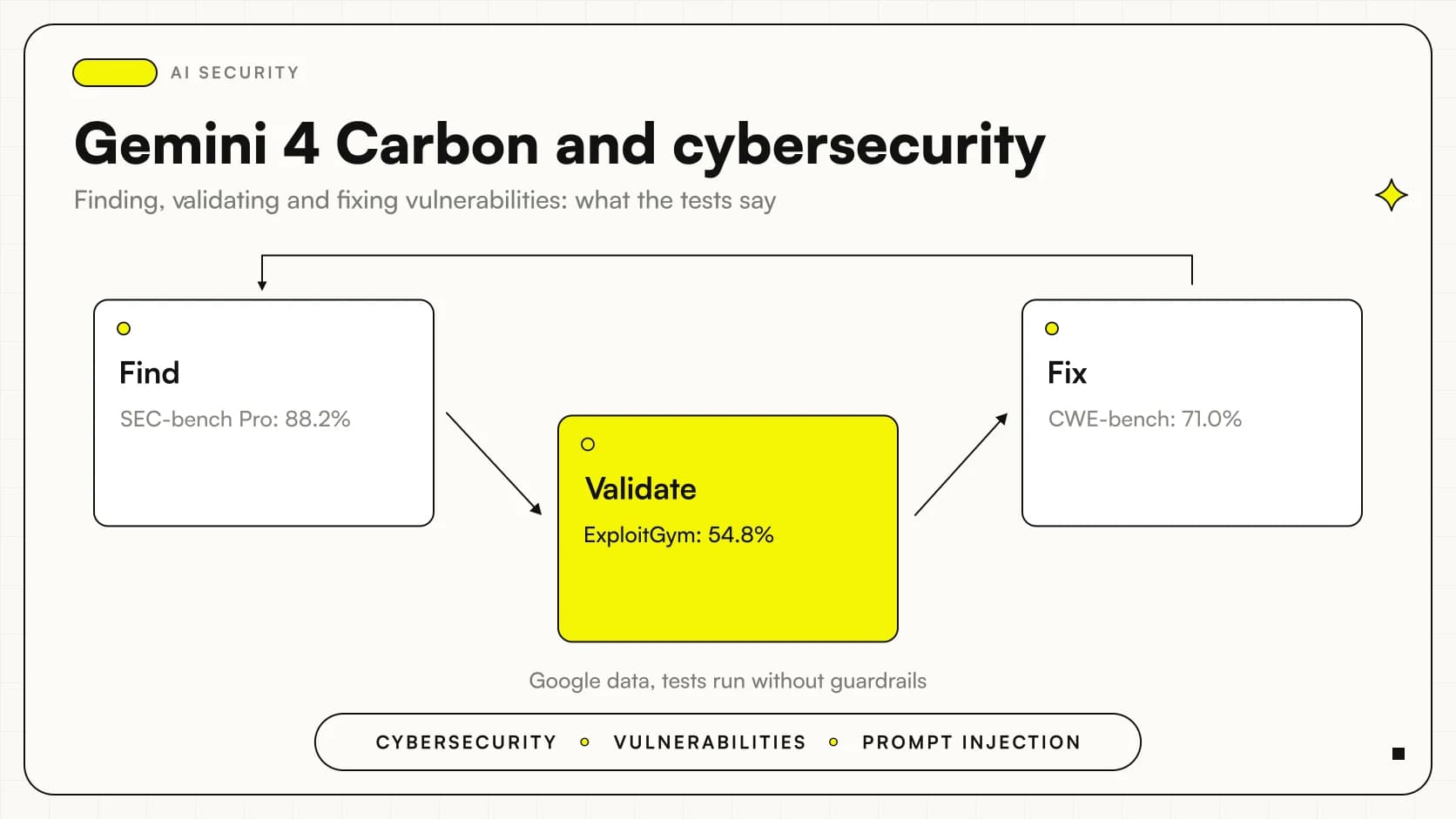
| Cybersecurity | CWE-bench | 71,0% | 68,0% | +3,0 |
| Cybersecurity | ExploitGym | 54,8% | 42,0% | +12,8 |
| Cybersecurity | SEC-bench Pro | 88,2% | 83,4% | +4,8 |
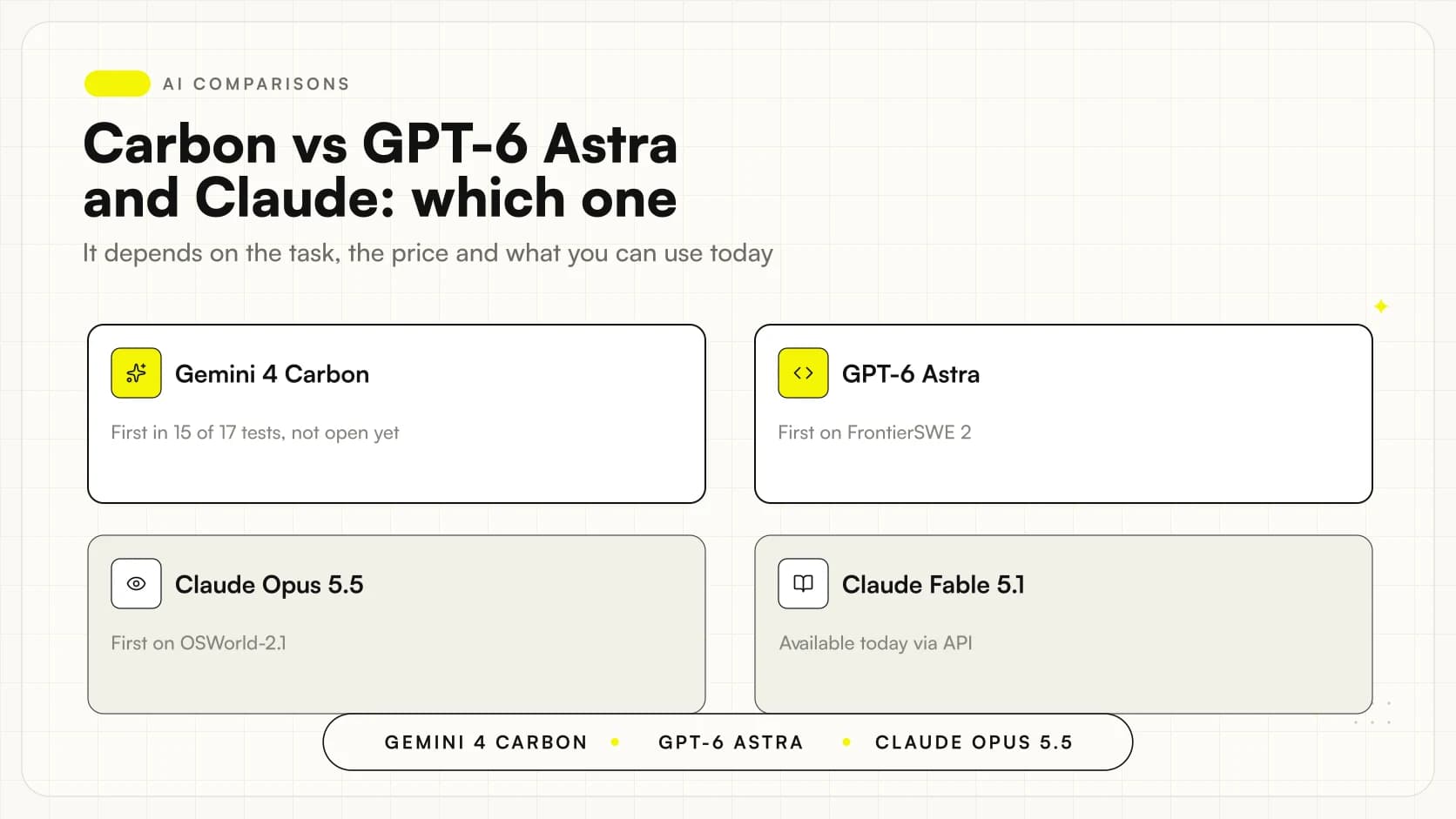
Carbon is not first overall, though: on FrontierSWE 2 the best is GPT-6 Astra with 65.5% (Opus 5.5 62.3%, Carbon 61.2%), and on OSWorld-2.1 the best is Claude Opus 5.5 with 87.2% (Carbon 81.5%). The competitors' figures are stated by the vendors or taken from different leaderboards. For the comparison with those models, see Gemini 4 Carbon vs GPT-6 Astra and Claude; for what each benchmark means, see the Carbon benchmarks guide.
Where is the gap largest, and where is it almost zero?
The largest gaps between Carbon and Argon are in cybersecurity, long context and scientific tasks: ExploitGym +12.8 points, GraphWalks +12.0 and Terminal-Bench-Science 0.1 +11.9. Next come the AA Index (+9) and agentic tasks: Agents' Last Exam +8.4, Terminal-Bench 4.0 +8.1. This pattern is consistent with what Google says about Carbon, which it describes as built for long-running agentic workflows on complex engineering tasks.
The smallest gaps are in chart reading, the general index and office automation: Chartography +0.9, Vals Index +1.2, AutomationBench +2.6 and CWE-bench +3.0. This reading by area is ours, not Google's: it helps show where waiting for Carbon matters least, namely activities such as summarizing documents, reading tables or preparing drafts.
Before giving weight to the decimals, it matters how the data was built. Google states that Carbon and Argon are measured, barring declared exceptions, with the same setup (pass@1 with a single attempt and thinking at maximum), which makes the pair more consistent than the comparison with competitors. But some tests are small: Agents' Last Exam uses 122 tasks and OSWorld-2.1 an offline subset of 82. On samples like these, differences of one or two points are, in our view, indistinguishable from noise.
Beyond benchmarks, how does Carbon behave differently?
Google states three behavioral differences for Carbon compared with Argon, all measured in internal tests or on a specific benchmark. The first is code security: in internal benchmarks Carbon has more than double the success rate at generating secure code compared with Argon. The second is the reliability of claims: unsupported claims are roughly halved. The third is resistance to indirect prompt injection: on the Gray Swan IPI benchmark, Argon suffers successful attacks in 0.7% of cases, Carbon in 0.0%.
That last figure should be read with caution: 0.0% means Carbon withstood all the attempts evaluated, not that the attack is impossible. Anyone who connects a model to email, external documents or web pages must still limit the tools' permissions, as explained in the guide to Argon privacy and security in business. The announcement's cybersecurity benchmarks are also “evaluated without guardrails”: behavior in the final product, with the safeguards switched on, may differ. More detail in the guide to Gemini 4 Carbon cybersecurity.
The announcement reports other values going down: successful cheating on Terminal-Bench 4.0 at 0.0% (attempts at 0.4%), high-severity misalignment alerts down by almost 80% in live testing with internal teams, overreach −26% and under-service −29%. For these, the baseline is not specified in the data we checked: they are reductions stated by Google, not a certain difference between Carbon and Argon. Google also describes two useful habits: faced with an ambiguity, Carbon retrieves the sources and flags discrepancies before acting, and when it cannot carry out a blocked action it lists what is missing instead of making things up.
Does Carbon cost more than Argon?
No: during the introductory period Gemini 4 Carbon has the same price as Argon, $2 per million input tokens and $10 per million output tokens, according to the Google announcement. For Argon, prices can be checked in the official Gemini API price list, where Carbon does not appear as of 28 October 2026.
| Voice (per million tokens) | Carbon | Argon |
|---|---|---|
| Input, introductory price | 2 $ | 2 $ |
| Output, introductory price | 10 $ | 10 $ |
| Cached input, introductory price | $0.10 (95% discount, our calculation) | $0.10 (implicit caching only) |
| After the introductory period | $4 input, $20 output | $4 input, $20 output, cache $0.20 from 1 December 2026 |
| End of the introductory period | not announced | 30 November 2026 |
| Batch and Flex | not published | half the Standard price |
Two practical consequences. First: at the same price per token, the cost per result can still differ, because Google has not published how many tokens Carbon uses per task and its benchmarks use the highest thinking settings. In a hypothetical example, a job of 10 million input tokens and 1 million output tokens costs $30 at the introductory price and $60 afterwards, for both models; what changes is the attempts and review needed to get an accepted result. Second: 30 November 2026 is Argon's date and should not be attributed to Carbon. It is worth calculating the budget on the $4 and $20 list price as well. The Carbon pricing guide compares them with competitors; to organize the cost items, see the worksheet in the guide to Argon costs.
When is Gemini 4 Carbon released, and how do you access it?
Google has not announced a release date for Gemini 4 Carbon. Since the week of the announcement the model has been available to a subset of cyber defenders; then, gradually, to other trusted partners through the Fairwind Program. For developers, enterprises and consumers Google speaks of “as soon as possible” and “soon”, adding that it is still gathering feedback and iterating on the safeguards. Google describes the release as deliberate and takes part in the US government's voluntary process of testing models before release.
The Fairwind Program is aimed at governments, critical infrastructure operators (healthcare, telecommunications, energy, financial networks), core technology platforms and academic labs doing defensive benchmarking. Google vets applicants, imposes usage rules and prohibits sharing or reselling access. Requests are made through a form, but as of 28 October 2026 the page names only Gemini 4 Argon, not Carbon. Going by these criteria, an ordinary SME is not among the intended recipients.
What has not been published: general availability date, model identifier in the API, context window, output limits, availability in the Gemini app, AI Studio or Vertex AI, and supported countries. We therefore write nothing about these points for Carbon. Argon, by contrast, appears in the Gemini API price list; for access from Italy, see how to use Argon in Italy. Always check the official pages, because the situation may change in the coming days.
Should you wait for Gemini 4 Carbon or start with Argon?
For a project that is needed now, waiting for Gemini 4 Carbon is not worth it: Argon is available, Carbon is not, and no date has been announced. An open-ended wait stalls the work for a benefit that can be neither measured nor scheduled. Use Argon and prepare for the comparison, so that Carbon's arrival is a test you rerun and not a new project.
Start with Argon now if
- The process has a deadline or a cost of waiting: delays, manual work to clear.
- The tasks are documents, emails, tables and drafts, where the stated numbers are closer.
- You can measure results with your own cases and change course without contractual lock-in.
- Any advantage of Carbon can be checked later by changing a configuration.
Consider waiting for Carbon if
- The project's value depends on cybersecurity tasks or very long contexts, where the stated gap is largest.
- You fall among the intended recipients of the Fairwind Program and can apply.
- The project has no near deadline and no decision depends on it.
- In the meantime you can use Argon or another available model for the less critical cases.
Even those in the right-hand column should not stand still: data, acceptance criteria, formats and checks do not depend on the model and can be prepared today. To choose between several providers, there is the method for choosing an AI model.
How do you prepare today for a future switch from Argon to Carbon?
The switch becomes a configuration change when the integration is designed that way from day one. There are six steps, and they apply to any pair of models, not just this one.
- Write down the process and the required result. A short sheet: what goes in, what must come out, what the system must never do.
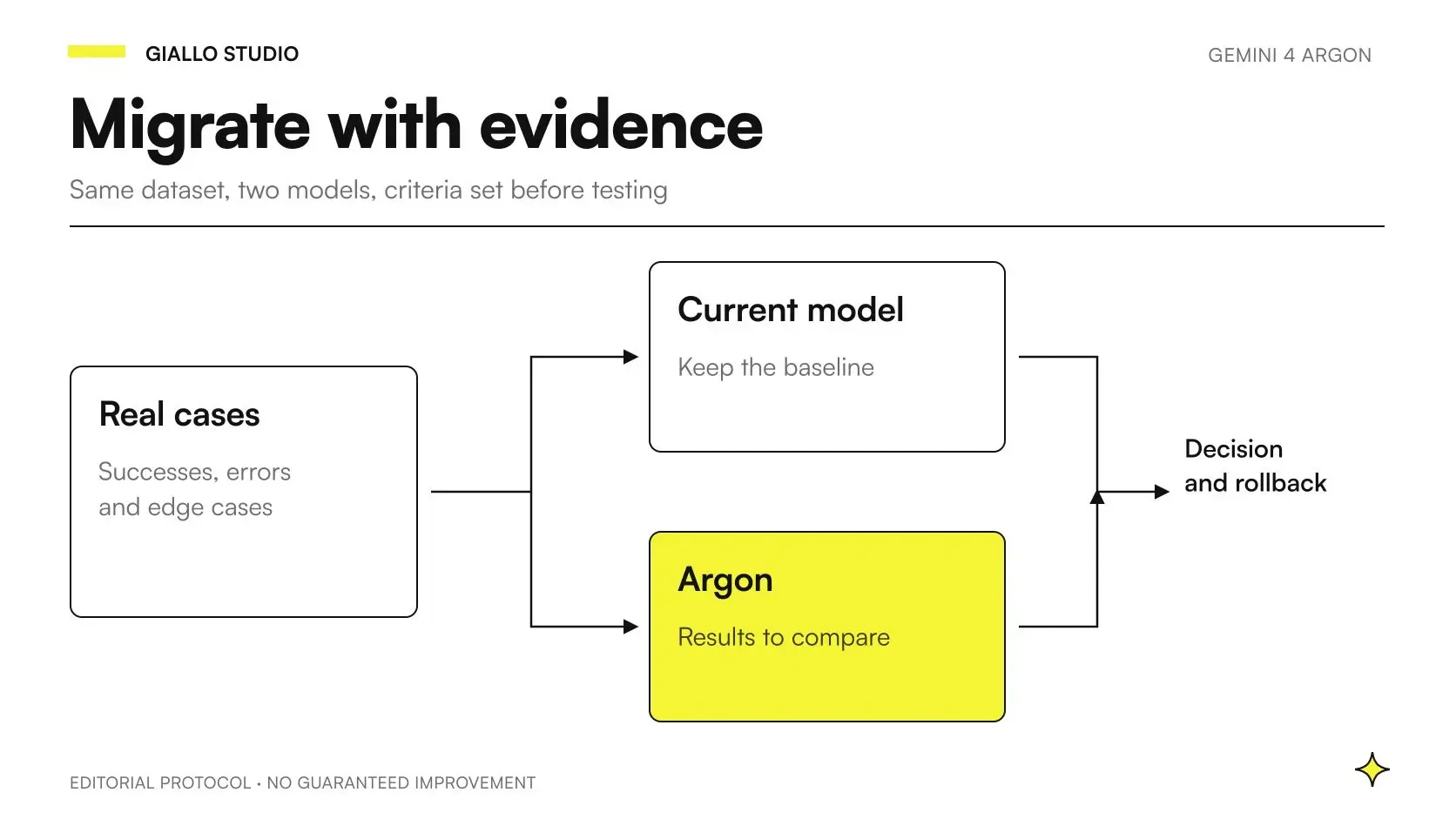
- Build a reusable test set. Real cases, even incomplete or conflicting ones, with acceptance criteria written before seeing the answers. Keep part of the set aside and do not use it to tweak the prompts.
- Keep the model out of the code. Model name, parameters and tools live in a configuration file or in environment variables, not hard-coded in functions.
- Record cost and time per accepted result. Requests, attempts and minutes of review, not just the price per token.
- Plan a gradual rollout and a rollback. A share of requests on the new model, the previous configuration saved and a switch to go back to it.
- Set the comparison day. When Google publishes the identifier, limits and availability, reread the official documentation and rerun the test set on both models.
The full test protocol, with blocking criteria and a release sheet, is in the guide to migrating to Gemini 4 Argon and applies unchanged to Carbon. For the technical side of the integration, see the Argon API integration.
When Carbon becomes available, parameters, tools and limits must be reread in its documentation: today we do not know whether they match Argon's. A separate configuration for each model avoids surprises.
- The model name is in configuration and can change without modifying the code.
- The test set is saved, versioned and can be rerun by anyone on the team.
- The blocking criteria are written before the comparison, not after.
- The cost per accepted result is already recorded for the current model.
- A procedure exists for rolling back to the previous configuration, tested at least once.
Two hypothetical scenarios: a machine shop and a software house
The scenarios below are examples we made up, not clients or tests we ran. They claim no result for Carbon or Argon.
A 15-person machine shop wants an assistant that reads the quote requests received by email and prepares a sheet for the salesperson: material, quantity, attached drawing, missing information. The work is document-based, Carbon's stated advantage on these tasks is among the smallest, and the backlog weighs on them every week. Here it makes sense to start with Argon, with thirty past requests as the test set and the model in configuration; if Carbon arrives, rerunning that set will be enough.
A software house with 6 developers maintains a business management system with a large codebase and would like support for code review and vulnerability detection. Here Carbon's stated numbers on CWE-bench (+3.0), SEC-bench Pro (+4.8) and on secure code (more than double, in internal tests) are interesting, but there is no access and Fairwind does not appear to be aimed at this profile. The reasonable choice is to use Argon for non-sensitive code, collect a set of past bugs and fixes with a known solution, and wait for Carbon without stopping work. For how we set up the development service, the page on software house describes how we work.
Which mistakes make the Carbon vs Argon comparison misleading?
The first mistake is reading “best in the table” as “best for my documents”: benchmarks help you decide what to test, not replace testing on your own cases. The second is suspending a project while waiting for a model with no date.
The third is writing the model name into the code, in several places: when the change is needed, it becomes a search and replace with a risk of missed spots. The fourth is assuming that equal price means equal cost, when Carbon's token consumption per task is not published. The fifth is widening tool permissions because prompt injection is at 0.0%: see agents and automations with Argon.
What should you do this week?
The Gemini 4 Carbon vs Argon comparison says that Carbon is stronger on paper, costs the same during the introductory period, and cannot be used today. The prudent decision is to start with Argon on the process that really needs it, build the test set and keep the model in configuration; the rest is decided when Google publishes access, limits and a date.
If you want to set up a test on your own process, with acceptance criteria and an integration ready to switch models, Giallo Studio supports you with AI consulting. For the starting overview, the Gemini 4 Carbon guide and the one on Gemini 4 Argon remain the references.
Giallo Studio guides: methodology and sources
How we apply it in the company
Related resources
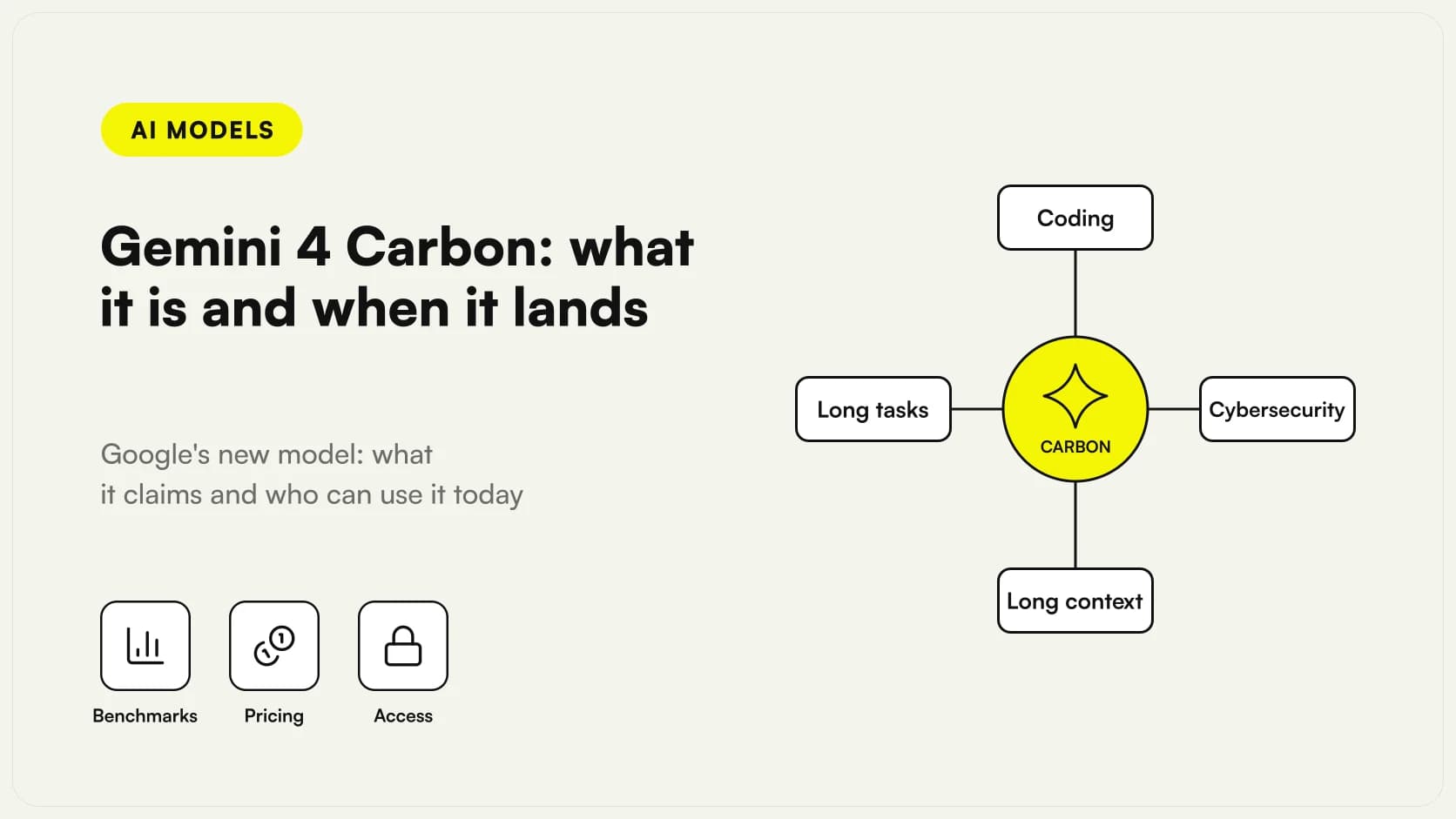 Gemini 4 Carbon: what it is, what Google claims and when it will be available
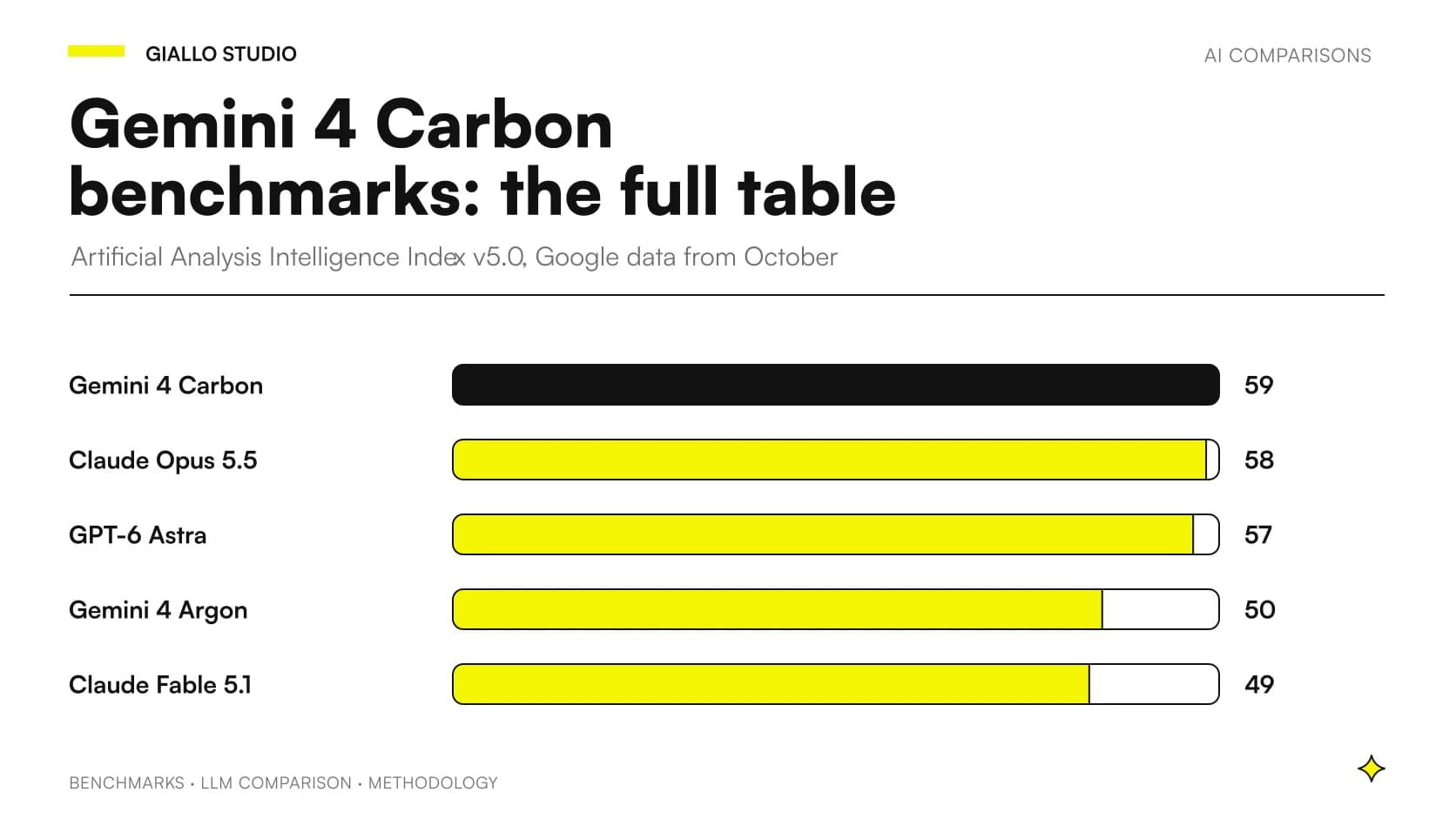 Gemini 4 Carbon benchmarks: the full table and how to read it
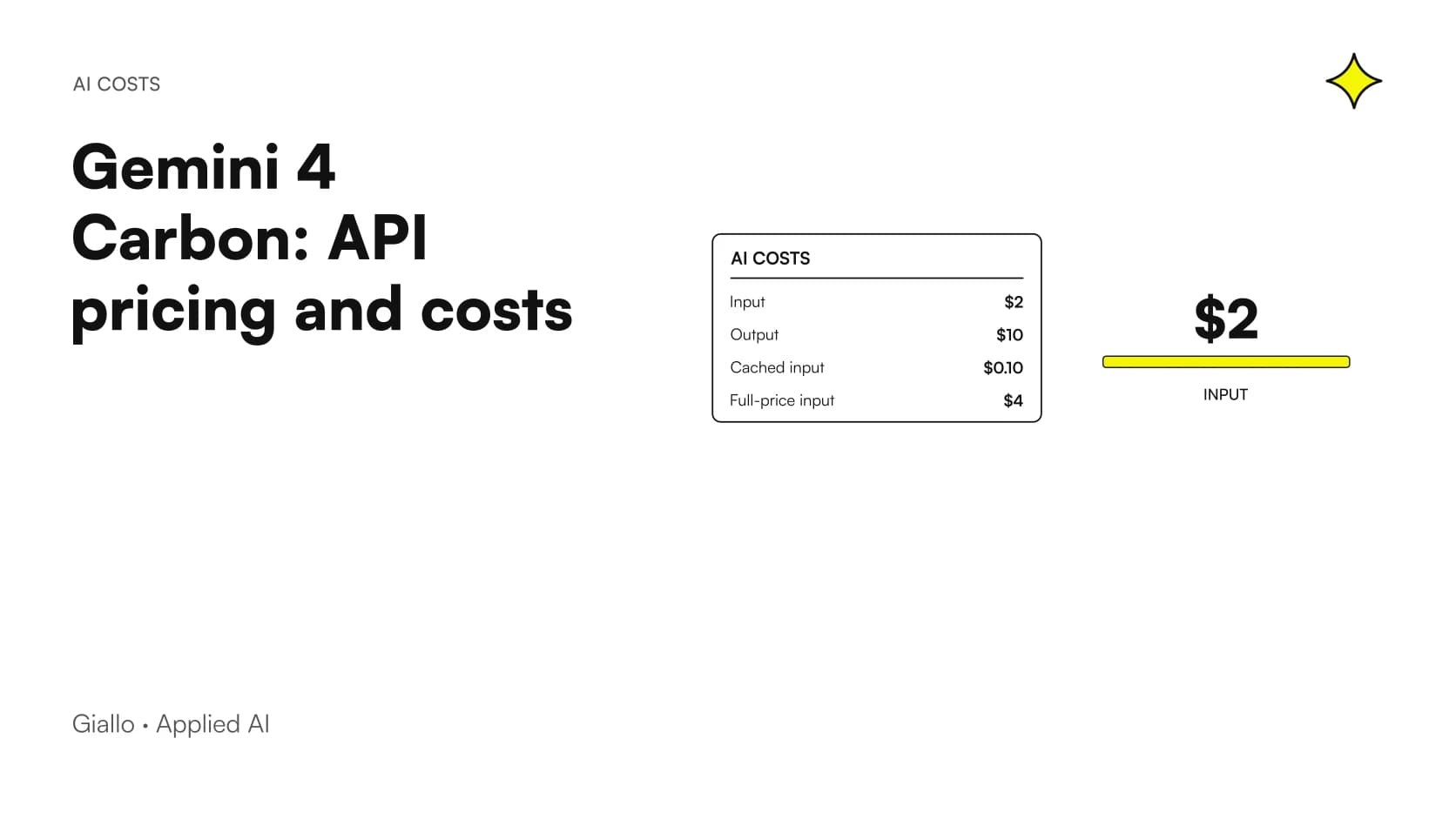 Gemini 4 Carbon pricing: API prices, cost per million tokens and comparison
 Gemini 4 Carbon cybersecurity: finding, validating and fixing vulnerabilities
 Gemini 4 Argon: what it is, what it does and when to use it in business
 Migrating to Gemini 4 Argon: evaluation, testing and rollback
 Gemini 4 Carbon vs GPT-6 Astra and Claude: Which to Choose for Each Task
Other direct comparisons
The same criteria applied to other model pairs.
- Gemini 4 Argon vs ChatGPT and Claude: which should you choose?
- Gemini 4 Carbon vs GPT-6 Astra and Claude: Which to Choose for Each Task
- Gemini 3.6 Flash vs 3.5 Flash
- ChatGPT vs Gemini: which subscription is worthwhile in October 2026?
- Claude Fable 5.1 vs Sonnet 5
- Gemini vs Copilot: Which to Choose
- DeepSeek R1 Distill 32B vs Qwen3.8-27B locally
- Gemma 4 12B vs Ministral 3 14B: compact local AI
- Claude vs Perplexity
- GPT-5.6 Sol vs Terra: which makes sense?
- Claude vs Gemini: Which to Use
- GPT-6 Astra vs Claude Fable 5.1
FAQ
What is the difference between Gemini 4 Carbon and Gemini 4 Argon?
As of 28 October 2026, Gemini 4 Carbon scores higher than Gemini 4 Argon on all 17 rows of Google's official table, with gaps from 0.9 points (Chartography) to 12.8 points (ExploitGym). Google also states that Carbon has more than double the success rate at generating secure code and about half as many unsupported claims as Argon. The figures are published by Google and have not been independently reproduced.
When is Gemini 4 Carbon coming out for businesses and developers?
Google has not given a date. In its 28 October 2026 announcement it says developers, enterprises and consumers will get access “as soon as possible”, after gathering feedback and iterating on the safeguards. Until an official date appears, any forecast of general release is a guess.
How do you access Gemini 4 Carbon?
As of 28 October 2026, Gemini 4 Carbon is available only to a subset of cyber defenders selected by Google, then gradually to other trusted partners through the Fairwind Program. It does not appear in the Gemini API price list, and Google has not published a model identifier in the API. An SME has no ordinary route to access it today.
Does Gemini 4 Carbon cost more than Gemini 4 Argon?
No. During the introductory period the stated price for Gemini 4 Carbon is identical to Argon's: $2 per million input tokens and $10 per million output tokens. After the introductory period Google lists $4 and $20. The end date of Carbon's promotion has not been announced, while for Argon the price list shows 30 November 2026.
Should you wait for Gemini 4 Carbon or use Argon now?
For a project that is needed now, use Argon, because Gemini 4 Carbon has no release date and is not available to businesses as of 28 October 2026. It is worth building a reusable test set from day one and keeping the model name in configuration, so you can compare Carbon when it arrives.
What should you prepare today to switch from Argon to Carbon?
You need three things: a set of real cases with acceptance criteria written beforehand, a record of cost and time per accepted result, and a model selectable from configuration rather than written into the code. With these three elements, comparing against Gemini 4 Carbon becomes a repeatable test and the switch a configuration change, not a new project.
Is Gemini 4 Carbon better than GPT-6 Astra and Claude Opus 5.5 at everything?
No. In Google's table, Gemini 4 Carbon is not first on FrontierSWE 2, where GPT-6 Astra scores 65.5% against Carbon's 61.2%, nor on OSWorld-2.1, where Claude Opus 5.5 scores 87.2% against 81.5%. The competitors' figures are stated by the vendors or taken from different leaderboards, so they should be read with caution.