
Gemma 4 12B vs Ministral 3 14B: compact local AI
Gemma 4 12B vs Ministral 3 14B: audio, images, memory and documents. Comparing two compact models for a business workflow.
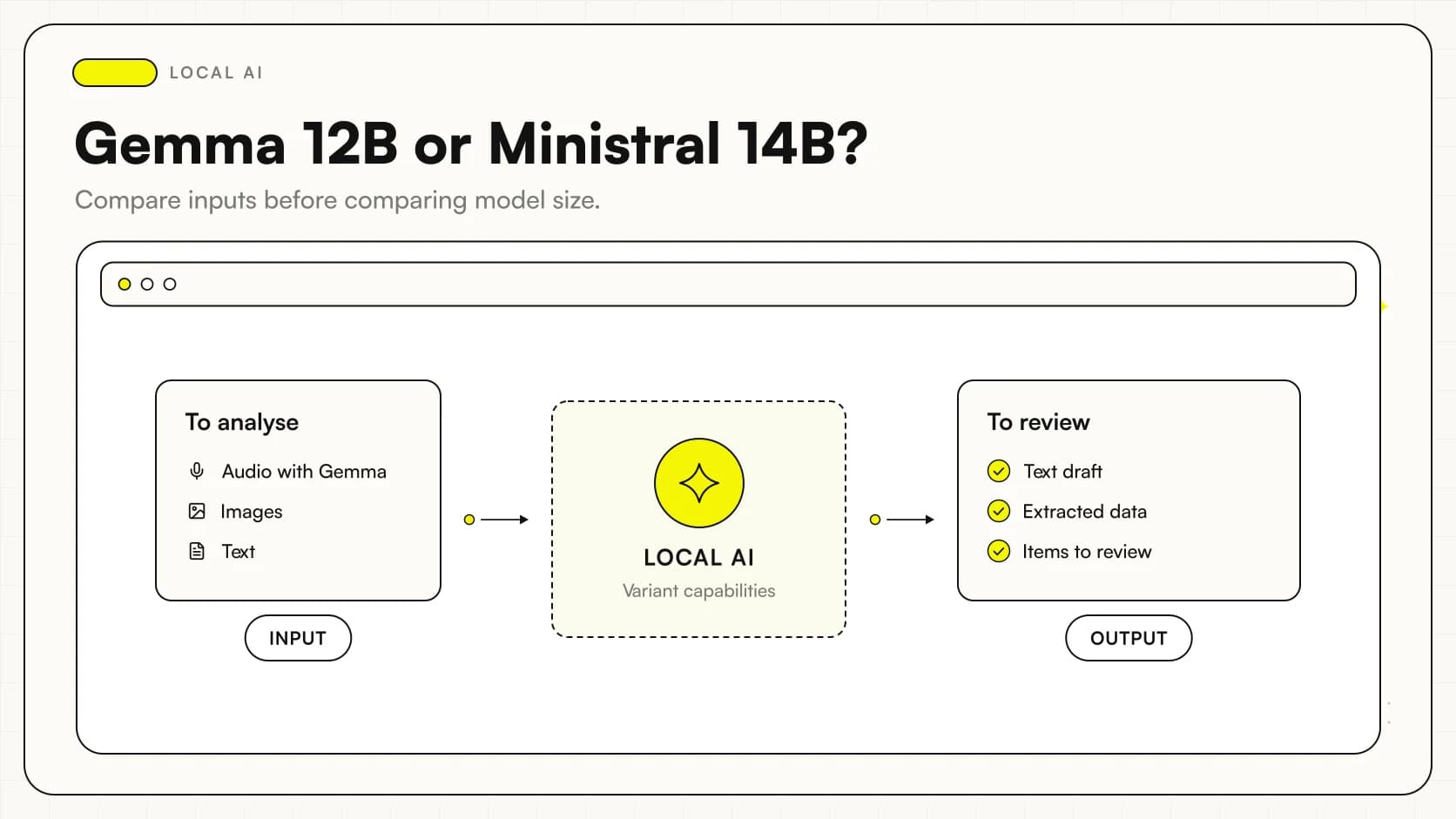
Gemma 4 12B understands text, images and audio; Ministral 3 14B understands text and images. If your local workflow needs direct audio input, this difference already helps shape the pilot; for text or visual documents alone, compare them on actual work. We have no measured winner on your data. Sources: Gemma 4 model card, Ministral 3 14B Instruct.
These sizes may interest an SME seeking an assistant less demanding than models with many more tens of billions of parameters. “Compact” remains relative: it does not mean every computer is suitable or the entire workflow is automatically offline. This guide distinguishes capabilities, manufacturer estimates and tests to perform, using official sources consulted on October 27, 2026.
In summary
- Gemma 4 12B Unified specifies 11.95B parameters and text, image and audio inputs.
- Ministral 3 14B combines 13.5B language parameters with a 0.4B vision encoder.
- Both specify 256K context and Apache 2.0 licensing.
- Gemma generates text: audio input does not imply synthetic speech output.
- For documents, meetings and internal requests, verified accuracy matters alongside memory.
Which checkpoints are being compared?
For Google, the reference is Gemma 4 12B Unified, a dense variant described in the official model card. For Mistral, it is Ministral-3-14B-Instruct-2512, using the BF16 distribution as the specification reference and distinguishing other formats. Base and Reasoning are different variants, not simple aliases for Instruct. Mistral source.
The full name avoids comparisons with results from Gemma 4 31B or a Mistral Large. If a review refers only to “Gemma” or “Mistral,” ask which model and weights were used. The guide to Local AI Models clarifies the difference between family, checkpoint and application, which is useful before choosing software for the trial.
What does Unified mean for Gemma 4 12B?
Google describes the 12B variant as encoder-free: rather than first passing through dedicated multimodal encoders, images and audio are projected directly into embedding space through lightweight components. The card specifies 11.95B parameters and support for text, images and audio, with text generation. Source: Gemma 4 12B architecture.
For application users, the practical point is the ability to evaluate different inputs with the same model. Any actual benefit must still be tested with the selected engine: a card capability does not guarantee every interface can send an audio file correctly. Before judging the answer, check what the checkpoint actually receives and which transformations the software applies. If a remote service transcribes the file, you are already evaluating a different path.
Which audio input does Ministral 3 14B lack?
Ministral’s card specifies text and vision capabilities through a 13.5B language model and 0.4B vision encoder. It does not describe native audio input for this checkpoint. An application can still pair it with a separate transcriber and pass the resulting text. Source: Ministral 3 14B Instruct BF16.
This may be suitable, but the comparison must include transcription too. An incorrect name in meeting minutes may arise before generation, and a text model cannot hear the original sound to correct it. With Gemma, you can test the direct audio path supported by the runtime, without assuming it is better: names, negations and references need checking. Choose between systems to test, rather than treating the number of steps as a score in itself.
Which specifications help define the test?
The sources specify a context window of 256K tokens and Apache 2.0 licensing for both variants. However, the nominal window does not describe how many recording minutes or pages you can process in every environment: preparation, tokenization and available resources are part of the path. Google source, Mistral source.
| Criterion | Gemma 4 12B Unified | Ministral 3 14B Instruct |
|---|---|---|
| Reference architecture | Dense, unified multimodal | Dense language model plus vision encoder |
| Stated size | 11.95B | 13.5B language + 0.4B vision |
| Images | Yes | Yes |
| Native audio input | Yes | Not specified for this variant |
| Output | Text | Text |
| Stated context | 256K | 256K |
| Licence | Apache 2.0 | Apache 2.0 |
| Suitability for your workflow | To be measured | To be measured |
The table helps select the appropriate sample without adding advantages unsupported by the sources.
How much memory do the manufacturers indicate?
For Gemma 4 12B, Google publishes loading estimates of approximately 26.7 GB BF16, 13.4 GB SFP8 and 6.7 GB Q4_0, including an indicative 20% overhead. The documentation states that the result depends on tool and environment. These values do not establish that audio with long context always fits the same memory. Source: Gemma 4 overview.
For the 14B, Mistral indicates that it can fit within 32 GB VRAM in BF16 and less than 24 GB RAM or VRAM when quantized. This is also manufacturer guidance, not a test comparable with Google’s scope. Source: Mistral card. Do not turn two differently constructed estimates into a ranking. Observe the actual file and workload, keeping system, cache and other application headroom separate.
Which format should you test first?
Choose a format supported by your infrastructure and document the conversion. Ministral has an official GGUF repository; for Gemma, start with download links and environments listed in the official getting-started guide. Do not assume a conversion retains all original modalities and functions in your runtime.
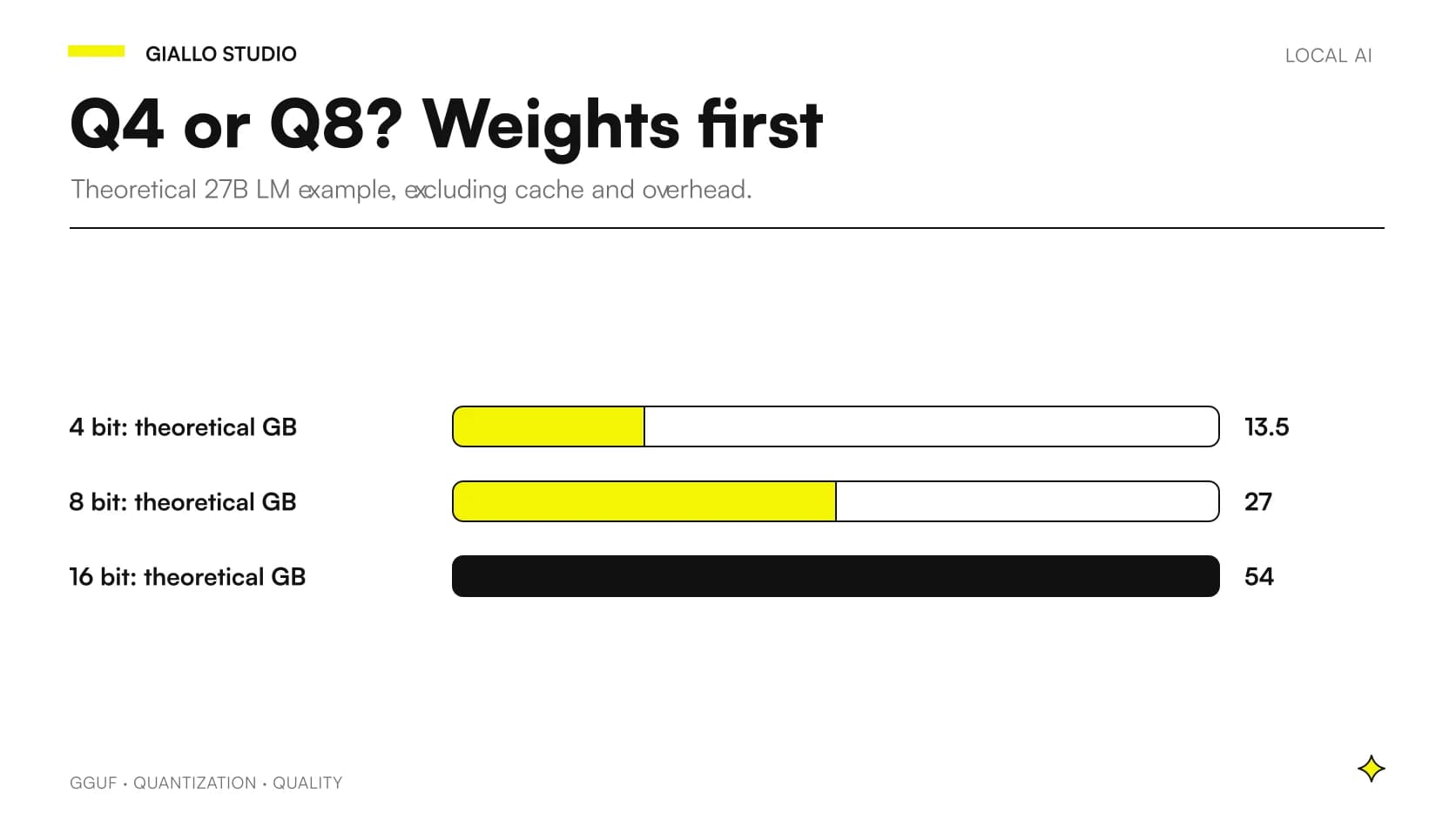
For the initial comparison, avoid changing precision, file preparation and prompt simultaneously. If memory requires a more compressed variant, record the constraint and check errors in sensitive fields. The guide to GGUF, Q4 and Q8 explains why container and precision are different things. A smaller download is useful only if the result remains suitable for the task.
How should you test them on administrative documents?
Hypothetical scenario: an office wants to compare terms in orders, quotations and attachments. The task is to flag differences and references, not automatically approve the document. Vision capabilities in both models allow a trial, but field fidelity must be checked.
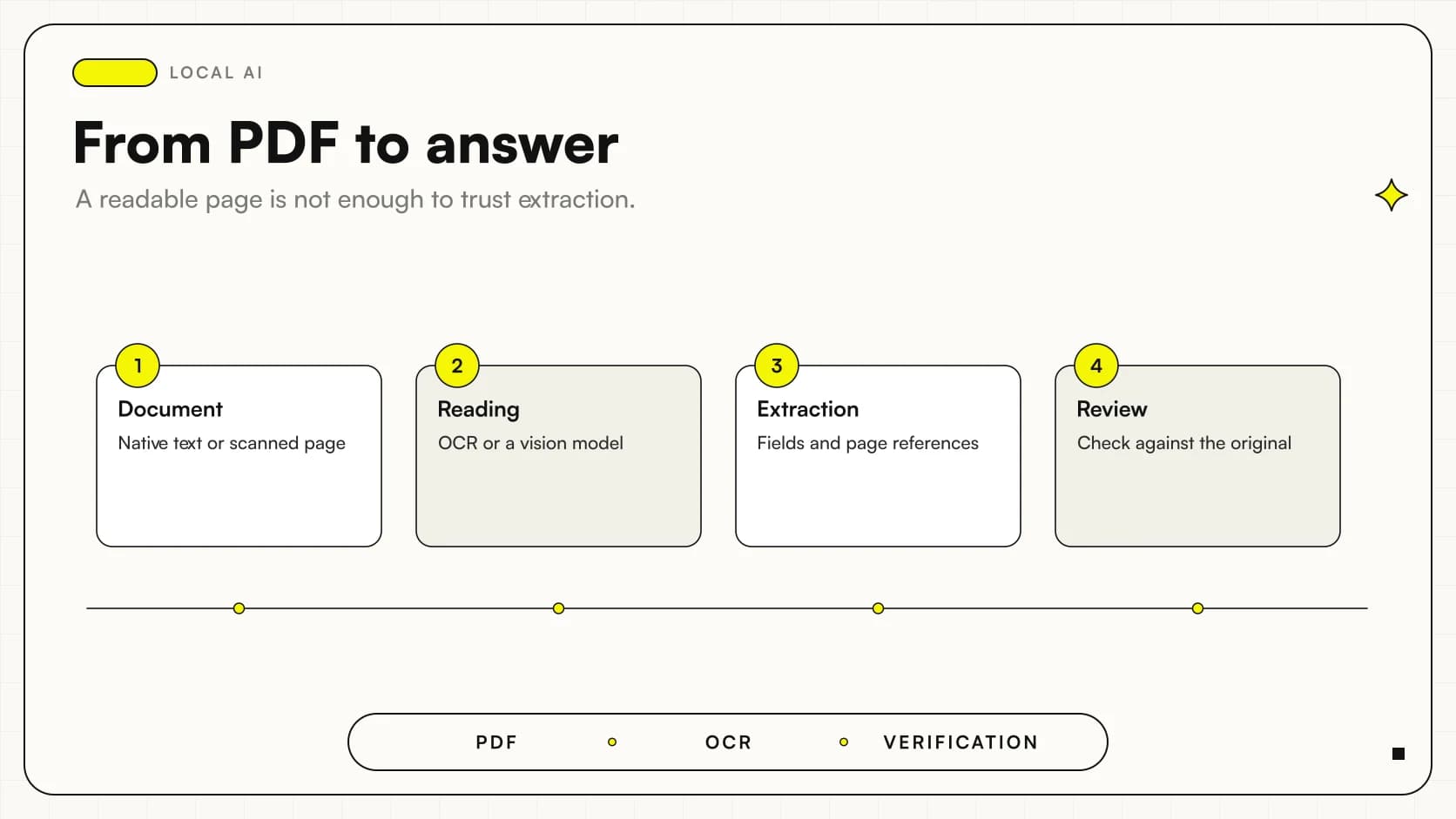
Prepare documents with dates in different formats, discounts described in text and exclusions in a note. Request a table with data, source and missing information. Also check whether the model attributes a condition from another attachment to the document. If a cell is unreadable, the output must say so. The article on local multimodal AI for PDFs and images explains how to preserve page references: those references make drafts checkable by staff.
How does a test on internal meetings differ?
Second hypothetical scenario: a project team wants to summarize an authorized meeting, including decisions, assigned tasks and open questions. With Gemma, test direct audio if the runtime supports it; with Ministral, test a transcript prepared by a separate component. Keep these paths distinct in the sample.
Instruct the system not to invent an assignee when an intervention is unclear. A discussed proposal must not become an approved decision, and uncertainty must not disappear from the minutes. Have participants check the outcome against the original material. Record transcription, attribution and summarization errors separately. If a spoken reply is needed, add a dedicated component: Gemma’s stated text output does not automatically become speech synthesis because the model receives audio.
Which tests distinguish useful summaries from plausible ones?
A useful summary preserves what changes a decision: conditions, responsibilities, exceptions and references. Prepare cases containing a negation, a deadline corrected during discussion or an instruction replaced by an attachment. The expected result must make the change visible rather than flattening it.
Also evaluate what the model adds. A reasonable but unsupported sentence may be more harmful than an omitted detail, especially when presented as team agreement. Define error categories before reading answers: invented fact, incorrect reference, missing essential information and appropriate abstention. Use the guide to benchmarking local LLMs in Italian to organize assessment. A percentage is unnecessary if you have not first clarified what counts as a correct answer.
Do you need maximum context to work well?
Not necessarily. A short, well-prepared document may be more useful than a huge, disorganized collection of attachments. The manufacturers’ stated 256K window describes a technical capability, not an obligation to use it all. Sources: Google, Mistral.
For a business archive, start by retrieving relevant passages and preserve source dates, revisions and permissions. The guide to local RAG for business documents lets you design this step without loading every file into every request. For long recordings, check how inputs are split and whether the summary preserves links between distant sections. Splitting may lose a reference to a later correction; testing must specifically look for that error.
How can you measure the experience on the actual workstation?
Observe the entire path from opening a file to the verifiable result. Generation time is only part of it: import, conversion and model loading can change perceived waiting time. Measure cold starts separately from requests with the model already in memory, without assigning values you have not observed.
Check the workstation with normal work tools open. If testing happens with every application closed but the assistant will share resources with a browser and business software, the result may not represent intended use. For an Apple Silicon choice, read Local LLMs on a Mac with 16, 24 or 32 GB; for a workstation with a dedicated GPU, local LLMs on Windows and VRAM. None of these conditions can be inferred from the model name.
Also assess how results can be corrected. The interface should let users return to the original passage, mark uncertainty and retain the approved revision separately from the draft. For a meeting, the team may need to correct a name or distinguish a proposal from an assigned task. If the system overwrites the source or hides corrections, model quality does not solve the product problem. Before expanding use, verify that a person can understand what changed and why. The pilot must observe this work too, without inventing time savings.
Which audio, privacy and licensing mistakes should you avoid?
Do not confuse audio input with generated speech, or family capabilities with the modalities of a single variant. Do not call a system offline if transcription or OCR sends content to an external service. Do not describe a loading estimate as sufficient memory for every request.
Both checkpoints considered here declare Apache 2.0; check license links in the cards from Google and Mistral, as well as terms for the programs and derivatives used. For data and recordings, define access, retention and destinations before the pilot. The guide to local AI and business privacy helps verify the complete path. Generation on the computer alone does not establish where attachments, logs and backups end up.
Which candidate should you test for your workflow?
Audio among required inputs
Evaluate Gemma 4 12B through the direct path supported by the runtime and compare it with a text system including transcription. Keep errors from every step.
Text and images as sufficient inputs
Test Gemma and Ministral on the same document sample. Choose based on evidence fidelity, observed resources and ease of operation.
Start with a verifiable task and leave approval to a person. The right compact model meets essential checks without making the workstation fragile or sources difficult to verify.
If a larger size is needed, compare Qwen3.8-27B and Ministral 3 14B. To design an assistant connecting documents and meetings to the team’s work, Giallo Studio provides workflow-focused AI consulting, with a pilot making inputs, expected outcomes and review criteria explicit; in The Lab you can find other application examples.
Giallo Studio guides: methodology and sources
How we apply it in the company
Related resources
 Qwen3.8-27B vs Ministral 3 14B: choosing local AI
 Local multimodal AI for business PDFs and images
 GGUF quantization: Q4 or Q8 for local LLMs?
 Local LLMs on a Mac with 16, 24 or 32 GB
 Local LLMs in Italian: comparing without misleading tests
 Mistral vs Llama: comparison between the two open weight models
Other direct comparisons
The same criteria applied to other model pairs.
- Gemini vs Copilot: Which to Choose
- GPT-5.6 Sol vs Terra: which makes sense?
- ChatGPT vs Gemini: which subscription is worthwhile in October 2026?
- GPT-6 Astra vs Claude Fable 5.1
- Gemini 4 Argon vs ChatGPT and Claude: which should you choose?
- GPT-6 Astra vs GPT-5.6 Sol
- Gemini 3.6 Flash vs 3.5 Flash
- GPT-6 Sol vs Claude Opus 5.5: the official numbers and when to use which
- Claude Fable 5.1 vs Sonnet 5
- GPT-6 Sol vs Luna: which one to choose and for which jobs
- DeepSeek R1 Distill 32B vs Qwen3.8-27B locally
- Claude Haiku 4.5 vs Gemini Flash-Lite
FAQ
Can both Gemma 4 12B and Ministral 3 14B read images?
Yes, official cards declare vision capabilities for both. Accuracy on tables, notes and scans requires testing the actual workflow documents.
Which understands audio directly?
Gemma 4 12B specifies audio input alongside text and images. Ministral 3 14B does not specify native audio for this checkpoint and can be paired with a separate transcription model.
Does Gemma 4 12B generate speech?
The model card specifies text output. Audio input does not imply speech synthesis: a spoken answer needs a separate path to verify.
Which model needs less RAM?
Nominal sizes are insufficient. Compare weight format, quantization, context, cache and pipeline; manufacturer estimates do not necessarily cover the same scope.
Which should an SME choose?
Start with required modalities and a verifiable sample. For direct audio, consider Gemma; for text and images, test both, measuring errors, resources and review work.