
DeepSeek R1 Distill 32B vs Qwen3.8-27B locally
DeepSeek R1 Distill 32B vs Qwen3.8-27B: text, images, reasoning and memory. Choose a local model using tests relevant to your work.
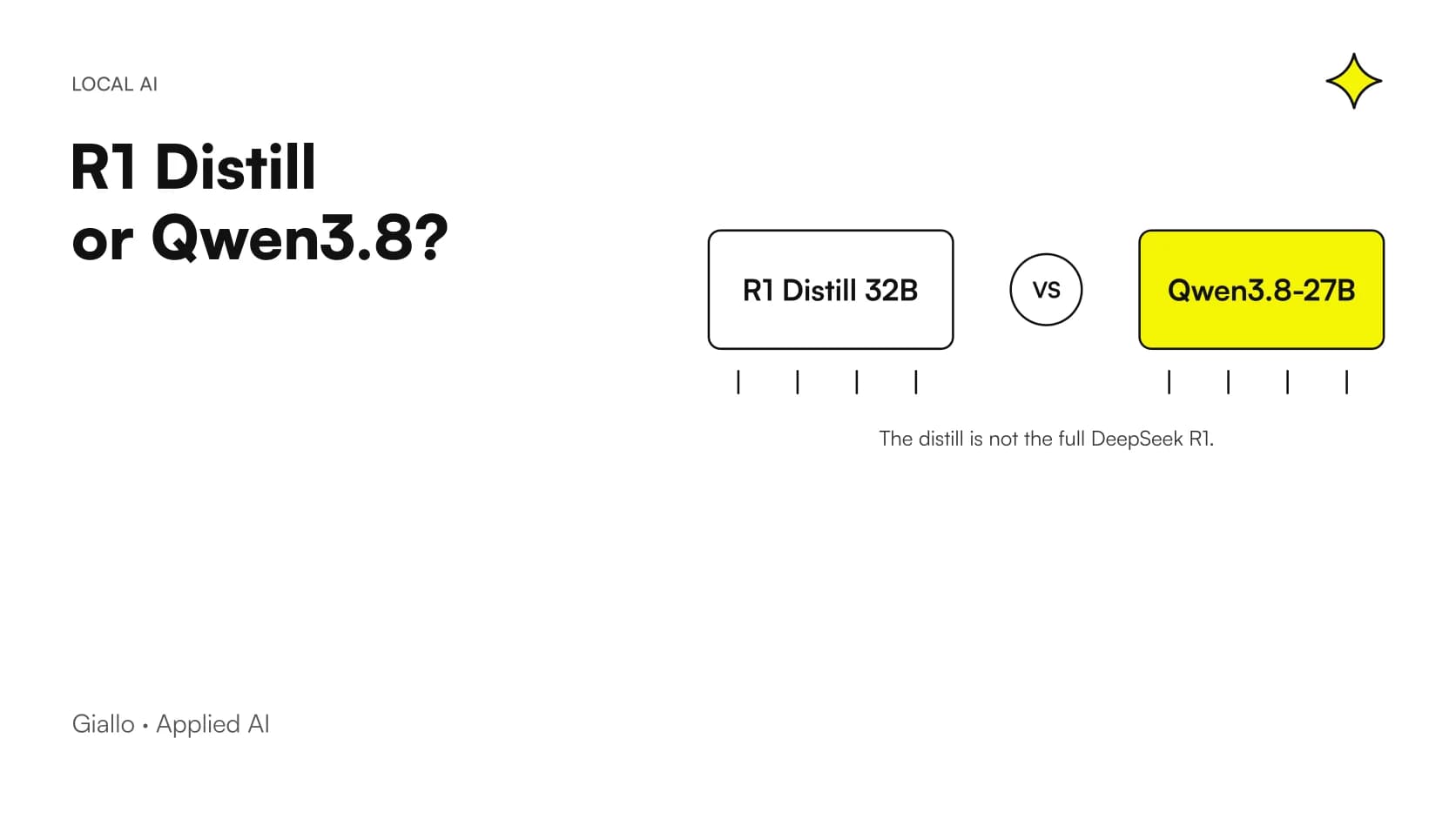
DeepSeek R1 Distill 32B vs Qwen3.8-27B is primarily a choice between two workflows: reasoning over text and handling visual content as well. Giallo has not measured a winner between these checkpoints: the choice depends on the documents, hardware and errors your workflow can tolerate.
The first name specifically identifies DeepSeek-R1-Distill-Qwen-32B, a dense text-only model based on Qwen2.5-32B. Qwen3.8-27B belongs to a different generation and supports text, images and video. These are vendor specifications, checked on 27 October 2026; they are not a comparative quality test.
In summary
- Distill 32B is not the full DeepSeek R1 model.
- Text and visual pipelines require different tests.
- Parameter counts explain only part of memory consumption.
- More reasoning text does not mean more correct answers.
- The useful measure is reliable work remaining after review.
What does Distill actually mean in this comparison?
Distillation transfers behaviour through training data or signals: it does not simply shrink the original model file. Here, the vendor explicitly distinguishes the derived checkpoint from the full R1 model in its DeepSeek model table. The reference to the Qwen family in the name describes the starting point, not an upgrade relationship with Qwen3.8.
For anyone commissioning a business project, the practical consequence is clear: ask for the exact repository. A proposal that says only “DeepSeek” does not explain which software will be installed, how much memory it will need or which capabilities have actually been evaluated. The same applies to a generic promise of “local Qwen”. In the guide to choosing an AI model the checkpoint is therefore something to specify before testing, alongside the weights revision and runtime.
Text and images: where does the pipeline change?
A contract exported as text and a photograph of the same contract are not the same input. In the first case, both systems can receive the extracted content. In the second, Distill needs an external image-reading step, while Qwen can use a compatible visual pipeline. If external OCR misreads a digit, the final answer may look like a model error even though it originated earlier.
The llama.cpp multimodal documentation distinguishes language weights from the components needed to process visual input. The downloaded filename alone does not confirm that this pipeline is configured. Designing the test requires two separate questions: did the system read the page correctly? Did it reason correctly about what it read? The guide to local PDFs and images develops this practical distinction.
Which differences belong in the decision sheet?
| Aspect | DeepSeek R1 Distill Qwen 32B | Qwen3.8-27B | Verification to be done |
|---|---|---|---|
| Model input | Text | Text and visual input | Test the actual format |
| Base family | Qwen2.5 | Qwen3.8 | Record repository and revision |
| Architecture considered | Dense | Dense | Do not apply MoE assumptions |
| Comparison objective | Textual reasoning | Reasoning and visual reading | Separate the results |
| Quality in Italian | Measure on the task | Measure on the task | Use expected answers |
| Operating memory | Depends on configuration | Depends on configuration | Read logs and peaks |
The table helps decide what to test, not award medals. An essential requirement can exclude a candidate before scoring: if a layout must be interpreted directly, a text-only pipeline must show how it preserves that information. If inputs are exclusively records that are already structured, the additional capability may provide no usable benefit.
How much does the difference between 32B and 27B matter?
As an independent calculation limited to language weights, multiplying parameters by bits and dividing by eight gives about 16 decimal GB for 32 billion parameters at four bits and 13.5 GB for 27 billion. These are not measurements of the distributed files, and they do not show that a machine with that memory can run the service.
The Hugging Face quantization documentation explains the trade-off between precision and size. The project must add metadata, multimodal components, caches and runtime workspace. Memory left for everyday applications also matters. A sound comparison records the file actually loaded and the configuration, rather than assigning hardware based only on the B suffix. For sizing Qwen, see the guide to RAM and VRAM for the 27B model.
Does longer reasoning make an answer better?
A model can produce a reasoned explanation and still reach a false conclusion. It may also use a great deal of text for a question that needed only a brief check. Business use requires verifiable outcomes: a correctly extracted deadline, a reconciled quantity, a contradiction flagged with its source. Explanation length is an output characteristic, not a certification.
Separate the answer intended for the operator from the data used to check it. For example, request the value, source document and supporting passage, then validate the format against defined rules. A long chain of thought is not needed to establish the reliability of a total: the source values and a repeatable calculation are. For sensitive decisions, human reviewers must be able to reconstruct the evidence without relying on a confident tone.
How can prompts avoid biasing the comparison?
A fair test starts with the same problem but respects each model's documented formats. Blindly copying one family's chat template to another can disadvantage a candidate. Record instructions, generation settings, output limit and document processing, distinguishing shared choices from runtime requirements.
The DeepSeek model card publishes specific usage recommendations. Following them does not justify changing the question only for your preferred candidate. A good test record also includes formatting errors and interrupted responses: excluding them would artificially improve the result. For more on the method, the Italian-language benchmarking protocol sets separate criteria for correctness, abstention and latency.
An engineering practice comparing specifications
Imagine a practice that needs to compare two specifications and a quotation. This is an illustrative scenario, not a Giallo client. If all texts are digital, the test can ask which services are missing, where quantities differ and which conditions conflict. A human-prepared table becomes the reference: every AI observation must identify the document and passage.
Then add a variation with a scanned page and a marginal note. Do not combine its result with the previous one: visual reading is now involved too. A candidate might handle the text comparison well but fail on the note. This is more useful than a single average score because it suggests an operating boundary: digital documents accepted, scans checked through a different pipeline.
An administration team checking charges
In a second hypothetical scenario, an office must explain differences between orders and charges. The model receives already normalized extracts, so images do not automatically add value. The important test concerns matches, exceptions and missing data. A charge without supporting documentation must remain flagged, without inventing a plausible explanation.
Totals are checked with deterministic software; the model can help describe discrepancies and suggest checks. Also measure how much work remains for the operator after the response. An elegant explanation that is difficult to verify may take more time than a simple table. The financial comparison must therefore include review and maintenance, as explained in the analysis of local AI and cloud business costs.
When is it worth keeping two candidates?
The workflow receives very different documents: must it use just one model?
Not necessarily. First separate the tasks and check whether one configuration covers them with sufficient quality. A second model makes sense when it addresses an observed limitation and the benefit outweighs duplication, updates and additional checks.
Maintaining two systems doubles some responsibilities, rather than merely requiring another download. Versions, configurations, regression tests and authorized users all need managing. The choice can be reasonable for distinct jobs; it is less convincing when it stems only from uncertainty about which model to prefer.
A small business can start with one candidate and retain the second for periodic comparison. Document why you chose it and what would reopen the decision: poorer results on new documents, a new visual requirement or lower operating costs. This avoids constant switching driven by announcements.
Which mistakes make the evaluation unreliable?
The first mistake is attributing full R1 results to Distill. The second is comparing an aggressively quantized model with the other at a different precision without saying so. The third is changing runtime, prompt and documents at the same time: when the outcome changes, you no longer know which variable mattered.
A fourth mistake is measuring only the most striking correct answers. Include questions unanswered by the documents, contradictions and unreadable input. Finally, “local” does not establish that the entire workflow is isolated: external OCR, tools and storage may involve other services. The guide to Local AI Models clarifies the scope; checks must follow the actual content flow rather than stop at the model's name.
How can results be assessed without hiding rare errors?
A sample made up only of simple questions tends to make every candidate look satisfactory. The process owner should therefore add cases that genuinely distinguish alternatives: a table split across pages, a reference to an outdated version, two companies with similar names, a document missing a referenced attachment. These are not artificial traps when they represent possible problems in the working archive.
The evaluation can distinguish a correct answer, an incomplete answer, a correctable error and an unsupported statement. Define the categories before reading outputs. Someone other than the person who configured the model can assess a subset without seeing the candidate's name, reducing the risk of rewarding wording that matches their expectations.
Keep the reason for each error too. “It confused two versions” points to a different problem from “it failed to read a digit” or “it ignored the instruction to flag missing data”. The correction may belong in the archive, extraction or request format. Changing models without this distinction risks moving the problem and repeating the same test without learning anything.
What should you ask the installer?
A concrete proposal should provide the weights identifier, revision, conversion provenance and a readable component description. It must explain who updates the runtime, who can see conversations and where temporary documents go. Check licences against the distributed files and project dependencies: a family's commercial name does not establish every applicable obligation.
The test record should include the sample, exclusion criteria and unfavourable results, alongside the chosen configuration. Promises about any computer are not useful: measurements are needed on the intended machine, with the other work applications open. If the proposal concerns a shared service, the test must simulate overlapping requests rather than show only an individual chat.
Finally, ask for a demonstration of recovery. An unreadable file, interrupted response or memory exhaustion must produce an outcome the operator understands. Workflow continuity depends on this behaviour too, which is often less visible than a successful presentation response.
From comparison to a clearly bounded workflow
The final decision should be a verifiable statement: “this configuration helps compare these documents, with these exclusions and this review”. That is more useful than “we installed the best model”. Keep a reference sample and rerun it after every weights or runtime update, without silently replacing the approved configuration.
Before extending the service, assign responsibility for anomalies and decide how to return to manual work when an answer is missing or unsupported. A local project becomes reliable through these boundaries, not a ranking. If you want to turn the DeepSeek and Qwen comparison into a test on your documents, AI consulting by Giallo Studio can define the sample, criteria and configuration before integration.
Giallo Studio guides: methodology and sources
How we apply it in the company
Related resources
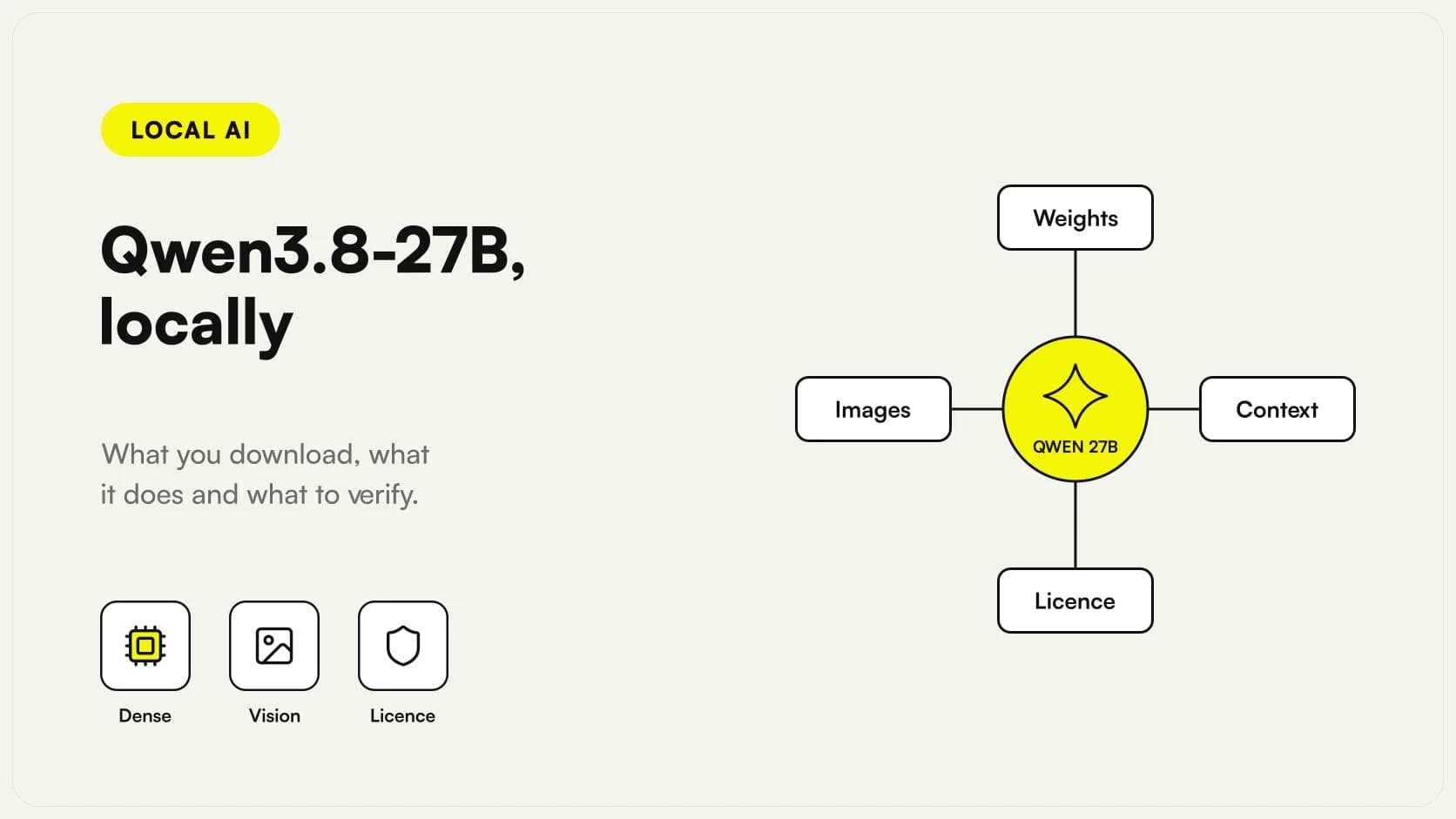 Qwen3.8-27B locally: capabilities, limits and requirements
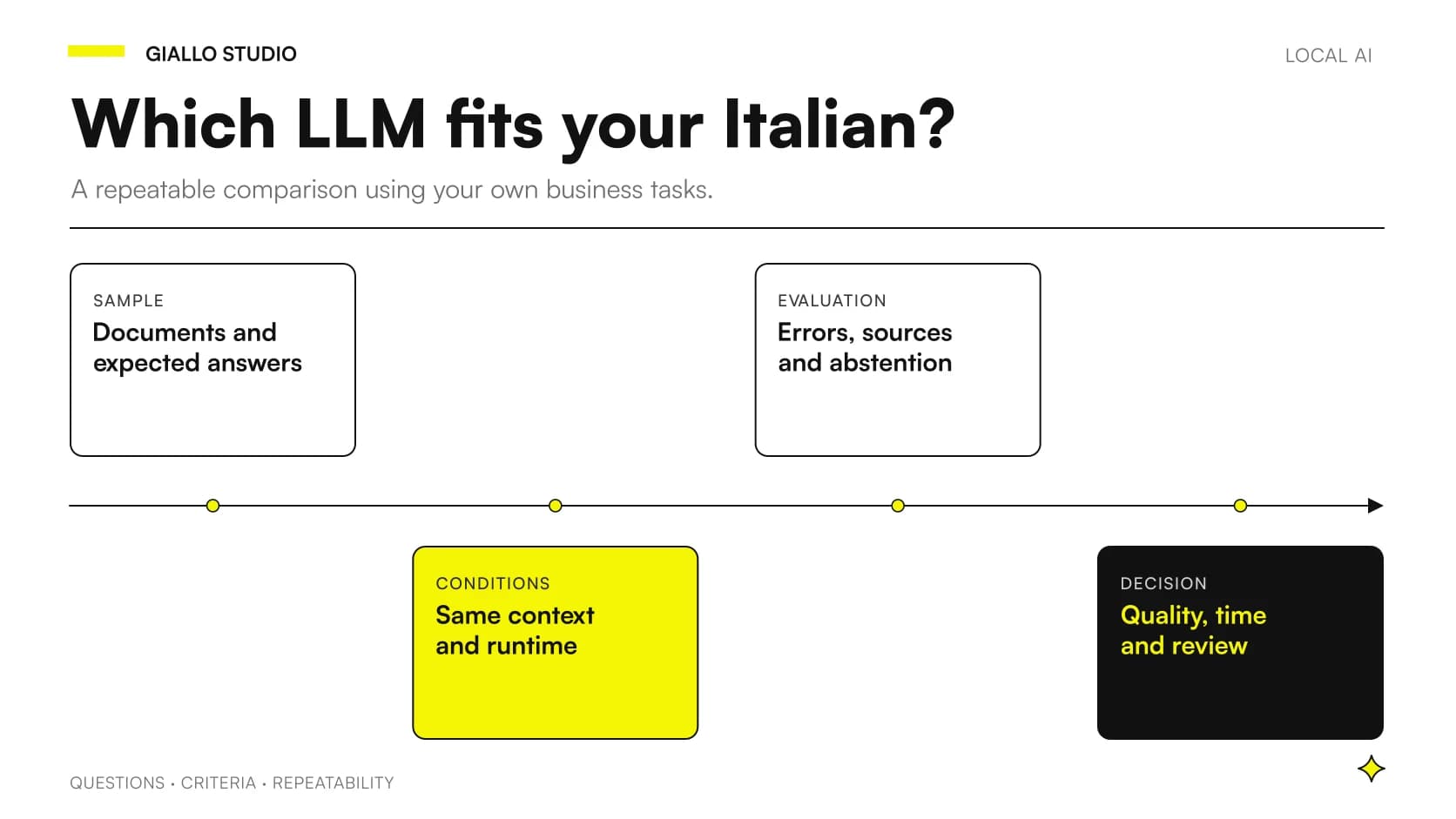 Local LLMs in Italian: comparing without misleading tests
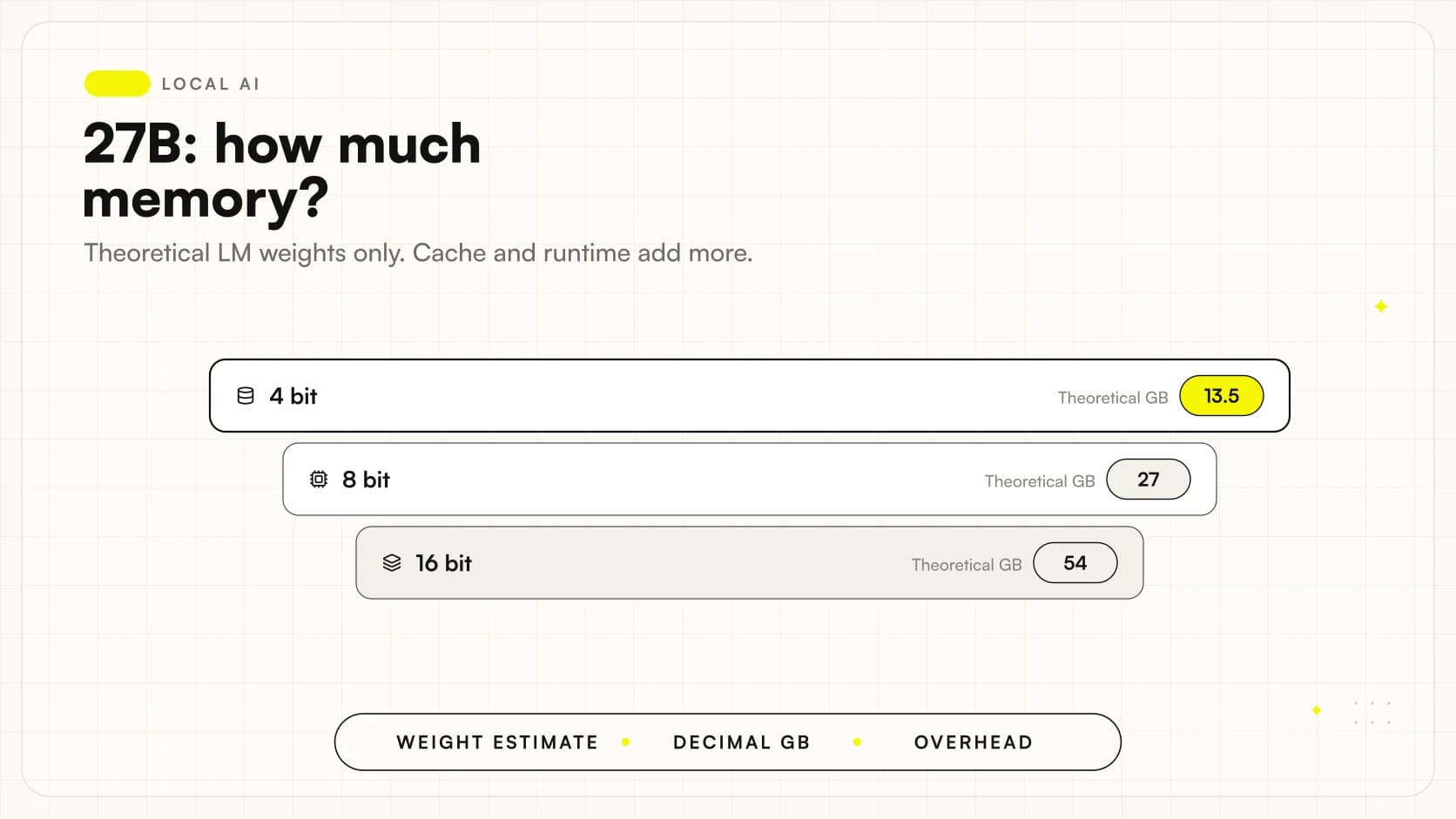 How much RAM and VRAM does Qwen3.8-27B really need?
 Local AI models: when they make sense
 RAG: what it is and why it improves AI responses
 Mistral vs Llama: comparison between the two open weight models
 Perplexity vs Google: response with sources or link list
Other direct comparisons
The same criteria applied to other model pairs.
- Claude vs Perplexity
- Claude Fable 5.1 vs Sonnet 5
- Claude vs Gemini: Which to Use
- Gemini 3.6 Flash vs 3.5 Flash
- Claude vs DeepSeek: Which to Choose
- Gemini 4 Argon vs ChatGPT and Claude: which should you choose?
- Claude Duet, Cowork and Claude Code: which to choose
- ChatGPT vs Gemini: which subscription is worthwhile in October 2026?
- ChatGPT vs Perplexity: Research or Generation
- Gemini vs Copilot: Which to Choose
- ChatGPT vs Grok
- Gemma 4 12B vs Ministral 3 14B: compact local AI
FAQ
Is DeepSeek R1 Distill 32B the full DeepSeek R1 model?
No. DeepSeek-R1-Distill-Qwen-32B is a dense checkpoint based on Qwen2.5-32B and trained on data generated by R1. Results from the full R1 model cannot automatically be attributed to it.
Which model reads images directly?
Qwen3.8-27B accepts visual input through a supported multimodal pipeline. DeepSeek R1 Distill Qwen 32B is text-only: a scanned document needs a separate component to extract its content.
Is Qwen3.8-27B always better because it is newer?
The release date does not establish quality for your workflow. Compare correct results, errors, review time and memory use with the same documents and criteria.
How much memory do four-bit weights require?
A theoretical calculation for the language parameters alone gives about 16 decimal GB for 32B and 13.5 GB for 27B. This excludes encoders, metadata, caches, buffers and the operating system, and is not a sufficient hardware requirement.
Does a reasoning model guarantee accurate calculations?
No. A plausible explanation can contain incorrect operations. Workflows involving amounts or quantities should verify results through deterministic calculations and checks on the source data.