
Gemini 4 Carbon benchmarks: the full table and how to read it
Gemini 4 Carbon benchmarks: all 17 rows of Google's table, where it doesn't win, who computed the numbers and how to run your own test.
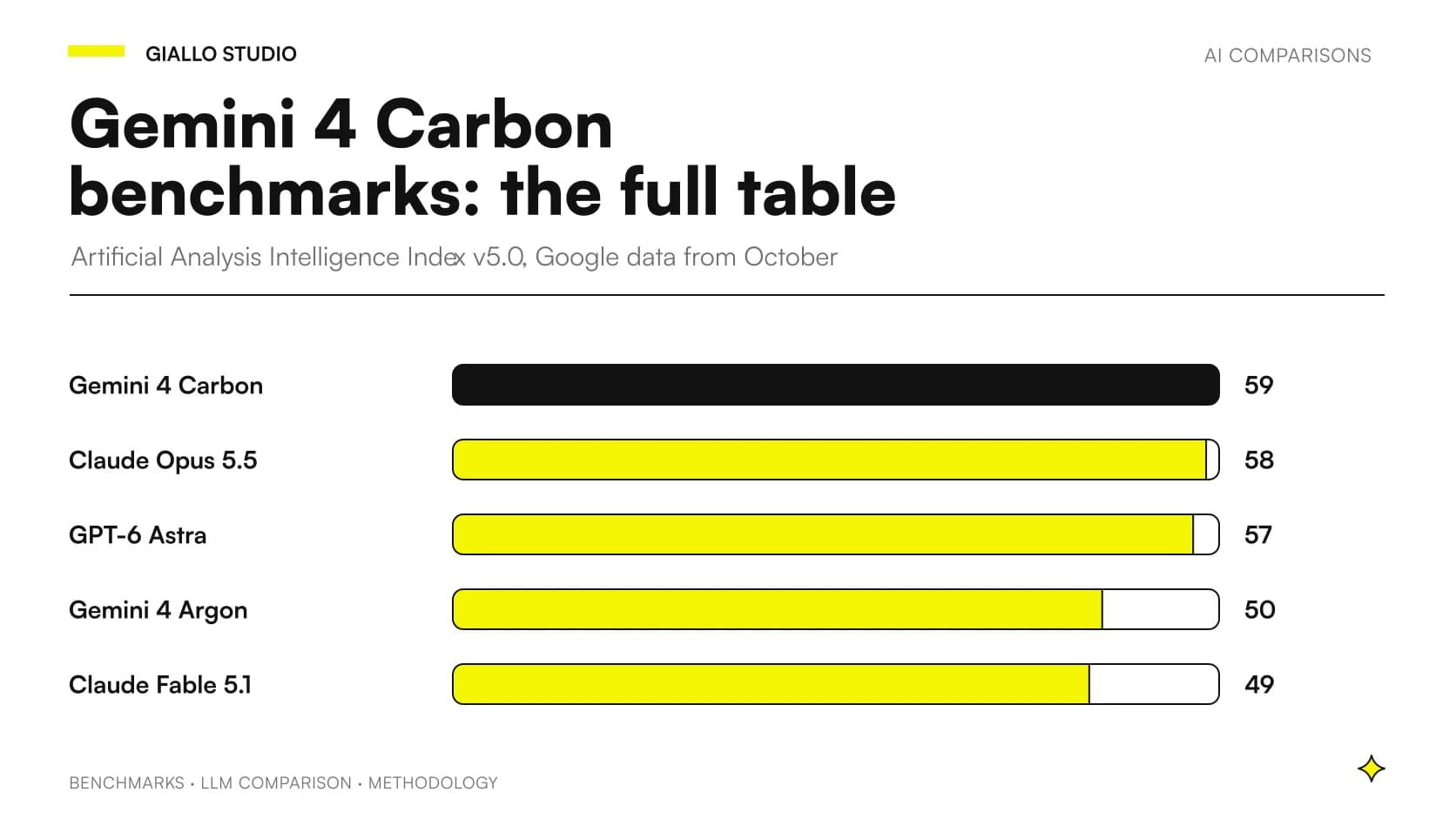
In the official table Google published on 28 October 2026, Gemini 4 Carbon ranks first in 15 of the 17 rows, but not on FrontierSWE 2 (GPT-6 Astra is first with 65.5%) or on OSWorld-2.1 (Claude Opus 5.5 is first with 87.2%). The count is ours and only covers the models Google chose: Gemini 4 Argon, GPT-6 Astra, Claude Opus 5.5 and Claude Fable 5.1. Here you will find the full Gemini 4 Carbon benchmarks and a method for reading them without turning a vendor's table into a purchase decision.
The data comes from the Google announcement and from the model evaluation, with a table dated “as of October, 2026” and methodology notes, both consulted on 28 October 2026. Giallo has not tested Gemini 4 Carbon and has not rerun any benchmark: we read what Google has published. As of 28 October the model is not available to businesses and developers: Google is opening it first to a subset of cyber defenders, then to other partners through the Fairwind Program.
To understand what the model is and when it might arrive, start with the Gemini 4 Carbon guide.
In summary
- Gemini 4 Carbon is first in 15 of the 17 rows of Google's October 2026 table (our count), with very different margins.
- It is not first on FrontierSWE 2 (61.2% against GPT-6 Astra's 65.5%) or on offline OSWorld-2.1 (81.5% against Opus 5.5's 87.2%).
- On Vals Index (0.2 points), SWE-sweep (0.1 points), Chartography (0.9 points) and Artificial Analysis Index (59, 58, 57) the differences are too small to declare a winner.
- Every row has a different author: for Carbon Google often did the computing, while for the other models vendor declarations and leaderboards are what count.
- As of 28 October 2026 an SME cannot use Carbon: it can use the table to choose what to test and to prepare its own sample.
What are the official Gemini 4 Carbon benchmarks, row by row?
Google's October 2026 table compares five models on 17 benchmarks across eight areas. “—” means the data is not available; bold marks the highest value in the row. The values are those of the model evaluation.
| Area | Benchmark | Gemini 4 Carbon | Gemini 4 Argon | GPT-6 Astra | Claude Opus 5.5 | Claude Fable 5.1 |
|---|---|---|---|---|---|---|
| General capabilities | AA Index v5.0 | 59 | 50 | 57 | 58 | 49 |
| General capabilities | Vals Index v2.2 | 70,4% | 69,2% | 65,0% | 70,2% | — |
| Agentic coding | SWE-sweep | 9,6% | 4,3% | 9,5% | 3,6% | 2,9% |
| Agentic coding | FrontierSWE 2 | 61,2% | 55,0% | 65,5% | 62,3% | 56,3% |
| Agentic coding | Terminal-Bench 4.0 (AA) | 65,2% | 57,1% | 59,1% | 59,6% | 52,0% |
| Computer use | Agents' Last Exam v1.1 | 77,4% | 69,0% | 73,1% | 71,6% | — |
| Computer use | OSWorld-2.1 (offline) | 81,5% | 74,7% | 80,9% | 87,2% | 76,8% |
| Office work | AutomationBench (Zapier) | 53,9% | 51,3% | 41,4% | 42,5% | 31,4% |
| Office work | Vending-Bench 2 (balance in $) | 16.484 | 13.718 | 15.515 | 9.235 | 5.422 |
| Multimodal | Chartography | 72,5% | 71,6% | 71,0% | 66,3% | 46,2% |
| Multimodal | Blueprint-Bench 2 (similarity) | 58,6% | 54,4% | 49,7% | 51,2% | 41,9% |
| Long Background | GraphWalks (256k–1M, BFS F1) | 96,2% | 84,2% | 71,8% | 66,8% | 65,0% |
| Science and math | RiemannBench | 80,0% | 76,0% | 72,0% | 69,6% | 65,6% |
| Science and math | Terminal-Bench-Science 0.1 (AA) | 64,8% | 52,9% | 63,3% | 59,0% | 43,3% |
| Cybersecurity | CWE-bench | 71,0% | 68,0% | 68,0% | 67,0% | 58,0% |
| Cybersecurity | ExploitGym | 54,8% | 42,0% | 42,4% | 34,5% | — |
| Cybersecurity | SEC-bench Pro | 88,2% | 83,4% | 85,4% | — | — |
The columns do not all carry the same weight: the competitors' numbers are declared by the vendors or taken from leaderboards, while Carbon's are often computed by Google. For the comparison between the two Google models, see the Carbon vs Argon analysis.
Where is Gemini 4 Carbon ahead, area by area?
The lead is clear-cut in some rows and a matter of decimals in others: read it area by area, because the area tells you whether the number resembles your own work.
General capabilities and agentic coding
On the Artificial Analysis Intelligence Index v5.0, computed by Artificial Analysis with tools, Carbon scores 59, Opus 5.5 scores 58 and Astra 57; Google also reports Carbon in first place in its announcement as well. On coding the picture is mixed. On SWE-sweep Carbon scores 9.6% against Argon's 4.3% (more than double, our calculation) but only 0.1 points above Astra. On Terminal-Bench 4.0 (AA) Carbon is at 65.2% and Opus 5.5, in second place, at 59.6%: a 5.6-point gap (our calculation). On FrontierSWE 2, however, Carbon is behind.
In the announcement Google adds that successful cheating on Terminal-Bench 4.0 has fallen to 0.0%, with attempts at 0.4%: this is a vendor claim, not an external verification. For the comparison with Astra, see the page on Carbon, GPT-6 Astra and Claude and the Astra benchmark table.
Computer use and office work
On Agents' Last Exam v1.1 Carbon scores 77.4% against 73.1% for Astra and 71.6% for Opus 5.5. On OSWorld-2.1 offline Carbon is second (81.5%), just above Astra (80.9%) and behind Opus 5.5. On AutomationBench (private set, Zapier leaderboard) Carbon scores 53.9% against 51.3% for Argon, the runner-up (2.6 points), 41.4% for Astra and 42.5% for Opus 5.5: the gap to the non-Google models is wide, the gap to Argon small. On Vending-Bench 2 Carbon's balance is $16,484 against $15,515 for Astra: it is a test score, not real revenue.
Multimodal, long context, science
On Chartography Carbon scores 72.5% and Argon 71.6% (without tools); on Blueprint-Bench 2, 58.6% against 54.4%. GraphWalks, from 256k to 1M tokens, has Carbon at 96.2% against 84.2% for Argon and 71.8% for Astra: together with ExploitGym, it is one of the two biggest leads in the table. In science Carbon scores 80.0% on RiemannBench and 64.8% on Terminal-Bench-Science 0.1, where Astra is close at 63.3%. For CWE-bench, ExploitGym and SEC-bench Pro, where Carbon is first, see the in-depth look at Carbon and cybersecurity.
Where does Gemini 4 Carbon not win?
Gemini 4 Carbon is not first in two rows out of 17, both on agentic work. Google speaks of state-of-the-art capabilities in cybersecurity and on long-running tasks, not of absolute leadership.
On FrontierSWE 2 the order is Astra (65.5%), Opus 5.5 (62.3%), Carbon (61.2%), Fable 5.1 (56.3%), Argon (55.0%): Carbon is 4.3 points behind Astra (our calculation). The number comes from the Proximal leaderboard, not from a Google calculation. Compared with Argon, Carbon gains 6.2 points, but it does not overtake the two models ahead of it.
On OSWorld-2.1 Carbon is 5.7 points behind Opus 5.5 (our calculation). The test is an offline subset of 82 tasks, and for Carbon and Argon Google reports the maximum over 3 runs with an updated Gemini CUA harness. That criterion favors Carbon, and Opus 5.5 is still ahead; for the competitors, what counts is what the vendors published in their system cards. Anyone looking for an agent that uses a computer cannot read the “Computer use” area as a win for Carbon.
When is a score difference too small to matter?
A difference of 0.2 points is not enough to say that one model is better than the other. Four rows have a tiny gap between first and second and should be treated as ties until proven otherwise: Vals Index v2.2 (Carbon 70.4% against 70.2% for Opus 5.5, that is 0.2 points), SWE-sweep (9.6% against 9.5% for Astra, 0.1 points), Artificial Analysis Index (59, 58 and 57) and Chartography (72.5% against 71.6% for Argon, 0.9 points).
The Vals Index v2.2 is produced by Vals AI; for each model we have a single value and no margin of error to cite, so 0.2 points may be a real advantage or measurement noise. On SWE-sweep the problem is twofold: Carbon's figure is computed by Google with the mini-swe-agent harness and a reward weighted by subtasks, while the competitors' figures come from the public leaderboard. Different procedures and a gap of 0.1 points do not justify any ranking.
On the Artificial Analysis Index, 59 against 58 and 57 describes a tight leading group, not a model that is clearly smarter: aggregate indexes compress very different activities, as explained in the guide on how to read AI benchmarks.
How do you read the methodology: who computed what?
The methodology states, for each row, who produced the number, and the weight of the row changes accordingly. For Carbon and Argon Google declares pass@1 unless noted: a single attempt, with no majority voting or parallel compute, using the highest thinking settings of the Gemini API. For Astra, Opus 5.5 and Fable 5.1 it uses the vendors' numbers, with reasoning at maximum when available, as reported in the model evaluation.
| Who produced the number | Benchmark |
|---|---|
| Google (for Carbon, in some cases also for Argon) | SWE-sweep, Agents' Last Exam v1.1, OSWorld-2.1, ExploitGym, SEC-bench Pro |
| Google (for all models) | GraphWalks |
| Artificial Analysis | AA Index v5.0, Terminal-Bench 4.0, Terminal-Bench-Science 0.1 |
| Vals AI | Vals Index v2.2 |
| Proximal | FrontierSWE 2 |
| Zapier (private set) | AutomationBench |
| Andon Labs | Vending-Bench 2, Blueprint-Bench 2 |
| Surge | Chartography (without tools), RiemannBench |
| Collinear AI (all models) | CWE-bench v1 |
A row computed by Google for its own models is not an independent test. The cards below say what to check before trusting a number.
Harness: the tooling around the model changes the score
On SWE-sweep Google used mini-swe-agent, on Agents' Last Exam v1.1 ALE-Claw (122 tasks), on OSWorld-2.1 an updated Gemini CUA harness, and on ExploitGym and SEC-bench Pro Antigravity. The competitors were measured elsewhere: the table compares models plus tooling, not bare models.
Timeouts and attempts: how much time and how many tries the model had
Agents' Last Exam has a 5-hour window. ExploitGym allows one attempt per task, and the methodology reports timeouts of 6 and 10 hours. The table reports a single value (54.8%) without saying which of the two timeouts it corresponds to. OSWorld-2.1 counts the maximum over 3 runs; SEC-bench Pro the average of 3 attempts on 183 tasks from the “JavaScript engine” split of May 2026.
Filters and versions: what was switched on and from which date
On Agents' Last Exam the safety filters were on, with the tasks of 17 October 2026 and without the 26 October update; Claude Fable 5.1 is absent. In cybersecurity the values were obtained without guardrails, and in ExploitGym the internet and mitigations were off: lab conditions, not how a business would use the model.
GraphWalks: the only row where Google measured every model
GraphWalks is computed by Google for all five models, on 200 problems between 256k and 1M tokens, with F1 on the BFS task. It is the most homogeneous comparison in the table and Carbon's lead (96.2%) is clear-cut, but it remains a synthetic test on graphs: it measures long context, not the understanding of your PDFs. For the basic concepts, see the guide to tokens in AI models.
What do these numbers mean for an Italian SME?
For an SME the table serves to choose what to test, not to choose a vendor. As of 28 October 2026 Carbon is not accessible to a business, and Google has not published a general availability date, a context window or output limits. The rows close to your work help you pick the available models to compare in the meantime.
| If your work is… | Rows to look at | Caution |
|---|---|---|
| Automation and office processes | AutomationBench, Vending-Bench 2 | Zapier's private set: you cannot rerun the test |
| Software Development | SWE-sweep, FrontierSWE 2, Terminal-Bench 4.0 | Different harnesses, minimal gaps on SWE-sweep |
| Agents that use a computer | OSWorld-2.1, Agents' Last Exam | Subset of 82 tasks, different runs |
| Very Long Documents | GraphWalks | Synthetic test on graphs |
Hypothetical scenario: a 15-person workshop receives orders by email and wants to prepare draft confirmations. The closest row is AutomationBench, but it is a private set and cannot be repeated: you need your own sample of 30-40 real, anonymized emails, each with the draft the manager considers correct. Hypothetical scenario: an accounting firm wants to query very long financial-statement files. GraphWalks only says that Carbon handles long contexts on a synthetic test; what the firm cares about is whether it cites the right page in a file with scanned documents.
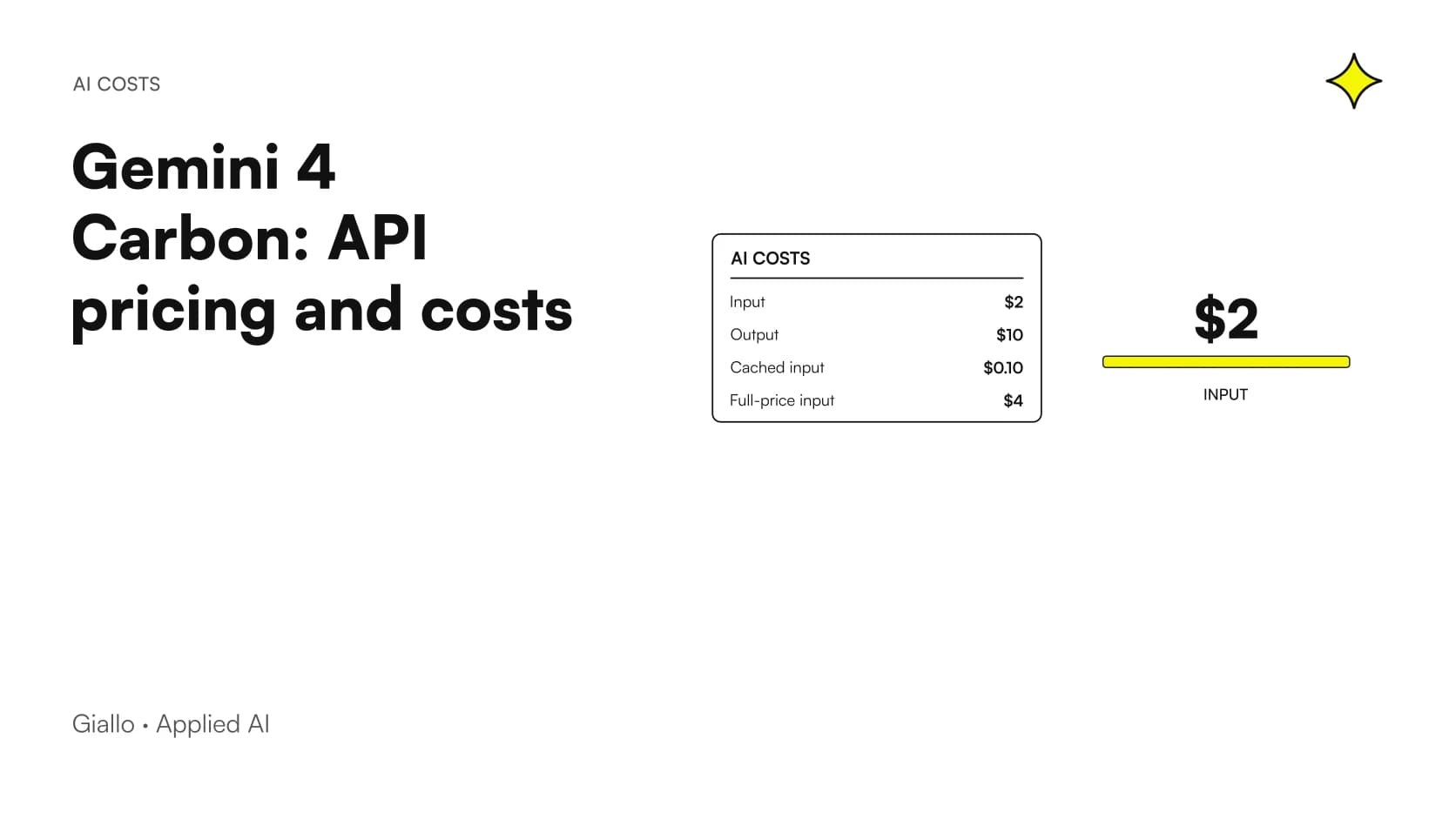
A benchmark says nothing about the cost per accepted answer. The introductory price stated in the announcement is $2 per million input tokens and $10 per million output tokens, the same as Argon, then $4 and $20; Google has not said when Carbon's introductory period ends. Claude Opus 5.5 costs $4 and $20 according to the Anthropic price list. The calculations are in the Carbon API pricing guide.
How do you build your own test once Gemini 4 Carbon is available?
Start from your own cases, with a method that works today for other models and tomorrow for Carbon: Google's table gives you the candidates, your sample gives you the answer. The evaluation path for Argon uses the same scheme with a model that is already available through the API.
- Pick a single process with a verifiable result: a draft quote, an email classification, a patch for a known defect.
- Collect 30-50 real, anonymized cases, including the difficult ones and those where the system must say “I don't know”.
- Write down the acceptance criterion first, and what counts as a serious error.
- Give each model the same material, the same instructions and the same tools; record version, date and settings.
- Measure correctness (checked by a person), waiting time and cost of the accepted results, retries included.
- Keep a second sample, never used to tune the instructions, to check that it holds up.
- Repeat the comparison when the model version changes.
In the meantime you can try accessible models, for example Gemini 4 Argon via API: the sample will be ready when Carbon arrives. A project on AI agents starts from exactly this kind of sample; for choosing a model in general, see the guide on how to choose an AI model.
Which mistakes do the most damage when reading the benchmarks of a new model?
The first mistake is treating columns with different authors as a single experiment (see why vendor benchmarks are not comparable). The second is counting wins: “15 rows out of 17” does not weigh the rows, and a win by 0.1 points counts the same as one by 12.
The third is ignoring lab conditions: guardrails off, internet disabled, 5-hour windows and the maximum over several runs do not resemble everyday use. The fourth is forgetting hallucinations, which a high score does not eliminate (guide). The fifth is waiting for Carbon without preparing any test.
Should you wait for Gemini 4 Carbon or start with the models that are available?
Start from the test, not from the model. Carbon's claimed advantage is large in a few rows (long context with GraphWalks, exploits with ExploitGym) and narrow or uncertain in others (coding and computer use), and access for your business has no date. Preparing the sample and the criteria today takes the same work, whichever model wins.
If you want to turn this table into a repeatable comparison on your own processes, the AI consulting of Giallo starts from your documents and your acceptance rules. Always check the official pages: tables, versions and prices may change.
Giallo Studio guides: methodology and sources
How we apply it in the company
Related resources
 Gemini 4 Carbon: what it is, what Google claims and when it will be available
 Gemini 4 Carbon vs GPT-6 Astra and Claude: Which to Choose for Each Task
 Gemini 4 Carbon pricing: API prices, cost per million tokens and comparison
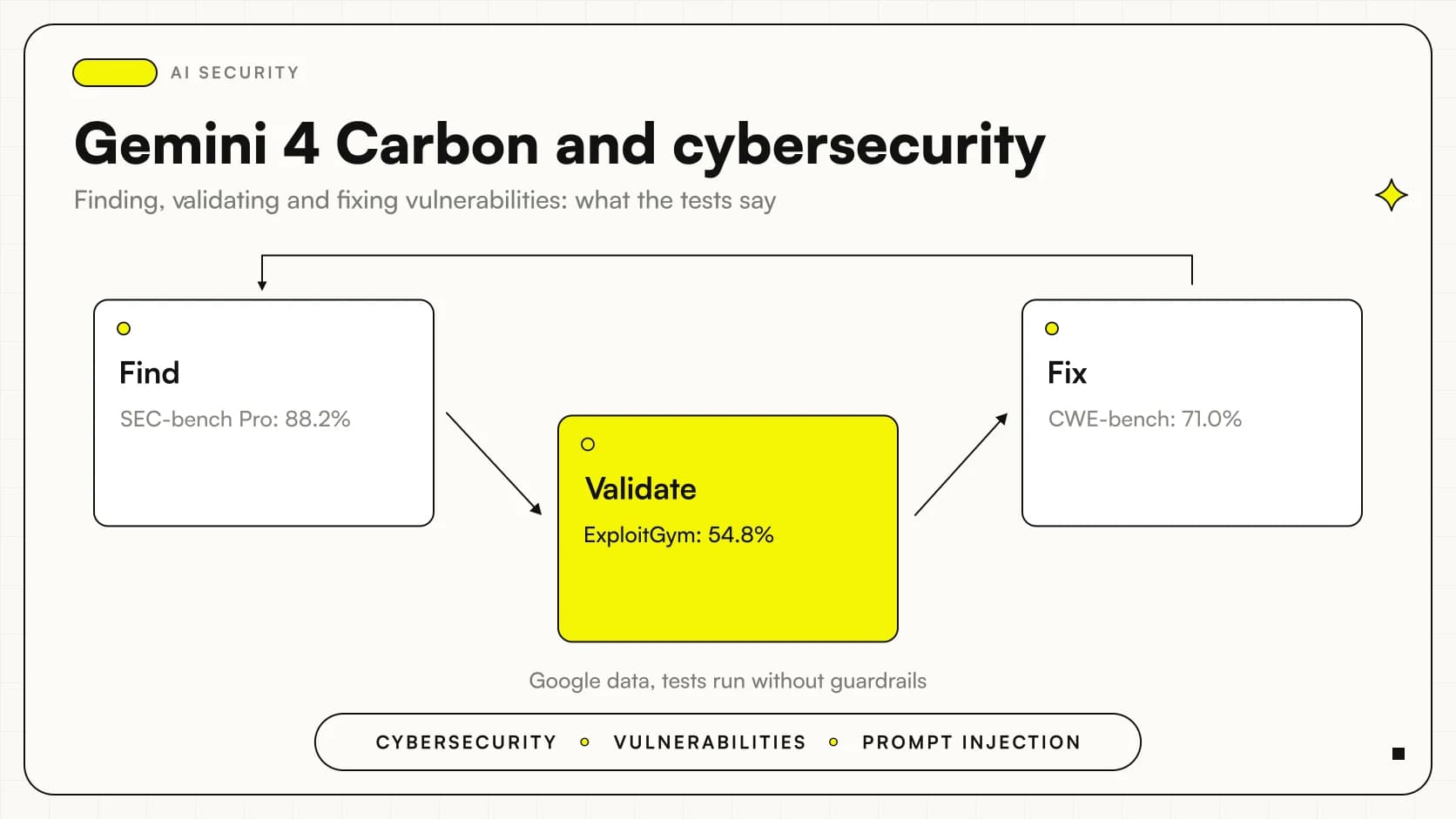 Gemini 4 Carbon cybersecurity: finding, validating and fixing vulnerabilities
 Gemini 4 Carbon vs Argon: Differences and Is It Worth Waiting?
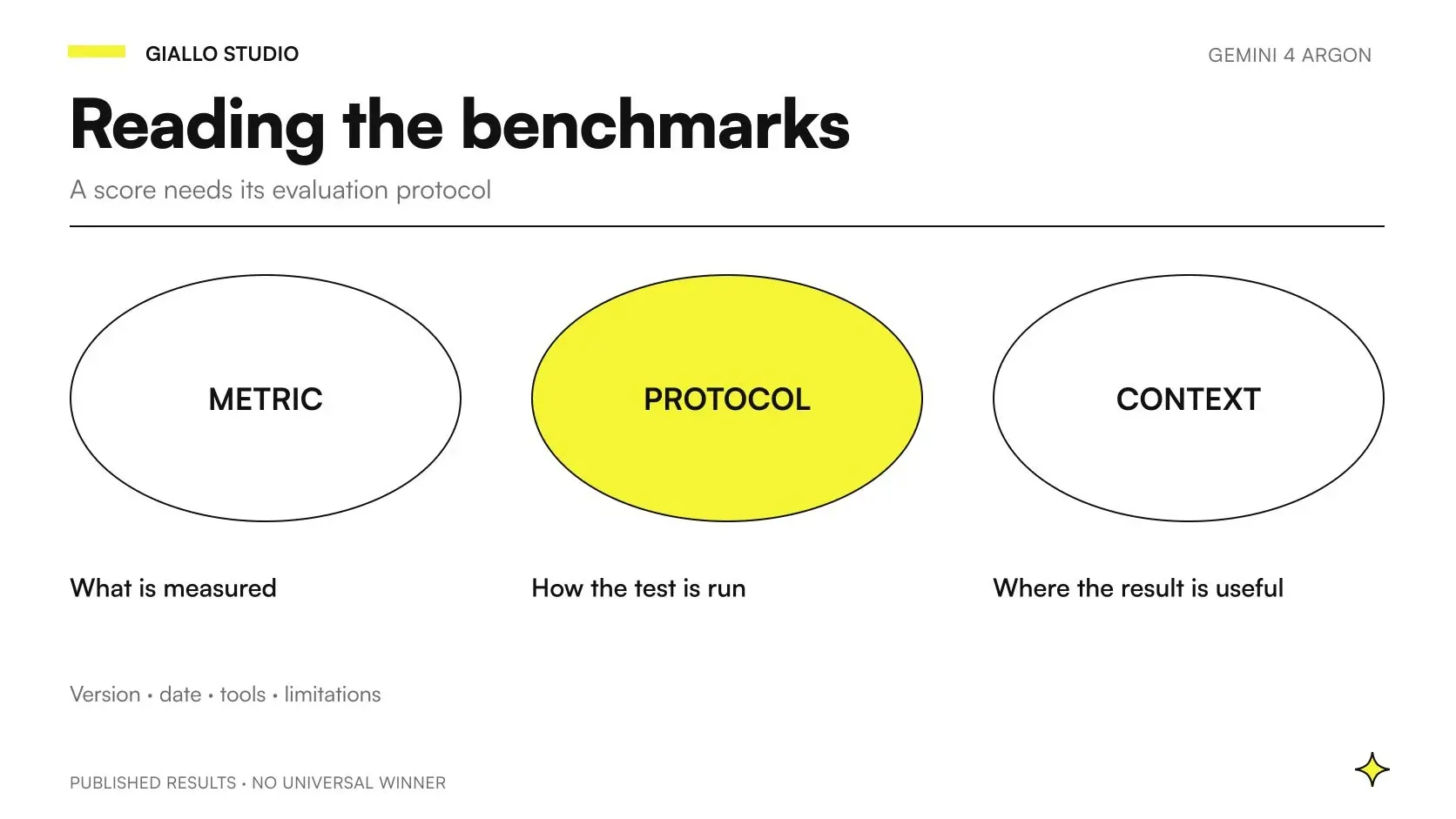 Gemini 4 Argon benchmarks: how to read the LLM comparison
 GPT-6 Astra: all official benchmarks
FAQ
Is Gemini 4 Carbon first on every benchmark in Google's table?
No. In Google's official October 2026 table, Gemini 4 Carbon is ahead in 15 of the 17 rows (our count), but on FrontierSWE 2 it is third with 61.2%, behind GPT-6 Astra (65.5%) and Claude Opus 5.5 (62.3%). On OSWorld-2.1, an offline subset, it is second with 81.5%, behind Claude Opus 5.5 (87.2%).
What is Gemini 4 Carbon's score on the Artificial Analysis Intelligence Index?
On the Artificial Analysis Intelligence Index v5.0, Gemini 4 Carbon scores 59 points, ahead of Claude Opus 5.5 with 58 and GPT-6 Astra with 57. Gemini 4 Argon scores 50 and Claude Fable 5.1 scores 49. The figure is reported by Google in its 28 October 2026 announcement and in the evaluation table.
Who computed the numbers in the Gemini 4 Carbon table?
It depends on the row. Google computed some for Carbon and in some cases also for Argon (SWE-sweep, Agents' Last Exam, OSWorld-2.1, ExploitGym, SEC-bench Pro), while others come from third-party leaderboards such as Artificial Analysis, Vals AI, Proximal, Zapier, Andon Labs, Surge and Collinear AI. The competing models' numbers are declared by the vendors or taken from leaderboards, unless noted.
Does the 0.2-point gap on the Vals Index really matter?
Not on its own. On the Vals Index v2.2, Gemini 4 Carbon scores 70.4% and Claude Opus 5.5 scores 70.2%: we have a single value per model, with no margin of error to cite. A gap this small does not let you say that one model is better than the other.
Can I use Gemini 4 Carbon in my business as of 28 October 2026?
No. As of 28 October 2026, Google has opened Gemini 4 Carbon to a subset of cyber defenders and, later, to other trusted partners through the Fairwind Program. For developers and businesses it says the model is coming soon, without a date. In the meantime an SME can prepare its own tests and work with the models already available.
Has Giallo run the Gemini 4 Carbon benchmarks?
No. Giallo has not tested Gemini 4 Carbon and has not rerun any benchmark: the article reports the results Google published on 28 October 2026 and their methodology notes. The test plan proposed for your business is a working method, not the account of a trial.
How do you compare Gemini 4 Carbon with GPT-6 Astra correctly?
Row by row: check who produced the number, with which harness and with which settings. On Google's table Carbon is ahead of Astra in many rows (for example Terminal-Bench 4.0: 65.2% against 59.1%), but Astra is first on FrontierSWE 2. The decisive comparison remains a test on your own documents and processes.