
Gemini 4 Carbon pricing: API prices, cost per million tokens and comparison
Gemini 4 Carbon pricing: $2/$10 per million tokens at launch, then $4/$20. Compared with Argon, GPT-6 Astra and Claude, with worked cost examples.
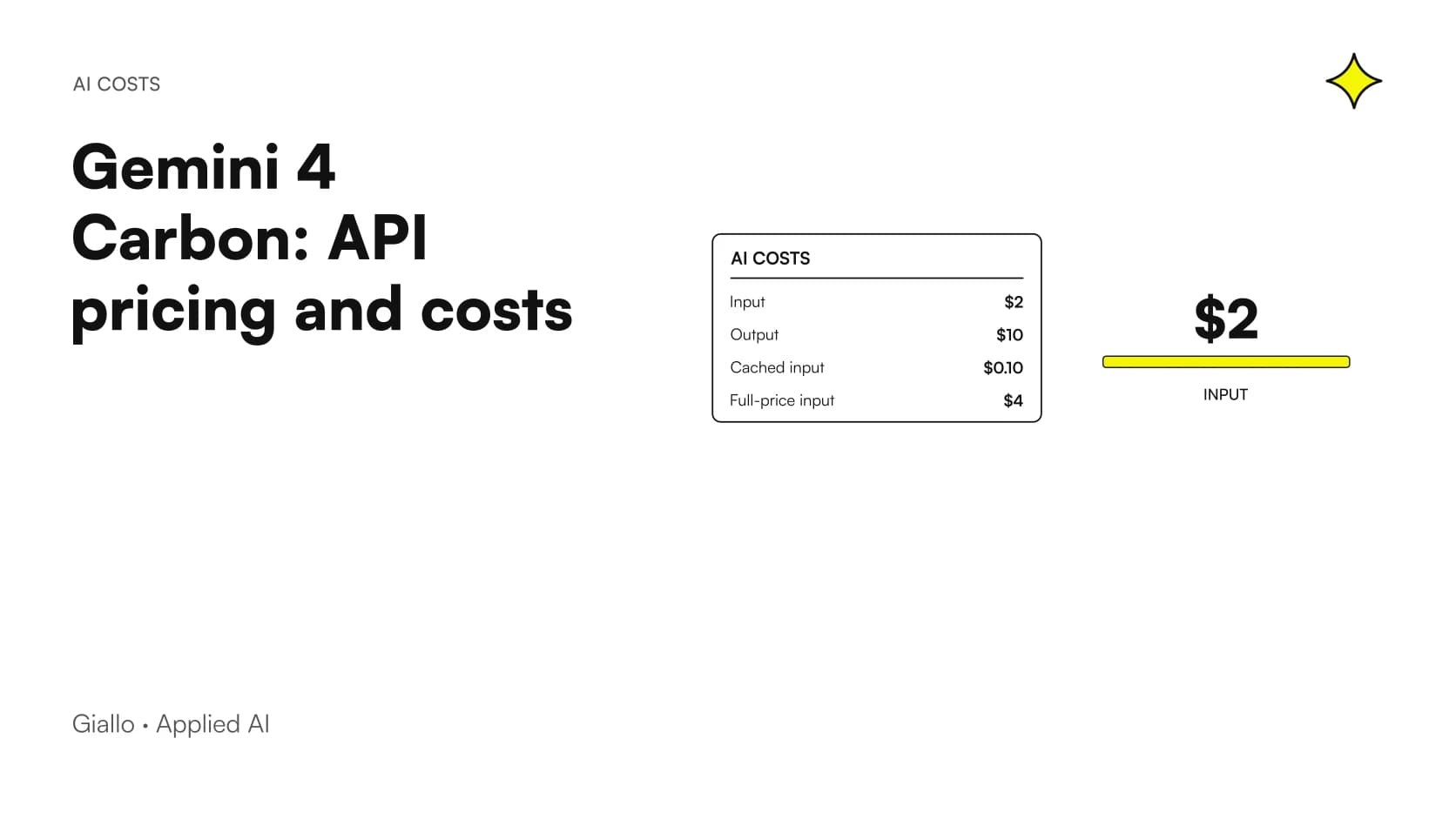
Gemini 4 Carbon costs, according to Google's announcement of 28 October 2026, $2 per million input tokens and $10 per million output tokens in the introductory period, then $4 and $20. Cached input carries a 95% discount, i.e. $0.10 per million tokens in the introductory phase (our calculation). The figures come from the Google official announcement; the end date of the introductory period has not been announced, and Carbon does not yet appear in the Gemini API price list.
This guide sets Gemini 4 Carbon pricing next to that of Argon, GPT-6.1 Sol, GPT-6 Astra and the Claude models, with two worked examples. Giallo has not tested Carbon and has not rerun the benchmarks: the rates come from the vendors' official pages, and the volumes in the examples are invented.
In summary
- Gemini 4 Carbon costs $2 per million input tokens and $10 per million output tokens in the introductory period, then $4 and $20 (Google announcement, 28 October 2026).
- As of 28 October 2026, Google has not said when Carbon's introductory period ends: the 30 November 2026 date applies only to Argon.
- Carbon is not yet in the Gemini API price list and is not available to businesses and developers: today it cannot be bought at these rates.
- At full price, Carbon costs the same as Claude Opus 5.5 and 60% less than GPT-6 Astra per token, for both input and output.
- The cost that matters to a business is the cost per successful task: retries, reasoning and review can weigh more than the price list.
Gemini 4 Carbon pricing: how much does it cost to use via API today?
How much does Gemini 4 Carbon cost? As for the Gemini 4 Carbon API price, as of 28 October 2026 the figure is theoretical: using it via API is not yet possible. Google is releasing it gradually: from this week to a subset of cyber defenders, then to other trusted partners through the Fairwind Program, and finally to developers, businesses and consumers “as soon as possible”, with no date given (the overview is in What is Gemini 4 Carbon). The announced price is the introductory one, the same as Argon's: $2 per million input tokens and $10 for output, rising to $4 and $20 after the introductory period. Source: Google announcement, 28 October 2026.
Several items are still missing for a complete quote: Google has not published the model identifier in the API, the context window or the output limits. Without the context window, we can neither rule out nor confirm a threshold above which the price changes, as happens with OpenAI. When Carbon enters the price list, the official price page will take precedence over this guide.
Gemini 4 Carbon cost per million tokens: how does it compare with other models?
Gemini 4 Carbon's price per million tokens is the same as Argon's, Claude Sonnet 5.5's and GPT-6.1 Sol's during the introductory period, and the same as Claude Opus 5.5's afterwards. The figures are dollars per million tokens; the concept is explained in the guide to price per million tokens.
| Model (Standard price list) | Input | Cache input | Output | References |
|---|---|---|---|---|
| Gemini 4 Carbon, introductory period | 2 $ | $0.10 (our calculation) | 10 $ | End of period not announced; not yet in the API price list |
| Gemini 4 Carbon, after the introductory period | 4 $ | $0.20 (if the discount stays at 95%, our calculation) | 20 $ | Figures from the Google announcement |
| Gemini 4 Argon, until 30 November 2026 | 2 $ | 0,10 $ | 10 $ | Thinking included in output; implicit caching only |
| Gemini 4 Argon, from 1 December 2026 | 4 $ | 0,20 $ | 20 $ | Batch and Flex at half price |
| GPT-6.1 Sol, context up to 272K | 2 $ | 0,10 $ | 10 $ | Above 272K: $4 / $0.20 / $15 |
| Claude Sonnet 5.5 | 2 $ | 0,10 $ | 10 $ | |
| Claude Opus 5.5 | 4 $ | 0,20 $ | 20 $ | Fast mode: $8 input, $40 output |
| GPT-6 Astra, context up to 272K | 10 $ | 1 $ | 50 $ | Above 272K: $20 / $2 / $75 |
| Claude Fable 5.1 | 10 $ | 0,25 $ | 50 $ |
Sources, accessed on 28 October 2026: Google announcement for Carbon, Gemini API price list for Argon, Claude Price list for Sonnet, Opus and Fable, OpenAI price list for GPT-6.1 Sol and GPT-6 Astra.
In the Gemini 4 Carbon vs GPT-6 Astra price comparison, the gap is the widest. During the introductory period Carbon costs one fifth of Astra, for both input ($2 versus $10) and output ($10 versus $50). At full price it is 2.5 times cheaper, i.e. 60% less: $4 versus $10 and $20 versus $50. On cache, $0.10 versus $1 means a rate ten times lower in the introductory phase. For performance, see the guide Gemini 4 Carbon vs GPT-6 Astra and Claude; the price lists are covered in GPT-6 Astra: pricing and Claude Opus 5.5: benchmarks and prices.
When does the Gemini 4 Carbon introductory price end?
As of 28 October 2026, Google has not said when the Gemini 4 Carbon introductory price ends. The only date known in the price list concerns Gemini 4 Argon, with promotional rates until 30 November 2026 and a price of $4 and $20 from 1 December 2026 (Gemini API price list). Carrying it over to Carbon would be an unsupported assumption. Details on the sibling model are in Gemini 4 Argon: pricing and API costs.
For a quote, the rule is simple: use the full price in the business case, and treat the introductory price as a temporary advantage of unknown duration. Rates double from $2/$10 to $4/$20: a workload that costs $140 a month in the introductory phase will cost $280 at full price, for the same tokens. A fee calculated on the introductory price leaves the difference to whoever signed it. If you are wondering whether to wait or start with Argon, the comparison Gemini 4 Carbon vs Argon helps: the introductory rates are identical.
How much does the 95% cache discount really save?
The 95% discount on cached input cuts the price of tokens the service recognizes as already seen by a factor of twenty: from $2 to $0.10 per million in the introductory phase, our calculation based on the Google announcement. Caching rewards workloads in which the same part of the prompt comes back at every step: instructions, reference documents, an agent's history.
Read it with caution. The sources consulted do not state the conditions of Carbon's cache: minimum token threshold, duration, type of cache (for Argon the price list indicates implicit caching only). You cannot assume that every repetition costs $0.10: in a budget, the cached share is an assumption, to be replaced with observed data.
At full price, if the discount stayed at 95% on $4, cached input would cost $0.20 per million: our calculation, not a Google figure. How caching works in models that are already available is covered in Claude Sonnet 5.5: prompt caching and pricing.
Example 1: how much would 2,000 cases a month cost for an accounting firm?
Imagine an accounting firm that has 2,000 cases analyzed per month. Assume 20,000 input tokens and 3,000 output tokens per case, with no cache. These are invented volumes to show the method, not a measurement on Carbon. Monthly input is 40 million tokens (2,000 × 20,000), output 6 million (2,000 × 3,000).
| Model (rates as of 28 October 2026) | Calculating | Total per month | Per case |
|---|---|---|---|
| Gemini 4 Carbon, introductory period | 40 × 2 + 6 × 10 = 80 + 60 | 140 $ | 0,07 $ |
| Gemini 4 Carbon, after the introductory period | 40 × 4 + 6 × 20 = 160 + 120 | 280 $ | 0,14 $ |
| Claude Opus 5.5 | 40 × 4 + 6 × 20 = 160 + 120 | 280 $ | 0,14 $ |
| GPT-6 Astra (context up to 272K) | 40 × 10 + 6 × 50 = 400 + 300 | 700 $ | 0,35 $ |
Rates from the Google announcement, Claude Price list and OpenAI price list, accessed on 28 October 2026. Google has not detailed Carbon's thinking (for Argon it is included in the billed output): the 3,000 output tokens should be understood as a total that includes reasoning.
With these numbers, the difference between introductory-price Carbon and Astra is $560 a month: for an accounting firm it weighs less than the time of whoever checks the cases. It becomes relevant if volume multiplies or if contexts are much longer than 20,000 tokens.
Example 2: how much does a multi-step agent that reuses the cache cost?
The second scenario is a 15-person distribution company that uses an agent to prepare 300 quotes a month. Assume 12 steps per quote. At each step the model rereads 30,000 tokens, of which 24,000 are repeated (recognized in cache) and 6,000 are new, and produces 1,500 output tokens. Monthly totals: ordinary input 300 × 12 × 6,000 = 21.6 million tokens; cached input 300 × 12 × 24,000 = 86.4 million; output 300 × 12 × 1,500 = 5.4 million.
| Model (rates as of 28 October 2026) | Standard input | Cache input | Output | Total per month | Per quote |
|---|---|---|---|---|---|
| Gemini 4 Carbon, introductory period | 21,6 × 2 = 43,20 $ | 86,4 × 0,10 = 8,64 $ | 5,4 × 10 = 54,00 $ | 105,84 $ | 0,35 $ |
| Gemini 4 Carbon, after the introductory period | 21,6 × 4 = 86,40 $ | 86,4 × 0,20 = 17,28 $ | 5,4 × 20 = 108,00 $ | 211,68 $ | 0,71 $ |
| Claude Opus 5.5 | 21,6 × 4 = 86,40 $ | 86,4 × 0,20 = 17,28 $ | 5,4 × 20 = 108,00 $ | 211,68 $ | 0,71 $ |
| GPT-6 Astra (context up to 272K) | 21,6 × 10 = 216,00 $ | 86,4 × 1 = 86,40 $ | 5,4 × 50 = 270,00 $ | 572,40 $ | 1,91 $ |
Carbon's cache rate at full price ($0.20) is our calculation; those for Opus 5.5 and Astra come from the price lists already cited. The calculation uses only the items shown in the pricing table: any other items, for example for writing data to the cache, must be checked in the vendor's price list.
Without any cache reuse, the 108 million input tokens at $2 would cost $216 and the introductory total would rise to $270, against the $105.84 calculated above: the cache removes about 61% of the spend. It matters most for agents, which reread the same context at every step, as explained in the guide to AI API costs and usage. The flip side is that cost grows with the number of steps, and Google describes Carbon as a model for long-running tasks.
Can a more capable model cost less than a cheaper one?
Yes, if it needs fewer attempts to produce an accepted result: the right comparison is not the price per million tokens but the cost per accepted result, i.e. the cost of one attempt divided by the share of attempts that pass the check. A hypothetical example: one model costs $0.14 per attempt and 30% of its results are accepted, so each accepted result costs about $0.47 ($0.14 ÷ 0.30). Another costs $0.35 per attempt but 90% of its results are accepted: $0.39 ($0.35 ÷ 0.90). The model that is more expensive per attempt turns out cheaper per result. The percentages are invented; the mechanism is not: a model 2.5 times more expensive ($0.35 versus $0.14) must get at least 2.5 times more accepted results to avoid being beaten.
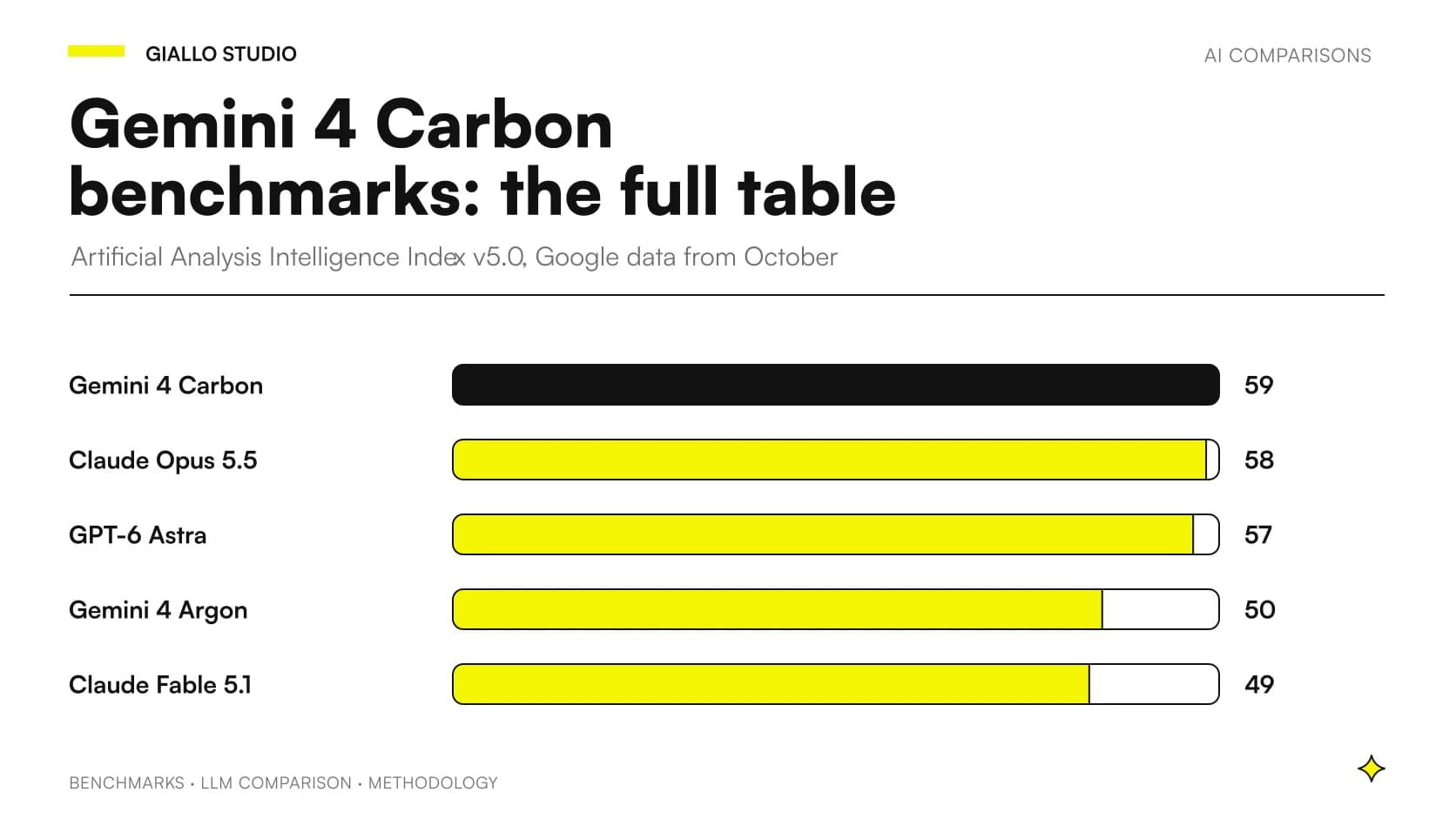
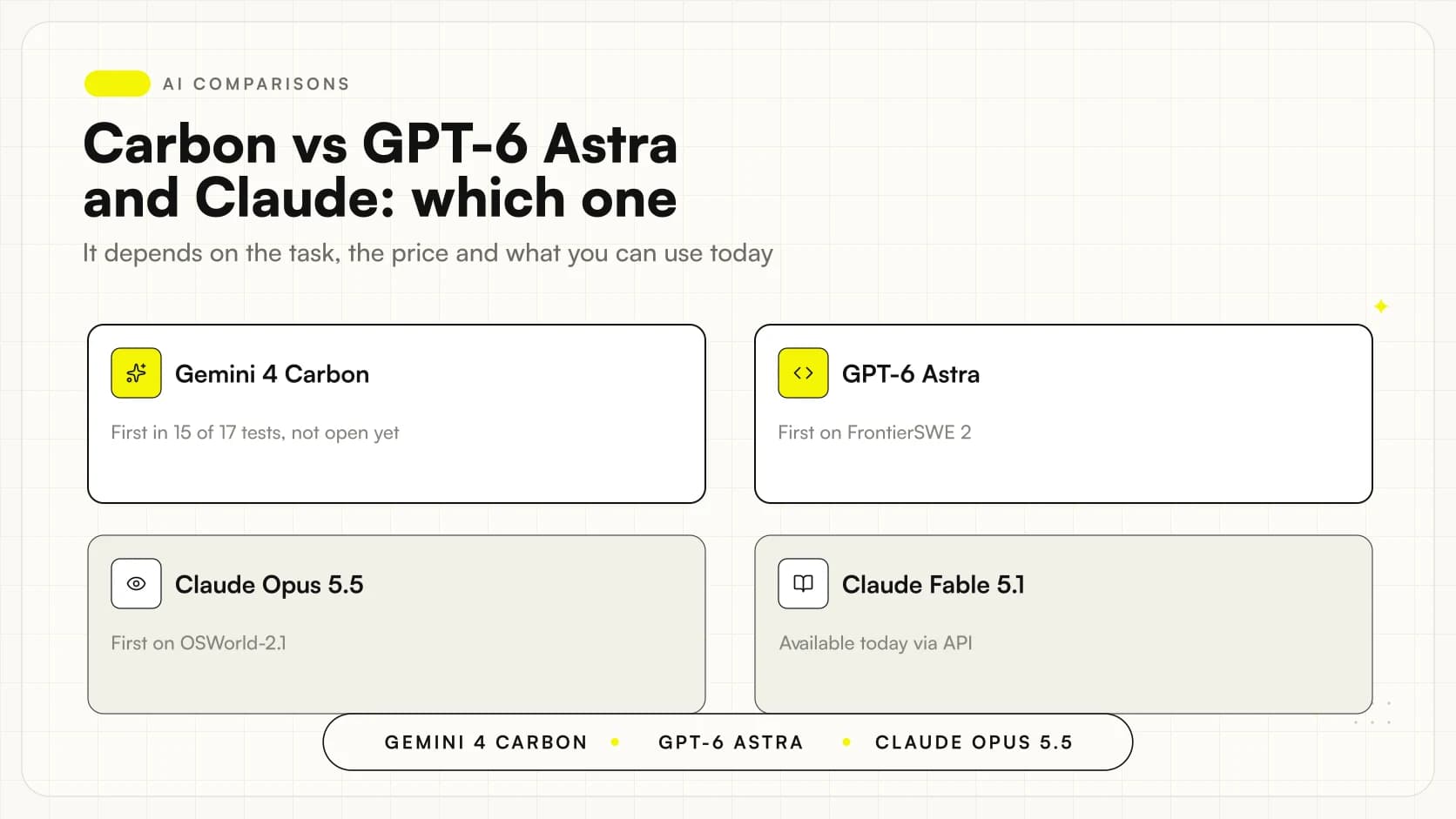
Benchmarks do not settle the question. The evaluation table published by Google reports, for example, 53.9% for Carbon on AutomationBench against 41.4% for GPT-6 Astra and 42.5% for Claude Opus 5.5, and 65.2% on Terminal-Bench 4.0 against 59.1% and 59.6%. But on FrontierSWE 2 Carbon (61.2%) is not first, because Astra is at 65.5% and Opus 5.5 at 62.3%, and on OSWorld-2.1 it is second (81.5%) behind Opus 5.5 (87.2%). The competitors' numbers are self-reported or come from leaderboards with different methodologies (how to read them: Gemini 4 Carbon benchmarks and comparison).
None of these results tells you how many attempts your own documents will need. Beyond attempts, you must count reasoning tokens, repeats after an error and human review time; how usage and limits affect spend is covered in AI tokens, costs and response limits.
How do you estimate the cost of Gemini 4 Carbon before it is available?
You can build the spreadsheet today with an available model and swap in the prices when Carbon arrives: Argon, Sonnet 5.5 and GPT-6.1 Sol have rates equal to Carbon's introductory ones (for Sonnet 5.5 and GPT-6.1 Sol they are the standard price list). Five steps:
- Pick a concrete task. A case, a quote, a ticket: the unit the business cares about, not the individual technical request.
- Measure tokens on an available model. Record new input, input repeated at every step, and output. If the vendor separates them, keep reasoning tokens apart too.
- Apply two price columns. One with the introductory rate ($2/$10) and one with the full rate ($4/$20). The approved budget is the second one.
- Add the attempts. On a real sample, count how many results pass the check and divide the cost by that number.
- Add the review. It can be the biggest line item. The method is covered in cost of AI API.
For the restricted access reserved to cyber defenders and Fairwind partners, see the guide to Gemini 4 Carbon and cybersecurity.
Which mistakes distort a Gemini 4 Carbon quote?
The first mistake is taking the introductory price for granted beyond today's date. Google has not said when it ends, so an annual budget should be built at $4 and $20. The second is putting Carbon into a contract as an available service: as of 28 October 2026 it is not, and it is not in the API price list either.
The third mistake is using $0.10 as the average input price: it applies only to tokens recognized as cached. The fourth is comparing only input and output, leaving out reasoning, retried attempts and, for OpenAI, the higher rates beyond 272K tokens of context. The fifth is reading benchmarks as value for money: they are results on sample tasks, with different methodologies across vendors.
What should an SME do now with its AI budget?
The practical move is to prepare the measurement, not to pick the model. The announced rates make Carbon competitive on price per token: it costs the same as Sonnet 5.5 and GPT-6.1 Sol in the introductory phase, the same as Opus 5.5 at full price, and less than half of Astra and Fable 5.1 ($10 and $50). How much it is really worth can only be told by a sample of your own processes, evaluated with the same criteria across several models. For the big picture, see the guide to AI costs in business.
If you want to estimate the cost per task of one of your processes, with two-column rates and a test ready for when Carbon becomes available, Giallo Studio's AI consultancy starts from a sample of your documents. If you already have a workflow to automate, we build the automation and its budget with you.
Giallo Studio guides: methodology and sources
How we apply it in the company
Related resources
 Gemini 4 Carbon: what it is, what Google claims and when it will be available
 Gemini 4 Carbon benchmarks: the full table and how to read it
 Gemini 4 Carbon vs GPT-6 Astra and Claude: Which to Choose for Each Task
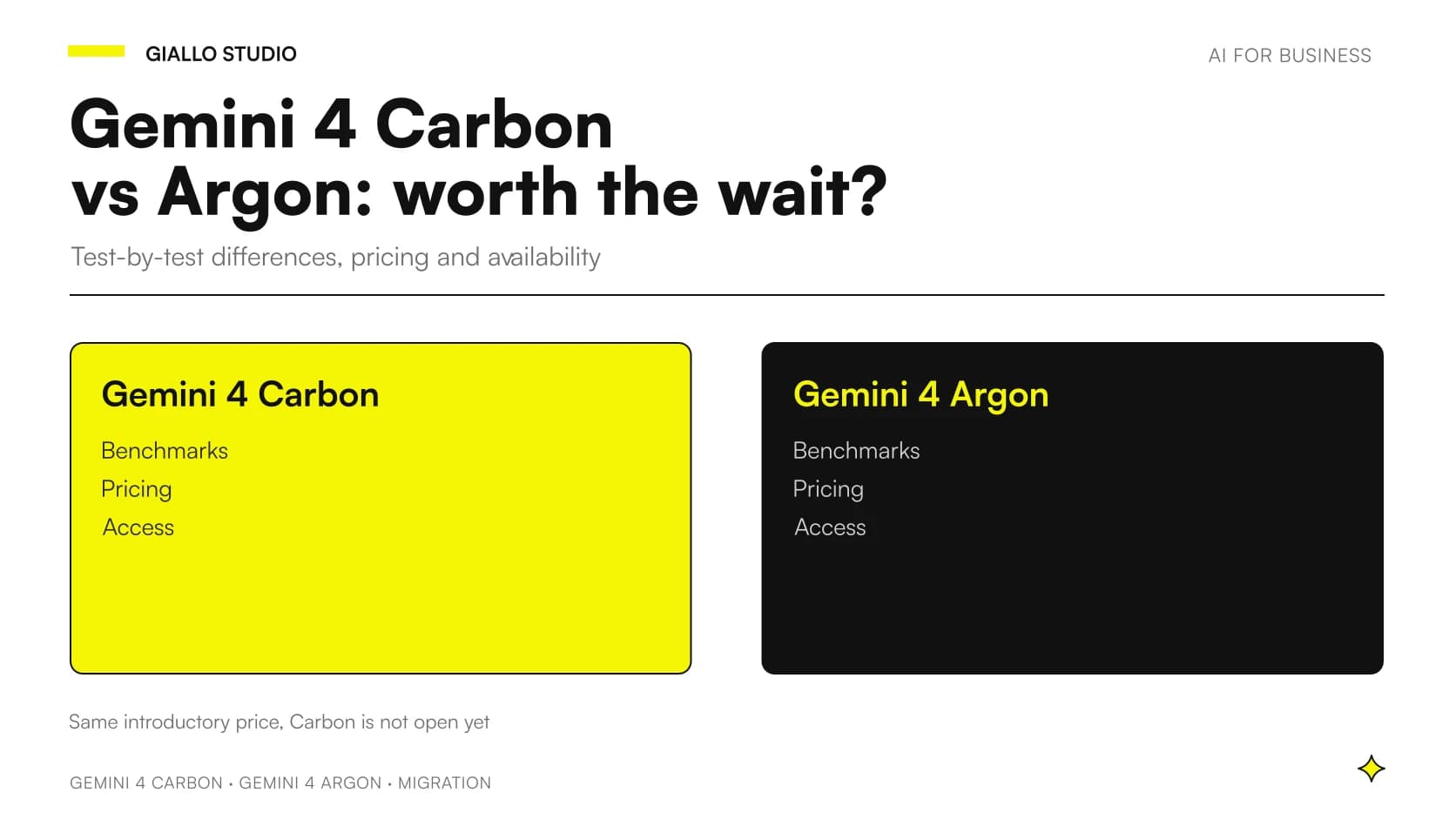 Gemini 4 Carbon vs Argon: Differences and Is It Worth Waiting?
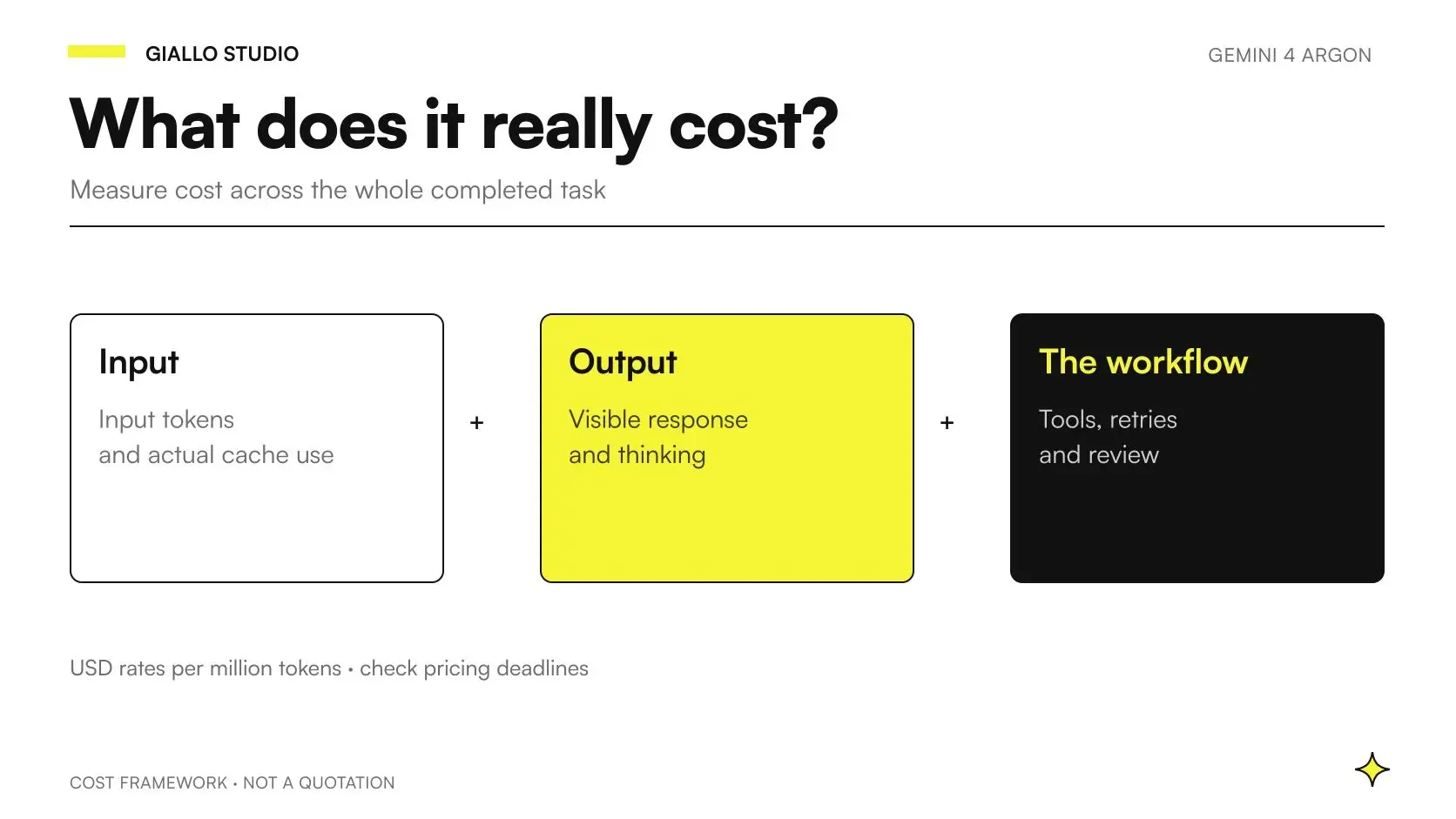 Gemini 4 Argon: API pricing and business cost calculations
 GPT-6 Astra: pricing, real costs and when it is worthwhile
 Claude Opus 5.5: official benchmarks, prices and comparison with Fable 5.1 and GPT-6 Astra
FAQ
How much does Gemini 4 Carbon cost via API?
According to Google's announcement of 28 October 2026, Gemini 4 Carbon costs $2 per million input tokens and $10 per million output tokens during the introductory period. However, as of 28 October 2026 it does not yet appear in the Gemini API price list and is not available to businesses and developers: the price is an announced rate, not a service you can buy.
How much does Gemini 4 Carbon cost after the introductory period?
After the introductory period, Google has announced $4 per million input tokens and $20 per million output tokens for Gemini 4 Carbon. For the same usage, spend doubles compared with the introductory phase, so a business budget should be built on the full price.
When does the Gemini 4 Carbon introductory price end?
As of 28 October 2026, Google has not announced when the Gemini 4 Carbon introductory period ends. The 30 November 2026 deadline applies to Gemini 4 Argon in the API price list and should not be carried over to Carbon.
Is Gemini 4 Carbon already in the Gemini API price list?
No. As of 28 October 2026, the Gemini API pricing page lists Gemini 4 Argon but not Gemini 4 Carbon. Google has not yet published the model identifier in the API, the context window or the output limits.
How much does cached input cost on Gemini 4 Carbon?
Google announces a 95% discount on cached input for Gemini 4 Carbon: at the introductory price of $2, that works out at $0.10 per million tokens (our calculation). If the discount stayed the same on the full price of $4, the rate would be $0.20, but Google has not detailed this step.
Gemini 4 Carbon vs GPT-6 Astra: which costs less?
As of 28 October 2026, Gemini 4 Carbon costs less than GPT-6 Astra, which is priced at $10 per million input tokens and $50 for output in OpenAI's Standard short-context price list. Even at full price ($4 and $20), Carbon is 60% cheaper per token, but the real cost depends on how many attempts each model needs to produce an accepted result.
Does Gemini 4 Carbon cost less than Claude Opus 5.5?
During the introductory price, yes: $2 and $10 versus $4 and $20 for Claude Opus 5.5 in the Claude price list of 28 October 2026. At full price, input and output rates are identical ($4 and $20), so the difference comes down to the attempts needed and the reasoning produced.
How do you estimate the real cost of a task done with an AI model?
Measure the input tokens, the repeated (cached) portion and the output tokens on a sample, apply the price list and divide the total by the number of accepted results. Cost per accepted result is more useful than cost per million tokens, because it includes repeated attempts and reasoning.