
Gemini 4 Carbon vs GPT-6 Astra and Claude: Which to Choose for Each Task
Gemini 4 Carbon vs GPT-6 Astra, Opus 5.5 and Fable 5.1: who leads in coding, agents, automation, documents, security and cost, with margins and limits.
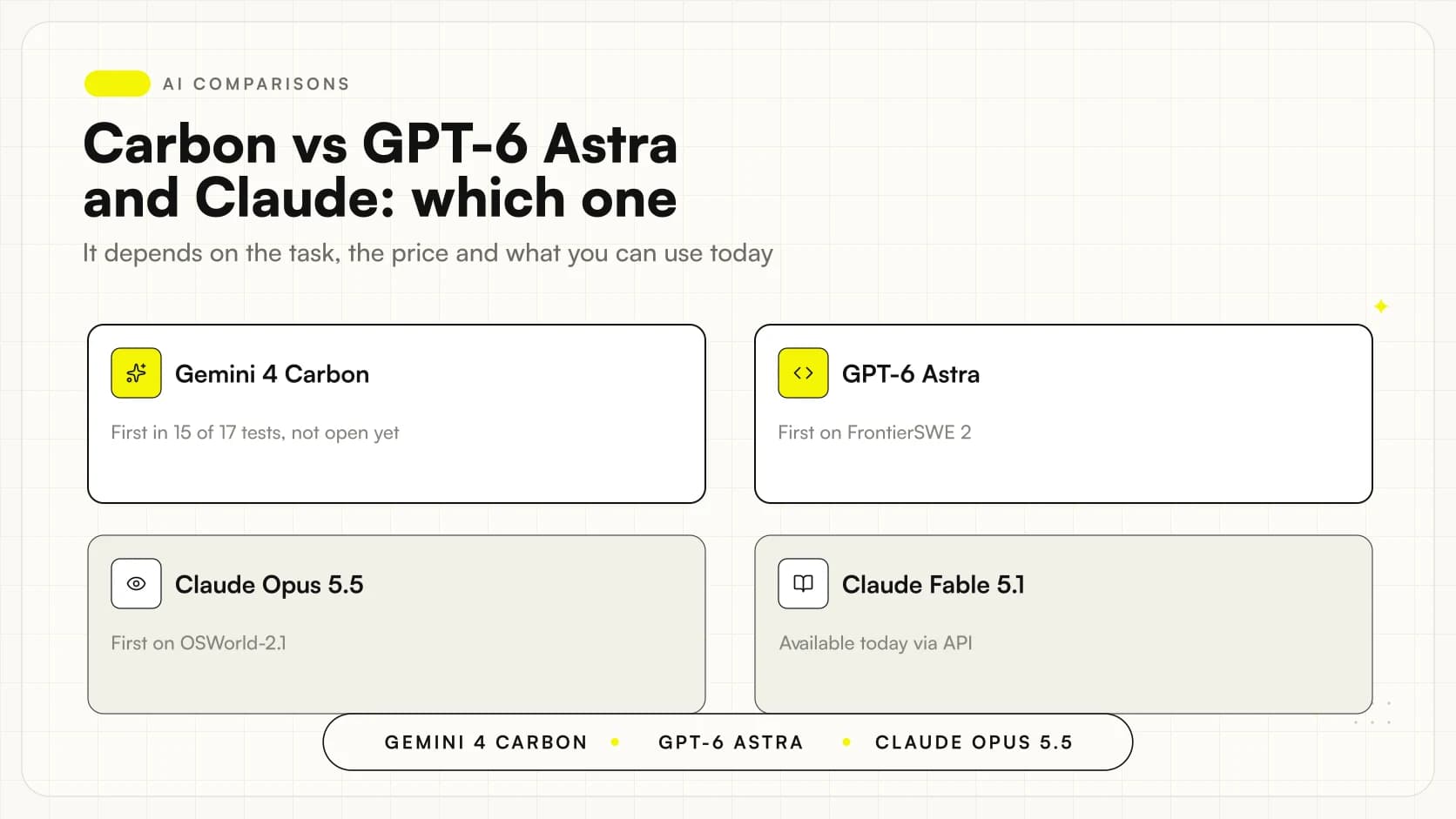
In the Gemini 4 Carbon vs GPT-6 Astra, Claude Opus 5.5 and Claude Fable 5.1 comparison, the answer changes with the type of work, and today it changes mostly for one concrete reason: Carbon cannot be used yet. In the table published by Google on 28 October 2026, the model is first in 15 of the 17 tests, but not on FrontierSWE 2, where GPT-6 Astra is first, and not on OSWorld-2.1, where Claude Opus 5.5 is first.
This guide does not offer a general ranking: it breaks the table down by task and, for each one, says who leads, by how much and with what limit. It then sets availability and price alongside, which for an SME weigh as much as the scores.
For an overview, start with what Gemini 4 Carbon is; for the full table, see the benchmark comparison. Here the goal is to decide which model to test for which job.
In summary
- As of 28 October 2026, Gemini 4 Carbon cannot be used by businesses and developers: Google is opening it first to cyber defenders and then to Fairwind Program partners, with no date for the others.
- In the Google numbers Carbon is first in 15 of 17 tests, but not on FrontierSWE 2 (GPT-6 Astra is first) or on OSWorld-2.1 (Claude Opus 5.5 is first).
- Carbon's widest margins over the runner-up are on ExploitGym (12.4 points over Astra) and GraphWalks (12.0 over Argon), followed by Terminal-Bench 4.0 (5.6 over Opus 5.5); the narrowest are under one point.
- Carbon costs according to Google, $2 and $10 per million tokens in the introductory period, then $4 and $20; Opus 5.5 costs $4 and $20; Astra and Fable 5.1 cost $10 and $50.
- To choose today, test on your own cases among the available models, writing the test so that Carbon can be added when it arrives.
Gemini 4 Carbon vs GPT-6 Astra: Who Leads in Each Task?
The table sorts the tests in Google's evaluationby type of work, “as of October, 2026”. The margin is the difference in points with the runner-up among Carbon, Gemini 4 Argon, GPT-6 Astra, Claude Opus 5.5 and Claude Fable 5.1; the subtraction is ours.
| Task (benchmark) | Leader | Margin | Note |
|---|---|---|---|
| Repository coding (SWE-sweep) | Carbon 9.6% | 0.1 points over Astra (9.5%) | Almost a tie; different sources |
| Repository coding (FrontierSWE 2) | Astra 65.5% | 3.2 points over Opus 5.5 (62.3%) | Carbon third with 61.2%; Proximal leaderboard |
| Terminal coding (Terminal-Bench 4.0) | Carbon 65.2% | 5.6 points over Opus 5.5 (59.6%) | Measured by Artificial Analysis, not Google |
| Agents that use a computer (OSWorld-2.1) | Opus 5.5 87.2% | 5.7 points over Carbon (81.5%) | Offline subset of 82 tasks |
| Agents on long tasks (Agents' Last Exam v1.1) | Carbon 77.4% | 4.3 points over Astra (73.1%) | Fable 5.1 absent; tasks from 17 October 2026 |
| Office automation (AutomationBench) | Carbon 53.9% | 2.6 points over Argon (51.3%) | Zapier private set |
| Long documents (GraphWalks, 256k–1M tokens) | Carbon 96.2 | 12.0 points over Argon (84.2) | Calculated by Google for all models |
| Charts (Chartography) | Carbon 72.5% | 0.9 points over Argon (71.6%) | No-tools test; minimal margin |
| Technical drawings (Blueprint-Bench 2) | Carbon 58.6 | 4.2 points over Argon (54.4) | Similarity score; Andon Labs leaderboard |
| Code security (CWE-bench, ExploitGym) | Carbon 71.0% and 54.8% | 3.0 points over Astra and Argon (CWE-bench); 12.4 over Astra (ExploitGym) | Cybersecurity evaluated “without guardrails” |
| Cost per million tokens | No overall leader | Carbon $2 / $10 introductory, then $4 / $20 | Carbon price not yet in the API price list |
In the overall rankings the margins are minimal: the Artificial Analysis Intelligence Index v5.0 puts Carbon at 59, Opus 5.5 at 58 and Astra at 57, while on Vals Index v2.2 Carbon has 70.4% and Opus 5.5 70.2%. A difference of 0.2 points is not a reason to switch vendors. Claude Fable 5.1 is never first in the table and has no figure on four tests: the table reflects the tests Google chose, not its usefulness for your work.
Which Model Can You Actually Use Today?
As of 28 October 2026, Gemini 4 Carbon is not available to businesses and developers. According to the Google announcement, access starts the week of the announcement with a subset of cyber defenders, then gradually extends to other trusted partners through the Fairwind Program. For developers, businesses and consumers, Google writes “as soon as possible” and “soon”, with no date.
Google has not published the model ID in the API, the context window, the output limits, the countries, or whether it will be in the Gemini app, AI Studio or Vertex AI, and the Gemini API price list does not list Carbon (it lists Argon). An Italian SME cannot yet sign a contract or run a test; the cost estimate remains provisional.
GPT-6 Astra, Claude Opus 5.5, Claude Fable 5.1 and Gemini 4 Argon, by contrast, have a list price and can be used. Write your test on your own cases today, run it on the available models and keep it ready for Carbon. If you are wondering whether it is worth waiting, read the comparison between Carbon and Argon.
Does Carbon or Astra Win for Repository Coding?
Up SWE-sweep Carbon scores 9.6% and Astra 9.5%: 0.1 points, in practice a tie, and under different conditions, because Carbon is calculated by Google with the mini-swe-agent harness while the competitors come from the public leaderboard, as indicated in the Google methodology. On FrontierSWE 2 the order changes: Astra 65.5%, Opus 5.5 62.3%, Carbon 61.2%, Fable 5.1 56.3%, Argon 55.0%. On Terminal-Bench 4.0, measured by Artificial Analysis, Carbon is first again with 65.2% against Opus 5.5's 59.6% and Astra's 59.1%.
A model that is first in two tests out of three is not “the best at coding”: what matters is how closely your work resembles the test. Anyone with a large repository can already compare Astra and Opus 5.5 on their own issues today; the guides to GPT-6 Astra for coding and Claude Opus 5.5 with Claude Code help you set up the test.
Do Computer-Use Agents Need Carbon or Opus 5.5?
Up OSWorld-2.1, an offline subset of 82 tasks, the leader is Claude Opus 5.5 with 87.2%; Carbon is second with 81.5% and Astra third with 80.9%. Opus 5.5's lead is 5.7 points, and the conditions are not the same: for Carbon and Argon Google reports the best of three runs, while the competitors come from their own publications (methodology).
Up Agents' Last Exam v1.1 Carbon is first with 77.4%, ahead of Astra (73.1%); Fable 5.1 has no figure. Google calculated it on 122 tasks, a five-hour window, and the 17 October 2026 version of the tasks, without the 26 October update. The signal favors Carbon, but on a small sample and with an already superseded version. An agent that clicks and fills in forms should be restricted anyway: AI agents and automations with Argon explains how to separate proposal from execution.
For Office Automation and Long Documents, How Much Does Carbon's Lead Matter?
Up AutomationBench, the private set of the Zapier leaderboard, Carbon scores 53.9%, Argon 51.3%, Opus 5.5 42.5% and Astra 41.4%: the margin over the runner-up, Argon, is 2.6 points. On Vending-Bench 2, bank balance in dollars, Carbon reaches 16,484 against 15,515 for Astra and 9,235 for Opus 5.5 (Google).
On AutomationBench, second place goes to Gemini 4 Argon, which can be used now, at the same price as Carbon's introductory price; for Argon the promotion runs until 30 November 2026 according to the Google price list: a reasonable testbed for sorting emails or preparing quotes.
On long documents the margin is one of the two widest in the table (12.0 points; ExploitGym 12.4). On GraphWalks (256k–1M tokens) Carbon scores 96.2, Argon 84.2, Astra 71.8, Opus 5.5 66.8 and Fable 5.1 65.0, and Google calculated it for all models, so the comparison is like for like. There are two limits: it is a subset of 200 problems, not the reading of a contract, and Google has not published Carbon's context window. For real documents, see Claude Opus 5.5 for checking documents.
Charts, Technical Drawings and Code Security: Where Is the Margin Real?
Up Chartography, a no-tools test, Carbon has 72.5%, Argon 71.6% and Astra 71.0%: 0.9 points are not enough for a winner, while Fable 5.1 is far behind with 46.2% (Google). On Blueprint-Bench 2, a similarity score, Carbon has 58.6 against Argon's 54.4. By its name it concerns technical drawings: check the exact task on the Andon Labs leaderboard before relying on it.
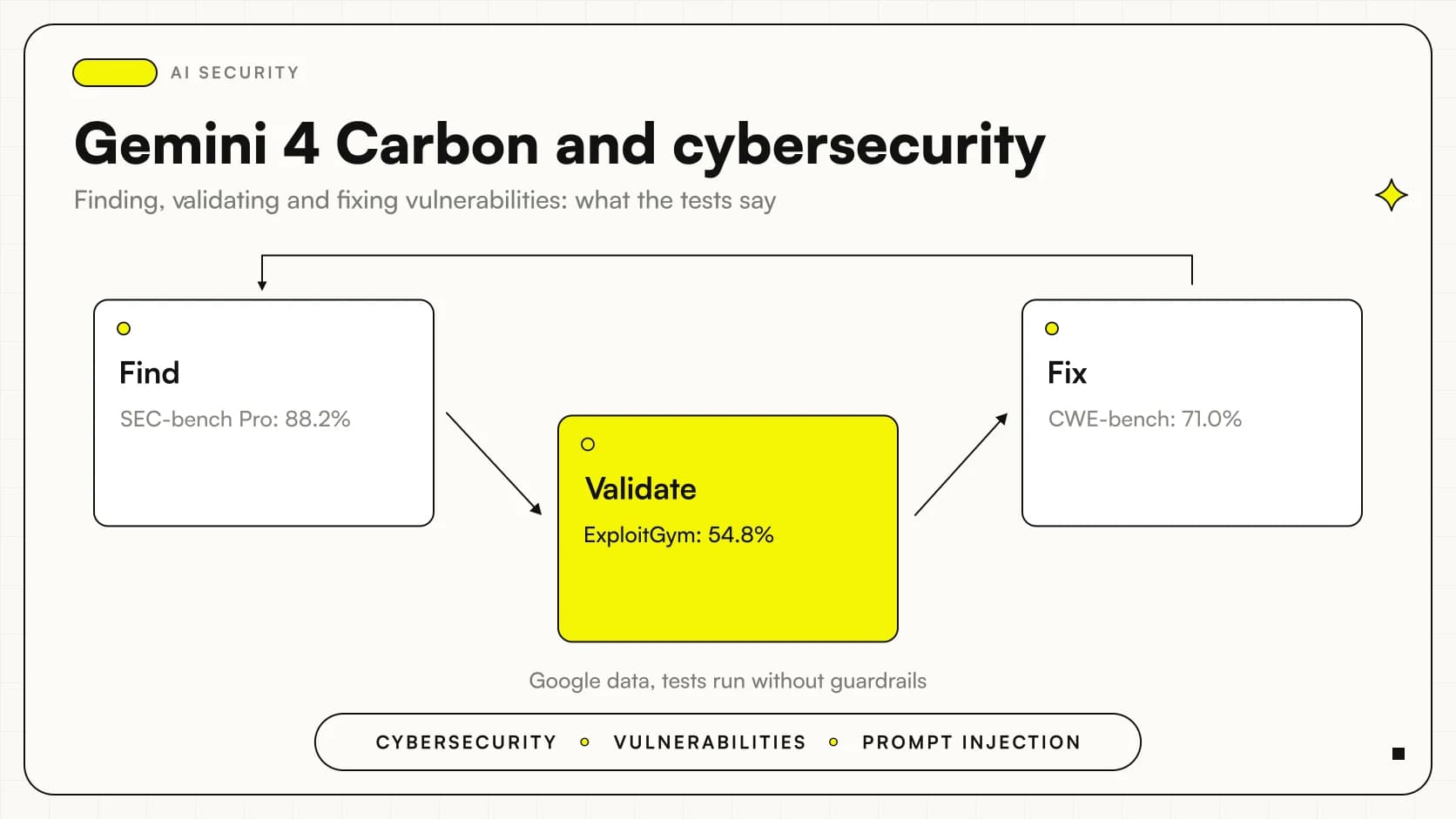
On code security the margin is clear: Carbon has 71.0% on CWE-bench (68.0% for Argon and Astra), 54.8% on ExploitGym (42.4% for Astra) and 88.2% on SEC-bench Pro (85.4% for Astra, no figure for Opus 5.5 and Fable 5.1). Google specifies in the announcement that these benchmarks are evaluated without guardrails, meaning without the protections of real-world use, and concern people working on cyber defense, the group Carbon is open to today. The security side is covered in the article on Gemini 4 Carbon and cybersecurity.
How Much Does Each Model Cost, and Why Is Carbon's Price Provisional?
Price matters as much as the score, because an automation consumes millions of tokens. The table reports prices per million tokens from the official price lists (Google, Anthropic, OpenAI), checked on 28 October 2026, for standard use.
| Model | Input | Output | Cache input | Listed as of 28 October 2026 |
|---|---|---|---|---|
| Gemini 4 Carbon, introductory period | 2 $ | 10 $ | $0.10 (our calculation, 95% discount) | No: not in the API price list |
| Gemini 4 Carbon, after the introductory period | 4 $ | 20 $ | $0.20 if the discount stays at 95% (our calculation; Google has not specified) | No: promo end date not stated |
| Gemini 4 Argon, until 30 November 2026 | 2 $ | 10 $ | 0,10 $ | Yes |
| Gemini 4 Argon, from 1 December 2026 | 4 $ | 20 $ | 0,20 $ | Yes |
| Claude Opus 5.5 | 4 $ | 20 $ | 0,20 $ | Yes |
| GPT-6 Astra (up to 272K tokens) | 10 $ | 50 $ | 1 $ | Yes |
| Claude Fable 5.1 | 10 $ | 50 $ | 0,25 $ | Yes |
| Claude Sonnet 5.5; GPT-6.1 Sol (up to 272K tokens) | 2 $ | 10 $ | 0,10 $ | Yes |
Google said in the announcement that Carbon's introductory price will end, but not when. The 30 November 2026 date applies to Argon and should not be transferred to Carbon. Beyond 272K input tokens, Astra goes to $20 for input and $75 for output according to the OpenAI price list.
Hypothetical scenario: an automation that consumes 50 million input tokens and 5 million output tokens a month, without cache. At 2/10 pricing the monthly cost is $150; at 4/20 (Carbon after the introductory period, Opus 5.5) it is $300; at 10/50 (Astra, Fable 5.1) it is $750. This is our calculation, based on the official price lists and it does not count reasoning tokens, which the Argon price list bills as output. Details in GPT-6 Astra prices, Opus 5.5 benchmarks and pricing and Carbon API pricing and costs.
When Should You Wait for Carbon, and When Not?
When it makes sense to wait for Carbon
- Your work involves very long documents or multi-step automations, where Carbon is first in the table (with a wide margin on long documents).
- You are not in a hurry and can work with Argon, from the same family, in the meantime.
When it does not make sense to wait
- The process has to start within a few weeks: Google has given no date for businesses.
- Your case resembles FrontierSWE 2 or OSWorld-2.1, where Carbon is not first.
- You need countries, context window and output limits, which are not published today.
Which Questions Help You Choose the Right Model?
- Does the task resemble a published test, or is it different?
- Which error blocks the work even if everything else is correct?
- Is the model available to you today, in your country and under a contract?
- How many tokens does the process consume in a month, and at what price, even after the introductory offer?
- What data can the model receive, and who checks the result?
- Can you switch models without rewriting everything, by keeping the test cases?
For a more general method, see the guide to how to choose an AI model; for the comparison from before Carbon, see Gemini 4 Argon vs ChatGPT and Claude.
How Would the Choice Change for a Software House and an Accounting Firm?
Hypothetical scenario: a six-person software house with large repositories. The test uses twenty already-solved issues with the solution hidden: Astra and Opus 5.5 are compared today, measuring accepted patches, corrections requested and cost. Carbon is a candidate for the terminal (Terminal-Bench 4.0) but not a favorite on FrontierSWE 2: the sample decides, not the chart.
Hypothetical scenario: an accounting firm that wants to automate document sorting and the preparation of client files. What matters here are AutomationBench and long documents, where Carbon is first and Argon is second: a 12.0-point margin on GraphWalks, 2.6 on AutomationBench. The firm starts with Argon on cleaned-up documents, with a manager who checks every file, and writes the test so that the model can be replaced later. The process automations should be designed with minimal permissions: the model proposes, a person confirms.
What Mistakes Should You Avoid When Comparing These Models?
- Reading a single test as a verdict. Carbon is first in 15 of 17 tests in the Google table, but the two where it is not coincide with agentic coding and computer use, two jobs that are central to agents.
- Comparing tiny margins. 0.1 points on SWE-sweep, 0.2 on Vals Index and 0.9 on Chartography (Google data) do not indicate a useful advantage.
- Choosing on the introductory price. Carbon's $2 / $10 has no end date stated in the announcement: run the numbers with $4 / $20 as well.
How Can You Set Up the Choice Without Waiting for Carbon?
The most solid approach is small: one real process, twenty cleaned-up cases with the expected answer, a definition of serious error, and two or three available models, Argon included. Human review counts too, not just tokens. When Google opens Carbon to businesses, repeat the test without changing the criteria.
In short: Carbon is a very strong candidate on paper, but today the concrete choices are Astra, Opus 5.5, Fable 5.1 and Argon, and no score replaces a test on your own cases. For Astra and Fable, see GPT-6 Astra vs Claude Fable 5.1.
If you want to turn your processes into a verifiable sample, the AI consulting of Giallo helps you choose cases, criteria and permissions; for agents and integrations there are the AI agents, and for code, the software house. To discuss it, Contact Us.
Giallo Studio guides: methodology and sources
How we apply it in the company
Related resources
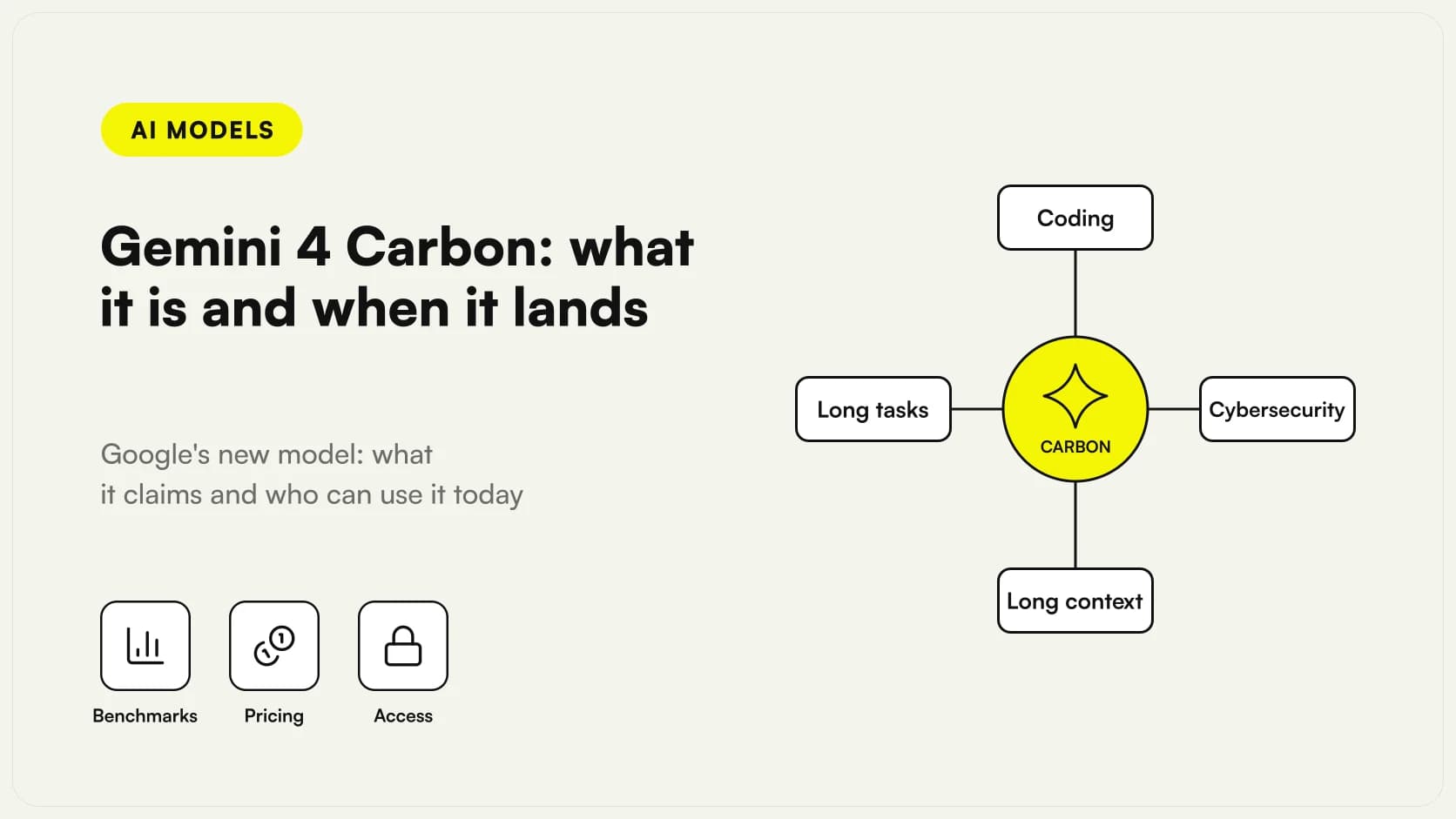 Gemini 4 Carbon: what it is, what Google claims and when it will be available
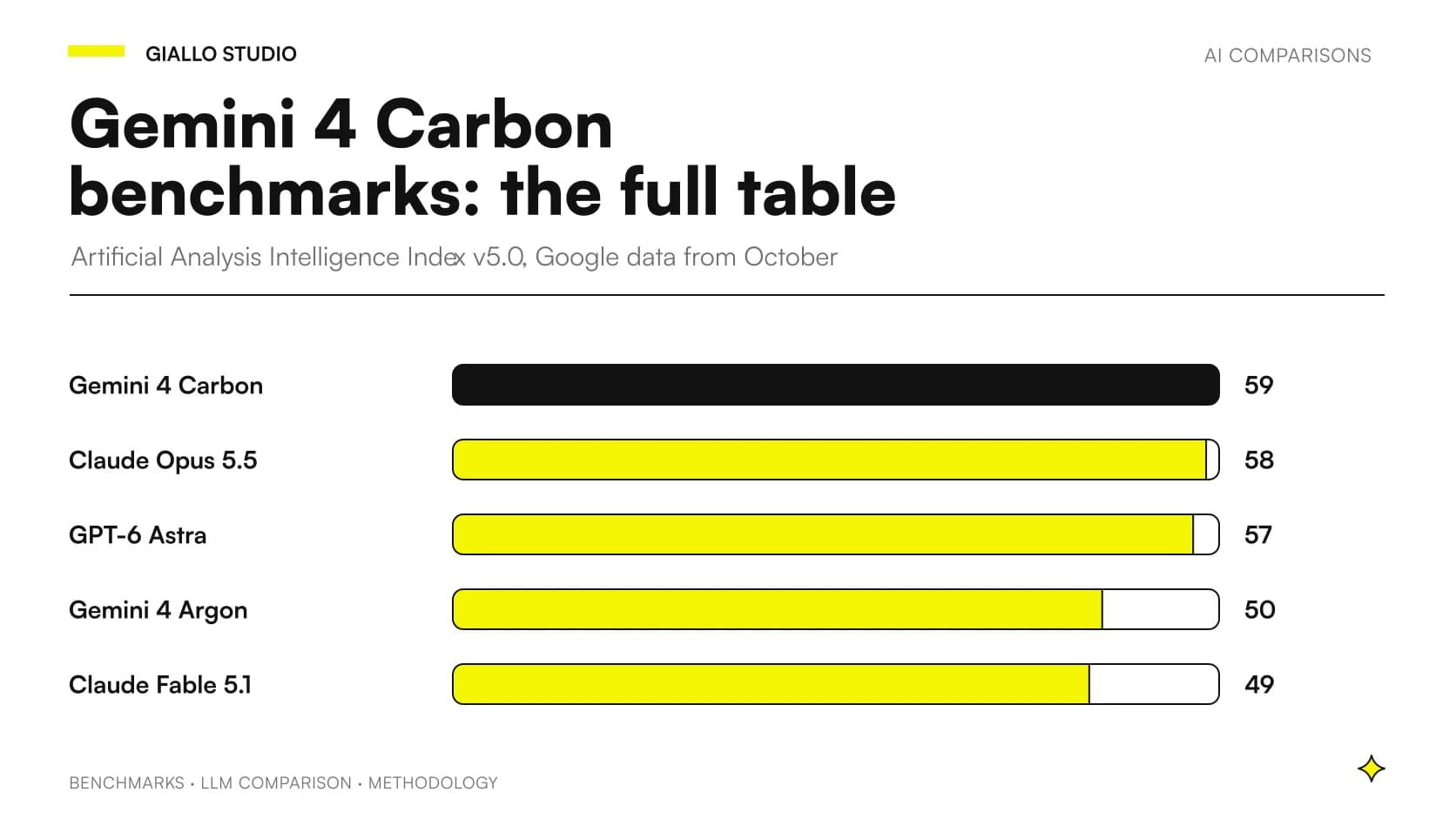 Gemini 4 Carbon benchmarks: the full table and how to read it
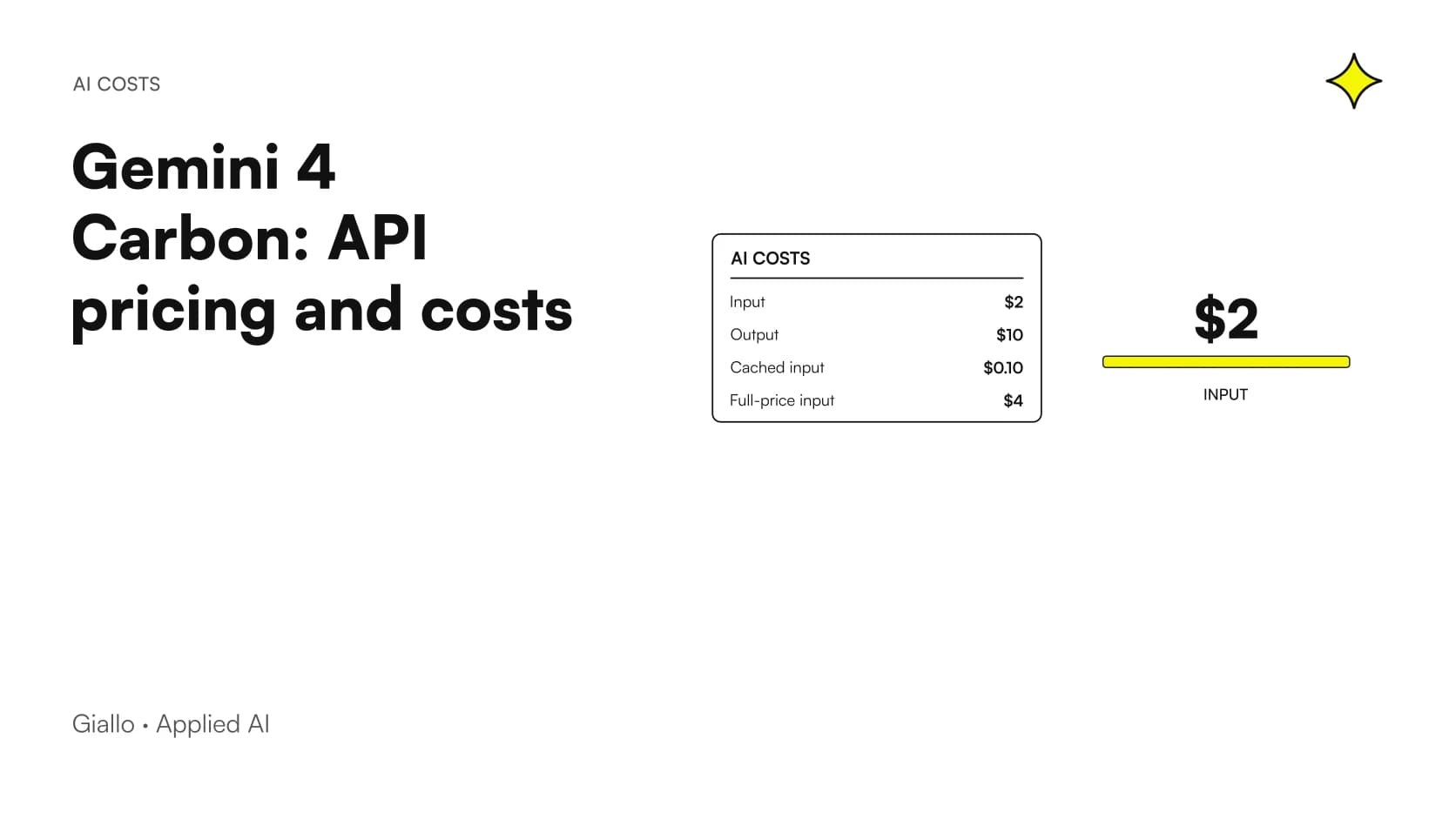 Gemini 4 Carbon pricing: API prices, cost per million tokens and comparison
 Gemini 4 Carbon vs Argon: Differences and Is It Worth Waiting?
 Gemini 4 Carbon cybersecurity: finding, validating and fixing vulnerabilities
 GPT-6 Astra vs Claude Fable 5.1
 Claude Opus 5.5: official benchmarks, prices and comparison with Fable 5.1 and GPT-6 Astra
 Gemini vs Copilot: Which to Choose
Other direct comparisons
The same criteria applied to other model pairs.
- Gemini 4 Carbon vs Argon: Differences and Is It Worth Waiting?
- ChatGPT vs Gemini: which subscription is worthwhile in October 2026?
- Gemini 4 Argon vs ChatGPT and Claude: which should you choose?
- Gemini vs Copilot: Which to Choose
- Gemini 3.6 Flash vs 3.5 Flash
- Gemma 4 12B vs Ministral 3 14B: compact local AI
- Claude Fable 5.1 vs Sonnet 5
- GPT-5.6 Sol vs Terra: which makes sense?
- DeepSeek R1 Distill 32B vs Qwen3.8-27B locally
- GPT-6 Astra vs Claude Fable 5.1
- Claude vs Perplexity
- GPT-6 Astra vs GPT-5.6 Sol
FAQ
Is Gemini 4 Carbon better than GPT-6 Astra?
It depends on the task. In the table Google published on 28 October 2026, Carbon is first in 15 of the 17 tests and ahead of Astra in 16, but on FrontierSWE 2 GPT-6 Astra is first with 65.5% against Carbon's 61.2%. On SWE-sweep the difference is 0.1 points (9.6% versus 9.5%).
Is Gemini 4 Carbon better than Claude Opus 5.5?
In Google's table, Carbon is ahead of Opus 5.5 in 14 of the 16 tests where both have a value (on SEC-bench Pro there is no Opus figure), but Opus 5.5 is ahead on OSWorld-2.1 (87.2% versus 81.5%) and on FrontierSWE 2 (62.3% versus 61.2%). On Vals Index the gap is just 0.2 points (70.4% versus 70.2%). The comparison rests on numbers published by Google, which for Opus 5.5 come from the vendors or from leaderboards.
Which AI model should you choose today, 28 October 2026?
As of 28 October 2026, Gemini 4 Carbon cannot be used by businesses and developers: Google is opening it first to cyber defenders and then to Fairwind Program partners, with no date for everyone else. The real choices are GPT-6 Astra, Claude Opus 5.5, Claude Fable 5.1 and Gemini 4 Argon. It is best to test them on your own cases, keeping the same test ready for Carbon.
How much does Gemini 4 Carbon cost compared with Opus 5.5 and Astra?
Carbon costs $2 per million input tokens and $10 per million output tokens in the introductory period, then $4 and $20. Claude Opus 5.5 costs $4 and $20; GPT-6 Astra and Claude Fable 5.1 cost $10 and $50. Google has not said when Carbon's introductory period ends.
For writing code, is Gemini 4 Carbon or GPT-6 Astra the better choice?
The numbers are split: Carbon is first on Terminal-Bench 4.0 with 65.2% and on SWE-sweep with 9.6%, while Astra is first on FrontierSWE 2 with 65.5%. Anyone working on large repositories should test both on their own issues. In any case, Carbon is not available to developers as of 28 October 2026.
Does Carbon win for agents that use a computer?
Not in everything. On Agents' Last Exam v1.1 Carbon is first with 77.4%, but on OSWorld-2.1 it is second with 81.5%, behind Claude Opus 5.5 (87.2%). In this table OSWorld-2.1 is an offline subset of 82 tasks, so a small sample.
Why should Google's numbers be read with caution?
Because some of the Carbon and Argon numbers are calculated by Google with its own settings, while for the other models the table uses numbers declared by the vendors or taken from different leaderboards. Google states this in the Gemini 4 Carbon methodology. For this reason, small margins should not be treated as certain advantages.