
Gemini 4 Carbon: what it is, what Google claims and when it will be available
Gemini 4 Carbon is Google's strongest model for coding, cybersecurity and long tasks. Read what's new, benchmarks, pricing and availability (28 October 2026).
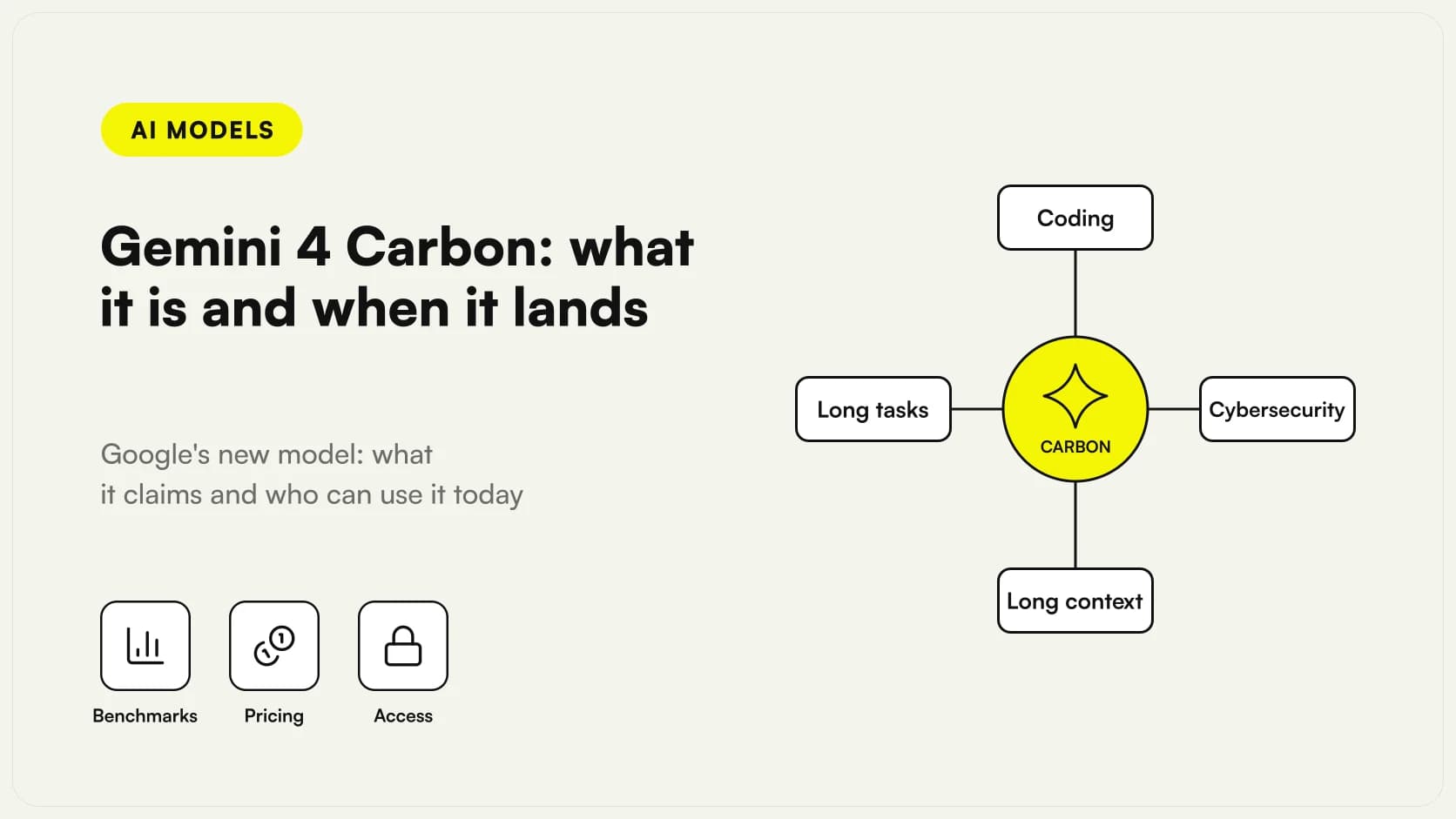
Gemini 4 Carbon is the model Google announced on 28 October 2026 as its most powerful, built for long-running tasks, coding and cybersecurity; as of 28 October 2026, however, it is not available to businesses and developers. For now, Google is opening it to a subset of cyber defenders and, later, to other trusted partners through the Fairwind Program. The data in this guide comes from the Google official announcement, the model evaluation and the page for the Fairwind Program, all accessed on 28 October 2026.
The model arrives two weeks after Gemini 4 Argon, which it builds on. Readers of the news ask what really changes, how solid the numbers are, how much it costs and when it can be used: here are the answers, with what Google has claimed kept separate from what it has not yet published.
For an Italian SME, the practical conclusion is simple. Access cannot be purchased yet, so it makes no sense to reorganize a process around Carbon. It does make sense to prepare the tests now, with models you can use today, so you can judge Carbon in a few hours once it becomes accessible.
In summary
- According to Google, Gemini 4 Carbon is its most powerful model, with claimed state-of-the-art capabilities in long-running tasks and in cybersecurity.
- In Google's table it beats Gemini 4 Argon on all 17 reported tests, but it is not first on FrontierSWE 2 or on OSWorld-2.1.
- The stated introductory price is $2 per million input tokens and $10 per million output tokens; Google has not said when the introductory period ends.
- As of 28 October 2026, access is limited to selected cyber defenders and then to Fairwind Program partners: no date for developers and businesses.
- Google has not published the context window, the model ID in the API, supported countries, or availability in the Gemini app, AI Studio or Vertex AI.
- An SME can prepare test cases today and use available models, without waiting for a release with no date.
What is Gemini 4 Carbon and where does it fit in the Gemini 4 family?
Gemini 4 Carbon is an artificial intelligence model from Google, introduced on 28 October 2026 in an announcement signed by Koray Kavukcuoglu, SVP of Google DeepMind and the company's Chief AI Architect. Google calls it its most powerful model and attributes to it state-of-the-art capabilities in cybersecurity and in long-running tasks, which researchers call “long horizon”. Source: Google announcement of 28 October 2026.
Carbon arrives two weeks after Gemini 4 Argon and builds on it. To understand the starting point, read what Gemini 4 Argon is, the model already on the Gemini API price list, while the historical overview of the products is in Gemini AI: what it is and how it works.
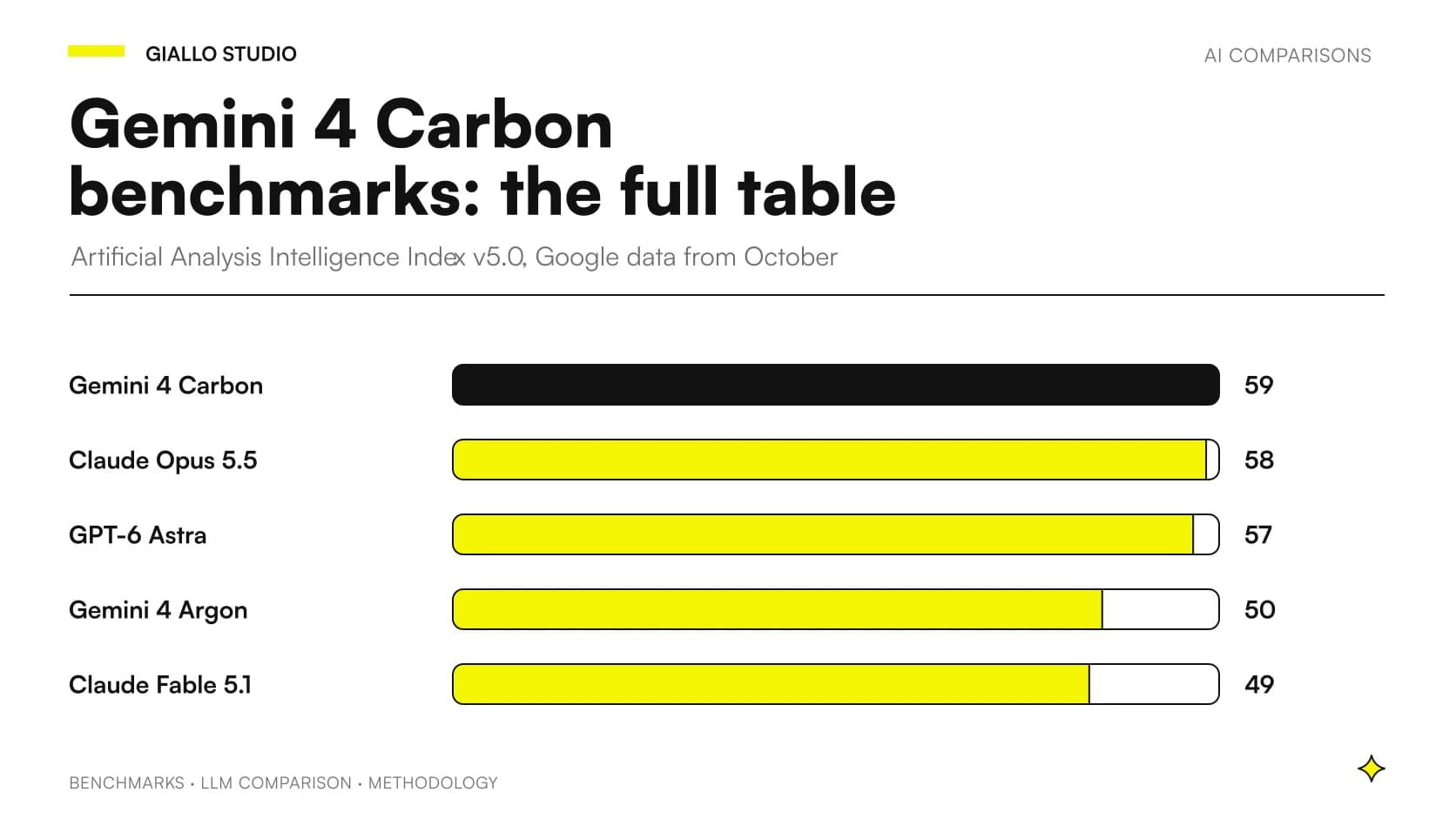
Google claims improvements in four areas: coding, agentic and scientific tasks, full-stack web development and multimodal understanding. On web development, the announcement cites WebDev Arena, where it reports a gain of 89 Elo points and fourth place with 1768 points. On Artificial Analysis's index, the Intelligence Index v5.0, Carbon scores 59 and ranks first. Sources: announcement and the model evaluation.
“Gemini 4 Carbon” is the name of a model, not of an app or of a service you can subscribe to. Whether it will be offered in the Gemini app, on a Cloud platform or in the API, Google has not yet said.
What does it mean that Gemini 4 Carbon is built for long-running tasks?
A long-running task is a job that requires many steps, tool calls and intermediate checks, often over hours, instead of a single answer to a single question. Google writes that its teams have seen Gemini 4 Carbon work for days on complex engineering assignments: finding the cause of, and fixing, subtle bugs in large codebases and low-level systems. Source: Google announcement, 28 October 2026.
Why does it matter outside software? Because in a long job an early error propagates to later steps: for a business, reliability over a hundred steps is worth more than brilliance on one. Three figures in the model evaluationbear on this.
- Agents' Last Exam v1.1 (Google leaderboard and calculations): 77.4% versus 69.0% for Argon, 73.1% for GPT-6 Astra and 71.6% for Claude Opus 5.5. Google calculated it for Carbon and Argon on 122 tasks, with a 5-hour window and safety filters on; Claude Fable 5.1 does not appear.
- AutomationBench (Zapier): 53.9% versus 51.3% for Argon, 41.4% for Astra, 42.5% for Opus 5.5 and 31.4% for Fable 5.1, on a private set of office-work tasks.
- Vending-Bench 2: a final balance of $16,484 versus $13,718 for Argon, $15,515 for Astra, $9,235 for Opus 5.5 and $5,422 for Fable 5.1 (Andon Labs ranking).
They point to a category where, on paper, Carbon is ahead. They are not a forecast for your process: no test uses your documents or your customers.
What is new in Gemini 4 Carbon compared with Gemini 4 Argon?
In the table published by Google, Gemini 4 Carbon scores higher than Gemini 4 Argon on all 17 reported tests, with very different gaps from test to test. Source: “as of October, 2026” table in the model evaluation. The widest gaps are on:
- GraphWalks (long context, from 256 thousand to 1 million tokens): 96.2% versus 84.2%, calculated by Google for all models;
- Agents' Last Exam v1.1 (agentic tasks): 77.4% versus 69.0%;
- ExploitGym (cybersecurity): 54.8% versus 42.0%;
- Terminal-Bench-Science 0.1: 64.8% versus 52.9%;
- AA Intelligence Index v5.0: 59 versus 50.
The narrower gaps concern chart understanding (Chartography, 72.5% versus 71.6%) and the Vals Index v2.2 (70.4% versus 69.2%): reading the numbers, the jump is marked in agentic work, very long context and cybersecurity. The guide Gemini 4 Carbon vs Argon goes deeper into when it makes sense to wait and when to carry on with Argon.
Argon is already on the Gemini API price list as of 28 October 2026, and the Argon migration protocol can be reused for every later model.
How does Gemini 4 Carbon compare with GPT-6 Astra, Claude Opus 5.5 and Fable 5.1?
The most useful comparison is a condensed table. It shows eight tests chosen from Google's 17, with the best value in each row in bold; the full table, with a row-by-row reading, is in Gemini 4 Carbon benchmarks and comparison. All values come from the model evaluation of 28 October 2026; “n/a” means the data is not available.
| Test (category) | Gemini 4 Carbon | Gemini 4 Argon | GPT-6 Astra | Claude Opus 5.5 | Claude Fable 5.1 |
|---|---|---|---|---|---|
| AA Intelligence Index v5.0 (general) | 59 | 50 | 57 | 58 | 49 |
| Vals Index v2.2 (general) | 70,4% | 69,2% | 65,0% | 70,2% | n/a |
| FrontierSWE 2 (agentic coding) | 61,2% | 55,0% | 65,5% | 62,3% | 56,3% |
| Terminal-Bench 4.0 (agentic coding) | 65,2% | 57,1% | 59,1% | 59,6% | 52,0% |
| OSWorld-2.1, offline subset (computer use) | 81,5% | 74,7% | 80,9% | 87,2% | 76,8% |
| AutomationBench (office work) | 53,9% | 51,3% | 41,4% | 42,5% | 31,4% |
| GraphWalks 256k–1M (long context) | 96,2% | 84,2% | 71,8% | 66,8% | 65,0% |
| ExploitGym (cybersecurity) | 54,8% | 42,0% | 42,4% | 34,5% | n/a |
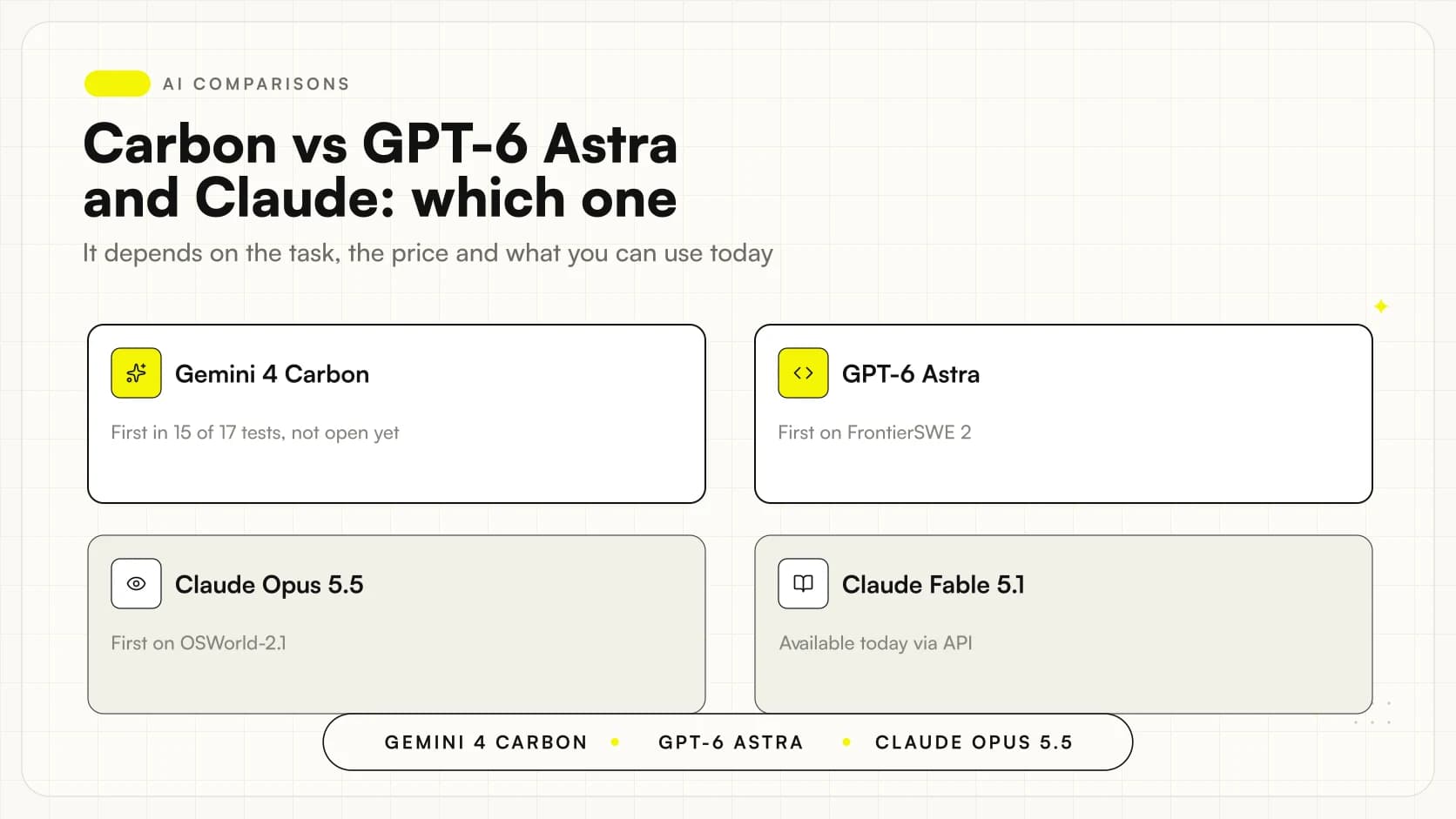
The honest reading has three points. First: Carbon is first in six rows out of eight, but not on FrontierSWE 2, where GPT-6 Astra is first with 65.5% and Carbon, at 61.2%, is third, also behind Claude Opus 5.5 (62.3%). Second: it is not first on OSWorld-2.1, the computer-use test, where Opus 5.5 scores 87.2% and Carbon is second with 81.5%. Third: on some rows the margin is minimal, such as the 0.2 points on the Vals Index over Opus 5.5 or the single point on the AA Index.
The comparison by use case is in Gemini 4 Carbon vs GPT-6 Astra and Claude. The competitors are presented in detail in GPT-6 Astra: what it is and where it falls short and in Claude Opus 5.5: what it is and who it suits; for Fable 5.1, see the comparison with GPT-6 Astra.
Why does Google stress cybersecurity, and what does it claim?
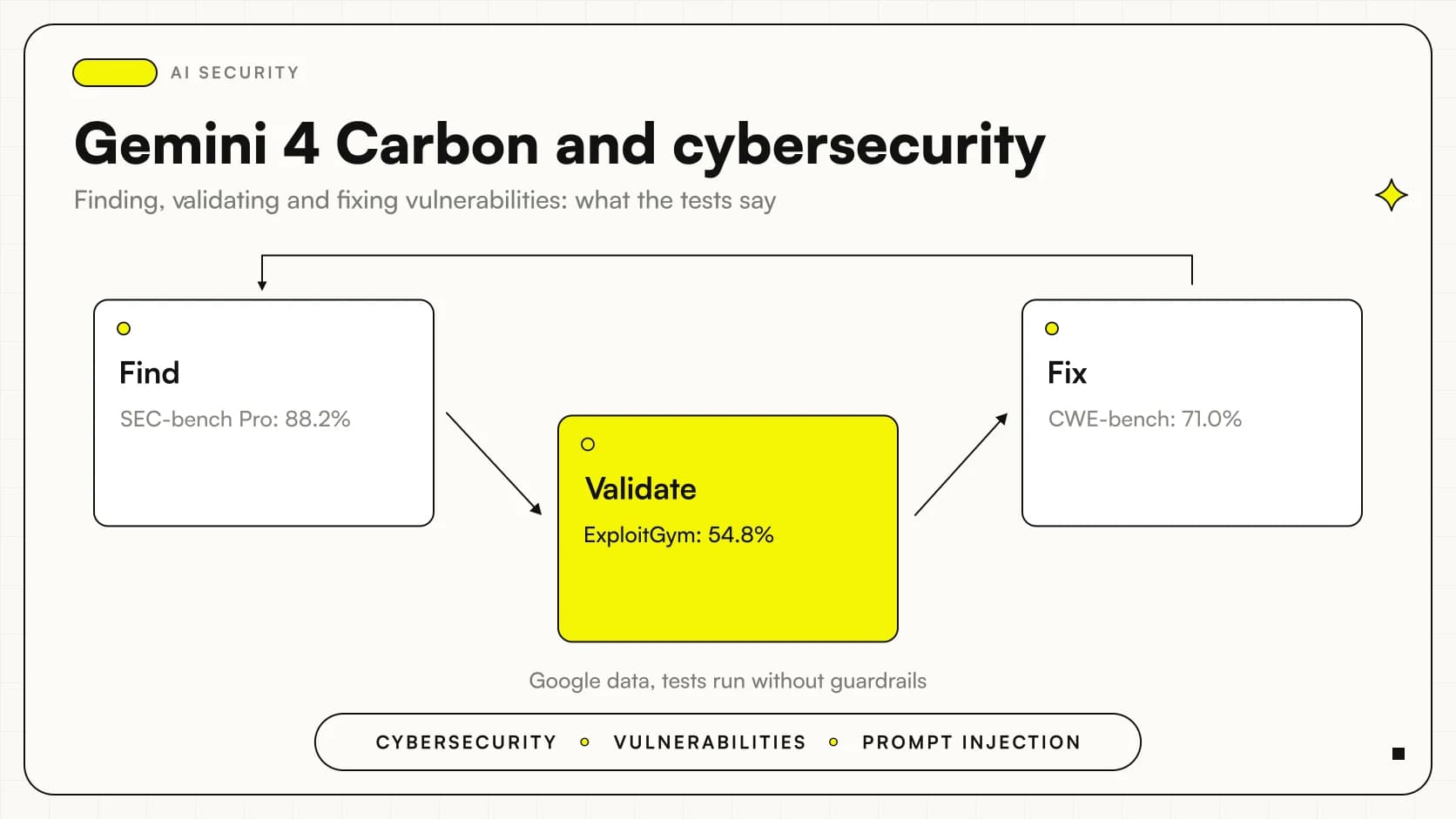
Google presents Gemini 4 Carbon as a state-of-the-art model across the whole defense cycle: detecting vulnerabilities, validating them and fixing them. It backs this with three figures: SEC-bench Pro 88.2% for finding real vulnerabilities, ExploitGym 54.8% for validating the risk with an exploit and CWE-bench by Collinear 71.0% for fixing at the root cause. In the announcement, the cybersecurity benchmarks are evaluated without guardrails. Source: Google announcement, 28 October 2026.
In the table, SEC-bench Pro puts Argon at 83.4% and GPT-6 Astra at 85.4%, while Opus 5.5 and Fable 5.1 have no figure; on CWE-bench, Carbon scores 71.0% versus 68.0% for Argon and Astra and 67.0% for Opus 5.5. Source: the model evaluation. Google adds two testimonials: the Chrome team reports that Carbon did more than 10 times better than a large frontier model from another lab, unnamed, at generating high-quality patches; Wiz sees Carbon leading on web penetration-testing benchmarks, without figures.
On the attack side, the Gray Swan benchmark on indirect prompt injection, meaning malicious instructions hidden in documents or pages the model reads, reports 0.7% successful attacks for Argon and 0.0% for Carbon, which withstood all the attempts evaluated (source: Google announcement). For a business thinking about an agent that reads emails and PDFs from strangers, this is the most concrete risk; the practical implications are in the guide Gemini 4 Carbon and cybersecurity.
What does Google claim about reliability and agent behavior?
Google reports a series of internal measurements of the model's behavior when it works for a long time. Successful cheating on Terminal-Bench 4.0 falls to 0.0% and cheating attempts to 0.4%, with improved accuracy. In live coding tests with internal teams, high-severity misalignment alerts fall by almost 80%; in internal tests, unsupported claims are roughly halved compared with Argon, overreach falls by 26% and under-service by 29%. Source: Google announcement, 28 October 2026.
Google also describes two desired behaviors: faced with ambiguity, Carbon retrieves sources and flags discrepancies before acting; if an action is blocked, it lists what is missing instead of making things up. These are useful traits for a business agent, but they remain internal measurements claimed by Google, not independent verification.
How much does Gemini 4 Carbon cost?
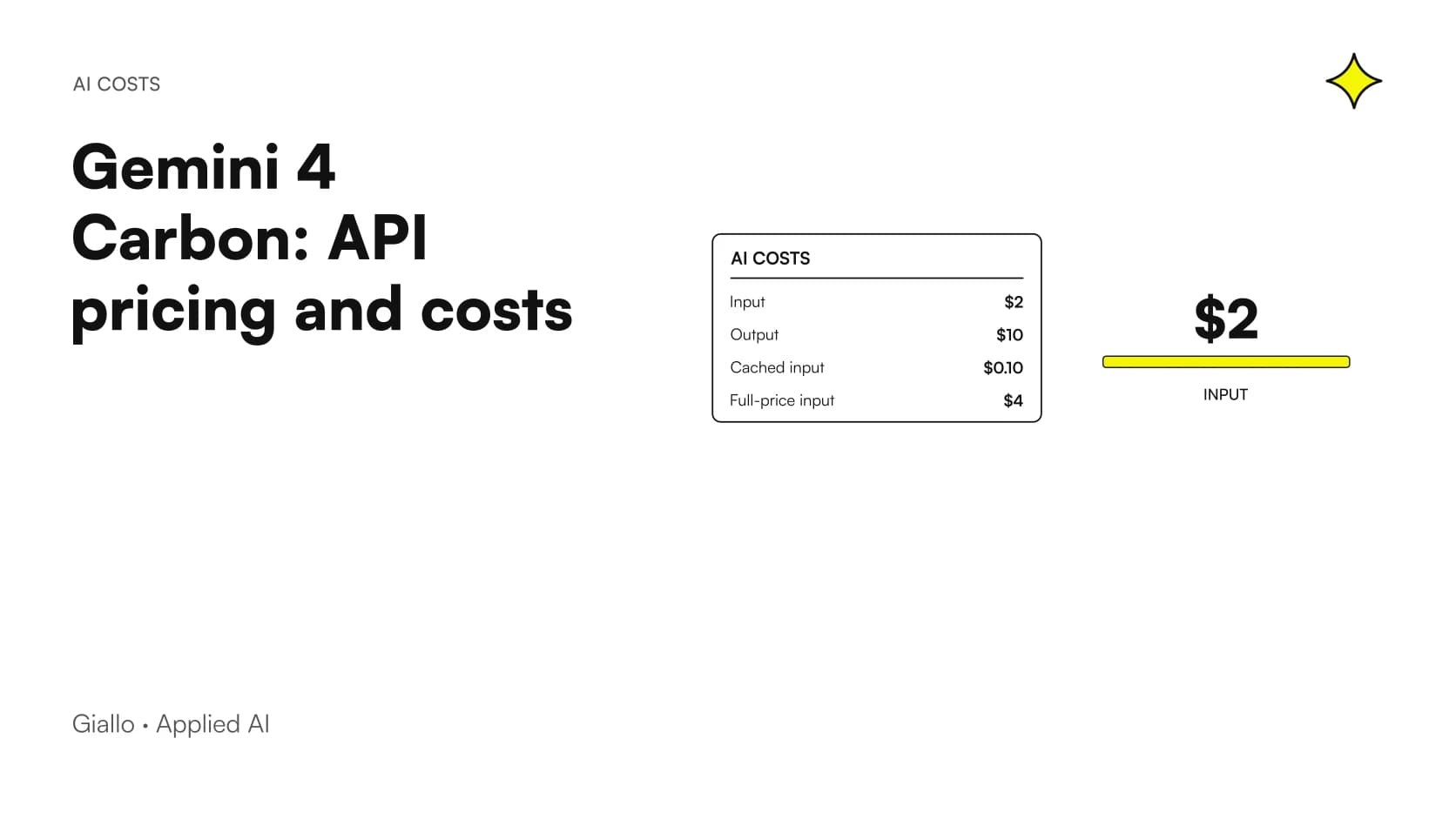
For Gemini 4 Carbon, Google states an introductory price of $2 per million input tokens and $10 per million output tokens, the same as Argon's, with a 95% discount on cached input tokens. After the introductory period, prices become $4 for input and $20 for output. Google has not said when Carbon's introductory period ends. Source: Google announcement, 28 October 2026.
The 30 November 2026 deadline belongs to Argon, whose price list shows $2 and $10 until that date and $4 and $20 from 1 December; it should not be attributed to Carbon. Carbon's price, moreover, does not yet appear on the Gemini API price list as of 28 October 2026. The comparison with competitors' price lists, per million tokens:
| Model | Input | Output | Cache input |
|---|---|---|---|
| Gemini 4 Carbon, introductory price | 2 $ | 10 $ | $0.10 (our calculation: 95% discount) |
| Gemini 4 Carbon, after the introductory period | 4 $ | 20 $ | $0.20 if the discount stays at 95% (our calculation; Google has not specified it) |
| Gemini 4 Argon, until 30 November 2026 | 2 $ | 10 $ | 0,10 $ |
| Claude Sonnet 5.5 | 2 $ | 10 $ | 0,10 $ |
| Claude Opus 5.5 | 4 $ | 20 $ | 0,20 $ |
| GPT-6 Astra, context up to 272K tokens | 10 $ | 50 $ | 1 $ |
| Claude Fable 5.1 | 10 $ | 50 $ | 0,25 $ |
Sources: Claude Price list and OpenAI price list, checked on 28 October 2026. Example of our calculation: 5 million input tokens and 1 million output tokens would cost $20 at the introductory price and $40 afterwards, without caching. The price per token, however, does not equal the cost of the finished work, because different models consume different amounts of tokens. In the documents consulted, moreover, it is not stated whether reasoning counts as billed output, as it does for Argon. The detail is in Gemini 4 Carbon: API pricing and estimated costs.
Is Gemini 4 Carbon available? The situation as of 28 October 2026
As of 28 October 2026, Gemini 4 Carbon is not available to businesses, developers or consumers. Google has chosen a deliberate release: it takes part in the US government's voluntary pre-release model testing process and, from this week, gives access to a subset of cyber defenders; it will then extend it gradually to other trusted partners through the Fairwind Program. For developers, businesses and consumers Google says “as soon as possible” and “soon”, because it is still gathering feedback and iterating on the safeguards. Source: Google announcement.
| Addressees | Stated status as of 28 October 2026 |
|---|---|
| Selected cyber defenders | Access from this week |
| Other trusted partners, via the Fairwind Program | Gradual access, no dates |
| Developers and businesses | “Soon”, no date |
| Consumers | “Soon”, no date |
What is the Fairwind Program and who can join?
The Fairwind Program gives trusted partners an advantage against cyber threats. It provides priority early access for governments, critical-infrastructure operators, such as healthcare, telecommunications, energy and financial networks, and core technology platforms; academic defensive-benchmarking labs can also apply. Google vets applicants, who apply through a form and accept usage rules: limits on dual-use tasks, MFA, a ban on reselling access. Source: Fairwind Program page, 28 October 2026.
One detail not to overlook: as of the same date, the page names only Gemini 4 Argon and CodeMender, the code-security agent, and does not mention Carbon. An SME that does not run critical infrastructure is not the natural recipient of the program; those who are can read the page and consider applying.
What has Google not yet published about Gemini 4 Carbon?
The list of missing information is long, and you should keep it in front of you before making any plan. As of 28 October 2026, according to the pages we consulted, Google has not published:
- the general availability date;
- the model identifier in the Gemini API and its presence on the price list;
- the context window and output limits;
- availability in the Gemini app, AI Studio or Vertex AI;
- the supported countries, so not Italy either;
- the end date of the introductory price;
- specific multimodal capabilities, such as audio and video.
The “Safety and Security” report linked in the announcement is titled for Gemini 4 Argon: it covers Argon and contains no data on Carbon (report, accessed on 28 October 2026). Anyone who writes “Carbon supports a million tokens” or “Carbon is available on Vertex” is saying something Google has not said.
What can an Italian SME do today to prepare for Gemini 4 Carbon?
An SME can prepare a model-independent test bench and run it on what is already available: a good set of cases can be reused with Carbon, Argon, Claude Opus 5.5 or any other model. Six steps, in order:
- Pick one or two long processes: jobs with many steps and different sources, such as preparing a case file or analyzing an error report.
- Collect 15-20 real, already closed cases: with the correct outcome known, including two or three incomplete or contradictory cases.
- Define the correction criteria: which errors make the result unusable, which are tolerable, how much time human review takes.
- Test them on models available today: for example Argon via API, as explained in integrating Argon via API, and a Claude or GPT model already on a price list.
- Separate model and process: permissions, approvals and the action log live in the software, not in the model, so that the model can be swapped.
- Postpone the purchase decision: when Carbon becomes accessible, you rerun the same test and compare quality, cost and review time.
Two hypothetical scenarios, declared as such. A 15-person mechanic's workshop receives fault reports with photos, technicians' notes and service history: the test bench uses 20 closed cases and measures whether the model proposes the same diagnosis as the workshop manager and flags missing data, without inventing it. An accounting firm with 8 staff reconciles year-end documents from different clients: the test counts the real discrepancies found and the false flags that trigger needless review.
The useful result is not “we chose Carbon”, but “we have a test that tells us which model is the right fit”. To build one, the AI consulting of Giallo starts from choosing the process and the criteria; for workflows that touch several tools, the page on AI agents explains permissions and approvals. The general picture is in AI Agents: What They Are and how to choose an AI model.
Worth waiting for Carbon if
- the process is long and an error is costly;
- tests on Argon show limits that Carbon claims to reduce;
- there is no urgency and the test is already ready.
Not worth waiting if
- a simple process already works with an available model;
- the cost of waiting exceeds the possible gain;
- Carbon's date for businesses and developers remains unknown.
What limits and cautions apply when reading these numbers?
Giallo has not tested Gemini 4 Carbon and has not rerun the benchmarks: everything you read above is claimed by Google, with the methodology published in the model evaluation. Some methodological choices are worth knowing before giving the numbers weight.
For Carbon and Argon, Google uses pass@1 unless noted, with a single attempt and the highest thinking settings. On OSWorld-2.1 the subset is 82 tasks and for Carbon and Argon the best of three runs counts, while competitors come from their own publications. On Agents' Last Exam the task version is the one from 17 October 2026, without the 26 October update. ExploitGym was run without internet access and with mitigations turned off.
Two cautions follow. First: the cybersecurity benchmarks are evaluated without guardrails, while the real product will have protections on, so the observed behavior may differ. Second: the competitors' figures come from different sources; only GraphWalks is calculated by Google for all models. Also unknown, for business use, are latency, rate limits and contractual terms.
What mistakes should you avoid after the Gemini 4 Carbon announcement?
Four mistakes recur every time a new model is released.
- Treating “the most powerful” as “the best for you”. On FrontierSWE 2 and OSWorld-2.1 other models are ahead: the right model depends on the task.
- Taking availability for granted. As of 28 October 2026 no date has been given for businesses and developers, and Italy is not mentioned.
- Budgeting on the introductory price. After the offer, Carbon moves to $4 and $20 per million tokens; the budget should be built on the full price.
- Giving agents long jobs without approvals. Even with the claimed improvements in reliability and prompt injection, an agent that sends, pays or modifies should stay under human control until the contrary is shown on your cases.
What should you do this week, in practice?
Gemini 4 Carbon is Google's next step in long agentic work and cybersecurity, with strong claimed numbers and access that is still closed. For an Italian SME, the most sensible move is to build the test bench now, run it on an available model, and update it when Google publishes the date, countries, context window and price list. The guide Gemini 4 Carbon vs Argon helps you decide whether to wait or proceed, while API pricing, benchmark comparison, comparison with GPT-6 Astra and Claude and cybersecurity complete the picture.
Giallo Studio guides: methodology and sources
How we apply it in the company
Related resources
 Gemini 4 Carbon benchmarks: the full table and how to read it
 Gemini 4 Carbon vs GPT-6 Astra and Claude: Which to Choose for Each Task
 Gemini 4 Carbon pricing: API prices, cost per million tokens and comparison
 Gemini 4 Carbon cybersecurity: finding, validating and fixing vulnerabilities
 Gemini 4 Carbon vs Argon: Differences and Is It Worth Waiting?
 Gemini 4 Argon: what it is, what it does and when to use it in business
 GPT-6 Astra: what it is, how to use it and its limitations
 Gemini vs Copilot: Which to Choose
FAQ
What is Gemini 4 Carbon?
Gemini 4 Carbon is the model Google announced on 28 October 2026 and describes as its most powerful. It is designed for long-running tasks, coding and cybersecurity, arrives two weeks after Gemini 4 Argon and builds on it.
Is Gemini 4 Carbon available to businesses and developers yet?
No. As of 28 October 2026, Google makes it accessible to a subset of cyber defenders and, gradually, to other trusted partners through the Fairwind Program. For developers, businesses and consumers it says “soon”, without giving a date.
Will Gemini 4 Carbon be available in Italy?
Not confirmed. Google has not published the list of countries for Gemini 4 Carbon, nor its presence in the Gemini app, AI Studio or Vertex AI. As of 28 October 2026 there is therefore no confirmation for Italy: an Italian SME can only prepare tests and use models that are already available in the meantime.
How much does Gemini 4 Carbon cost?
Google states an introductory price of $2 per million input tokens and $10 per million output tokens, with a 95% discount on cached input tokens. After the introductory period the price becomes $4 for input and $20 for output; Google has not said when the offer ends.
Is Gemini 4 Carbon better than Gemini 4 Argon?
On Google's numbers, yes. In the table Google published on 28 October 2026, Gemini 4 Carbon scores higher than Argon on all 17 reported tests. The values are claimed by Google and Giallo has not rerun them: for a business process, a test on your own cases is still necessary.
Is Gemini 4 Carbon the best compared with GPT-6 Astra and Claude Opus 5.5?
Not in everything. In Google's table, as of 28 October 2026, Carbon is first on many tests but not on FrontierSWE 2, where GPT-6 Astra is first, nor on OSWorld-2.1, where Claude Opus 5.5 is first. The competitors' figures are claimed by the vendors or taken from different leaderboards.
What is Google's Fairwind Program?
It is the program through which Google gives trusted partners an advantage against cyber threats: priority early access for governments, critical-infrastructure operators and core technology platforms. Google vets applicants, who apply through a form and accept usage rules, including a ban on reselling access.
What can an SME do today to prepare for Gemini 4 Carbon?
It can pick one or two long processes, build a small set of test cases with clear correction criteria and run them on models that are already available. When Gemini 4 Carbon becomes accessible, the same test lets you compare it without starting from scratch.