
ChatGPT for SEO
How to use ChatGPT for SEO: keyword research, topic clusters, briefs, titles, metadata and FAQs. Strengths, tasks it cannot replace and mistakes to avoid.
Reading time: 10 min
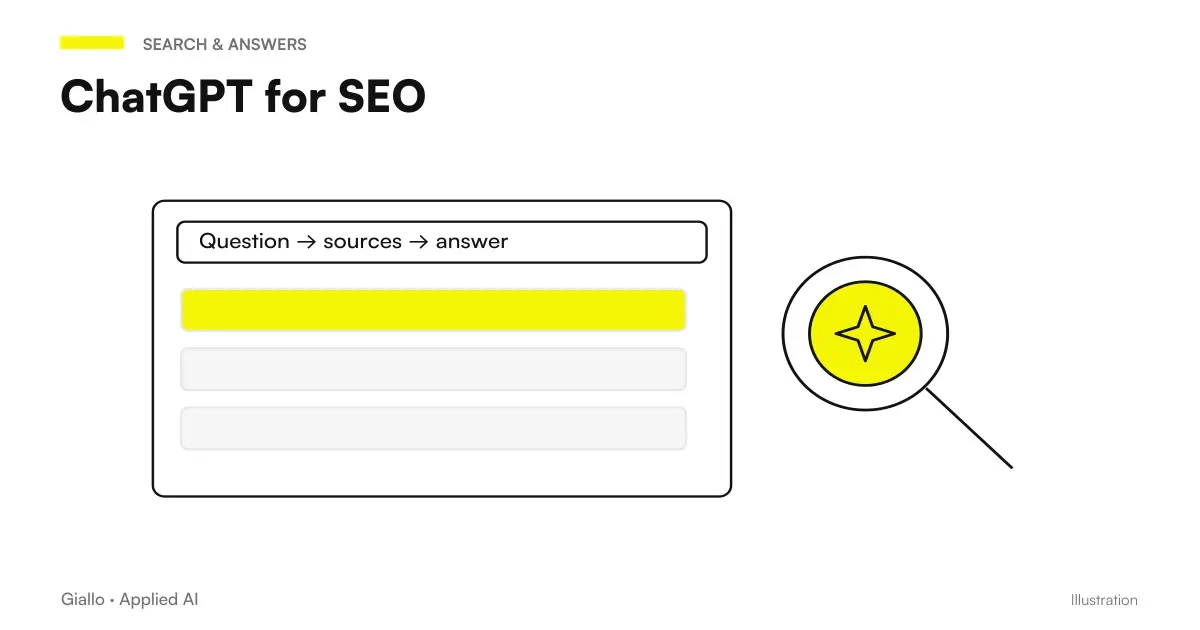
Use ChatGPT for SEO It means speeding up operational work: finding keyword ideas, organizing them into thematic clusters, preparing briefs, writing title and meta description drafts, generating FAQs and setting up the structure of an article. It is a tool that saves hours on repetitive tasks, but does not replace SEO tools with real data (search volumes, difficulties, placements) and does not guarantee the ranking in any way on Google.
The point to understand immediately is this: ChatGPT is an accelerator, not an oracle. It produces the most likely response based on language, not verified data. If you ask him "how much do you look for this keyword?", he will give you a plausible number but Invented. And if you publish your texts without review, you risk generic content that Google rewards little — or, in the worst cases, inaccurate. Knowing how to use it methodically is what separates a real advantage from a waste of time disguised as efficiency.
In this guide we see where ChatGPT really helps in SEO, where it ends its field of action, concrete prompts and workflows, mistakes to avoid and a hint to the GEO, the evolution that optimizes content to get quoted by AI.
In summary
- ChatGPT for SEO speed up keyword, cluster, brief, title, meta description, FAQ and structure ideas: operational work, not strategy.
- He doesn't know volumes and real difficulties: for numbers you need SEO tools with real data (Keyword Planner, Search Console, Semrush, Ahrefs).
- Does not guarantee the ranking: the positioning depends on quality, satisfied intent, authority and competition.
- Publishing raw texts risks generic or inaccurate content: must always be verified and enriched with real data and experience.
- The GEO (to be quoted by AI) is natural evolution: the same clear and reliable content works for Google and for generative engines.
What ChatGPT is for in SEO
ChatGPT works well on everything that is language generation and organization: produce many ideas in a short time, rewrite, summarize, structure. The SEO is full of tasks of this type, and that's where the gain is concrete.
The most solid cases are few and recurrent:
- Keyword expansion: starting from a theme, generate variants, synonyms, related questions and long-tails.
- Thematic Clustering: group a list of keywords by intent and topic, so as to plan pillar articles and clusters.
- Editorial briefs: turn a keyword into a playlist with angle, sections and questions to cover.
- Title and meta description: produce more variants that respect length and include the keyword.
- FAQ and snippets: extract frequently asked questions and write short and citationable answers.
- Rewriting and Synthesis: adapt the tone, shorten, translate, simplify a text already written.
The common thread is that ChatGPT handles the part repetitive and low risk of the production, while you keep the decision on what to publish and how to verify it. To better understand the basics of the tool, it is useful to start from What is ChatGPT and how to use it for create content.
What ChatGPT Can't Do for SEO
This is honesty that makes a difference. ChatGPT is a language model: it predicts the most likely text element, does not query up-to-date databases or know the real metrics of your market. Three limits must always be kept in mind.
1. Does not know the actual search volumes. If you ask how much you search for a keyword, it will respond with a likely but unverified number. It is one of the AI Hallucinations more insidious, because it looks like a data and instead it is a fabricated estimate. Real volumes come only from tools with access to data: Google Keyword Planner, Google Search Console, Semrush, Ahrefs.
2. It does not guarantee placement. No one can promise, and ChatGPT less than ever. Ranking depends on how well it satisfies the search intent, the quality and originality of the content, the authority of the domain and the competition. ChatGPT gets you to the draft first, not the top of the results.
3. It tends to produce generic content. Without precise instructions and without your own data, the output is median: correct but flat, similar to a thousand others. Google evaluates added value (experience, data, point of view), and raw texts rarely have it. To publish them as they are is to compete on the downside.
When to use ChatGPT and when to rely on data
Rely on ChatGPT
- Generate keyword ideas and related questions to expand.
- Group keywords already collected in thematic clusters.
- Write briefs, playlists and first drafts of text.
- Produce title and meta description variants.
- Rewrite, summarize, translate, adapt the tone.
Rely on real data
- Search volumes and seasonality: only from real tools.
- Keyword difficulty and competition analysis: you need an SEO tool.
- What your users are really looking for: Search Console.
- Deciding editorial priorities: data + strategy.
- Facts, numbers, regulations mentioned in the text: they must be verified.
The operating rule is simple: use ChatGPT for language, tools for numbers. The two combine. Typical flow: collect keywords and volumes with an SEO tool, then pass the list to ChatGPT for clustering and briefs. So you combine reliable data and production speed.
Table: SEO task, prompt and limit to know
For every SEO activity, here's how to set the prompt is —most importantly —the limit to keep in mind. This column is the most important: it tells you when NOT to trust the output.
| SEO Task | Prompt (what to ask) | Limit to know |
|---|---|---|
| Search keyword | "Genera 30 keywords and related questions on the X theme, for a Y audience in Italian" | Ideas yes, volumes no: invented estimates. Check with Keyword Planner/Semrush |
| Clustering | "Group these keywords by intent and argument, indicate pillar and cluster" | Good starting point, but review: it can bring together different intents |
| Editorial Brief | "Create a Keyword X Brief: Angle, Sections H2/H3, Questions to Cover" | He doesn't know the real SERP: check what's already in place |
| Title and meta | "Write 5 titles (max 60 characters) and 5 metas (max 155) with the X keyword" | Count the characters yourself: often exceed the limits |
| FAQ / People Also Ask | "Extract 6 Frequently Asked Questions on X with 2-3 Sentence Answers" | Real PAAs can be seen on Google, doesn't know them |
| Article Structure | "Propose an H2/H3 structure for an article on X, informational intent" | Generic logic: suited to real intent and competitors |
| Rewriting/Synthesis | "Rewrite this lighter text, professional tone, 200 words" | It Can Change the Sense: Always Read Again |
| Facts and data in the text | "Write a paragraph about X with industry data" | Invent Numbers: every data must be verified at the source |
Reading the table is just one: ChatGPT is reliable on language tasks and unreliable on anything that looks like a given. Keep this distinction always present and you will use the tool well.
How to Write SEO Prompts That Work
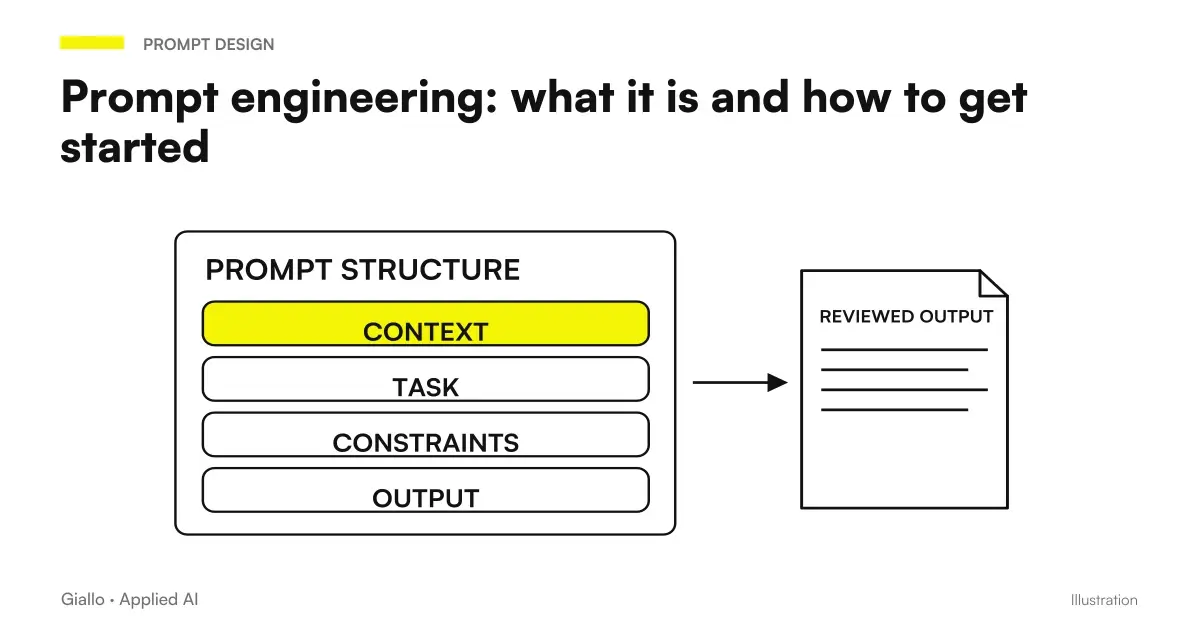
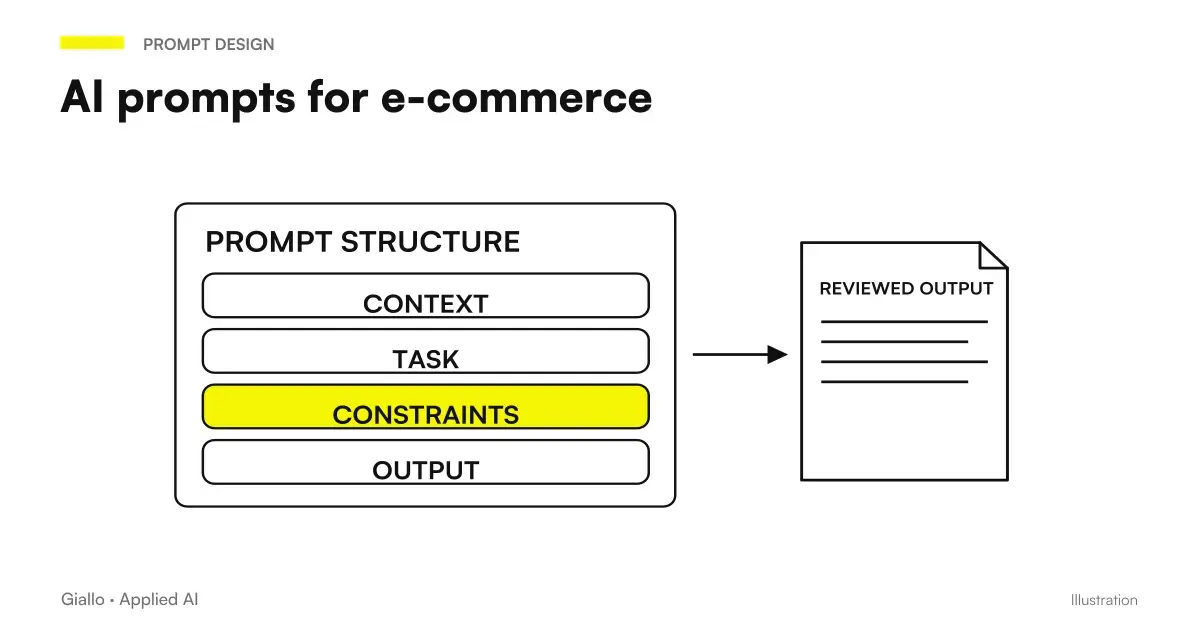
The quality of the output depends almost entirely on the quality of the prompt. A vague prompt produces a vague text. A good SEO prompt contains four elements.
- Context. Who you are, for whom you write, in what language and tone. "I am an SME that sells workshop equipment, technical public, professional Italian."
- Precise task. What exactly do you want: a brief, 5 title, a cluster, a FAQ. One task per prompt, not ten together.
- Constraints. Length, number of variants, keyword to include, output format (table, list, JSON).
- Example or reference. If you have a title you like or a competitor to imitate in style, paste it: the output aligns much better.
To go beyond improvised prompts, it is worth reading the guide to the prompt engineering: how to get started. The principles (describe role, goal, format and examples) apply identically to SEO. Also remember that ChatGPT is a form of Generative AI: produces plausible language, so the more context you give them, the less generic the output is.
Practical examples
Two realistic scenarios of Italian SMEs and professionals, to see the full flow.
1. Niche E-commerce — planning the blog. An online store of gardening products wants to grow organic traffic. The holder collects 60 keywords with real volumes from an SEO tool. Then paste them into ChatGPT asking to group them into clusters by intent and propose a pillar article with its linked clusters. From there it generates a brief for each piece. Result: a three-month editorial plan ready in half a day instead of a week. The volumes remain the real ones; ChatGPT only made the organization.
2. Professional study — title and FAQ. A consulting firm has 20 service pages with weak titles and no FAQs. For each page, the assistant generates 5 variants of title with the keyword and 5 meta descriptions, then 6 frequently asked questions with short answers. The professional chooses, corrects overshooting characters, and verifies that the responses are accurate for his or her industry (where legal accuracy matters). Time per page: a few minutes instead of half an hour. Human review remains, because on delicate issues an inaccuracy costs.
In both cases the model is worth: ChatGPT makes the first draft and organization, the person decides, verifies and publishes. It is the same scheme that works in all well-done AI automation.
GEO: evolution beyond classic SEO
There is a change going on that should be anticipated. More and more people don't Google and click: they ask directly to ChatGPT, Gemini or generative overviews, and read a synthetic answer with some cited source. Here comes the GEO (Generative Engine Optimization): optimize content not only to appear in blue results, but to be cited by AI responses.
The good news is that SEO and GEO overlap a lot. What makes a content that can be cited by an AI is also what makes it solid for Google: a direct response in the opening, net definitions, autonomous and verifiable sentences, clear structure with subtitles, precise FAQs, data and sources. Few specific tricks help:
What Makes Content "Quitable" by AI
Put the main response in the first two or three periods, before digressing. Use sentences that make sense on their own, without depending on the previous paragraph. Structure with subtitles that are real questions. Enter verifiable data and sources. Add a FAQ section with short answers. It avoids absolute unproven statements. They are the same rules as good SEO, applied with an extra eye to clarity and citation.
Paradoxically, ChatGPT can help you write GEO-friendly content (clear structure, direct answers, FAQ), but the same limit remains valid: you put the facts and verify them yourself. For those who want to see concrete applications and experiments on these issues, The Lab collects the projects we work on.
Mistakes to Avoid
- Trusting the invented volumes. If ChatGPT gives you a number of monthly searches, it's an unverified estimate. Don't build a strategy on it: use tools with real data.
- Publishing raw texts. Unreviewed output is generic and may contain errors. Check the facts, add data and experience, cut the filler. You put the added value.
- Title and destination that outflank. ChatGPT often ignores character limits. It always counts: title around 60 characters, meta within .155, otherwise Google will truncate them.
- Keyword stuffing. Asking "repeat the keyword 10 times" produces unnatural text that makes ranking worse. A well-used keyword is worth more than ten forced ones.
- Skipping the search intent. ChatGPT does not see the SERP: it can propose an informative article where the user searches for a product. Always check what is already positioned for that keyword.
How to apply it in the company
For an SME, integrating ChatGPT in SEO in a sensible way is a repeatable path, not a big project. The goal is to lighten production, not delegate decisions.
- Separates data and language. Collect keywords, volumes, and competition with real SEO tools. That's the foundation; ChatGPT comes next.
- Use ChatGPT to organize and draft. Clustering, brief, first drafts, title, FAQ. The repetitive and loud part.
- Build a prompt library. Save the prompts that work (with your context already inside) so the team reuses them, instead of improvising each time.
- Impose human review. No text goes online without a person verifying facts, intent and quality. It is the rule that protects against penalization.
- Measure and iterate. Positions, clicks, conversions before and after. If numbers improve, extend; if not, change approach.
When this becomes a recurring stream —keyword, brief, draft, revision, publication.it makes sense to structure it as a real process, not as a series of isolated tests with ChatGPT. It's exactly the transition from "I use AI every now and then" to "AI is within my editorial process," and you can design with AI agents and automations connected to your tools. If SEO is used to bring traffic to a site that converts, it is worth taking care of together: our creation of websites starts from contents and structure designed to be found.
Conclusion
ChatGPT for SEO is a powerful accelerator on language work —keyword ideas, clusters, brief, title, meta, FAQ, structure —but it is not a data tool and does not guarantee ranking. The real advantage comes when you pair it with tools with true data for numbers and keep human review on facts and quality. Publishing rough drafts is the quickest way to get generic content that Google rewards little; using it methodically is the way to produce more without losing quality. And looking ahead, the same clear, reliable content that works for SEO is the one that gets you quoted by AI with the GEO.
If you want to go from testing with ChatGPT to an AI system integrated into business processes, Giallo Studio designs custom-made agents and automations — and you can continue with ChatGPT to create content for the next step.
Giallo Studio guides: methodology and sources
How we apply it in the company
Related resources
 ChatGPT: what it is and how to use it
 ChatGPT to create content
 Prompt engineering: what it is and how to get started
 Generative AI: What It Is and Why It Matters
 AI Hallucinations: What They Are and How to Avoid Them
 Automation with Make: what it is and how it is used for SMEs
 Best AI for social media: tools for content and management
 AI e-commerce prompts: product descriptions, email and support
FAQ
Can ChatGPT do keyword research on its own?
Only partially. ChatGPT is great for generating keyword ideas, grouping them by theme and suggesting variants and related questions, but it doesn't know the actual search volumes or the difficulty of ranking. For numbers you need SEO tools with real data (Google Keyword Planner, Search Console, Semrush or Ahrefs).
Will ChatGPT help me rank on Google?
No: no tool guarantees rankings. ChatGPT helps you produce briefs, drafts, title tags and meta descriptions faster, but rankings depend on content quality, meeting search intent, site authority and competition. ChatGPT speeds up the work; it does not determine the outcome.
Can I publish ChatGPT texts as they are?
It is not recommended. Google does not penalise AI itself, but it does penalise content that is generic, inaccurate, or offers no added value. Unedited text tends to be repetitive and may contain errors (hallucinations). It must always be checked, enriched with real data and experience, and adapted to your intent.
What is the difference between SEO and GEO?
SEO optimises for traditional search engines (Google, Bing), so that content appears in blue-link results. GEO (Generative Engine Optimization) optimises for citations in AI answers such as those from ChatGPT, Gemini, or generative overviews. The two overlap considerably: clear, well-structured, reliable content works for both.
What prompts do I need to use ChatGPT for SEO?
The most useful describe the context (sector, audience, language), the precise task (cluster, brief, title, FAQ) and the constraints (length, tone, keyword to include). The more specific you are, the less generic the output is. A guide to fundamentals is prompt engineering: describing role, goal, format and examples.
Does ChatGPT replace an SEO consultant?
No. It replaces some of the repetitive operational work (ideas, drafts, structure), but not the strategy, the analysis of real data, the choices of priorities and the judgment on what to publish. The value of a professional is in deciding on what to aim for and in verifying the quality, not in writing the first draft.