
Superintelligence, memory and RAG: getting to know the company
Superintelligence, memory and context: what persistent sessions and business RAG demonstrate. Distinguish retrieved data, learning and capabilities.
Reading time: 12 min
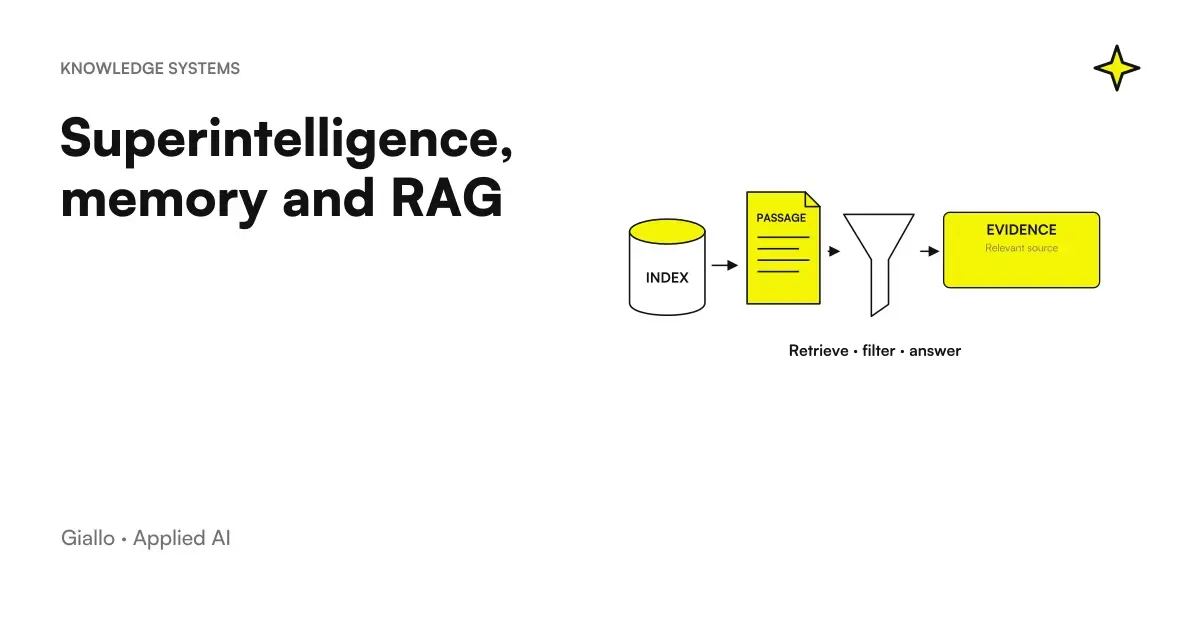
"Do you remember the price list I sent you?" seems like a simple question. In an AI system it can trigger very different operations: resume a conversation, read a saved note or search for a document in the archive. Memory and context may make an assistant more useful, but they do not demonstrate superintelligence or general learning.
The distinction concerns what has actually been improved. If the system responds with the right document, we've improved access to information. If it keeps the history, we have made a part of the task persistent. To talk about new abilities you need to verify something more: how he uses those materials, how he deals with different cases and how he recognizes what he doesn't know.
This article clarifies what it means to "know the company" and what conclusions we cannot draw from that sentence. The functioning of the document recovery is explained in the RAG Guide; here we focus on the difference between available information and demonstrated ability.
In summary
- Saving a conversation does not mean automatically updating the model's weights.
- The RAG retrieves information from external sources and makes it available to the response.
- A persistent session may contain more events than those presented to the model in a single step.
- Remembering a given wrong makes the error persistent, not the most competent system.
- Knowing the company requires appropriate sources, recognizable versions, and evidence on the use of documents.
Do memory, session, and context indicate the same thing?
Application memory is what the software stores for later use. It may include preferences, notes, summaries, files, or events. There is no single format: two products that talk about memory can save different information, with different storage times and revision possibilities.
The session is the story of an activity. It contains what was requested, the responses obtained and, when recorded, the actions performed. The full history can remain available to the application even when the model receives only one selection. So "the session still exists" and "the model is considering everything" are not equivalent statements.
Context is the information provided to the model for a given step. It can include instructions, previous messages, tool results, and documents. If a note is retained but is not recalled at the right time, it does not help the response. If it is called back without the correct date or reference, it can instead produce the wrong association.
In the Managed Agents description of April 2026, Anthropic separates session, agent cycle, and execution environment. The session is a persistent log of events; it does not coincide with the model or single context window. This is a documented example of architectural separation, not a test of general learning. Source: Scaling managed agents.
In order to understand the limits of the information presented to a model, the context window. There is no need to compare commercial capacities here. Even a broad context must contain the relevant data and allow it to be identified correctly; the available space, by itself, does not demonstrate understanding.
Why is retrieving a document not the same as learning a skill?
In the RAG a search selects external information and adds it to the model input. Anthropic also highlights that breaking documents can cause you to lose necessary references, preventing the right material from being recovered. This is about access and contextualization of sources; connecting an archive is not in itself an update of the model weights. Source: Contextual Retrieve.
The difference is seen by asking two questions. «What is the price shown in this price list?» requires finding and reading an information. "How should our trade policy change in a new market?" requires another combination of reasoning, data, and criteria. Success in the first question does not demonstrate the capacity needed for the second.
This does not mean that the system cannot adapt its behavior thanks to examples in context. It can produce different results when changing materials and instructions. The point is to describe the mechanism without jumping to conclusions: response adaptation, data retention and training are distinguishable phenomena. Learning, understood in a broad sense, must also be specified and verified.
When someone says "he learned our company", it's better to ask what happened. Have files been indexed? Has a preference been saved? Has a prompt been modified? Has a model been trained with a specific procedure? The answer allows you to understand what you update when the company changes and what tests to repeat.
The Guide to the fine-tuning AI It addresses a different form of intervention. Not even specific training automatically constitutes ASI testing. The level and breadth of capabilities must be assessed, as explained in the article on Artificial superintelligence.
| Mechanism | What Can Improve | What to Check | Deduction to Avoid |
|---|---|---|---|
| Session History | Continuity of activity | What events are filmed | All events are always in context |
| Persistent Note | Reusing an Information | Origin, modification and validity | Saved data has become true |
| Document search | Access to relevant sources | Document, version and permissions | The system knows the entire archive |
| Examples in context | Adaptation of response | Performance with and without examples | Permanent general capacity has been acquired |
| Specific training | Changing the model according to a procedure | Data, evaluations and regressions | The model has become superintelligent |
What does it mean to know the company when sources contradict each other?
An enterprise is not a single manual. There are official documents, informal messages, special agreements and replaced rules. A useful business memory must distinguish these categories. Keeping everything without a hierarchy can increase the number of information available and make it more difficult to identify the applicable one.
Think of a business condition noted in a chat and a procedure approved later. Both can be authentic, but relate to different periods or customers. If the system merges them into a uniform response, it loses just the difference necessary for the decision. The final text may seem consistent while the foundation is ambiguous.
A correct source can be used in the wrong case. It is not enough to check that the citation exists. You need to see whether it concerns the subject, period and situation being examined. A price list valid for resellers does not become valid for consumers because it contains the same product. A support procedure does not authorise a change to the contract.
This is a concrete reason to prefer responses that expose the relevant reference and signal conflicts. You don't need to turn every message into a technical report. It is necessary to give the person the material necessary to confirm the decision, especially when the request involves an economic or operational commitment.
The link with the AI Agents and Superintelligence is direct: improving memory can support a delegation, but does not automatically authorize new actions. Access to the data and permission to act on the data remain two distinct choices.
How can an assistant go wrong with a producer's price lists?
Hypothetical scenario, not client case: a furniture manufacturer from Pesaro keeps price lists, technical data sheets and sales conditions. The assistant is connected to these materials and answers questions from the sales office. A seller asks what finish to propose and what conditions to apply to a request received today.
The system quickly finds a document with the product name. The answer seems to show that he knows the company. But in the recovered document the finish belongs to a previous series, while the price concerns a different sales channel. The problem is not necessarily a failure to read: it is the application of the reference in the wrong context.
The test changes if we ask to distinguish the versions and motivate the choice. An acceptable answer indicates which price list it uses, identifies the applicable conditions and reports the missing data when the channel is unclear. The demonstrated ability concerns that document task, with those sources. It does not automatically extend to furniture design or business strategy.
The scenario suggests a precise responsibility for those who manage the archive: to make recognizable versions and scopes. A withdrawn document may remain useful in explaining a historical order, but it should not be treated as a current proposal. Deleting any old source is not always necessary; distinguishing historical use and current use is.
An interesting test uses the same question before and after a price list change. If the result does not change, we need to understand if the update entered the search and then the context. Attributing the problem to a "too small memory" without reconstructing these steps risks intervening on the wrong component.
What happens with the technical interventions stored in an archive?
According to hypothetical scenario: a Parma maintenance consortium records interventions, technical notes and manufacturer instructions. An assistant searches for similar precedents to help prepare for the next survey. The continuity of the information can prevent a new team from starting again without knowing the historian.
The most similar precedent, however, describes a machine with a different configuration. The technician had noted a valid solution for that case, not a general rule. If the system turns the note into a universal instruction, memory has retained the information but altered its operational meaning.
A useful answer separates the historian from the prescription: "in the previous one this was done; it must be verified if configuration and manual coincide". The assistant contributes to the preparation. The technical suitability of the intervention must follow the appropriate verification process, without inferring from the wealth of the archive a superior competence in each situation.
Here, too, the decisive test includes a difference that counts, not just a lexical similarity. If two machines have close names but incompatible procedures, the system must spell out the limit. The interesting result is no longer remembering episodes: it is using each episode while maintaining the boundaries of its validity.
The verification of AI Hallucinations remains important. However, an answer can be wrong even when no sentence is invented: just combine true facts belonging to different cases. It is an application error that a simple citation search might not detect.
How to check if memory really helps the task?
The test can compare the same type of request with and without a relevant source. Let's first define the result: response, document to be recalled, limit to be reported and information that should not be used. Thus we can observe whether access improves a specific behavior, without attributing to the system a general transformation.
We also need an unanswered case in the documents. An assistant who knows well the boundaries of the sources should be able to make this evident. If it attempts to complete each answer with a hypothesis, the archive can create a false feeling of completeness. ‘Not found in available sources’ is different from ‘doesn't exist'.
A third check concerns outdated information. We present two sources with explicit references and observe if the system recognizes which one applies to the request. Then we reverse a relevant element of the case. If he continues to choose the same source by habit, the good previous result was not enough to prove the required ability.
Open the three folder test: current, historical, out of perimeter
Prepare a request and three small groups of documents. Put the applicable source in the first, an authentic but outdated precedent in the second, and material the user must not use in the third. Define the result before starting the test.
Observe which source enters the answer and how it is presented. The historical precedent may be useful if indicated as such. Out of perimeter material must be excluded from the access system, without entrusting only the model with the task of ignoring it.
The proof makes a part of the information architecture visible. Overcoming does not demonstrate omniscience, new general abilities or absence of other errors.
These controls belong to the evaluation of one's assistant. The broader problem of supervising very capable systems is dealt with in superintelligence, alignment and control. Memory makes multiple items available; quality of control depends on how those items are selected and verified.
What mistakes confuse memory and intelligence?
To regard memory as a proof of truth. A wrong preference, a provisional interpretation or an old exception can be saved. Persistence changes the duration of information, not its correctness. There must be a way to recognize its origin and correct it.
To assume that every document is always read. A linked archive and a document actually used do not coincide. When an answer surprises, we reconstruct what sources have been recovered and made available, before discussing generically the capabilities of the model.
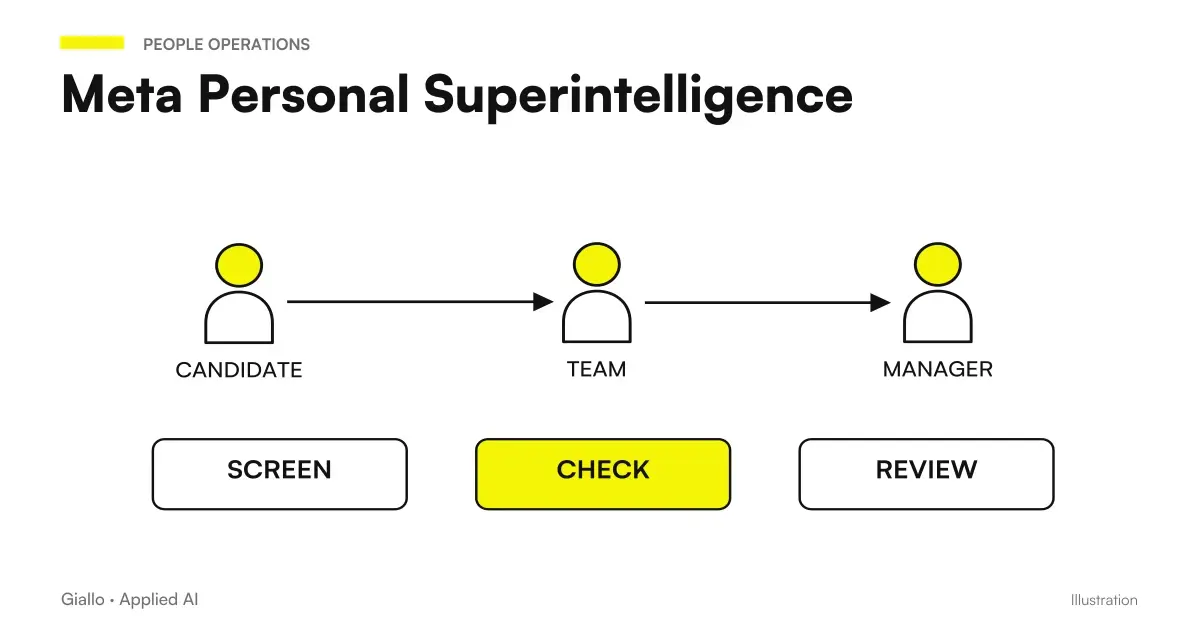
Confusing personalization and general learning. Recalling the preferred tone or name of a department can improve the experience. It does not demonstrate transfer of skills to new problems. The same applies to promises of Meta Personal Superintelligence: the commercial meaning must be compared with the documented functions.
Making invisible updates and conflicts. A memory that grows without distinguishing sources and validity may become less useful. The revision is not to rearrange the entire archive for aesthetics, but to keep the information that determines the response recognizable.
From what sources to start a business assistant?
The initial choice may be limited to one task: answering on the conditions of an offer, preparing a survey or reconstructing the state of a practice. For that task we identify the necessary sources, who updates them and what differences change their applicability. A small and understandable archive can be a better starting point than an indiscriminate collection.
It is also necessary to clarify what the product preserves and how it is recalled. Dots Memory and Privacy addresses a specific product; general questions remain origin, persistence, access, and possibility of correction. They should not be given for solving just because the interface says "active memory".
The useful step is to map information and result, then try the behavior on important differences. With the AI consulting of Giallo we can define which sources the first assistant needs and how to verify that he uses them in the right case.
Giallo Studio guides: methodology and sources
How we apply it in the company
Related resources
FAQ
Does memory make an AI assistant superintelligent?
Keeping information can make an assistant more useful, but it doesn't demonstrate superintelligence. You need to check how it uses sources and what capabilities it can transfer to different problems.
Does saving a conversation mean training the model?
Not necessarily: a conversation can remain in the application's log without updating the model's weights. To understand what changes, distinguish persistence, context and the training procedure.
What is the difference between session and context?
A session retains the activity's history according to the product's architecture. Context is the information presented to the model at a particular step and may contain only a selection of that history.
Does the RAG allow you to know all the company documents?
The RAG retrieves information and makes it available to the response, but does not guarantee to find every relevant source. Versions, scope, permissions and loss of references may affect the result.
Does a correct citation also make the answer correct?
An authentic source can be applied to the wrong case. It is necessary to check whether it concerns the subject, the period and the conditions of the request, as well as to verify its existence.
How do you evaluate a useful business memory?
Use requests with an applicable source, a historical document and a case with no answer. Check source selection, statements of limitations and the ability to correct retained information.