
EmbeddingGemma 2: Local AI search in business documents
EmbeddingGemma 2 for searching business documents and images: how it works, testing on real hardware, permissions and local search limitations.
Reading time: 11 min
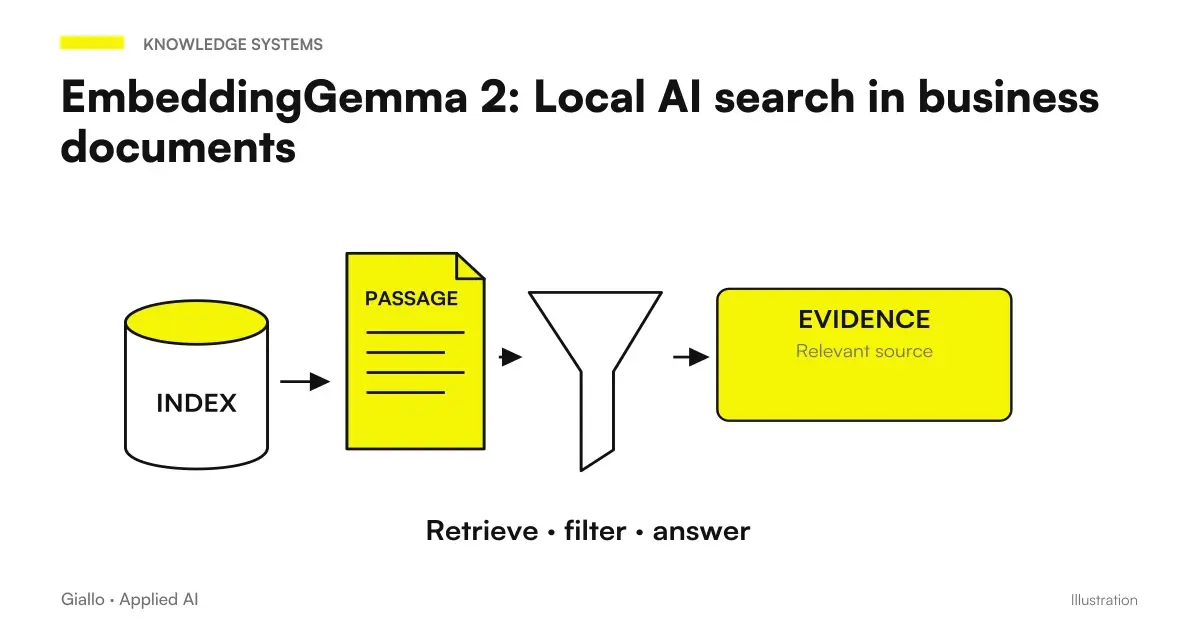
EmbeddingGemma 2 is a multimodal embedding model: it transforms different content into numerical representations that allow you to search for them by meaning. For a company it is mainly interested as a component of an internal research, even local, on documents and materials that do not end in the text. It is not a ready-to-connect chat to corporate folders.
Google presented it on October 6, 2026. The ad describes a shared space for text, code, images, audio and video; the possibility of local execution should be assessed on the actual configuration. The novelty concerns the model, while document management, permissions and interface remain parts of the project. Official Google announcement.
In summary
- EmbeddingGemma 2 represents content for search: it does not generate conversational responses alone.
- Local search requires an application, index, and source update process.
- Multimodality must be tested on the company's materials, including unreadable images and documents.
- Permissions must also be verified in the index and returned results.
- The decision depends on the quality of the answers found and the hardware available.
What does an embedding find that search for words loses?
Traditional search works well when the seeker knows the name of the document or the terminology used by the author. It becomes less immediate when the customer talks about "piece locking" and the manual describes an "actuator stop". An embedding looks for meaningful relationships between demand and indexed materials. It does not guarantee that the result is correct: it makes possible a comparison different from the mere presence of the same words.
EmbeddingGemma 2 extends this principle beyond text documents. Google describes representations that can relate different modes in the same space. Declared architecture includes 740 million total parameters and vectors of 768 reducible dimensions, with Apache 2.0 license. These are features of the model, not a promise on memory consumption of the entire application. Official Model Card.
For those who have to choose, the useful question is concrete: do materials that are not found today contain information that the model can best represent? An orderly archive of simple tabs could already work with a more essential search. Instead, a set of illustrated instructions deserves a comparison on real questions. The Guide to RAG clarifies the next step: retrieve sources and, if necessary, use them to build a verifiable response.
What does it take to build a local document search?
The model is only one of the elements. You have to collect the authorized files, figure out which versions are valid, extract or prepare the contents, calculate the representations and store them in an index. When a question arrives, the application must transform it, look for relevant materials, and show understandable references to a person. If a generated response is expected, a separate language model also comes into play.
This path does not force you to build a full assistant immediately. A first interface can return the title of the document, the relevant point and the link to the source. It is often easier to understand why a search fails when the result is directly visible, without a fluid response hiding its weaknesses. The choice of user experience must follow the work to be done, not the desire to add a chat.
Another essential element is updating. An index built on a proper archive can become unreliable if outdated procedures remain or if new versions are not processed. It is necessary to establish who publishes a document, how it is replaced and what happens to the eliminated materials. It is the organizational work that underlies a knowledge base company, regardless of the model chosen.
Does Local really mean that data doesn't come out of the company?
Local execution describes where a calculation takes place. It does not automatically describe the entire data path. An application can compute embedding on the computer and then send questions, logs or answers to an external service. It can synchronize the index, use a remote monitoring system, or store attachments in a shared folder. The verification must then follow the content from the origin until the final display.
It is best to draw this path before choosing the hardware: where the files arrive, who can read them, where the embeddings are produced, how the index is stored and what information ends up in the logs. For each step, the responsible person and the necessary access must be indicated. The privacy in the business use of AI It also covers these components, not just the model supplier.
The same attention is used for internal permits. If an employee cannot open a confidential offer, he should not read an excerpt from it through research. Storing a local copy does not solve this problem. You must link the user's identity to the permissions of the sources and verify that a change in permissions is also transposed by the index. A semantically relevant result can still be a result that that person is not allowed to see.
When to choose the local and when to evaluate other roads?
| Project Need | Possible orientation | Decisive verification |
|---|---|---|
| Searching a location with limited connectivity | Local processing to experiment with | Material availability and networkless behaviour |
| Archive shared with variable permissions | Internal service with identity management | Update permissions on each result |
| PDF with important figures and tables | Multimodal recovery to compare | Quality on questions that depend on figures |
| Few well-classified text documents | Easier to compare search | Additional benefit over existing research |
| Application for different devices | Test on representative hardware | Memory, Expectations, Compatibility, and Maintenance |
These options are not interchangeable products. The new work on Perplexity multimodal embedding for PDF, for example, offers another point of comparison on the recovery of pages and images. You need the same test archive, the same questions, and the same criteria to choose. Comparing only the model data sheet leaves out the company's problem.
When important information lives in SharePoint columns, the limit may not be the embedding model. The approach illustrated in PoC Foundry IQ with Metadata shows why status, department, and classification must enter recovery. A well-represented image does not replace a structured field that says if the document is still valid.
What evidence to take before investing in integration?
I would start with a collection of questions that staff should be able to answer by consulting the archive. Questions must include synonyms, terms used by customers, incomplete requests, and cases where the answer does not exist. For each question the correct source, acceptable documents and those to be excluded are noted. This collection becomes a shared reference between those who know the work and those who build the research.
The comparison must separately observe recovery and response. First it checks whether the right document appears in the results; then it evaluates the generated text, if any. If the source is not retrieved, improving the chat prompt can mask the problem without solving it. If the source is found but misinterpreted, the work is about the next step instead.
Google documents local quantized execution and results related to specific test conditions. Benchmark on Pixel 11 Pro doesn't prove performance on company's computer: the assessment of the expected configuration must be repeated. Model, precision and application must be described together with the result, without automatically transferring the measures of the supplier. Announcement and configurations reported by Google.
Does the evidence return plausible documents, but not the right ones?
Check the source first: has the correct document been acquired, is it readable and belongs to the valid version? Then it verifies the question and the subdivision of the contents. Only then does he compare another model. It also preserves the failed examples: they serve to understand if the improvement really concerns the work of the company.
A workshop with illustrated manuals: hypothetical scenario
Let's imagine a workshop that assists industrial machinery and preserves manuals, photographs and intervention notes. The technician searches for a procedure using the informal name of a component. Today he must know the folder and open several documents. The goal of the test would be to find the relevant manual and the correct passage, keeping visible model of the machinery and version of the documentation.
In this hypothetical scenario, multimodality is of interest because some information is in the figures, but it is not assumed that each photograph can be interpreted correctly. Requests are prepared that depend on the text and others that require a figure. It is observed where the system finds the source and where it instead proposes a document of a similar machine. Visual similarity is only useful if it does not erase operational differences.
The search should stop when sufficient identifiers are missing. The technician may receive a request for clarification instead of a procedure presented as certain. The outcome of the project would not be "we have installed a model", but "we can find out authorized instructions and verify them on the correct machine". Operational decisions would remain linked to the manual and the responsibility of the person.
A technical study with specifications: hypothetical scenario
Let us now consider a technical study that prepares offers and looks for requirements between specifications, tables and reports. Here the question is not about the operation of a machine, but the recovery of relevant precedents. A professional could look for requests similar to those of a race, without being able to share confidential materials with external collaborators.
The hypothetical evidence would distinguish the common archive from the confidential files. Each result should report project, document date, and link to the authorized version. Tables could be evaluated as multimodal content, while data defining accessibility and file status would remain explicit application information. It would not rely on the model to decide who can open a project.
A concrete risk would be to recover a similar clause but not applicable to the new assignment. For this reason the interface should favor comparison and reading of the source, avoiding presenting the previous as a definitive answer. Those who want to explore this type of work can also start from the guide to business document analysis with AI: Relevant recovery comes before professional interpretation.
How to manage documents that change after the test?
A prototype often uses a photograph of the archive. On the other hand, daily research must live with documents added, replaced and withdrawn. For this reason it is advisable to define an authoritative source for each family of materials. If the same manual appears in a workbook and an approved archive, the application must know which version to show. The semantic similarity does not contain this organizational information on its own.
The update procedure should also include acquisition errors. A file that is not read or content that is not processed must not disappear silently. Whoever looks after the archive should be able to see the excluded materials and decide whether to correct them, replace them or leave them out. Otherwise, a missing answer could be attributed to the model while the document never entered the index.
Then we need a rule for removal. When a material no longer needs to be available, one must intervene on the source and copy used by the research. The same applies to a person who changes roles or loses access to a file. The check should be tried with different users: seeing the correct source with the owner of the archive does not prove that the separation works for everyone else.
Finally, the initial assessment should be retained as a reference when changing the system. A new version of the model, a different subdivision method, or an application update can modify the results. Repeating the already agreed questions allows you to understand whether the change helps, introduces regressions, or simply moves errors. The company manager should be able to read this comparison without having to interpret alone vectors and parameters: source found, source missed, result not authorized and request to be clarified are categories understandable and useful to the decision.
The mistakes that make the project fragile
The first mistake is to treat the open model as a cost-free service. Weight availability does not include archive preparation, hardware, upgrades, and support. The official page of the model on Hugging Face allows to verify distribution and license; the estimate of the application must also describe everything that surrounds the model.
The second is to index the entire shared folder before understanding its content and permissions. Duplicate materials, drafts, and outdated procedures can produce convincing but inappropriate results. The third is to evaluate only easy questions, written in the same words as the document. It is precisely on ambiguous requests, missing sources and different permits that the quality that is useful for daily work emerges.
Finally, local does not mean a single architecture. An assistant for developers, as in the case of Copilot CLI with local models via Ollama, solves a different task than a business document search. The useful link is the need to verify dependencies and data path, not the idea of replacing one component with another without redesigning the system.
In order to decide on EmbeddingGemma 2 you need an authorized archive, an observable comparison and a source manager. If these elements are available, we can design a Custom Document Research that makes explicit recovered documents, permits and acceptance criteria before extending it to the rest of the company.
Giallo Studio guides: methodology and sources
How we apply it in the company
Related resources
 RAG: what it is and why it improves AI responses
 AI for business knowledge bases: find the information you need
 AI for business document analysis: a practical guide
 AI and corporate privacy: what happens to your data in AI tools
 Perplexity opens multimodal embeddings: search inside PDF pages
 Foundry IQ and SharePoint: why metadata changes knowledge base responses
 Copilot CLI finds local Ollama models: offline mode requirements and limits
 Is Kimi AI free? Prices and plans to choose
FAQ
Is EmbeddingGemma 2 an AI chat?
No. It is an embedding model that represents content to allow search for meaning. A conversational assistant also requires other components, including a model that generates the answer.
Can EmbeddingGemma 2 work locally?
Google documents quantized local execution configurations. The feasibility of the application must be verified on the intended hardware, considering model, index and other components.
What content does EmbeddingGemma 2 represent?
Google describes a shared space for text, code, images, audio and video. The quality useful for research must be tested on the materials and questions of the company.
Does local search automatically make data private?
No. Synchronization, logs, external services, identities and permissions must also be checked. The place where embeddings are calculated does not describe the entire data path.
Does the open model eliminate the cost of the project?
No. Source preparation, hardware, application, index update and maintenance remain. Model distribution does not amount to a complete document service.
How do you decide whether to adopt EmbeddingGemma 2?
Compare questions and expected sources in an authorised repository, checking retrieval, permissions and behaviour on the actual hardware. The trial must include missing sources, outdated versions and ambiguous requests.