
AI embeddings explained simply
AI embeddings explained simply: numerical representations of meaning, how they work, real examples and business uses.
Reading time: 10 min
The AI embedding I am the Numerical representation of meaning of a content: a word, phrase, document or even an image are transformed into a list of numbers — a vector — constructed so that contents with similar meaning have numbers close to each other. It's basically how an AI stops seeing "words" and starts seeing "positions on a map of meaning".
The idea to be fixed immediately is this: If two texts talk about the same thing, their embeddings are close; if they talk about different things, they are far away. For this reason the software can understand that "expenses refund" and "expenses note to be liquidated" are related, even if they do not share any words. Embeddings are the building block that makes searching for meaning possible, systems that respond to your documents, and many automatic suggestions.
In this guide we see what embedding really is, how the "meaning map" works, what they serve in the company and how they connect to vector database and RAG Systems in a precise logical chain.
In summary
- A embedding is the numerical representation (a vector) of the meaning of a text, image or other content.
- The key principle is the Semantic proximity: contents with similar meaning end up close on a "map" made of numbers.
- Thanks to embedding the AI can look for meaning, not for exact word: find the right document even with different synonyms or phrases.
- The embeddings are the given; the vector database is the warehouse that keeps and seeks them, and the RAG is the stream that uses them to get an AI to respond to your documents.
- They do not "understand" as a person: they capture statistical regularities and must be verified on industry jargon, ambiguous terms and underrepresented languages.
What are embeddings, with an analogy
Imagine a great map. There are no cities on this map, but meanings. Every word, phrase, or document occupies a precise point. Things that want to say something like this are close; disconnected ones are far away.
In this map, "dog", "cat" and "hamster" would be grouped in one area (pets), while "invoice", "quote" and "financial statements" would belong to a completely different neighbourhood (accounting documents). A embedding is simply the address of a content on this map, expressed in coordinates.
The difference with a geographic map is that here the coordinates are not two (latitude and longitude), but hundreds or thousands. Each number of the vector describes a nuance of meaning. There is no point in asking "what does the number 47 of the carrier mean": taken alone it does not mean anything. It is the set of numbers, and especially the distance between one vector and another, that brings the information.
This is the conceptual leap: AI does not compare the words letter by letter, it compares positions in the space of meaning. That's why it can connect "delayed shipping" and "the package hasn't arrived yet" without words in common.
How an embedding works, step by step
Embeddings are not handwritten: they are produced by a model trained on huge amounts of text. The underlying principle is the same as the Machine Learning in general — learn patterns from data instead of programming rules. Here's the flow.
- Input. Give the model a content: a word, a sentence, a paragraph, a product card, sometimes an image.
- Processing. The model, trained to recognize how content appears together in data, analyzes input and measures its meaning along many dimensions.
- Carrier. The result is a list of numbers (for example 384, 768 or 1536 values). That list is embedding: the address of the content on the meaning map.
- Comparison. To understand if two contents are related, we measure the distance between their vectors. Close = similar; far apart = different.
- Use. That distance powers the function you need: searching, grouping, recommending, document retrieval for an AI.
Why "closeness" matters and not equality
Traditional Software Searches exact matches: if you look for "invoice" find only the texts that contain the word "invoice". If the document says "sales tax document," you don't find it. It is the classic keyword search, fragile in front of synonyms.
With embedding meter changes: don't look for the word, look for the meaning closer. The system turns your question into a vector and returns the contents whose vectors are closest. It is what is called Semantic Research, and is why an AI assistant on business documents finds the answer even when the user asks it "in his own words".
How big are these vectors
The "size" of an embedding is how many numbers it contains. More sizes allow you to capture more shades, but they take up more space and cost more to compare. For most business uses you work with vectors from a few hundred to a couple thousand values, and the choice of model makes it the tool or the consultant, not the end user.
What embedding is for in the company
Here the talk becomes concrete. Embeddings are not an end, they are the gear that makes some very useful things work. The most solid cases for an SME are few and recurring.
- Smart internal search: find the right document, procedure or email looking for meaning, not for exact word.
- Corporate Document Responses: feeding a system RAG that recovers relevant steps and has an AI respond to your content, reducing inventions.
- Automatic grouping: cluster support tickets, reviews, or similar requests to understand recurring themes without reading them one by one.
- Tips and Correlations: similar products in an e-commerce, related articles, "customers like this" based on the proximity of carriers.
- Deduplication and match: to recognize that two personal data, two suppliers or two requests are actually the same thing written differently.
The common thread is always the same: embeddings translate "meaning" into "distance", and on distance you can build research, order and suggestions. If you want a wider overview of where to start, the guide AI for businesses lines up processes, costs and priorities.
A recent example is EmbeddingGemma 2, designed for multimodal representations. The embedding model prepares content for research: it does not do the work of a chatbot alone or automatically manage access to documents.
The Logic Chain: Embedding → vector database → RAG
This is the point that puts everything in order. Embeddings do not work alone: they are part of a chain with two precise companions.
| Piece | What is it | Role in the chain |
|---|---|---|
| Embedding | The numerical representation of the meaning of a content | Translate texts and documents into comparable vectors |
| Vector database | A specialized archive for storing and searching vectors | Find in milliseconds the vectors closest to a question, even among millions |
| RAG | The stream that retrieves relevant content and gives it to a model | Use the results to get a response LLM on your real data |
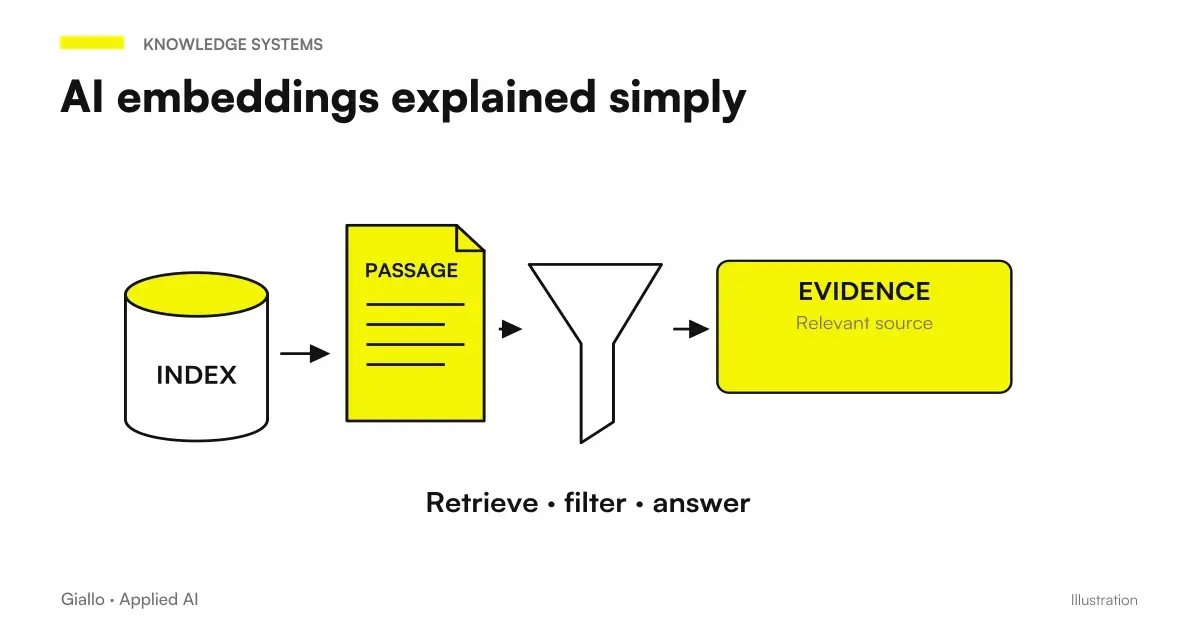
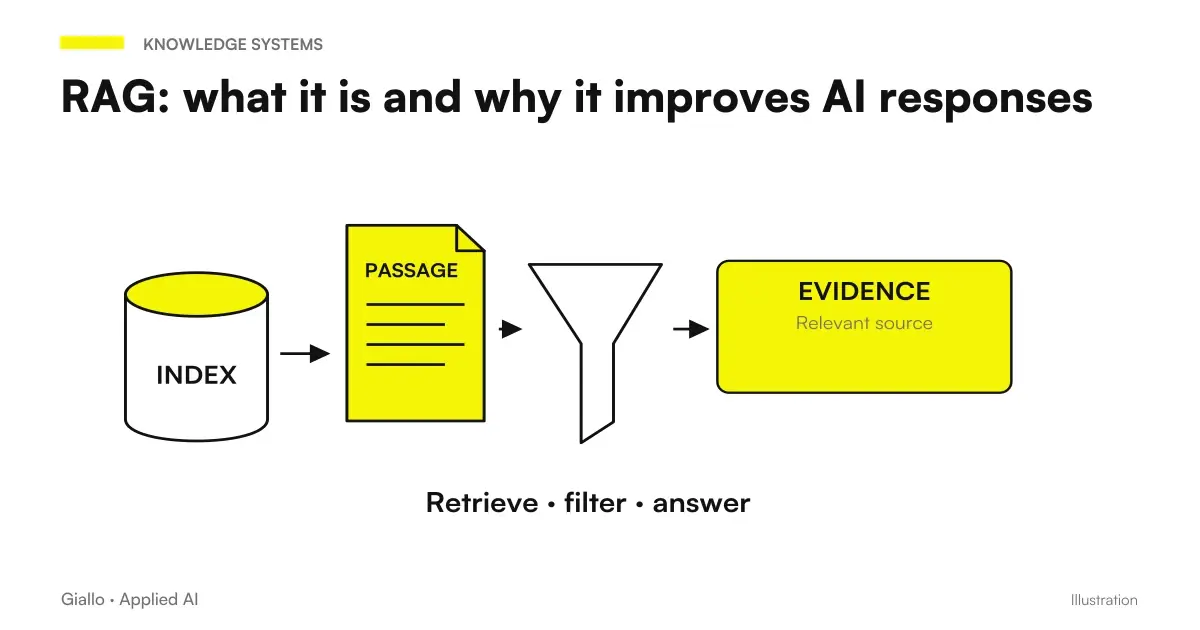
Read as Sequence: Take your documents and turn them into embedding; keep them in a vector database; when a question arrives, you turn it into embedding, the database returns you the closest steps, and a RAG System It passes them to the model that writes the answer based on them. Embeddings are the first ring: without them, the other two have nothing to look for.
Example of the chain with fake numbers
You have 5,000 pages of manuals and procedures. Break them into 30,000 paragraphs and generate an embedding for each: now you have 30,000 vectors. Load them into the vector database. An employee asks "how do I handle a return over 14 days?". The question becomes a vector, the database returns the closest 5 paragraphs, the RAG system passes them to the model that composes the answer citing the right procedures. Total time: a fraction of a second.
Practical examples
Three realistic scenarios of Italian SMEs and professionals, to make the idea tangible.
1. Professional study — research in circulars. A study accumulates years of circulars, opinions and internal notes. With keyword research, finding the right opinion depends on remembering the exact words used then. Generating the embedding of each document and putting them in a vector database, a contributor can ask for "tax treatment of customer giveaways" and get the relevant documents even if those used "representation expenses in kind". Research follows meaning, not formula.
2. E-commerce — related products that make sense. A store with 1,200 items wants to suggest related products. Instead of handwritten rules category by category, it calculates the embedding of product cards: articles with semantically close descriptions are also close as vectors. Result: Consistent suggestions ("trail shoes" close to "technical socks") without holding thousands of associations by hand.
3. Customer support — understand ticket themes. A team receives hundreds of requests a month and wants to know what customers really complain about. By turning tickets into embedding and grouping nearby carriers, recurring themes (shipping delays, size issues, returns concerns) emerge without someone reading and hand-classifying each message. The team intervenes on the most frequent causes.
In all three cases the embeddings do not "decide": they prepare the ground (seek, group, link) and the person uses the result to act better.
When embedding helps and when not
When they agree
- You have a lot of documents and keyword searching is no longer enough.
- Users search "in their own words", with synonyms and different phrases.
- You want to group or link similar content automatically.
- You are building an assistant who has to answer on your documents (RAG).
When they are excessive
- The documents are few and a keyword search is enough and advanced.
- You need an exact match (product code, VAT number, order number).
- The content is very technical and ambiguous and you have no way to verify the results.
- You are adding complexity without a measurable problem to solve.
Practice rule: embeddings shine on the approximate meaning ("find me something like this"), not about exact matches ("find me exactly this code"). For seconds, a traditional database remains more suitable. Often the best solution is to combine the two.
Mistakes to Avoid
- Confusing embedding and database. Embedding is the number; the vector database is the warehouse that looks for it. They are two different things in the same chain: calling them the same way leads to wrong technical choices.
- Mixing different models. Vectors produced by different models are not comparable. If you generate half of the documents with one model and half with another, the distances become senseless. One model for the whole archive.
- Breaking the papers wrong. If you turn too long or half-cut pieces into embedding, you recover confusing content. The quality of the chunking (as you divide the texts) weighs as much as the model.
- Trusting 100% proximity. "Near" does not mean "correct". On ambiguous terms or sector jargon the nearest vector may not be the right answer: verification is needed, especially in a RAG stream.
- Putting sensitive data without criterion. Generating embedding of documents with personal data via external services can have GDPR implications. Rules on what you can send and where carriers are stored should be defined.
How to apply it in the company
Introducing embedding in a sensible way is a step-by-step path, not a major technical project.
- Start with the problem, not the technology. "Internal search finds nothing" or "we waste time looking in documents" is a good place to start. "We want embeddings" is not.
- Collect and prepare the contents. Documents, cards, tickets: must be collected and broken into sensible pieces before turning them into vectors.
- Choose model and warehouse. An embedding model and a vector database suitable for volume. Often, managed services are sufficient, not tailor-made infrastructure.
- Connect the whole thing to a useful stream. Internal search, grouping or a RAG assistant. Embedding alone is not seen: you see the result it enables.
- Measure and correct. Are the results relevant? Do users find what they are looking for? You fix the chunking, pattern or instructions and iterate.
This kind of work — understanding where semantic search is actually worthwhile and building the embedding → database → RAG chain without waste — is precisely the domain of a good AI Consulting and of projects of automation of business processes. For more structured applications, the same bricks feed AI agents that search, retrieve and act on internal data.
Conclusion
The AI embedding are the translation of meaning into numbers: a map where related content is close and disconnected content is far away. It's a simple idea with powerful consequences, because it turns the question "these two texts talk about the same thing?" in a simple distance measure. They do nothing on their own: they become useful when they enter the chain with the vector database, who preserves them and seeks them, and with the RAG, which uses them to get a model to answer about your actual documents. For an SME the value lies not in the mathematics of vectors, but in choosing the use case —internal research, grouping, document assistant — and measuring the result.
Do you want to understand what processes in your company can be automated with AI? Giallo Studio can help you turn the problem into a real workflow — or take a look at the experiments of The Lab.
Giallo Studio guides: methodology and sources
How we apply it in the company
Related resources
 Vector databases: what they are and what they do
 RAG: what it is and why it improves AI responses
 LLM: What Language Models Are
 Machine learning: what it is and how it works
 AI for businesses: a complete guide to getting started
 AI data entry automation: eliminate manual copying
 Best AIs to summarize PDFs and documents
 How to choose an AI provider
FAQ
What are AI embeddings in simple terms?
Embeddings are the numerical representation of the meaning of a text, image or other content. AI turns a word or phrase into a list of numbers (a vector) constructed so that contents with similar meaning have close numbers. This is how software can understand that 'invoice' and 'accounting document' speak of the same thing while being different words.
What are embeddings used for in a business?
They are mainly used to search by meaning rather than exact words. With embeddings, you can build an internal search that finds the right document even when the user uses synonyms, automatically group similar tickets or reviews, suggest related products, and power a RAG system that lets an AI answer using your company documents.
What is the difference between embedding and vector database?
Embedding is the number (the vector) that represents the meaning of a piece of content. The vector database is the specialized warehouse that stores millions of these vectors and finds in a few milliseconds those closest to a question. Embeddings are the data; the vector database is the engine that searches for them.
Do embeddings really understand the meaning?
Not in the human sense. Embeddings capture statistical regularities of how words appear together in training data, and this reproduces very well the proximity of meaning for most practical cases. But they can be wrong on ambiguous terms, industry-specific jargon or underrepresented languages.
Do you need technical skills to use embedding?
To use them thoroughly you need a minimum of technical work, but you almost never have to build them from scratch. Most SMEs use them through ready-made tools or services that generate them via API, linking them to existing documents, CRM or e-commerce. The value lies in choosing the right use case, not in vector mathematics.
Are embeddings the same thing as tokens?
No, even if they are connected. Tokens are the pieces in which a model breaks the text to process it; embeddings are the numbers that represent the meaning of those pieces (or of entire texts). In short: the token is the unit, embedding is the meaning of that unit translated into coordinates.