
LLM: What Language Models Are
Large language models (LLMs) explained simply: how they work, uses, limitations, real examples and how to apply them in business.
Reading time: 10 min
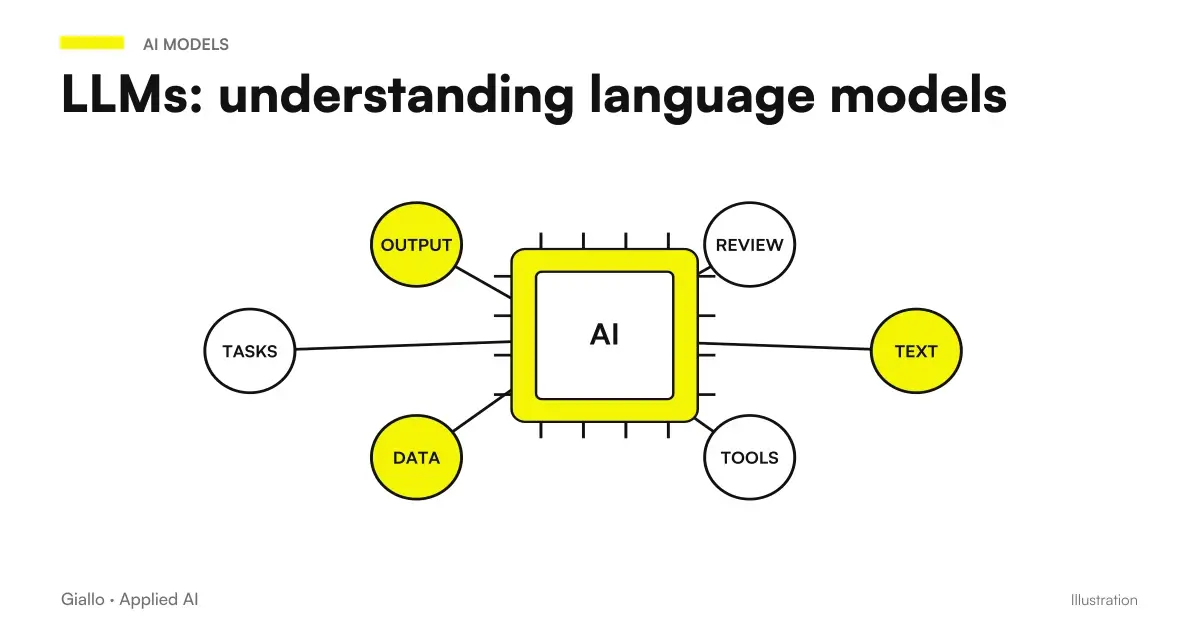
The LLM (large language model) are software trained on huge amounts of text to do an apparently simple thing: predict the next word more likely given a sequence of words. By repeating this prediction one piece at a time, an LLM writes consistent sentences, answers questions, summarizes documents, and generates code. ChatGPT, Claude and Gemini are the known faces of this technology.
The point to be fixed immediately is this: an LLM does not "know" and does not "understand" in the human sense. He does not consult a database of truth and does not reason like a person. Turn your text into numbers, calculate which words are most likely to follow and return them. It works so well that it looks like intelligence, but it remains a Statistical model of language: and it is precisely this nature that explains both its superpowers and its errors.
In this guide we see what language models really are, how they work step by step, what they are used for in the company, what their limits are and how to choose the right one without being guided by marketing.
In summary
- A LLM is a model trained on large amounts of text that generates language by predicting, one piece at a time, the next most likely word.
- LLMs are the heart of Generative AI textual: ChatGPT, Claude and Gemini are interfaces built over an LLM.
- They don't work with words but with words. Token (pieces of words) transformed into numbers: that's why they count and bill "token".
- They produce the most response likely, not the verified one: they can invent data with confidence (hallucinations) and must be checked on critical points.
- For an SME the value lies not in building a model, but in driving an existing LLM with clear instructions, context and their own documents.
What "large language model" means
The name itself explains almost everything. Language model (language model) is a software that assigns a probability to the sequences of words: given "coffee is too much...", it knows that "bitter" or "hot" are more likely continuations of "tractor". Language models have existed for decades; old ones were small and uncapable. Generating a response and choosing a controlled outcome require different evaluations: what JEV AI is deepens this second path.
The Word large (big) is the novelty of recent years. Modern models are "big" on two fronts: the huge amount of text on which they are trained (much of the web, books, code) and the number of parameters, that is, the internal knobs that the model regulates during learning, today in the order of billions. Over a certain scale, skills emerged that small models did not have: answering questions never seen, translating, writing code, following instructions in natural language.
LLMs are a branch of the Artificial Intelligence and, more precisely, a form of Generative AI specialized in the text. Understanding this placement helps not to confuse categories: AI is the umbrella, generative AI is the branch that creates content, LLM is the model that creates them in the form of language.
How LLMs Work, Step by Step
Behind the apparent magic is a repetitive and understandable mechanism. Let's see what really happens when you write a request and press enter.
- Tokenization. Your text is broken into Token: pieces of words or whole words. "Automation" can become two or three tokens. Each token is then translated into numbers, because the model only works with numbers.
- Context. The model considers all the tokens of the conversation up to that point (your question, system instructions, history) within the limit of its "context window".
- Forecast. Based on what he learned in training, he calculates the probability of each possible subsequent token and chooses one.
- Repeat. Adds the chosen token to the sequence and starts again: it predicts the next, then the next. One word at a time, until the answer is complete.
- Return. The tokens generated are translated into readable text and you find them on the screen, often as they are produced (the "writing live" effect).
Why It Matters to Understand Tokens
The fact that LLMs work on tokens is not a technical detail: it has practical consequences on costs and limits. bill to token (input and output), so long requests and bulky documents cost more. Also each model has a cap of tokens manageable at a time: past that, the model "forgets" the beginning of the conversation. That's why it's worth looking into what are AI tokens before putting an LLM into production on large amounts of text.
Training: where the LLM "learns"
An LLM is not born capable. He is trained in two typical phases. In the first (pre-training) he reads a huge amount of text and learns to predict the next word: here he absorbs grammar, facts, styles and patterns of reasoning. In the second it is finished with examples of good answers and with human feedback, to make it useful, safe and able to follow instructions. Hence a key point: the LLM only knows what was in the data up to its training date and knows nothing about your company, unless you provide it in context.
What LLMs are for
The best way to orient yourself is to group the uses by type of language task. Here are the most solid families, with a concrete business example.
| Task Type | What the LLM does | Example in an SME |
|---|---|---|
| Generation | Write new text from an instruction | First draft email, product description, post |
| Summary | Long Text Summaries | Summary of a contract or email thread |
| Extraction | Find and structure data within a text | Extract amount, deadline and supplier from an invoice |
| Classification | Assign a category to a text | Sort tickets by urgency or topic |
| Rewrite | Reformulate while keeping sense | Adjust the tone of a text, translate, correct |
| Questions and Answers | Responds on Provided Content | Responses based on your documents with RAG |
The common thread is that the LLM is very good at tasks text-based and repetitive, where speed and a first draft are needed, not the last word. It is no coincidence that the most successful projects combine two or three of these families: extracting data from a document, then generating a draft response, then classifying it by priority.
LLM, generative AI or chatbots: how they rank
They are terms that overlap and are often confused. The distinction is simple if you look at the level of abstraction.
Generative AI, LLM and Chatbots: Differences in Brief
Generative AI: the category of models that create new content (text, images, audio, code). It is the widest set.
LLM: the type of generative model specialized in language. It is the textual "engine".
Chatbot / assistant: the product you talk to. ChatGPT is an app that uses an LLM under the hood and adds interface, conversation memory, tools and security rules to it.
In other words: the chatbot is the car, the LLM is the engine, the generative AI is the category "generative motor vehicles".
This hierarchy is useful when choosing: when evaluating an instrument, always distinguish between the model (the raw capacities) and the product which is above it (interface, integrations, price). If you want a map of the models on the market, the guide to Main AI Models It compares them by family and use case.
Practical examples
Two realistic scenarios of Italian SMEs, to see an LLM working within a process, not as a gadget.
1. Professional study — customer responses based on internal documents. A study always receives the same questions (deadlines, documents to be carried, procedures). On its own, an LLM would respond generically and sometimes wrongly. Connected to study documents with an approach RAG, on the other hand, draws the answer from the real texts and cites the source. The operator checks delicate cases, the customer gets consistent responses without waiting. The value is not "we have a chatbot", but "the answers come from our documents, not from the fantasy of the model".
2. E-commerce — product cards from technical catalog. For a catalog of hundreds of articles, the LLM receives the actual data sheet (materials, measurements, compatibility) and obtains a sellable description, in the same tone for the whole site. The rule given to the model is clear: use only the data provided, do not invent features. The team reviews and publishes, instead of writing each text from scratch. Typical result: fewer copywriting hours and more uniform descriptions.
In both cases the LLM produces the first draft well set and the person keeps the final decision. It is the operating model that holds up over time.
When to use an LLM and when not
When an LLM is convenient
- The task is textual: write, summarize, classify, extract, translate.
- We need a quick first draft to finish, not an already perfect result.
- There's a human review on the points that matter.
- You can provide the right context: clear instructions and, if needed, your documents.
When to Avoid It
- You need exact calculations or deterministic operations: better a software, not an LLM.
- Every mistake has serious consequences and no one controls the output.
- The response requires confidential data that you do not want to send to an external service.
- You are looking for a verified "truth": the LLM gives the most likely version, not the certain one.
Practice rule: an LLM is a plausible language generator, not an oracle. Where absolute precision is needed (a total, a tax rule, a balance) the model must be bound to real sources or flanked by instruments that do the counting, not left to improvise.
Mistakes to Avoid
- Treating the answer as truth. An LLM produces plausible, unverified text: it can invent sources, dates, and numbers with a secure tone. On critical data, control is needed. AI hallucinations and how to avoid them.
- Giving vague instructions. "Write me something about the product" produces fuffa. The more precise the target, tone, constraints and format, the better the output: it's the sense of prompt engineering.
- Expecting me to know your company. The model only knows what was in the training data. For answers about your data you have to provide them, with instructions or with a linked document system.
- Sending sensitive data without criterion. Pasting personal data of customers into public tools can violate the GDPR. Rules on what you can share and with which service should be defined.
- Chasing the last model out. Changing LLM to each ad costs time and rarely shifts the result of the process. It matters more to set up instructions, data and human control well.
How to apply it in the company
Putting an LLM to work sensiblely is a short and repeatable path, not a big project.
- Start with the text process that costs the most time: email sorting, first drafts, summaries, repetitive replies.
- Measure the starting point: how many hours or how many mistakes today. Without a "before" there is no ROI.
- Use a ready-made LLM via app or API: for almost every SME there is no point in training one from scratch.
- Give it the right context: precise instructions and, where needed, your linked documents.
- Keep the human in control: the LLM prepares, the person approves, especially at first.
When the flow works, the LLM stops being "ChatGPT open in another tab" and becomes a piece integrated into the processes: this is where the automation of business processes, which links the model to the tools you already use (email, CRM, management software). For more autonomous uses, where the model not only writes but performs actions in sequence, you enter the territory of AI agents.
To go deeper with verified price lists and benchmarks, How to read AI benchmarks, Knowledge cutoff: what it means in practice and Which AI benchmarks matter?.
Conclusion
The LLM They are not artificial brains: they are very powerful linguistic models that generate text by predicting, one piece at a time, the most likely word. Understanding this mechanism is what separates those who use it methodically from those who hope it will work: you exploit its speed on textual tasks and keep the person where judgment and verification are needed. For an SME the advantage does not come from having the "newest LLM", but from choosing the right process, giving the model the right context and measuring the result. From here you can continue with how to get started with prompt engineering and with the Guide to the main AI models to choose the one suitable for your case.
If you want to go from testing with ChatGPT to an AI system integrated into business processes, Giallo Studio custom designed agents and automations.
Giallo Studio guides: methodology and sources
How we apply it in the company
Related resources
 Artificial intelligence: what it is and how it works
 Generative AI: What It Is and Why It Matters
 AI tokens: how they are counted and priced in October 2026
 AI Models: Guide to Major Models
 Prompt engineering: what it is and how to get started
 AI Hallucinations: What They Are and How to Avoid Them
 The levels of reasoning of Claude Opus 5.5: what they are and when to raise them
 Claude switched to an earlier model: why it happens and what to do
FAQ
What are LLMs in simple terms?
LLMs (large language models) are software trained on enormous amounts of text to predict the most likely word after those already written. Repeating this prediction one word at a time lets them produce meaningful sentences, answer questions and write text. ChatGPT, Claude and Gemini are all based on LLMs.
What is the difference between LLM and generative AI?
Generative AI is the category that includes all models capable of creating new content: text, images, audio, code. LLM is the type of generative model specialized in language. In practice every LLM is generative AI, but not every generative AI is an LLM (for example image generators are not).
How does an LLM understand what I write?
It does not understand it in the human sense. It turns your text into tokens (pieces of words) and numbers, calculates which tokens are most likely to follow and returns them. It appears to understand because it has been trained on an enormous amount of human-written text, but this remains a statistical calculation, not conscious reasoning.
Do LLMs always tell the truth?
No. An LLM produces the most plausible response based on its training data, not a verified one. It can confidently invent sources, dates, numbers and citations: these are called hallucinations. Business use requires human checks on critical data and, where possible, connections to real sources.
Do you need to train an LLM from scratch to use it in the company?
Almost never. Training an LLM from scratch costs millions and requires specialized teams. SMEs use ready-made LLMs through apps or APIs, possibly guiding them with instructions and their own documents (techniques such as targeted prompts or RAG). It starts with the existing model, not the custom-built model.
What are the main LLMs today?
The most popular are OpenAI (ChatGPT), Anthropic (Claude), Google (Gemini) and Meta (Llama) models, as well as various open models. Names, versions and prices often change: before choosing always check the official supplier page for updated capabilities and real costs.