
Fine-tuning AI: what it is and when it is needed
What AI fine-tuning is and when you need it: differences from RAG and prompting, costs, required skills and real SME examples.
Reading time: 10 min
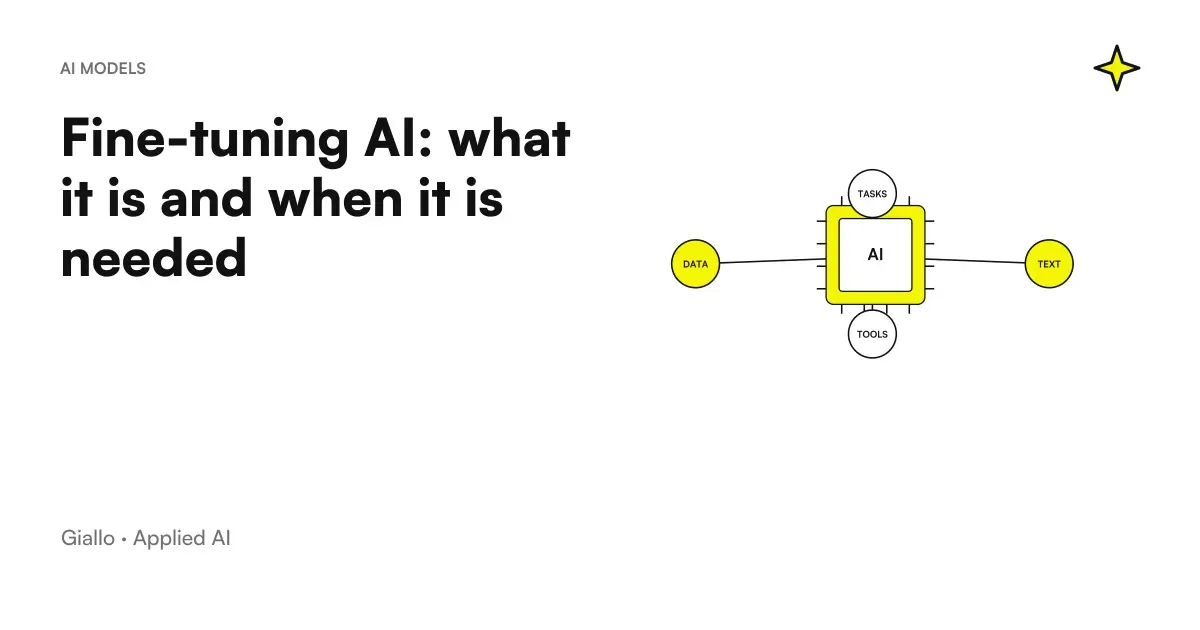
The fine-tuning AI is the process by which one takes an already trained model of artificial intelligence and has it do a further training phase on a set of specific examples, to teach it a behaviour, style or format precise. In practice you don't build a model from scratch: parts from an existing one (like a Language Model) and "specialize" it by showing him hundreds or thousands of examples of how you want him to respond.
The most important thing to understand right away is this: fine-tuning teaches a way to respond, not new and updated information. It is the most common and expensive confusion. If your problem is "AI doesn't know my products, my prices, my procedures", fine-tuning is almost always not the right answer — it is RAG or a good prompt. If instead the problem is "I want it to always respond in a certain format, with a certain tone, on a very repetitive task", then fine-tuning can make sense.
In this guide we see what fine-tuning really is, how it ranks relative to RAG and prompting, how much it really costs (including the skills required) and in which cases an SME should — or should not. take it into account.
In summary
- The fine-tuning retrain an existing model on your own examples to teach it a style, tone, or response format, not new information.
- To give an AI the knowledge of your company (products, prices, procedures) almost always serves the RAG, not the fine-tuning.
- For the Most SMEs Just a good prompt and, where context is needed, a RAG system: fine-tuning remains a niche case.
- The real cost of fine-tuning is not training, but the clean dataset, technical skills and maintenance over time.
- The fine-tuning does not eliminate hallucinations and, badly done, it can make them worse: to anchor the answers to the facts it is necessary to provide the sources (RAG).
What "fine-tuning" means in an AI model
A great model of AI, such as those you use via ChatGPT or Claude, comes pre-trained once on huge amounts of generic text. That "base" model already knows how to write, summarize, translate, reason on a wide variety of topics. The fine-tuning is an additional and targeted phase: it shows him a dataset of examples such as "here's an input, here's the answer I want" and the model adjusts its internal parameters to align with those examples.
The result is a model that, on that specific task, responds more consistently with your examples: same format, same tone, same conventions. To understand why this works, it helps to have clear what a model is and how to "learn": you find it explained in the guide on Main AI Models.
A useful technical point: today you rarely retrain the entire model (it would be very expensive and unstable). light (such as LoRA and the like) which modify only a small part of the parameters. This reduces the cost of computing, but not reduces the main cost: prepare a good dataset of examples.
Fine-tuning, RAG or prompting: how to choose
This is the decision that really matters, and where most companies mistake for excess. There are three ways, in increasing order of complexity and cost, to "fit" an AI to your needs. The practical rule is: start from the simplest and only go up if you really need.
- Prompting. Write clear instructions and give some examples directly in the request. Zero infrastructure, immediate changes. Solves the vast majority of cases. It is the obligatory starting point.
- RAG. Connect the model to your documents (manuals, cards, procedures): at the time of the application the system retrieves the right pieces and passes them to the model. It serves when AI needs to respond to your up-to-date, verifiable information.
- Fine-tuning. You retrain the model on many examples. This is needed only when prompting and RAG are not enough to achieve the desired style/format consistently, on a repetitive, high-volume task.
The easiest way to choose is to watch What's the real problem that you want to solve. They are not competing alternatives: often the best solution is prompting + RAG, and the fine-tuning stays out of the picture.
| Your problem is... | Right solution | Why |
|---|---|---|
| "AI doesn't know my products/prices/procedures" | RAG | It is necessary to give up-to-date and verifiable information, not new behavior. See What is RAG. |
| "I want you to respond with a certain tone / in my format" | Prompting (then fine-tuning only if it's not enough) | Often you get it with instructions and examples in the prompt. See prompt engineering. |
| "Answers must cite sources and not invent" | RAG | Hallucinations are reduced by providing the sources, not by retraining. |
| "Same task, thousands of times, very rigid format" | Fine-tuning | Here fine-tuning pays off: it stabilizes repetitive output and can reduce cost per request. |
| "I want a very specific and constant writing style" | Fine-tuning (if the examples are many and consistent) | Style is better "interiorized" with training than with prompt. |
| "I have to leave and I don't know where" | Prompting | It is free, immediate and tells you immediately if the problem is solvable. |
The honest summary: for most SMEs prompting and RAG is enough. Fine-tuning is a legitimate, but niche, tool, which is only convenient after verifying that the simplest options are not enough.
When fine-tuning really serves (and when not)
When fine-tuning is convenient
- The task is one, very repetitive and very high volume (thousands of requests).
- It needs a rigid and constant output format that the prompt cannot keep stable.
- You already have hundreds or thousands of clean examples of correct input/output.
- You want a very specific writing style, difficult to describe in words.
- You want to reduce the cost per request using a smaller but specialized model.
When to Avoid It
- The problem is knowledge (products, prices, documents): use the RAG.
- You don't have a clean, abundant example dataset to start from.
- Your needs often change: every change requires re-training.
- You want to "reduce hallucinations": fine-tuning is not the right tool.
- You have not yet tried seriously prompting and RAG.
The practical rule is simple: fine-tuning earns its place, you don't take it for granted. First prove that prompt and RAG are not enough, then (and only then) evaluate if the investment in a dataset and maintenance has a clear return.
How much does fine-tuning really cost
Here you need honesty, because marketing tends to show only the training cost, which is often the smallest item. The real costs are others.
- The dataset. Preparing hundreds or thousands of clean, consistent and representative examples is the longest and most expensive part. Wrong examples = Worst model.
- The skills. We need people who can prepare data, launch training, evaluate results, and figure out when the model is "learning badly."
- The evaluation. Without a procedure to measure whether the fine-tuned model is really better than the prompt, you are spending in the dark.
- Maintenance. When a better base model comes out, or your needs change, fine-tuning needs to be redone. It's a recurring cost, not a one-time one.
- The lock-in. A fine-tuned model is related to that supplier and that version: changing costs.
For comparison, prompting and RAG have much more predictable costs: prompting is almost free, RAG requires an infrastructure but not a training dataset or advanced machine learning skills. For many SMEs it is the combination prompting + RAG to give the best relationship between result and effort.
How it works, in practice
If you decide that fine-tuning makes sense in your case, the typical path is this. It helps to see it to understand how much work there is before the actual training.
- Define the task. One, precise and measurable. "Classify tickets in 8 categories", not "improve assistance".
- Collect the examples. Hundreds/thousands of input → correct output pairs, drawn from real cases and cleaned up.
- Create a baseline. It measures first how well the task does a good prompt (possibly with RAG). This is the number to beat.
- Train. Launch fine-tuning on the chosen base model, usually with light methods to contain costs.
- Evaluate. Compare the fine-tuned model with the baseline on examples it's never seen. If it's not clearly better, it's not worth it.
- Monitor. In production keep an eye on mistakes and predict when to re-train.
Note how central step 3: without a prompt/RAG baseline is, you will never know whether the fine-tuning gave you a real advantage or just the feeling of having done something "advanced".
Practical examples
Three scenarios of Italian SMEs, to distinguish when fine-tuning is needed and when not.
1. Studio accountant — responses to customers on deadlines and documents. The problem is the Knowledge (deadlines, procedures, study documents), which changes all the time. Here fine-tuning is the wrong choice: any regulatory update would require re-training. The correct solution is a system RAG that draws from the updated study documents. Industry Insight: AI for accountants.
2. E-commerce — generation of 5,000 product descriptions in the same style. Here the problem is the style and format, on very high volume and very repetitive. After trying the prompting (which with 5,000 cards tends to "slip" on tone and structure), fine-tuning on a few hundred descriptions already approved by the team can stabilize the style and reduce the cost per card. This is one of the few cases where it pays off.
3. Service company — classification of tickets into fixed categories. Unique, repetitive, high-volume task, with a very rigid output format (one category among eight). If the prompt misses ambiguous cases too often and you have thousands of tickets already ranked, fine-tuning can improve accuracy and lower costs using a smaller model. Also here: first the baseline at prompt, then the decision.
In two out of three cases the right answer not It's the fine-tuning. It's exactly the proportion you see in the reality of SMEs.
Mistakes to Avoid
- Using fine-tuning to give knowledge to the model. It is error number one. For products, prices, documents and procedures serves the RAG, not training. Fine-tuning works on behavior.
- Jumping prompting and RAG. Starting from the fine-tuning is like buying a race car to go to the supermarket. First it occurs that the simple options are not enough.
- Underestimating the dataset. A fine-tuning with few inconsistent examples or examples produces a worse model than the basic model. Dataset is the project, not a detail.
- To think it reduces hallucinations. It is not his work. For anchored answers to the facts we need sources (RAG), as also explained in the embedding that fuel semantic research.
- Ignoring maintenance. A fine-tuned model ages: new base models, new needs, new data. Without a re-training plan, the advantage evaporates.
How to apply it in the company
The sensible way to address the fine-tuning issue, in an SME, is almost always Find out you don't need — and that's just fine. Here's the practical route.
- Define the real problem. Is it knowledge (what does AI know) or behavior (how does it respond)? The answer already directs the choice.
- Start at the prompt. Clear instructions and examples in the request solve much more than you expect, at almost zero cost.
- Add the RAG if you need knowledge. If AI needs to respond on your documents, link your data instead of training.
- Consider fine-tuning only if a gap remains. Style/format unstable, very high volume, clean dataset available: only then does it make sense.
- Always measure before/after. Saved hours, avoided mistakes, cost per request. Without numbers, it is a fashion choice.
This type of assessment — figuring out if your problem is solved with a prompt, with a system RAG or (rarely) with a fine-tuning — is exactly the work of a AI Consulting made good: avoid spending on complex technologies when a simple one is enough. If you want to see how these bricks become real flows, look at how we design AI agents and process automations to measure, and the experiments of the The Lab.
To go deeper with verified price lists and benchmarks, When to Change Your AI Model and Reasoning effort: what changes in model comparisons.
Conclusion
The fine-tuning AI is a powerful but specific tool: it serves to teach a model a behavior, style or format, not new information. For this reason, in most business cases, the right answer is not the fine-tuning but a good prompt and, where context is needed, a RAG System. Fine-tuning only comes into play on unique, repetitive, high-volume tasks, when you have a clean dataset and have already proven that the simplest options are not enough —and bringing with them dataset costs, skills and maintenance not to be underestimated. From here you can continue with What is RAG and with the AI embedding to understand how you really get to know an AI.
AI becomes useful when it enters processes. Giallo Studio helps SMEs and teams to build concrete, measurable and sustainable automations.
Giallo Studio guides: methodology and sources
How we apply it in the company
Related resources
 LLM: What Language Models Are
 RAG: what it is and why it improves AI responses
 AI embeddings explained simply
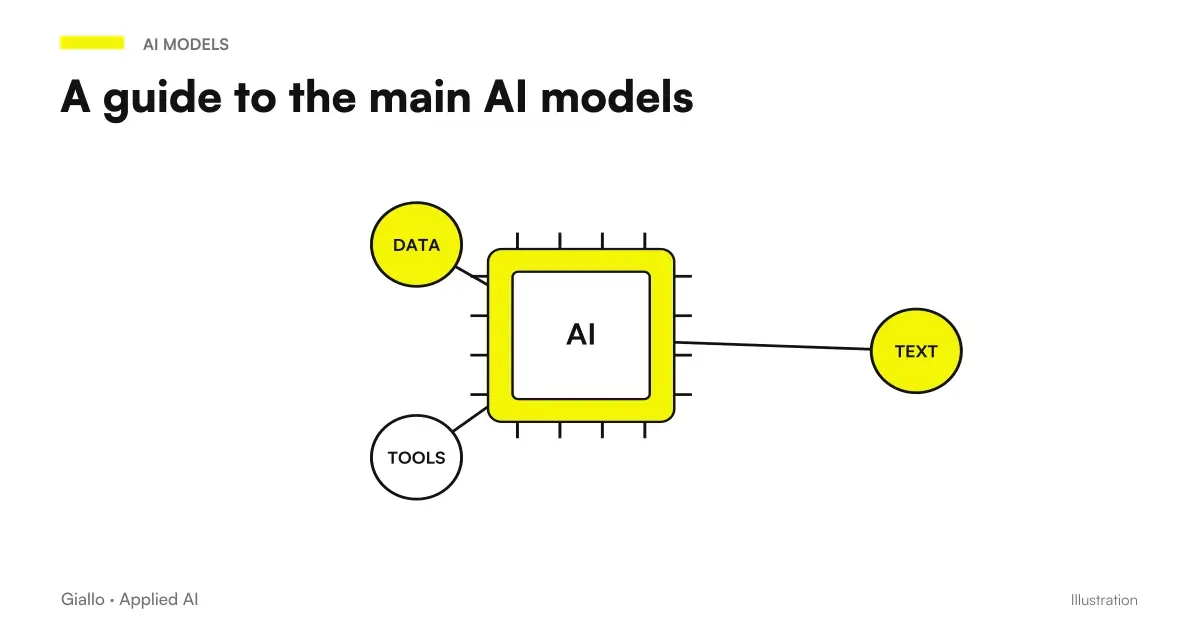 AI Models: Guide to Major Models
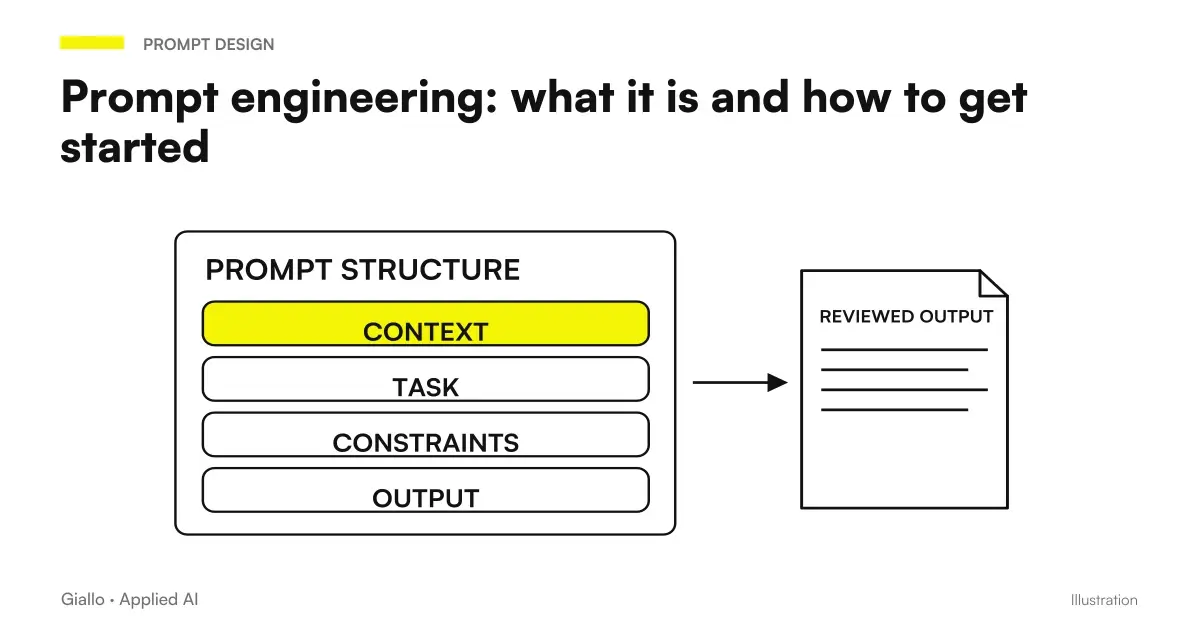 Prompt engineering: what it is and how to get started
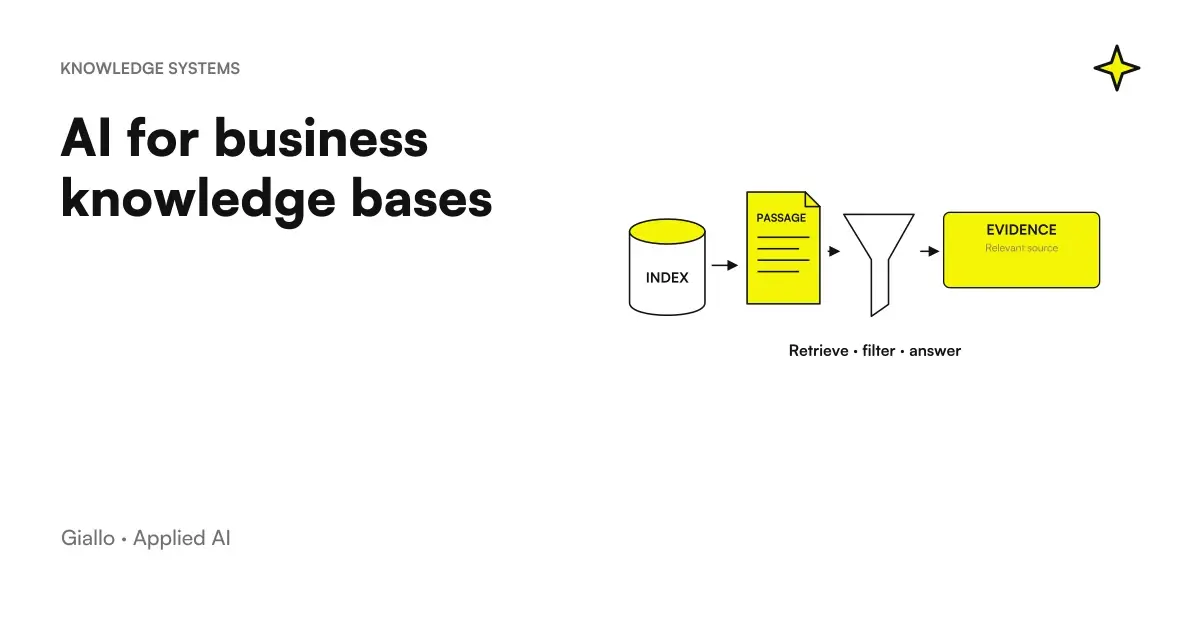 AI for business knowledge bases: find the information you need
 Best AI for SEO: Tools to Optimize Content
 How to choose an AI provider
FAQ
What is fine-tuning an AI model, in simple terms?
Fine-tuning takes an already trained AI model through an additional training stage using specific examples, so that it learns a particular behavior, style or format. It does not reliably teach new information: it teaches the model to respond in a certain way.
What is the difference between fine-tuning and RAG?
Fine-tuning changes a model’s behavior by training it on examples; RAG leaves the model unchanged and supplies the right documents when a question is asked. Giving an AI up-to-date knowledge of your company almost always requires RAG rather than fine-tuning. Fine-tuning is useful when the problem is the style or format of the answer, rather than its information.
Does an SME need fine-tuning?
In the vast majority of cases, no. A good prompt is enough for most business needs, with a RAG system where context and documents need to be supplied. Fine-tuning makes sense only for specific, high-volume cases that require a very repetitive style or format.
How much does it cost to fine-tune a model?
Costs include not just training, which is often modest, but above all hidden work: preparing a clean dataset of hundreds or thousands of examples, the technical expertise to manage it, quality evaluation and retraining whenever the base model is updated or requirements change. The dataset and maintenance are what cost money, rather than the GPU.
Does fine-tuning eliminate hallucinations?
No. Fine-tuning can reduce certain formatting or tone errors, but it does not make the model more factually accurate. Poorly executed fine-tuning can even worsen hallucinations. Anchoring answers to verifiable facts requires RAG, which supplies the sources, rather than fine-tuning.
Can I fine-tune a model using my customers’ data?
Only with great care. Using personal data to train a model raises important GDPR issues: you need a legal basis, must anonymize the data where possible, and must check the model provider’s terms. For many cases, RAG is safer: the data remains in your systems rather than becoming part of the model’s weights.