
Jev AI explained: what changes for SME automation
Jev AI helps classify and route requests. Integrate it into SME processes, choose which tasks to delegate and keep the right controls.
Reading time: 14 min
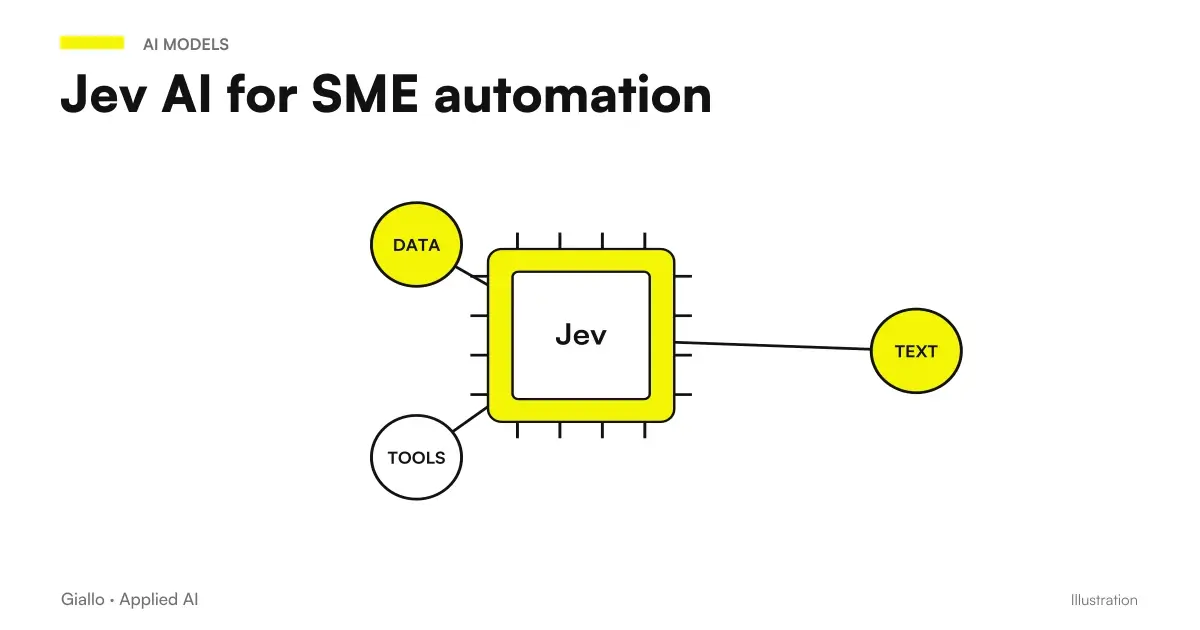
Jev AI is a TypeSafe model designed to evaluate content and return typed decisions, instead of composing a free response. In an automation for SMEs it can become the component that proposes a destination or an evaluation; the company software then decides how to use it. The TypeSafe introductory documentation describes this relationship between status, questions and results.
The difference is seen on a simple request: «The spare arrived yesterday does not match the ordered code, can you replace it?». A business does not necessarily need to have an AI response written immediately. First he has to figure out who takes charge of the message, if a reference is missing and what activity to open. They are small, but repeated steps: often it is there that waits and manual steps accumulate.
What to assess before leaving
- The decision must have a clear recipient and consequence.
- A formally usable result can be semantically wrong.
- The categories belong to the company: a criteria manager is needed.
- The first project should allow corrections and comparison with human work.
- The cost of an error matters more than the impression produced by a demo.
From written request to a usable decision
Let's imagine an office that today reads every message and forwards it to commercial, administration or assistance. The operator interprets the meaning, recognizes the context and chooses a box. Automation must make that step explicit: what distinguishes a payment question from a product claim? Where does a request end that contains both?
In the design proposal, the message becomes material to be evaluated. The explicit question what distinction it serves; the possible destinations correspond to routes really available. The result is recorded as a suggestion, controlled by the software and turned into assignment only when the established conditions are met. This path is different from asking for a summary and hoping that someone will then be able to use it.
TypeSafe separates the contents of the state from the required judgments and leaves the code the logic that combines the results. It is a useful setting when the application has to do something precise with the evaluation, without further interpreting a generated sentence. Official Introduction.
Organizational change comes before technical change. A ‘assistance’ destination is too generic if it includes returns, breakdowns and delays with different managers. Conversely, creating twenty categories when there are only three operational queues adds complexity without helping those who work. Good taxonomy describes the next concrete step, not all nuances of language.
Where the model ends and the process begins
A proposed decision does not amount to an authorised action. If a request appears to relate to a refund, the system may open a practice for the relevant office. Establishing that the refund is due, determining the amount and executing it are different steps, with other tests and other managers. Keeping them separate makes automation more understandable and easier to correct.
An SME can describe the boundary with three questions: which field will be filled out, who will use that field and what damage causes a wrong compilation? A category suggestion on an internal request is often recoverable. A contractual change or a final communication to the customer changes the level of responsibility. The project should advance for increasing consequences, starting with controllable ones.
Manual return must also be designed. If the operator changes the department, the system must retain the correction and the useful operational reason. An "other" entry is not a failure to hide: it may indicate that the process meets new demands, that categories overlap, or that the available material is not enough.
To frame the alternatives is useful our Guide to the main AI models. The choice is not just about the name of the model: it is about the role that that model will have to play in a process with data, people and applications already present.
Jev AI, LLM and people: complementary roles
Jev accepts textual content and JSON structures; it does not directly read PDFs, images, audio or video. A parser or OCR must prepare the text of the document before evaluation. System One.
This distinction helps to avoid vague projects such as ‘putting AI in the email box’. A message can take multiple jobs: identify the topic, retrieve the order, verify a condition, write a response. You don't have to assign them all to the same component. Separation allows each step to be tested and replaced without rewriting the entire system.
| Work to be done | Design setting to be evaluated | Responsibility to be maintained |
|---|---|---|
| Propose a destination between defined departments | Decision closed on business categories | Head of assistance defines boundaries |
| Compose a custom response | Generative component with relevant material | Operator controls commitments and information |
| Calculate amounts or verify codes | Deterministic Rules and Controls | Software applies formulas and constraints |
| Resolving a request with contradictory policies | Path of deepening | Manager decides which policy prevails |
| Make a change on the management software | Authorised application integration | Application checks permissions and duplicates |
The table is a proposed division of labor, not an experimental result. If the need is to write texts, the explanation of LLM and their operation helps to understand the generative component. If the doubt is how to flank the two roles, the comparison Jev AI vs LLM enter the architectural choices.
What business activities deserve a deepening
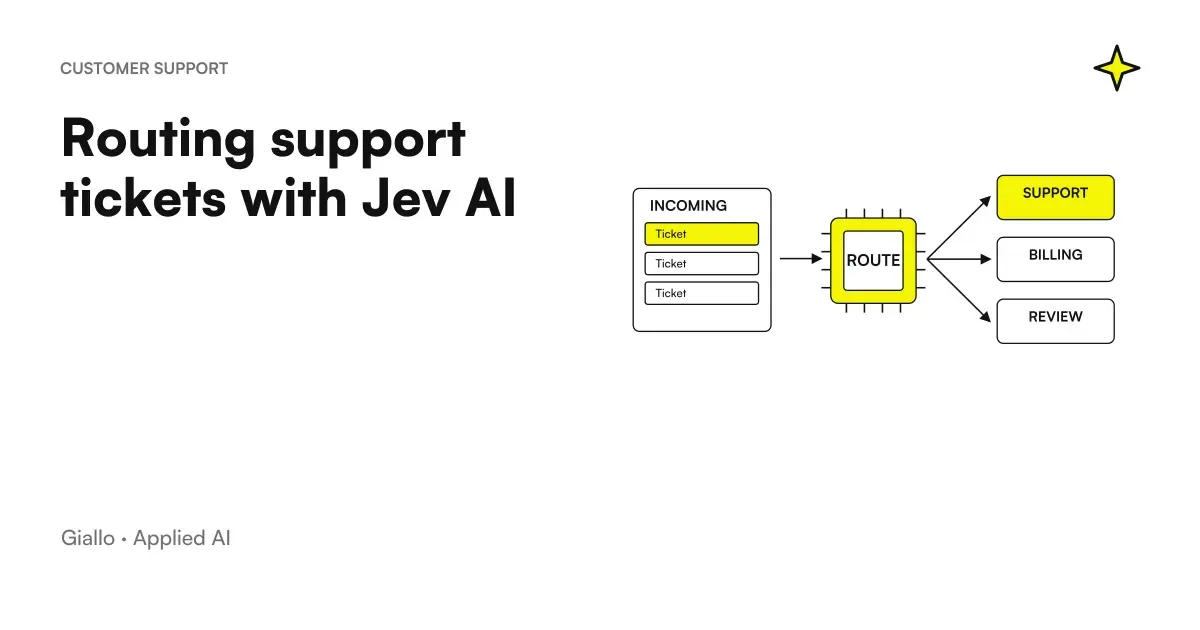
Customer service is a good vantage point because it brings together volumes, categories and responsibilities. The initial value can be a department proposal, without writing or sending answers. In the guide to sorting tickets with Jev AI We explore how to separate argument, urgency and review: three judgments that should not be crushed into a single label.
In commercial, sorting requests can be useful when the team receives messages with very different levels of detail. A contact that mentions a concrete need and a deadline deserves a different reading from an exploratory request. The lead scoring with Jev AI It concerns criteria and priorities; it does not authorize to automatically discard potential customers or to submit a score as a probability of sale.
Documents pose another problem: recognizing what kind of material has arrived. An order, quote and contract can share words and tables, but start different paths. The Classification of documents helps to build categories oriented to the next work. The extraction of typed data Instead, it addresses the choice of a field or a candidate: the level of analysis changes.
When the problem is similar, it is best to start with the list of possible duplicates and the consequence of a wrong link. Two nearby trade names may refer to different subjects. The in-depth study of deduplication of CRM and catalogs distinguishes suggestion, linkage and actual fusion, so as not to confuse data quality and irreversible operations.
These cases have a common trait: there is a precise object to evaluate and there is someone who can tell if the evaluation has been useful. When this person is missing, the project risks producing numbers without an acceptance criterion. The contact person must not know the internal functioning of the AI; he must know the work and know how to describe a mistake.
Two hypothetical scenarios, with different decisions
Industrial spare parts: sort before answering
Consider a hypothetical SME in Bergamo that distributes spare parts for machinery. Requests enter a shared box: availability, code disputes, shipping status and tax documents. Today a person forwards everything, often interrupting the business to understand whether a message is about a new sale or an error on an existing order.
The first project could be limited to proposing the operational queue. Categories are defined together with those who manage orders and assistance; ambiguous examples remain visible. The message "I need the spare bill you're replacing" requires a take charge rule, because it contains an administrative theme and an after-sales one. The choice could be to assign a primary manager and leave an internal note.
During the pilot, each assignment remains approved by one person. Trades between trade and assistance are mainly compared: they have different consequences from the transitions between two administrative queues. The manager measures how many requests go back, how long it takes to correct them, and what information is missing. If the categories change every day, you work on the procedure first.
The sensible extension is not ‘automatic response to all’. It could be the recovery of the order number from the management software or the preparation of a card for the operator. The company decides which step adds value based on the errors observed, without attributing to the model a knowledge that the message does not contain.
Installations and maintenance: recognizing the necessary work
A second hypothetical SME, in Bologna, manages installations and maintenance of plants. A request may relate to an appointment, a malfunction, a quote or a contract update. Here the most useful distinction does not necessarily coincide with the department: it may be the type of activity that must enter the calendar or the assistance system.
An initial route could propose ‘technical recall’, ‘rendezvous management’, ‘commercial assessment’ or ‘responsible reading’. The AI is not asked to diagnose a fault or authorize interventions. The technical contact defines the minimum information to open a practice; the office maintains control over the schedule and the actual availability of the technicians.
The test must include colloquial requests, incomplete descriptions, and messages that mix two problems. A particularly useful example is a communication with quiet tones but relevant consequences: the system should not exchange the courtly form for absence of operational urgency. The evaluation should be compared with the company procedure, without deriving universal rules from the individual case.
If the proposal works, the next step may be a better collection of information. The office receives a missing data sheet and contacts the customer. The quality of the process improves because the operator knows what to check, not because every request suddenly becomes automatically resolvable.
Probability, criteria, and cost of errors
TypeSafe calls RLCD its approach to decision-oriented training and calibrated probabilities. Calibration describes the relationship between estimates and results on sets of predictions; it is not a certification of correctness of the single message. It is the meaning presented in Official Primer.
For those who adopt automation, the useful question is more concrete: which assignments can I perform without verification and with what consequence if I am wrong? There is no need to start with a numerical threshold chosen by intuition. We need a collection of examples, a benchmark and a limit on actions. The Guide to confidence and human review It addresses precisely the interpretation of the signs of uncertainty.
A formally predicted category may still be the wrong one. This is why testing must include both technical validity and operational utility. The first check sees if the software receives what it knows how to handle. The second sees if the message ends in the right place, if a person understands the suggestion and if the correction costs less than the previous work.
Cases outside the automatic path should also be observed. A system that sends almost everything under review may seem prudent but contribute little. One that routes almost anything can lighten the initial reading and multiply subsequent recoveries. The result to be sought is a documented balance between coverage, errors and residual work, consistent with the specific process.
An AI within a knowledge base
In a business assistant, choosing what to read and write the answer are separate problems. Before producing text, a selection of relevant materials may be needed; after the answer, a check of the relationship between statement and source may be needed. The Guide to Jev AI in the RAG the first passage, while the one on the verification of AI quotations Face the second.
This separation makes the project more readable. If an answer is incorrect, one may ask whether the recovered material was relevant, whether it was up-to-date, and whether the final formulation represented it correctly. Without these distinctions, each error is generically attributed to the model and the correction becomes a new longer prompt.
When the assistant can initiate actions, then a boundary between evaluation and authorization is needed. guardrail for AI agents is useful for reasoning about escalation paths. Access and modification permits remain a responsibility of the application and the project, even when preliminary judgment is entrusted to a model.
How to get started without immediately expanding the whole system
The starting point is a process, not an indiscriminate collection of data. You choose an entry, a decision, a referent and a result to compare. For example: service box requests, suggested department, post sales manager, validated assignment. Attachments and other boxes remain out of the first test if they are not used to answer the chosen question.
Then a set of examples representing real work is prepared: frequent requests, rare but expensive cases, incomplete texts and boundaries between categories. The referent notes the expected path and admits cases in which two readings are reasonable. At that point the test must provide for a revision, not invent a unique truth just to calculate a percentage.
The technical link comes after. The guide to the API integration with n8n and enterprise software shows where to enter the rating. If the same content must feed different judgments, the article on parallel questions helps to distinguish what can be evaluated together from what depends on a previous result.
Instead, two accounts are needed for the estimate: consumption of the service and cost of the complete process. Jev AI API Pricing separates the public tariff from integration, control and maintenance activities. This prevents a low unit cost from becoming a savings promise before measuring the actually eliminated work.
A card to fill out before the first demo
- Entrance: what content comes from and from which channel.
- Decision: which field is to be proposed and which values are allowed.
- Responsible: who approves the criteria and resolves ambiguous cases.
- Expensive error: what confusion should be deliberately sought in the test.
- Recovery: how to return to the manual path and correct the outcome.
- Comparison: what operational data indicates if the project really helps.
Who is to govern the test and maintenance
Even a small project requires explicit responsibilities. The operational contact owns the categories and borderline cases; the technician owns the connection and the checks on writes; the person directing the process decides when a proposal can become an action. Separating these roles prevents a code change from silently changing a commercial or administrative procedure.
A useful review starts with examples, not generic opinions. When an operator corrects a classification, it should indicate whether a given was missing, whether the criterion was ambiguous, or whether the judgment was simply incorrect. They are different causes: the first suggests improving entry, the second rewriting the procedure, the third reviewing automation. Accumulating all corrections in an ‘AI error’ entry prevents you from figuring out what intervention is needed.
Maintenance can be arranged with a brief periodic reading of changed cases. If the company introduces a new product line, destination or policy, the relevant examples are repeated before extending the flow. It is not necessary to start over every time from scratch, but neither to assume that a successful test represents forever a changing activity. The registry should link criteria, activation date and approval officer.
It must also be decided who observes the manual path. A system can function technically while the review queue grows without being read. To avoid this situation, the project assigns a person to take charge, a priority to blocked cases and an alternative when the service is unavailable. The business continuity depends on this agreement: the customer must be able to receive assistance even during a failure or a change in automation.
The decision to adopt also concerns data
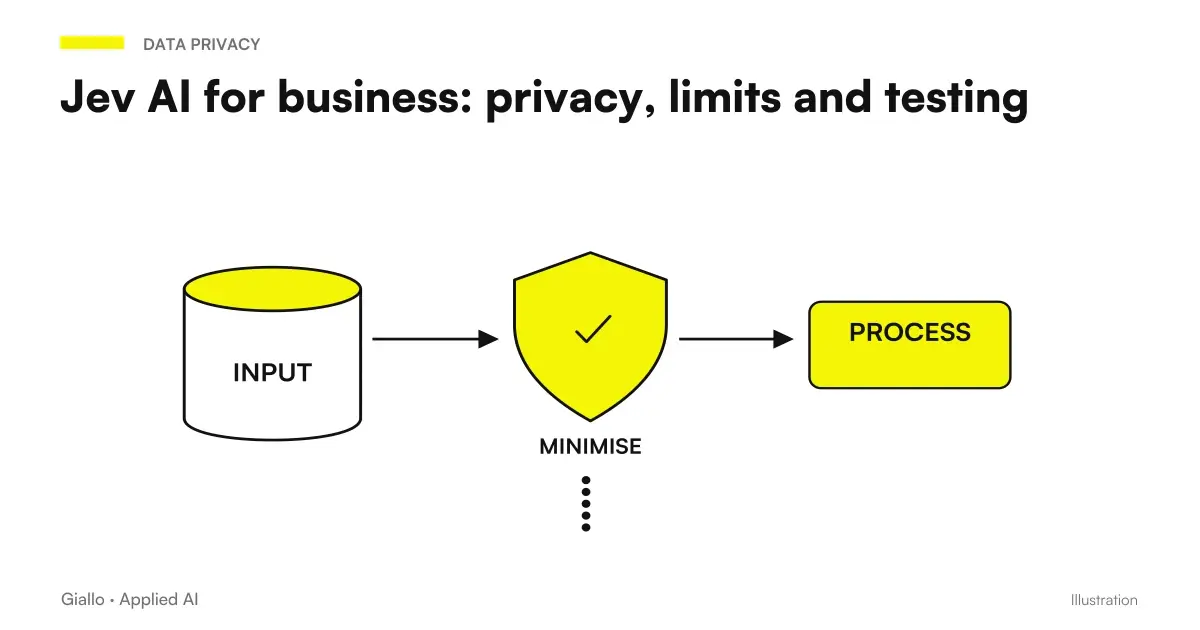
The first test should use only the material necessary for judgment. Before connecting a box or a CRM, the company must understand what information it sends, who accesses the results and what contractual conditions apply. These are questions different from the quality of the classification and deserve a dedicated path: privacy, limits and tests on Italian data.
The operational and technical manager should share an understandable progress condition. It is not enough «the demo looks good»: you need to know which categories can be activated, which ones remain assisted and how to interrupt the flow if the work changes. A circumscribed launch allows evidence to be gathered without turning the model into a point of dependency for each activity.
Jev AI deserves an assessment when work requires recurring judgments with definite consequences. The initial decision can be small: propose a queue, indicate a candidate, prepare a reading. A project of automation of business processes starts from this boundary and only grows when controls show that the next step is useful.
Giallo Studio guides: methodology and sources
How we apply it in the company
Related resources
 Jev AI vs LLM: how to choose the right model
 Route support tickets with Jev AI: department, urgency and review
 Jev AI for business: privacy, limits and testing on Italian data
 AI Models: Guide to Major Models
 LLM: What Language Models Are
 Grok AI: what it is and how it works
 Best AI Models for Programming
 Perplexity AI for companies
Jev AI in business processes
APIs, Decisions, Data, and Controls: Choose the step that relates to your process.
- Jev AI vs LLM: how to choose the right model
- Jev AI: API pricing and cost of business automation
- Verify chatbot citations with Jev AI
- Jev AI for business: privacy, limits and testing on Italian data
- Jev AI in RAG: choose sources before answering
- Parallel questions in Jev AI: fewer requests and repetitions
- Lead scoring with Jev AI: Prioritizing requests in CRM
- Integrate Jev AI through its API: a workflow for n8n and business software
- Business chatbot guardrails: where to use Jev AI
- Route support tickets with Jev AI: department, urgency and review
- Jev AI to extract data from emails and invoices: first find, then choose
- Document classification with Jev AI: build reliable categories
FAQ
Is Jev AI a chat to use instead of ChatGPT?
Jev AI is a component for evaluating content and returning typed decisions. If the work requires a written response, the project must include a separate generative component or a person.
Which process should you choose for a first project with Jev AI?
A frequent process with a few defined destinations and a recoverable error, such as suggesting the department for a request. There must be someone responsible who can explain the criteria and correct uncertain cases.
Does a properly returned category mean that the decision is right?
No. The category may be valid for the software but wrong for the content. Testing must compare assignments with verified judgements and measure the consequences of errors.
Do I need to change my business management software to introduce Jev AI?
The project can start with suggestions recorded alongside existing data, without immediately changing the operational workflow. Whether this is feasible depends on the business management system's interfaces and must be checked before building the automation.
How important is the quality of the business categories?
It matters even before evaluating the model. If two departments interpret the same request differently, the boundaries and review process must be clarified; otherwise the test will also measure ambiguity in the organisation.
Does calibration eliminate the need for human review?
Calibration concerns the behaviour of sets of predictions; it does not guarantee an individual case. The company must choose which errors to tolerate and which actions still require verification.