
Route support tickets with Jev AI: department, urgency and review
Design ticket triage with Jev AI: clear categories, urgency assessed separately, human handoffs and checks before assigning requests.
Reading time: 11 min
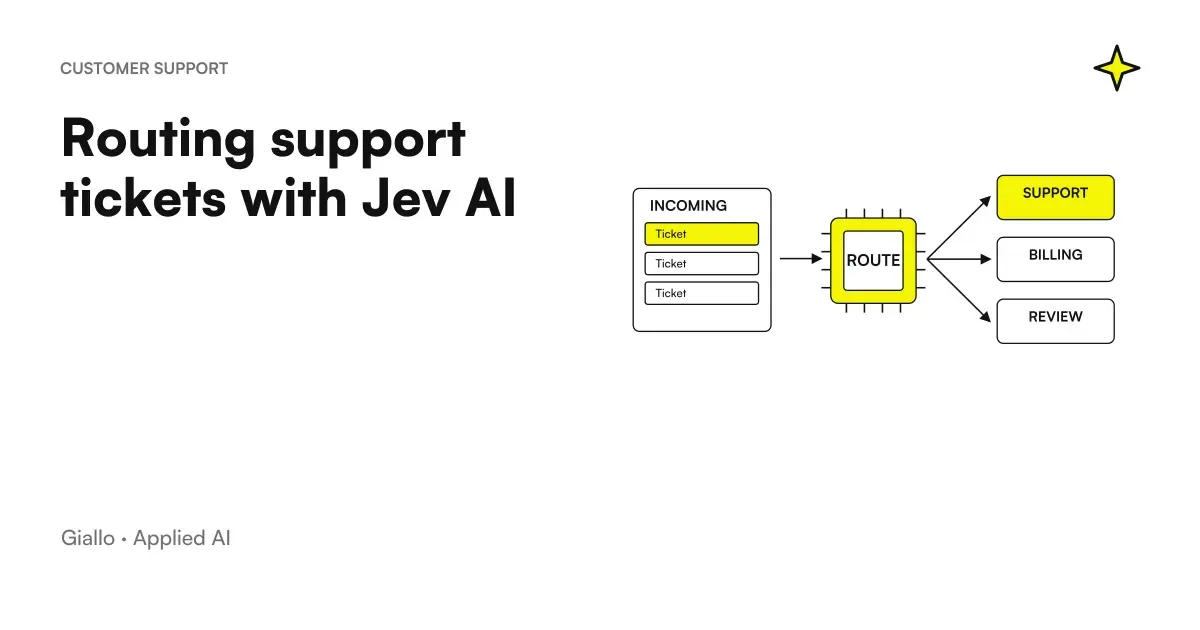
Jev AI can help sort tickets choosing the right path to the request, while the business software performs the assignment. The project works best when department, urgency and need for review are separate decisions, with a precise handler for exceptions.
To be fixed before the pilot
- Each category must indicate who takes charge of the request.
- The urgency depends on the impact, deadlines and rules of the service.
- A request can involve multiple departments without losing its referent.
- Classification suggests a path; refunds and communications require separate checks.
- The pilot must also count corrections and the work in the human review queue.
The problem to be solved is taking charge
A shared box may contain a tracking question, an invoice dispute, and a replacement request. The three emails need different skills. If they all come to the same person, time is consumed reading, forwarding and asking who should answer. The goal of triage is to make this step more orderly, without changing the responsibilities of the service.
Before choosing a model, look at a group of closed tickets. Rebuild the route: who read first, how many transfers took place, what information was missing and who solved it. The Guide to the AI for ticket management helps to place sorting in the overall process. Here the specific point is to turn that path into verifiable decisions.
TypeSafe documentation describes the intent routing as a classification that directs work towards code, information systems, specialized models or people. In assistance, this suggests a useful boundary: identify the request before choosing how to treat it. The overview on what is Jev AI It clarifies the role of this component.
The customer care contact should then write the destination map. The technician builds the flow; those who manage the assistance decide what it means to return, when a dispute passes to the administration and those who follow an incomplete request. If these rules are inconsistent between operators, a classifier can make them more visible, but cannot resolve organizational disagreement.
Department, priority and review answer different questions
A category identifies who has the expertise. Priority determines the order of work. Review identifies cases that must not advance without an additional assessment. Combining everything into a single label such as urgent administrative complaint makes it difficult to understand which part of the result is useful and which needs correcting.
To choose the department, the primitive Choice selects one of the prearranged options and also returns probability distribution and confidence. The list must include a way out for out-of-boundary requests. In the criteria it is best to describe the boundary between the departments, not just their name.
The following table is a design proposal for an aftermarket, not an official configuration or a measured result.
| Decision | Information to be evaluated | Useful result | Rule Manager |
|---|---|---|---|
| Main Department | Problem to be solved and subject of the request | Returns, shipments, billing, general triage | Service Manager |
| Operational priority | Declared impact, deadline, service involved | Ordinary queue or urgent assessment | Service Manager |
| Additional involvement | Second problem with distinct responsibility | Activities related to the ticket | Practice Coordinator |
| Review | Ambiguity, delicate dispute, missing data | Check before proceeding | Operator enabled |
Do not use the urgent word in the message as a sufficient criterion. The writer may need an invoice by the evening; another client may calmly describe an operational downtime. The policy must specify what facts matter. Even the presence of an important customer can change the destination, but this choice belongs to the company and must be declared, controllable and consistent with the commitments made.
Write categories that don't compete for the same messages
Consider a package arrived damaged. Is it a shipping or return issue? It depends on who handles the first answer. A useful taxonomy could assign it to returns, with one activity for logistics; another could give ownership to logistics until damage is verified. Both are possible. It is wrong to leave the choice implicit and then judge the model by criteria other than operator to operator.
For each category, it prepares three elements: what it includes, what it excludes and a border case. For billing, for example, it specifies whether it includes the request for a copy of the invoice, the modification of the data and the payment disputes. A refund still to be authorised may belong to the returns even if it concerns money. The label must follow the organization of the work.
The general triage category must be handled as a real queue. It must have an owner and a planned review time. If it becomes a container nobody looks at, abstention causes delays. Periodically check the messages that end up there: some will require a new category, while others will reveal unclear instructions or genuinely exceptional requests.
Also keep the theme classification separate from the conversation log. An irritated sentence does not authorize you to close a practice or settle a complaint. For sensitive cases, the in-depth study of customer complaints with AI is useful for designing the switch to the referent that can evaluate content, history and response.
Hypothetical scenario: a spare parts e-commerce in Bergamo
Imagine an Italian SME selling spare parts and managing after-sales with a shared box. A customer writes that the received component does not match the order and that a credit note is missing. Today the operator forwards the message to the warehouse, then to the administration; the customer receives two requests for partially equal information.
In the proposed stream, the ticket retains only one referent. The request on the component suggests the return queue; the credit note opens a related task for the administration. Before assignment, the software checks that the order number is associated with the correct customer. The text received is a clue, not a proof of the identity of the writer.
The operator sees original message, suggested department and operational reasons provided by the policy. There is no need for Jev to produce a free explanation: the screen can show the categories and controls performed by the application. If the message does not clarify which component is wrong, the practice comes under review with the missing information indicated in the work form.
The result to measure is concrete: did the right contact receive the case? Did administration find its task? Did the customer receive a coordinated response? This example is hypothetical. It is not a Giallo case and does not demonstrate savings; it describes which operational changes should be made observable during the test.
How many questions to ask on the same ticket
The official pattern of fan-out It also allows to evaluate questions relevant only to some branches; the code uses the necessary results and ignores the others. Additional questions consume tokens. For a ticket you can then prepare autonomous assessments, avoiding to build the context of a question starting from an answer not yet available.
In the proposed process, always asking for department and need for verification can be sensible. A question about the reason for the return has value only when that branch is used. Before adding it, check if a task changes: choose a procedure, prepare a check or locate a competency. A label that no one reads increases maintenance work without improving taking charge.
The parallel questions in Jev AI examine the distinction between independent assessments and steps requiring a second call. In support, a real dependency is common: first identify the order in the business management software, then assess the message together with that order’s status. Do not attribute data to the model that the workflow has not yet retrieved.
Check if a question deserves to enter the triage
Locate the operator that will use the result and the task that will change. Then describe what happens if the answer is wrong and who can correct it. If you don't find a user, an effect, and a route of correction, leave the question out of the first pilot.
For example, distinguishing a delay from a delivery that has never taken place can prepare different logistical checks. Evaluating five shades of irritation without an associated procedure is less useful.
Hypothetical scenario: assistance for installers in Emilia
A second hypothetical Italian SME supplies equipment to installers. Receives a short report: After an update, the plant does not complete the startup. The message is courteous and does not use alarming words. However, the customer specifies that the activity scheduled for the following day depends on the operation of the system.
Here the priority should follow the operating block and the stated deadline. The technical contact must decide which signals lead to immediate verification. The stream may assign the alert to an urgent assessment queue, but it does not promise a recovery time or send risky instructions just because a category has been detected.
If a second message arrives with new details, the ticket should be re-evaluated on the updated version of the practice. The software must prevent a classification relating to the previous text from overwriting the decision just made by a person. A version of the ticket or a check on the latest update makes this conflict recognizable.
The pilot would include synthetic messages, long descriptions, technical acronyms, and forward reports. The question is whether the system intercepts the need for the right department without overloading the urgent queue. An increase in urgent reports, alone, would not be a success: it could simply move the bottleneck.
From suggestion to assignment: checks and proof
Start with a stage where the operator continues to choose and the system retains a hint. Compare the two outcomes, separating organizational disagreements, missing data, and classification errors. When two operators do not agree, have the manager solve the case and update the policy. Do not treat each divergence as an AI component error.
The Guide to confidence and human review It serves to interpret uncertainty. In the project, alongside the cost of the action: moving a practice into a queue is correctable; approving a refund or communicating a conclusion to the customer has different effects. These actions must have their own controls and permissions, independent of classification.
For integration, prepare handling for duplicate messages, timeouts and temporarily unavailable departments. A ticket already assigned must not be recreated when the workflow restarts. If the component does not respond, the request remains in the ordinary queue with a visible signal. The guide to API integration with n8n and enterprise software addresses these technical links.
The comparison between Jev and generative LLM Instead, it helps when the project also includes draft responses. Sorting, consulting the management software and writing to the customer are different parts of the service. For each part you establish a user, a control and a measure: correct assignments, lost urgency, avoidable transfers and actual review time.
Prepare a first useful flow to the department
Before expanding the perimeter, prepare a small collection of cases to be re-executed when categories change. Include simple request, message with two issues, text without order reference, forwarding with a previous conversation, and complaint requesting a decision from the person in charge. For each case, note the expected destination and the organizational reason. It is a proof of flow consistency, not a universal demonstration of model quality.
It also controls what happens after the choice. If the department is renamed in the management software, the category could remain valid while the technical destination no longer exists. If an operator is absent, the queue must continue to have a referent. These issues only emerge by following the ticket until it is taken over, not by looking at the API's response.
Finally, leave a quick fix in the screen: correct department, modified priority, and reason for editing. The operator should not open a second tool to report each error. Corrections collected during work indicate which boundaries to review and which exceptions to keep human. The manager uses them to update the policy; the technician checks that the new version does not make the cases already solved worse.
A limited pilot may start from a single box, stable categories and a human destination for all cases not covered. Involve those who really work on tickets: it is used to collect exceptions and understand which screen makes the correction quick. It preserves changes to the rules, so a change in results can be linked to a precise choice.
Giallo can design the automation of business processes from this operational map. The first useful deliverable is a readable flow, with real destinations, action limits and pilot criteria. The decision to extend it comes after observing errors and burden of review.
He designs with Giallo the sorting of tickets: wards, exceptions and a verifiable pilot.
Giallo Studio guides: methodology and sources
How we apply it in the company
Related resources
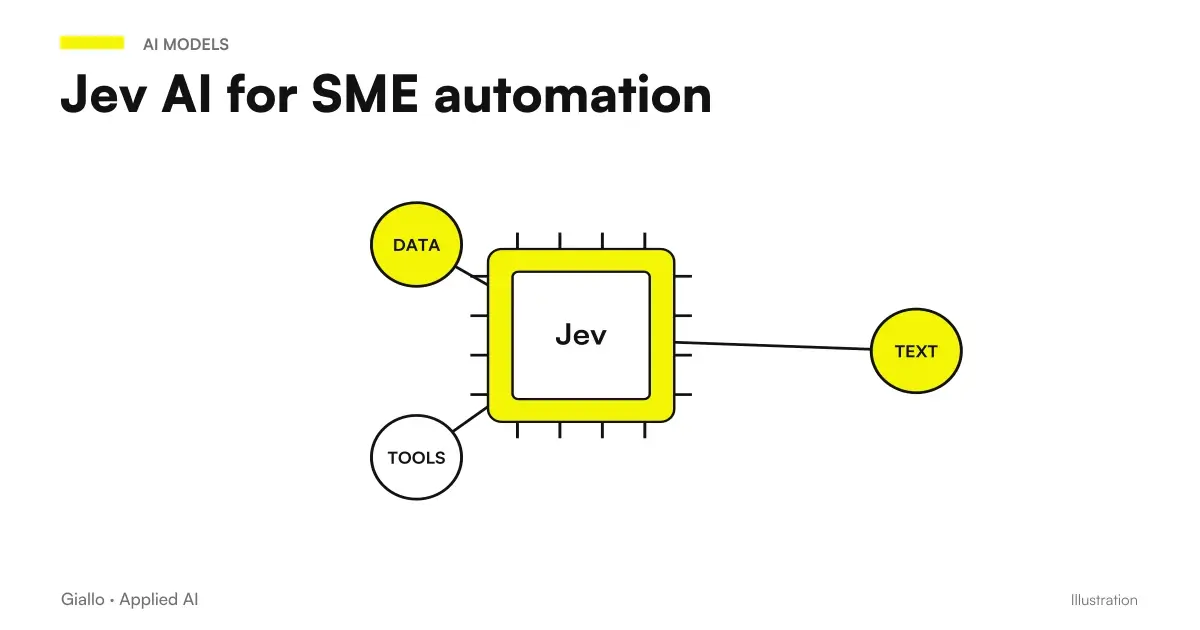 Jev AI explained: what changes for SME automation
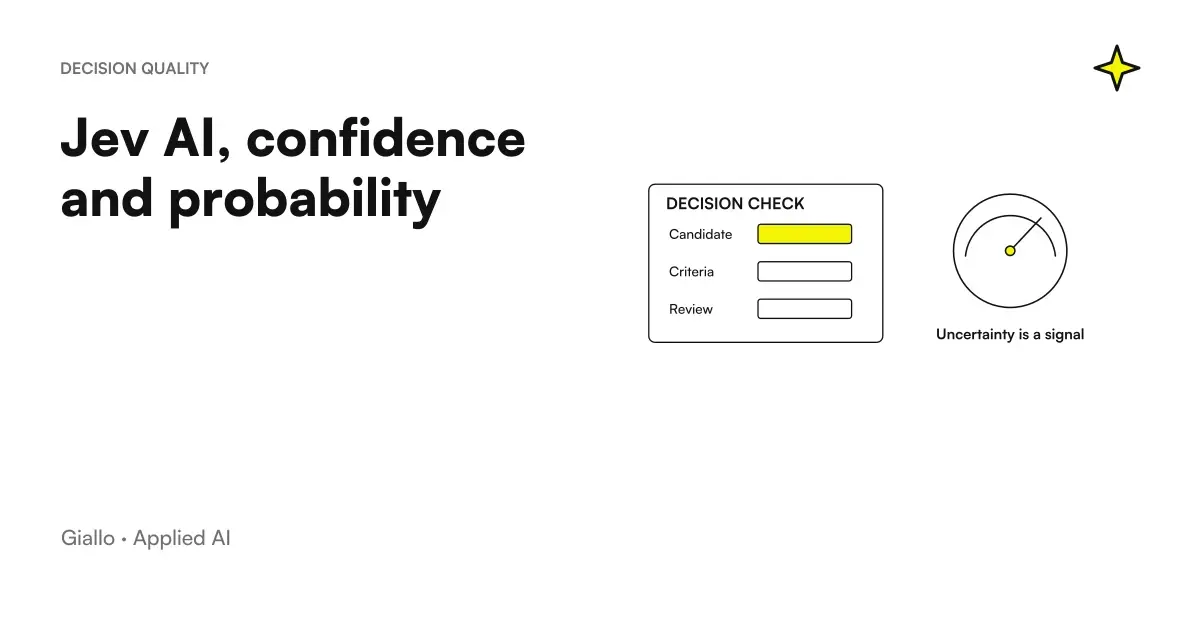 Jev AI, confidence and probability: when to get a person to intervene
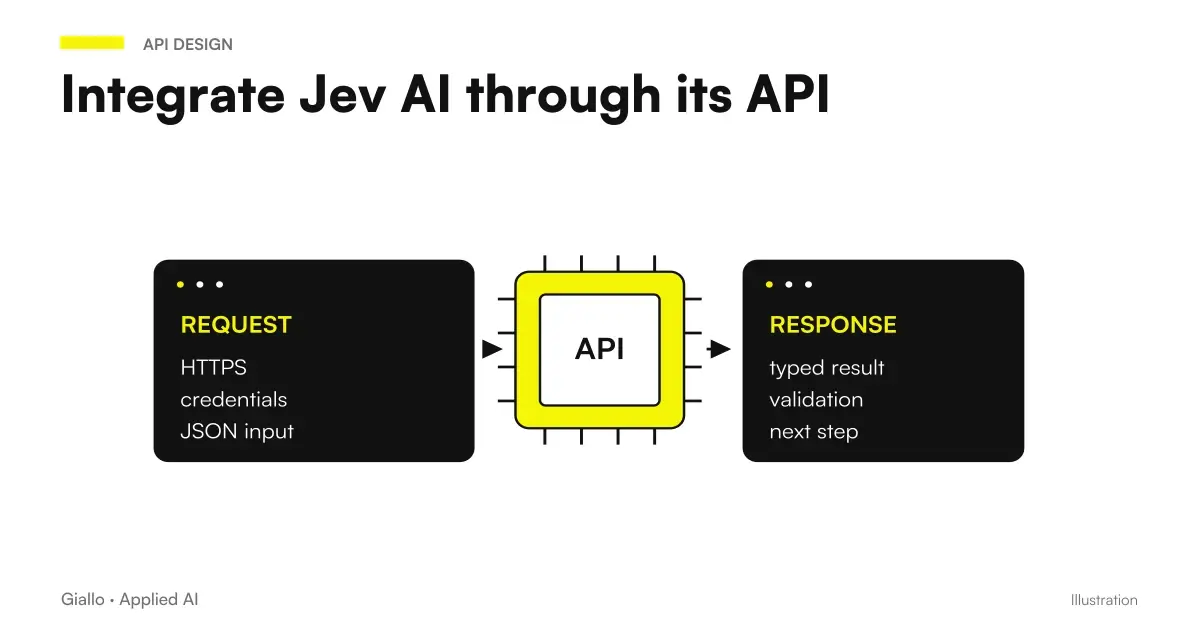 Integrate Jev AI through its API: a workflow for n8n and business software
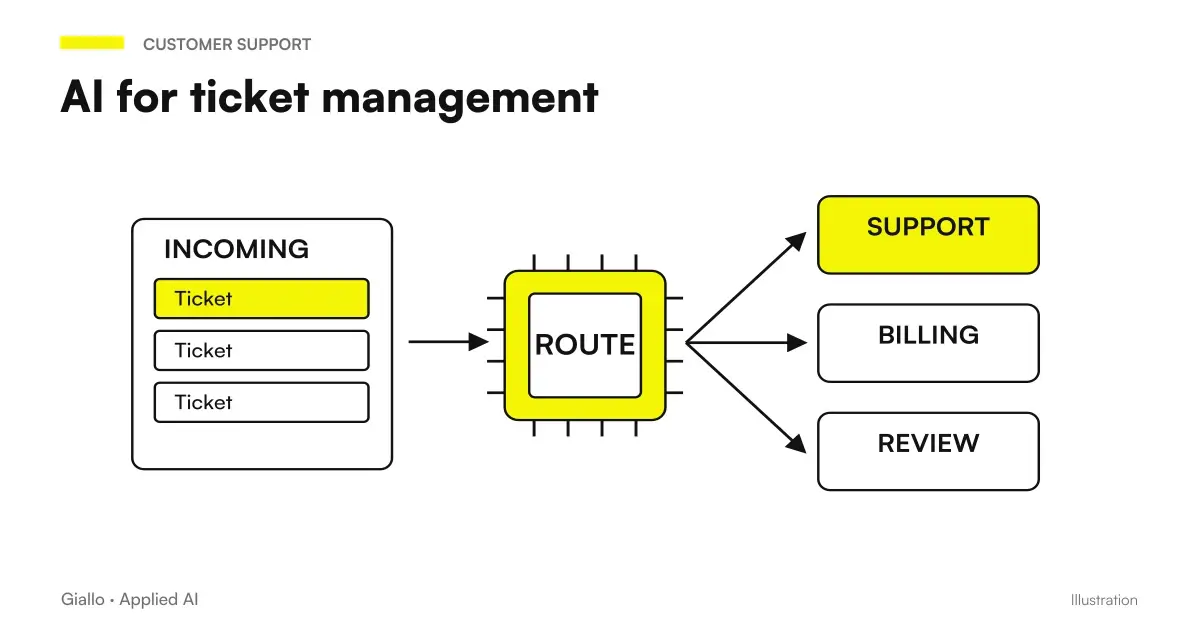 AI for ticket management: shorter waits, more resolutions
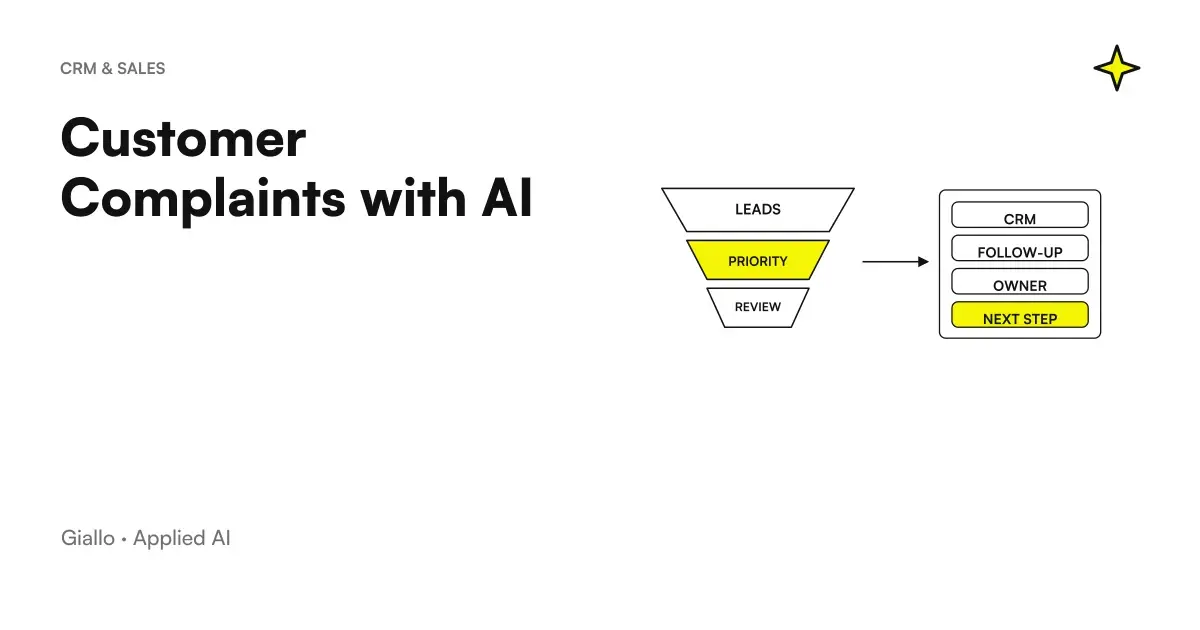 Customer Complaints with AI: Priorities, Facts, and Responsibilities
Jev AI in business processes
APIs, Decisions, Data, and Controls: Choose the step that relates to your process.
- Integrate Jev AI through its API: a workflow for n8n and business software
- Document classification with Jev AI: build reliable categories
- Parallel questions in Jev AI: fewer requests and repetitions
- Jev AI, confidence and probability: when to get a person to intervene
- Jev AI for business: privacy, limits and testing on Italian data
- Deduplication with Jev AI: connecting records without merging the wrong ones
- Jev AI: API pricing and cost of business automation
- Jev AI to extract data from emails and invoices: first find, then choose
- Jev AI explained: what changes for SME automation
- Business chatbot guardrails: where to use Jev AI
- Jev AI vs LLM: how to choose the right model
- Lead scoring with Jev AI: Prioritizing requests in CRM
FAQ
Can Jev AI assign a ticket to a department on its own?
It can provide the classification used by the workflow. The assignment is performed by the company's software, which checks rules, destinations and permissions. It is worth starting with suggestions visible to staff.
Which categories should you use for an initial test?
Choose categories that correspond to actual responsibilities: for example, returns, shipping, billing and general triage. Define who handles messages involving multiple departments. An additional category is useful only if it changes the subsequent work.
Must an angry customer always have high priority?
Tone is a signal to be considered separately from operational impact. A courteous message can describe a blocked service. Priority must follow a shared policy and include review of sensitive cases.
How to manage a ticket that asks for a return and reports a double charge?
Keep one ticket owner and engage the other department with a related task. The policy must establish who coordinates the response. Avoid creating two independent conversations that promise different solutions.
Can confidence replace human checking?
It does not guarantee that the classification is correct. Use it as one signal for deciding on review, alongside the action's effects and policy exceptions. Test the thresholds on tickets from your own process.
What is a useful measure to evaluate the project?
Measure how many assignments need correcting and which urgent requests reach the right department late. Also count the minutes needed to check suggestions. The number of messages processed alone does not describe service quality.