
Jev AI: API pricing and cost of business automation
Transparent Jev AI API cost calculations: tokens, volumes, review and integration. Build a budget while distinguishing rates from savings.
Reading time: 11 min
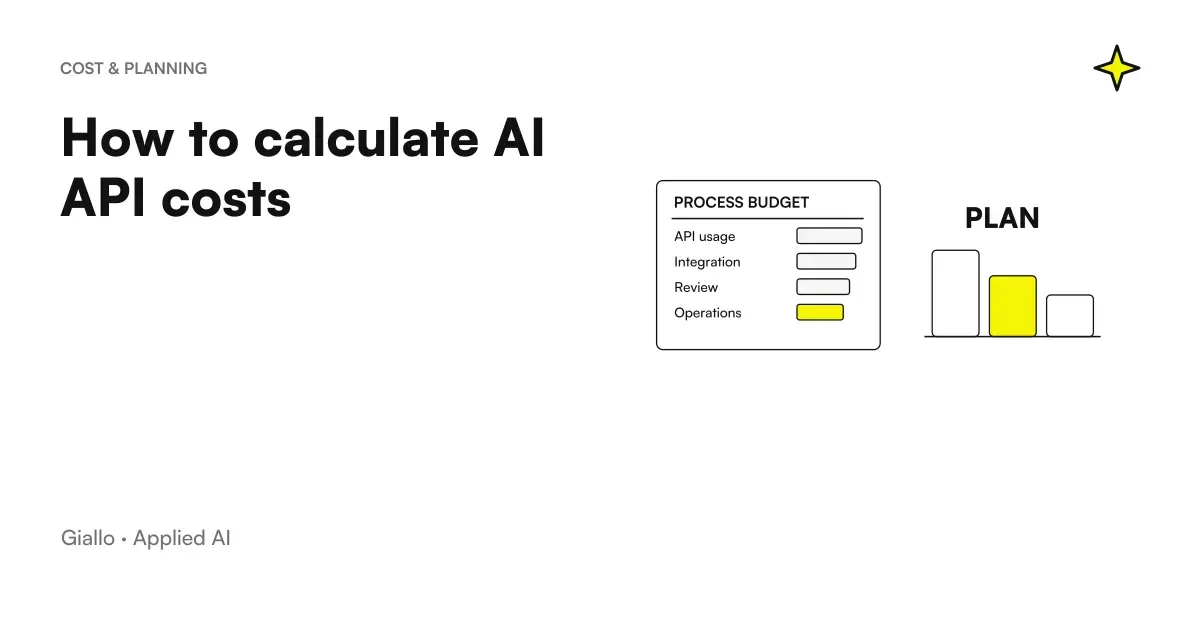
As of October 10, 2026, the public price of Jev 1.13.0 is 0.042 USD per million token input, with free output. However, the cost of an automation also includes connections, controls, infrastructure and human work: the API tariff is one entry. The dated reference is the TypeSafe Models page.
Estimating a project requires two separate questions. The first: how much content will be evaluated? The second: what work will remain before and after that assessment? The difference matters because a process can consume little service and still require many revisions. Or it can have a low technical cost and fail for an undesigned operational link.
The voices to be separated
- API prediction depends on the overall tokens, not just the number of messages.
- State, criteria and applications should be included in consumption assumptions.
- Additional attempts and unnecessary judgments can expand the account.
- Review and correction are human work to be measured separately.
- The economic return proves itself on the full process, after a trial.
The API calculation, with visible assumptions
For examples of this guide we use an arithmetic formula: total token input divided by one million, multiplied by the indicated rate. The value is in dollars and concerns only API consumption. It does not include VAT, exchange, OCR, other models, storage, hosting or working hours.
Suppose, as a hypothetical scenario, 100,000 requests with 2,000 average input tokens each. The volume is 200,000,000 tokens. Divided by one million we get 200; multiplying by 0.042 the illustrative cost is 8.40 USD. It is not an observed result on a Giallo customer and is not an estimate of the realization price.
| Hypothetical scenario | Overall Token Input | Calculation of API only | illustrative cost |
|---|---|---|---|
| Volume content | 50 million | 50 × 0.042 USD | 2.10 USD |
| 100,000 requests × 2,000 tokens | 200 million | 200 × 0.042 USD | 8.40 USD |
| Larger Volume | 500 million | 500 × 0.042 USD | 21.00 USD |
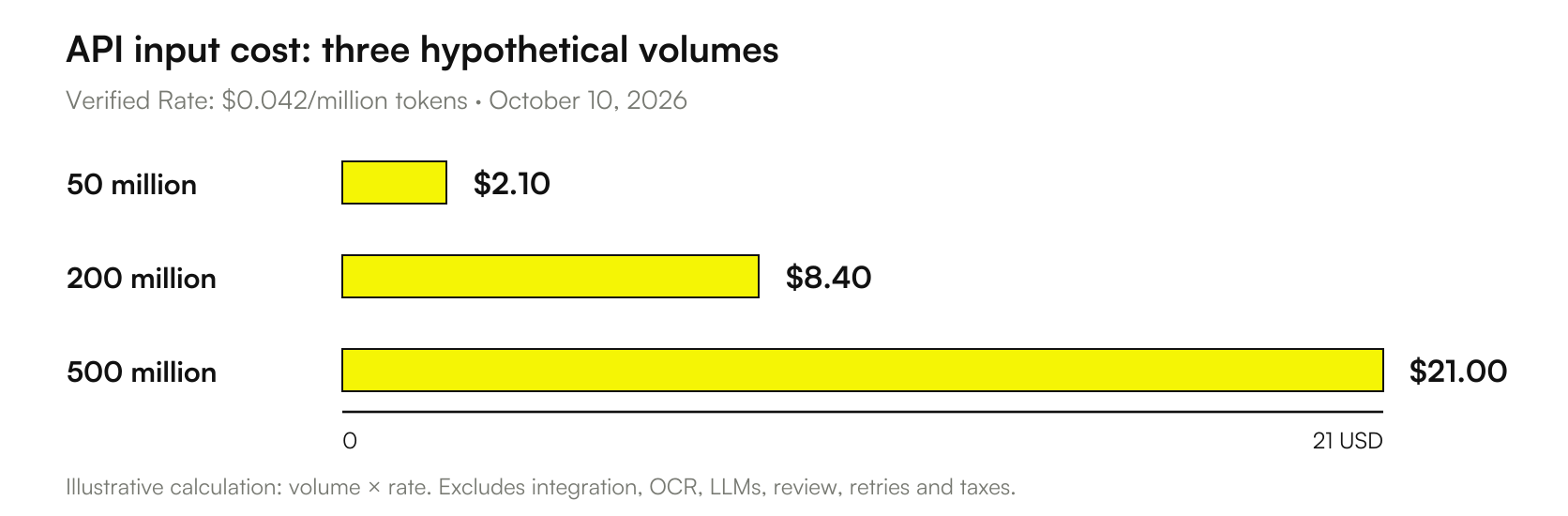
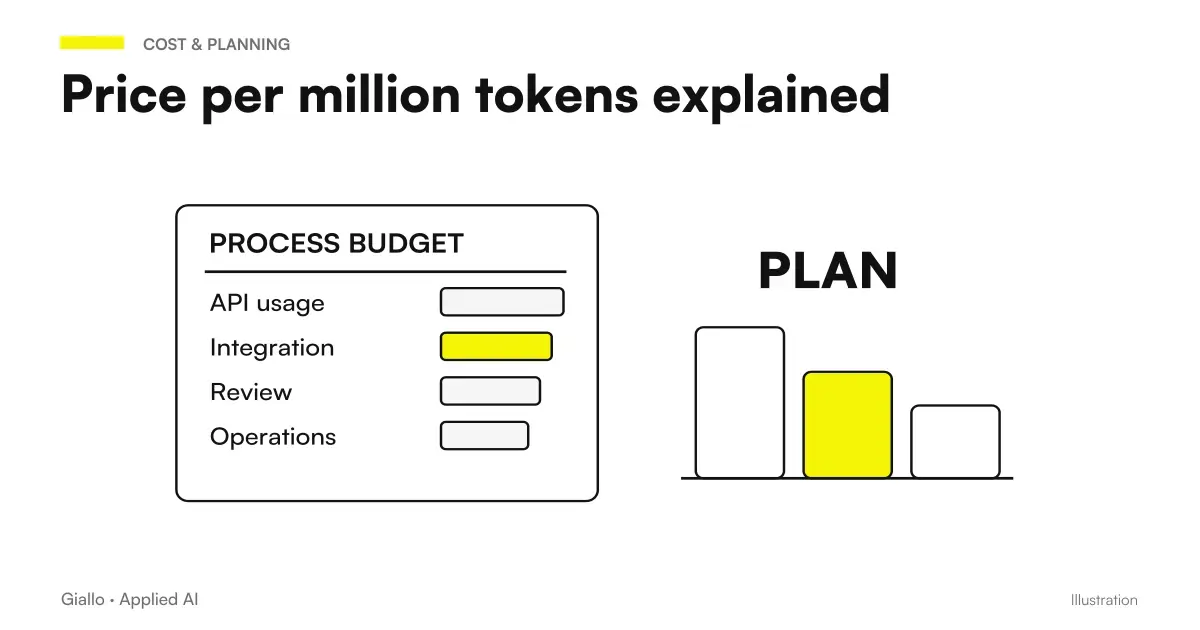
The table contains original calculations applied to the dated rate, not commercial packages. To read the unit correctly, the explanation of the price per million tokens avoids a common mistake: consider the million as the number of requests. The short and long message produce different consumptions, and the criteria added to the content are part of the forecast.
Why email number isn't enough
The first budget sheet should separate the volume of requests from the average content. An SME can receive many short emails or a few long conversations with reruns, signatures and attachments turned into text. Treating them as equal objects hides the main variable of the account.
In the design it is better to write down what you want to send: useful text of the message, data of the record necessary for the judgment, classification criteria and questions. You avoid dragging the full history just because it is available. This is a choice of content and quality of the process: reducing unnecessary information also makes it easier to understand what influenced the assessment.
The average should be read along with the distribution. If a restricted group of practices contains very long documents, it can weigh on the total more than ordinary requests. For prudent forecasting, the technical manager prepares at least one typical case, one long case and one exception. The final budget is updated with the consumption of the test, without presenting the assumptions as measures.
The AI API Cost Guide offers a more general method of organizing this account. For the role of the component in the process, what Jev AI is helps to define what needs to be evaluated before a monthly volume is attributed to it.
Useful questions, repetitions and additional attempts
If the same material fuels multiple judgments, the person in charge must distinguish necessary questions from curiosity. A department may need the destination and the need for in-depth, but not six indicators that no one uses. Each additional result should have a clear recipient or application rule.
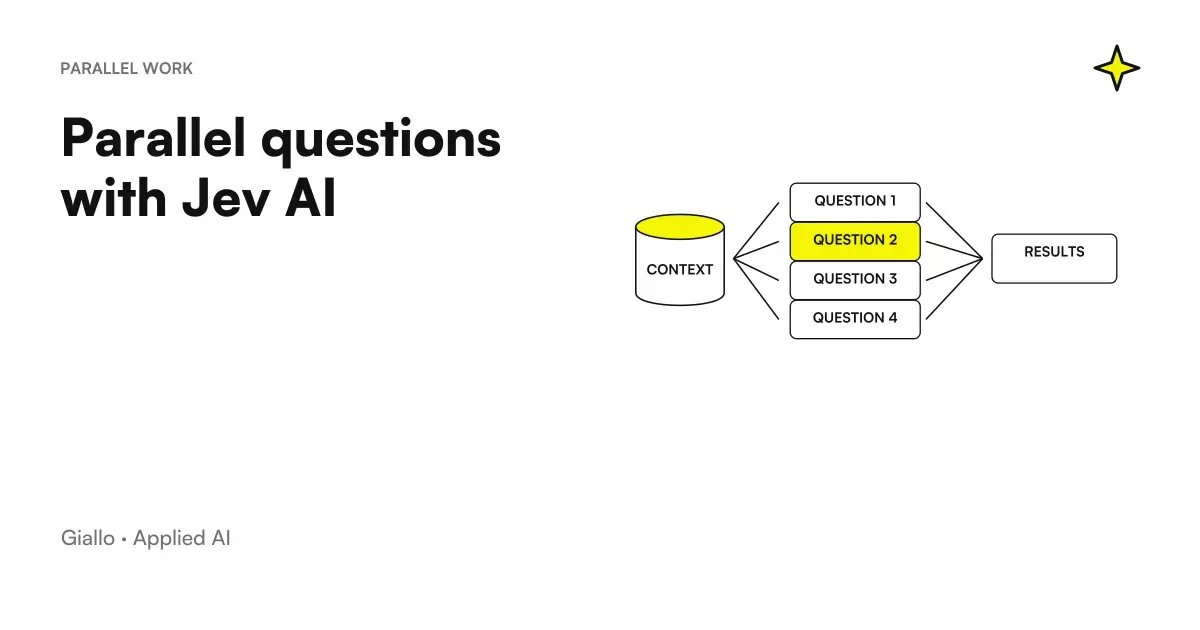
The calculation of parallel questions in Jev AI compare repetitions of the same content. The benefit depends on how much status is re-proposed and what questions can be assessed together. It is not enough to reduce the visible number of calls: it is necessary to compare the overall consumption and verify that the grouping retains the useful result.
Then include a line item for additional attempts. In a hypothetical simulation, 100,000 initial executions and 5,000 repetitions produce 105,000 executions, before considering other content changes. Five percent is a planning assumption here, not a product rate. During the test, record the reason for repetition: a technical error, corrected content, a new assessment or the reappearance of the same event.
When the flow is connected to a management system, duplication can have a higher cost than consumption. Two open practices on the same message force operators to check which one is valid. This is why the guide to the API and n8n integration It also focuses on the recognition of events and checks before the scriptures.
The project has costs that do not depend on the tariff
Initial construction includes process reading, criteria definition, sample preparation, and links. If the management does not offer the necessary interface, the problem is not solved with a cheaper call. The estimate must indicate what is integrated, what accesses are available and what behavior will be verified.
Recurring costs include services used, operation control and operating time. A company can already have an automation platform or have to activate one; it can have a text archive or have to organize a document entry. These conditions change the budget and must be ascertained on the concrete context.
The work on documents requires a dedicated entry when it is necessary to prepare the contents.extraction of typed data helps to distinguish field choice, preparation and validation. In the income statement, these steps must remain visible even if the user sees only a compiled practice.
The revision is finally an operational voice, with an owner. The number of cases to be read and the average time can change together: residual cases are often the most complex. Multiplying a hypothetical percentage by the time of the simple request can underestimate the work that remains.
Two hypothetical budgets for Italian SMEs
Online distribution: lots of volume, dominant cost in the queue
A hypothetical SME in Ferrara handles requests on deliveries and returns. For planning consider 100,000 monthly assessments with 2,000 average input tokens. The API calculation is the one already shown: 8.40 USD, with the exclusions declared. Management should not interpret this as the monthly cost of the entire automation.
Suppose, solely to reason about human work, that 2,000 requests are reviewed and each takes three minutes. That is 6,000 minutes, or 100 hours. If the company uses a hypothetical internal hourly value of 25 euros in its spreadsheet, the amount is 2,500 euros. It cannot be added directly to the dollar figure without choosing an exchange rate, and it is not a fee proposed by Giallo.
This example shows where to look for convenience: category quality, available data, reduction of corrections, and job distribution. The care manager should measure separately the cases reviewed before the action and those recovered after a wrong destination. Seconds can take more steps and involve more people.
The pilot is used to replace the four hypotheses —volume, content, revision, and minutes —with observed data. Only then does the new process compare with the previous one. If the queue grows because the policies are ambiguous, the next useful task can be to clarify the procedure, rather than adding other automatic judgments.
Administrative office: less volume, more demanding preparation
A second hypothetical SME, in Parma, handles documents received from customers and suppliers. For a first scenario consider 50,000 valuations from 1,000 average input tokens: 50 million tokens and 2.10 USD API alone in the simulation. The critical point is to have readable content and consistent references before evaluating.
The project must check which documents already arrive as text, which require separate preparation, and which contain incomplete information. The time of this phase cannot disappear from the budget because it takes place before the call. Verification of a code or amount also remains a phase with a cost and liability of its own.
The administrative manager could choose a limited objective: propose the destination of the practice and leave approval and accounting to the operators. In this way the first account is about a reduction in the initial reading, not the promise to eliminate any human intervention. The most difficult cases are collected to understand whether the problem is in classification or entry.
Convenience will depend on the quality of preparation and recovery of exceptions. A rare but expensive practice can change the economic outcome more than thousands of easy requests. The assessment must therefore include the consequence of the single error, in addition to the monthly average of consumption.
Mixed flows: the account changes with escalations
The TypeSafe cookbook on the waterfall describes a path with initial extraction, verification via Jev and resorting to another model when additional checks are needed. It is an example of the supplier, with a specific version and test; its historical prices should not be used as the current price list. SDE cascade.
For the company budget, a waterfall introduces a decisive variable: how many requests arrive at the next step. You must record the cost of the ordinary route and that of the thorough route, without multiplying the whole volume by just one. The choice between Jev AI and generative LLM It has economic consequences only when it really changes the work done.
TypeSafe also has gains in its demonstration workflows, but they are not a guaranteed economic return for the SME that adopts the service. The published comparison is supplier material and should be read in its perimeter. Official announcement.
The tie point requires an operational comparison
To estimate convenience, the manager can build two columns with the same perimeter: current process and proposed process. Both take charge, read, assignment, control and error recovery. The tasks that automation does not change remain the same; those added are entered explicitly. Thus the comparison does not attribute to the project a benefit obtained by moving the work out of the sheet.
Freed hours do not automatically become a cash savings. An SME can use them to reduce a queue, offer more attention to customers or absorb a higher volume with the same team. They are possible results to be defined with management, not an economic reduction to be assumed. The budget should explain which of these goals are being sought and with which indicator the change will be seen.
A rare error then deserves an autonomous voice when the consequence is relevant. If a request is misdirected and loses a deadline, recovery can involve responsible, commercial and customer. It is not enough to insert it in the average minutes of reading. The test must deliberately look for the boundaries that produce these consequences, and the flow must maintain a review for actions that the company does not want to entrust to the suggestion.
The economic comparison should be updated when the perimeter changes. If the pilot only assigned one queue and the next version prepares documents or drafts, activities, services and controls increase. Reusing the first quote without noting the extension would make the project less transparent at the very moment it grows. Each new phase should have a distinguishable function, responsibility and cost.
Finally, the management can set a stop condition. If the residual work exceeds the agreed limit or costly errors remain difficult to recognize, the assisted path is maintained and the process corrected. This makes the budget a decision tool: it authorizes the useful step, instead of justifying any extension just because API consumption appears contained.
A Paper That Leads to a Decision
A useful budget distinguishes known data, assumptions, and measures to collect. The person in charge can decide in advance which voice has the greatest uncertainty and focus the evidence there. If tokens affect little and the review time is unknown, measuring a hundred representative examples can help more than fine-tuning the fee calculation to the fourth decimal place.
The columns to be included in the pilot's budget
- Volume: Expected demands and observable peaks.
- Contents: Medium tokens, long cases and necessary material.
- Repetitions: Additional attempts and related causes.
- Work: Preventive review, subsequent correction, and maintenance.
- Services: infrastructure, document preparation and other components.
- Exclusions: change, taxes and activities outside the agreed perimeter.
The final decision should compare the new overall cost with the previous work, using the same boundaries. The timing of those who correct the process and maintain the criteria should also be included. The Guide to Human review and uncertainty helps to design this entry; a AI Consulting can turn assumptions into a pilot with acceptance criteria.
Giallo Studio guides: methodology and sources
How we apply it in the company
Related resources
Jev AI in business processes
APIs, Decisions, Data, and Controls: Choose the step that relates to your process.
- Jev AI explained: what changes for SME automation
- Jev AI for business: privacy, limits and testing on Italian data
- Jev AI vs LLM: how to choose the right model
- Parallel questions in Jev AI: fewer requests and repetitions
- Verify chatbot citations with Jev AI
- Integrate Jev AI through its API: a workflow for n8n and business software
- Jev AI in RAG: choose sources before answering
- Route support tickets with Jev AI: department, urgency and review
- Lead scoring with Jev AI: Prioritizing requests in CRM
- Document classification with Jev AI: build reliable categories
- Business chatbot guardrails: where to use Jev AI
- Jev AI, confidence and probability: when to get a person to intervene
FAQ
How much does the scenario with one hundred thousand requests of two thousand tokens each cost?
Under the article's assumptions, it produces two hundred million input tokens and a bill of USD 8.40 at the rate used in the calculation. This is a simulation of the API cost item alone, excluding integration, infrastructure, review, VAT and currency conversion.
Does a low API cost automatically make the project worthwhile?
No. You must compare the work eliminated with the work added by reviews, corrections, maintenance and exception handling. A lower rate does not fix a process with ambiguous categories or incomplete data.
How do I estimate tokens before I have an operational workflow?
Collect representative examples and prepare the same content and criteria that would be sent in the test. Replace the initial estimate with observed consumption, including long messages, repeated requests and additional attempts.
How do I put human time into the budget?
Separate the proportion of requests reviewed, the average minutes spent reviewing them and the internal cost chosen by the company. Add the time spent correcting cases processed automatically, because this may be a separate, more expensive cost item.
Do parallel questions guarantee a fixed saving?
The financial benefit depends on how much content is repeated and which questions are actually needed. Compare the calculation with the workflow's consumption, without assuming a percentage reduction that applies to every project.
What should a quote for automation with Jev AI contain?
It must distinguish initial development, recurring services, operational review and maintenance. It must also specify volumes, acceptance criteria and excluded costs, so that the project's price can be compared with the current work.