
Perplexity AI for companies
Perplexity AI for business: market research, monitoring and internal knowledge, privacy and data, and when you need a custom RAG system.
Reading time: 10 min
Perplexity AI for companies means to use a conversational search engine that responds in natural language citing the sources, applying it to work tasks: market analysis, monitoring of competitors and industry, summary of documents, preliminary research before a decision. The difference from a generic assistant is just this: each answer brings with it the links from which it comes, so it is verifiable, not to be taken on trust.
The point to be clarified immediately is the boundary. Perplexity is a tool of External Research: excels at finding and synthesizing information from the web (and from the files you upload), but it is not a knowledge base that "knows" how your company works. When value lies in your confidential documents, internal processes or integrations with management software, the right tool changes: you need a knowledge base RAG or a tailor-made system. Understanding where one ends and the other begins is half the work.
In this guide we see the concrete business cases, the privacy and data theme (including Enterprise plans), and the practical difference with an internal RAG system, so as to choose the right tool for every need.
In summary
- Perplexity AI is a conversational search engine: it responds in natural language and he always cites sources, so the answers are verifiable.
- The most robust business cases are Market research, sector and competitor monitoring, rapid due diligence and public document synthesis.
- Privacy and Data Depend on Plan: Plans Enterprise They offer stronger guarantees, but policies change and need to be verified on the official page.
- The Spaces give a light shared knowledge about files and sources; for a true internal knowledge base it takes instead a RAG System.
- Perplexity is research external; a knowledge base RAG works on your private data: they are complementary, not alternative.
What is Perplexity AI for in the company?
Perplexity was born to answer questions by fishing from the web and showing where the information comes from. In a work context this results in some recurring uses, where the citation of sources it really makes the difference from a traditional chatbot. If you want to understand the basic operation first, start from What is Perplexity AI and by use for doing research.
The three most useful strands are market research, Monitoring and light shared knowledge Let's see them one by one, because each one has a precise boundary beyond which another instrument is convenient.
Market research and competitive analysis
This is the most immediate case. Instead of opening ten cards and reading by hand, ask a targeted question ("what are the main Italian suppliers of X and how do they rank on the price?") and get a summary with the sources. It works well to frame an industry, prepare a meeting, pick up initial signals before delving in.
The limit: remains one Recon, not a definitive analysis. Market data should always be cross-referenced with official sources (budgets, records, industry reports) because a summary can weigh the sources badly or include unreliable pages.
Monitoring of competitors and industry
Perplexity is convenient to "stand on the piece": product news of competitors, regulatory changes in your industry, emerging trends. The ability to ask and get up-to-date answers with links makes monitoring faster than a manual review.
Knowledge shared with Spaces
The Perplexity Spaces are workspaces where you collect files and sources, from custom instructions and ask limited questions to that context, sharing them with the team. They are great for a project, a customer or a collection of materials on a theme: a knowledge light and collaborative.
The boundary, again, is clear: Spaces are not an always up-to-date and integrated business knowledge base. For that we need a different system, as we see later.
Privacy and Data: What to Know Before Uploading Content
This is the theme that separates curious use from responsible business use. When you upload a file or paste text, you are sending content to an external service. The correct question is not "is it safe?" in the abstract, but "what the plan I'm using predicts?".
In general, free and individual plans have different data processing than Enterprise Plans, which typically offer stronger safeguards: administrative controls, access management and more stringent commitments on data use (including non-use for model training). But policies change over time and vary by plan and geographic area.
Operational rule, valid for any external AI instrument: do not enter personal data of customers, industrial secrets or confidential documents without a clear corporate policy on what can and cannot be shared and without having verified the guarantees of the plan. Source citation makes Perplexity transparent outbound, but it doesn't change the fact that you're inbound sending content out of your infrastructure.
Perplexity vs knowledge base internal RAG: the difference that matters
This is the strategic decision. Many companies try to use Perplexity (or Spaces) as "the place where I look for internal answers" and are disappointed, because they are using an external search tool for an internal knowledge problem. They're two different things.
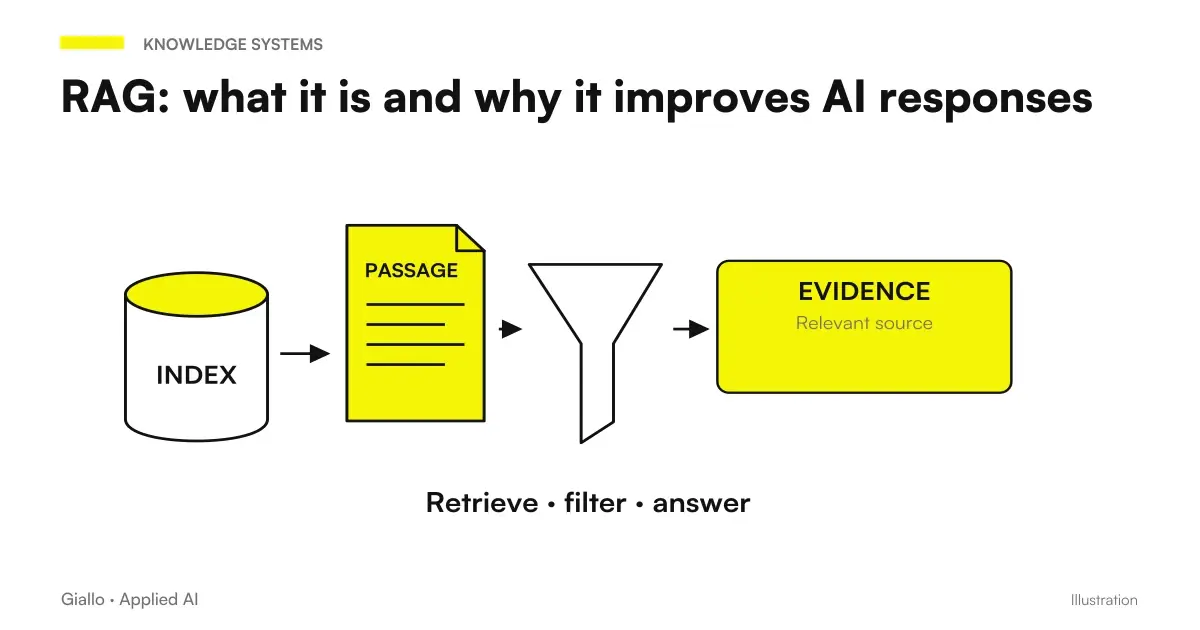
A system RAG (Retrieval-Augmented Generation) connects an AI model to yours documents: retrieves the relevant passages from your private sources and builds on it the answer, citing the exact document. If you want the mechanism in detail, see What is RAG. The table below makes the difference clear.
| Criterion | Perplexity AI | Internal RAG knowledge base |
|---|---|---|
| What you're looking for | Public Web + uploaded files | Only your private documents (contracts, manuals, CRM) |
| Where data lives | External Service (Perplexity) | Your infrastructure / cloud you choose |
| Permissions and accesses | By User/Space | Granular, Respecting Corporate Roles |
| Update | You upload/update files | Synchronized with systems (automatic) |
| Out of Context Answers | It can tap into the web | Responds only on business documents |
| Ideal use case | External research and monitoring | "What does our X procedure say?" |
| Cost | License per user | Tailored project, then management |
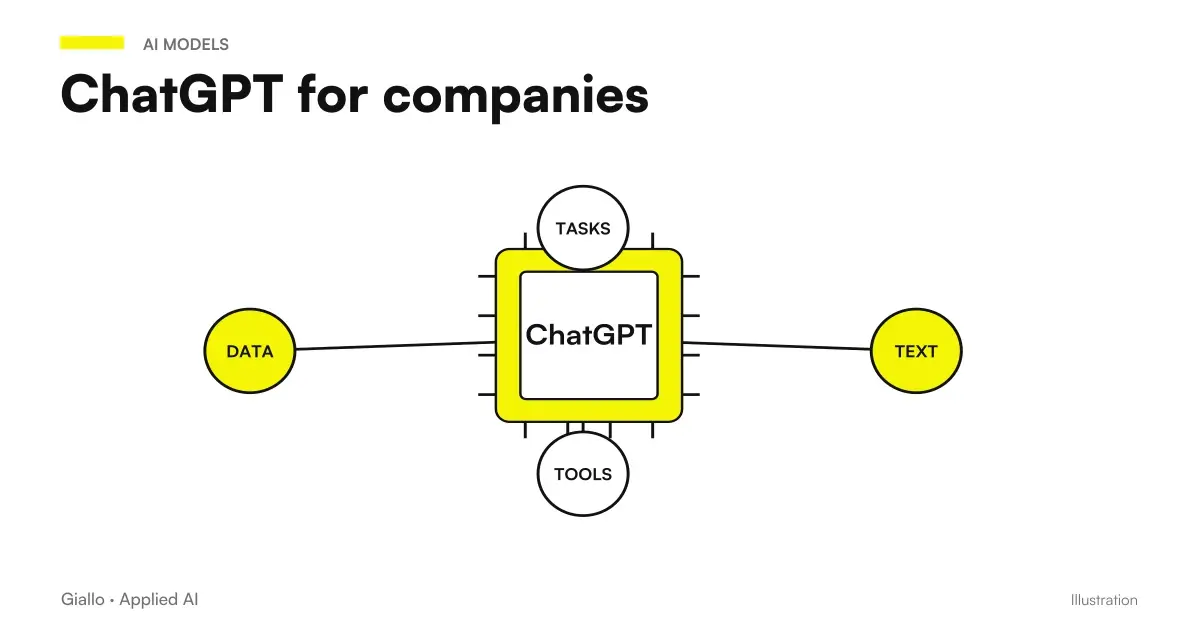
The right reading is not "which wins", but when needed which. They are complementary: Perplexity to look out (market, competitors, web), the internal RAG to answer about what is inside the company. For the general framework of adoption see the guide AI for businesses; for comparison with another widespread tool, ChatGPT for companies.
Example: "I would like a Perplexity that answers on our internal manuals"
It is the most frequent request — and it is exactly the case where Perplexity not is the right tool. A reserved internal manual, with permissions per department, always up-to-date and quoted by procedure, is the territory of a tailor-made RAG knowledge base, not an external search engine. Loading manuals in a Space solves a small project; it does not replace an integrated system. When the need is this, it is best to design a AI Agent on internal documents.
The search application and developer components should be distinguished. The new embedding Perplexity for text, images and PDFs serve to build a custom document recovery; open weights, API availability, and index costs require separate verifications.
When to use Perplexity and when a custom-made system
Use Perplexity when
- The need is research external: market, competitors, industry, web.
- You need a quick answer with cited sources and verifiable.
- You want to give the whole team a reliable search tool, right away.
- Work on public materials or files that you can share without any problems.
We need a tailor-made system when
- The value lies in the private internal data and in permissions by role.
- The task is recurring and automatic, not an occasional question.
- Integration with CRM, business management systems or email inboxes is needed.
- Answers must be based only on company documents, without drawing on the web.
In short: Perplexity is a great shelf tool for external research; a tailored system arises when the problem is within your processes. They often live together in the same team.
Practical examples
Three realistic scenarios of SMEs and Italian professional studios, to see the border in action.
1. Consulting study — preliminary research for a client. Before a meeting, the consultant asks Perplexity for an overview of the customer sector, major competitors and recent trends, with the sources attached. In fifteen minutes it has a solid base from which to start, instead of an afternoon of manual research. Then check the key numbers on the official sources. Here Perplexity is perfect: the material is public and external.
2. E-commerce — price and novelty monitoring of competitors. Marketing uses Perplexity to sample what competitors throw and how they communicate. It works as a manual reconnaissance. But when a check is needed every week, automatic and archived, the case changes: we move to an process automation with an agent who collects, synthesizes and sends the report alone.
3. Manufacturing company — responses on internal procedures. Operators want to ask "what is the testing procedure for product X?" and get the answer from the business manual. Loading manuals in a Space helps on a few documents, but with dozens of confidential procedures, different versions and permission per department you need a real internal knowledge base: a AI Agent on a RAG system, inside the company infrastructure.
The common thread: out of the company → Perplexity; inside the company, recurringly and with confidential data → Customized System.
Mistakes to Avoid
- Treating answers as truth because they cite sources. Quotation helps, but does not guarantee. Open and verify sources on numbers, regulations, and sensitive data: a summary can report outdated information or misweight pages.
- Uploading confidential data without verifying the plan. Customer documents, contracts, personal data: first check what the plan (free, individual or Enterprise) and the GDPR obligations. Do not take guarantees for granted.
- Using Perplexity as an internal knowledge base. It is an external search tool. To reply on your private documents with permissions and automatic update you need a RAG System, not a Space.
- Automating by hand what is recurring. If you repeat the same search every week copying the results, you're doing an automation job by hand. The time to build an agent has come.
- Adopt it "because it's fashionable". The tool is chosen by the problem. If there is no repetitive task or a recurring search that weighs, an extra license is just a cost.
How to apply it in the company
Introducing Perplexity in a sensible way is a short path, not a project. The goal is to understand where it is really useful and where the need is another.
- Separates external research and internal knowledge. List the tasks: which are "look out" (market, web, competitors) and which are "answer what we have inside". The former are for Perplexity, the latter are not.
- Start with a pilot team. Give access to those who do more research (consulting, marketing, sales) and measure the time saved on real tasks, not in the abstract.
- Define data rules. Write what you can and can't load, and on what plan. Check official policies and GDPR aspects before touching customer data.
- Teaches to verify sources. The Golden Rule: For any data that ends in a decision, open the source. Quotation is a starting point, not a guarantee stamp.
- Recognize when you need anything else. When a need is recurring, automatic or on internal data, stop: there you don't need another license, you need a custom system.
- I have distinguished the research tasks external from those of knowledge internal.
- I have verified the plan data policy we will use (including Enterprise if needed).
- I have a written rule on what NOT to load (personal data, contracts, secrets).
- The team knows that sources need to be opened and verified on critical data.
- I know when a need requires an agent or a RAG system, not Perplexity.
This is the type of choice in which a AI Consulting avoid waste: distinguish what you solve with a shelf tool from what a system designed on your processes and data requires. To see experiments and prototypes in this direction there is also The Lab.
Conclusion
Perplexity AI for companies is an excellent tool for a precise task: external research with cited and verifiable sources — market, competitors, industry, public content synthesis. Used this way, it saves real time and maintains the transparency that a generic chatbot lacks. Its limit, however, is structural: it is not an internal knowledge base and does not live in your processes.
The practical rule is clear: out of the company → Perplexity; within the company, on confidential data and in a recurring way → Customized System. When need slips to private documents or automation, the right step is a RAG System or a AI Agent designed on your data.
If you want to go from testing with ChatGPT to an AI system integrated into business processes, Giallo Studio custom designed agents and automations.
Giallo Studio guides: methodology and sources
How we apply it in the company
Related resources
 Perplexity AI: what it is and how it works
 Perplexity AI to do research
 AI for businesses: a complete guide to getting started
 RAG: what it is and why it improves AI responses
 ChatGPT for companies
 Creating quotes with AI: how to speed up the process
 AI for CRM and sales: automate the sales process
 AI for Business Customer Care: How It Really Works
FAQ
What is Perplexity AI for in a company?
It is mainly used for information research with cited sources: market analysis, monitoring competitors and the sector, quick due diligence, and summarising documents and web pages. Unlike a generic chatbot, every answer includes links to its sources, so it can be checked. It remains an external research tool, rather than a system that knows your company's internal data.
Does Perplexity AI use my data to train its models?
It depends on the plan. On free and individual plans there are different settings and treatments than Enterprise plans, which offer stronger guarantees about privacy and not using data for training. Policies change over time: before uploading confidential content always check the official page and the documentation of the specific plan.
What are Perplexity Spaces?
Spaces are workspaces where you collect files and sources and ask questions limited to that context, with custom instructions for the team. They are useful for lightweight shared knowledge about a project or client. For a true business knowledge base that stays up to date and integrates with your systems, a custom RAG system is usually needed instead.
What is the difference between Perplexity and an internal RAG knowledge base?
Perplexity mainly searches the public web (plus files you upload) and cites its sources. An internal RAG knowledge base works with your private documents (contracts, manuals, procedures and CRM), answers only from those documents, respects permissions and runs within your infrastructure. They are complementary: one supports external research, the other internal knowledge.
Can Perplexity AI make mistakes or invent information?
Yes. Even when it cites sources, it can summarise them incorrectly, report outdated data or cite unreliable pages. A citation reduces the risk but does not eliminate it: important decisions always require opening and checking the original sources, especially for numbers, regulations and sensitive data.
When is it convenient for an SME to use Perplexity instead of a tailored system?
Perplexity is useful for quick external research and for giving the whole team a reliable research tool whose answers can be cited, at a per-licence cost. A custom system (AI agents or automation) is useful when the value lies in repetitive internal processes or private data, requiring integration, permission controls and answers based only on company documents.