
Claude Opus 5.5: official benchmarks, prices and comparison with Fable 5.1 and GPT-6 Astra
Claude Opus 5.5, released 22 September 2026: $4 input and $20 output per million tokens, like Fable 5.1. Official benchmarks versus GPT-6 Astra.
Reading time: 11 min
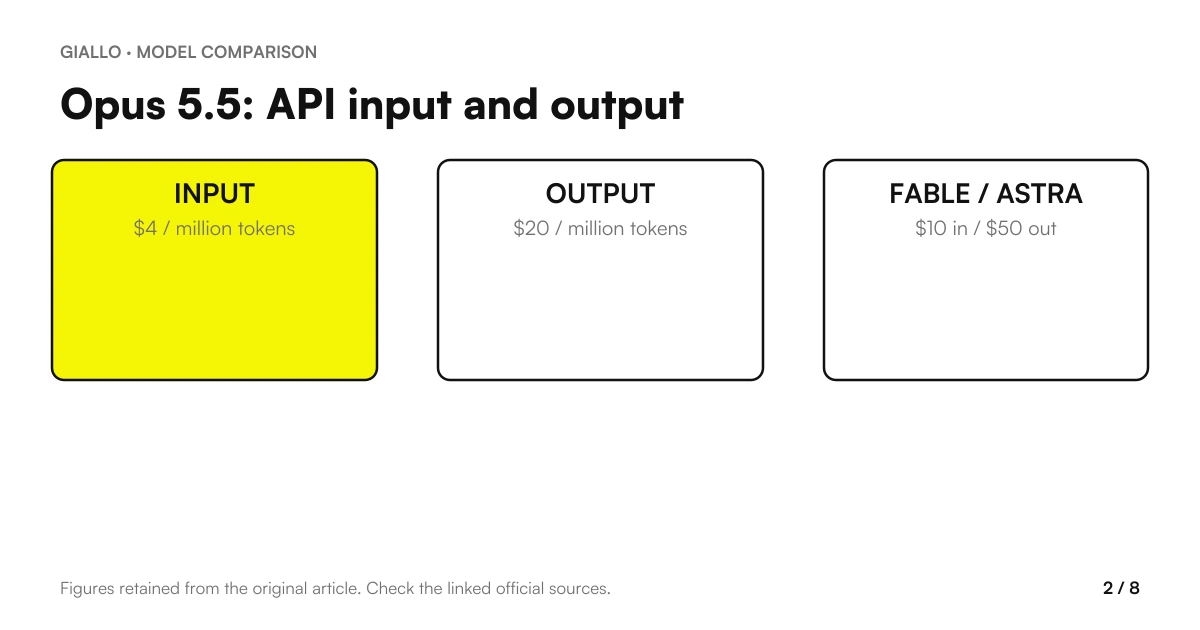
Claude Opus 5.5 is the new model of Anthropic, released on September 22, 2026 as the first member of the Claude 5.5 family. The news is not the higher score: it is the price. It costs $4 per million of incoming and 20 outgoing tokens, against the 10 and 50 of Claude Fable 5.1 and GPT-6 Astra, and according to Anthropic works at Fable 5.1 level on most tasks.
For an SME using AI within its processes rather than out of curiosity, this changes the cost calculation: the same invoice read by an agent, email classified and quote prepared cost less than half as much as three weeks earlier, with equal or higher quality. This article covers the official benchmarks line by line, prices, where GPT-6 Astra remains ahead and how to make a business decision. Data verified on 23 September 2026 on the Anthropic and OpenAI pages: models change quickly, so always check the official page before signing a contract.
In summary
- Claude Opus 5.5 costs 4$ input and 20$ output per million tokens: 60% less than Fable 5.1 and GPT-6 Astra at list prices.
- On typical work costs the 40% less than Opus 5 and generates text 30% faster.
- In the official table Anthropic is ahead of Fable 5.1 in 9 out of 9 benchmarks and at GPT-6 Astra in 4 out of 6.
- GPT-6 Astra remains ahead on AutomationBench and Terminal-Bench-Science.
- Context of 1 million tokens, Fast mode at $8 and $40, protections on biology and cybersecurity such as Fable 5.1.
- The right choice is made on the Cost per activity finished, not on the score.
What is Claude Opus 5.5 and what changes compared to Opus 5?
Opus 5.5 is the model that Anthropic calls "the new leading model": a clear jump from Opus 5, but with a lower computing consumption, and therefore a lower price. It is the same strategy we told in Fable 5.1 v Sonnet 5: the top models arrive first, then the same capacity drops in range and price.
Three numbers stated by Anthropic summarise the change:
- −40% in cost on typical workloads compared to Opus 5. The decline comes from two factors together: the lower price per token and the fact that the model uses fewer tokens and fewer steps to close the same task.
- +30% speed in text generation, with a Fast mode that reaches 2.5 times.
- −85% in attempts to bypass the limits compared to Opus 5 in internal behavioral testing. A fact that in the company weighs as much as a benchmark: an agent that respects the boundaries you give him is an agent that you can let work alone.
There is also a change of tone in responses. Anthropic says that messages are "much easier to understand at a glance", and the mentioned testers talk about 40% shorter responses with equal content. For those who pay the outgoing tokens it is a direct saving.
How much does Claude Opus 5.5 cost?
Here are the official price lists per million tokens, updated as of September 23, 2026.
| Model | Input | Output | Background | Exit |
|---|---|---|---|---|
| Claude Opus 5.5 | 4 $ | 20 $ | 1M in / 128K out | September 22, 2026 |
| Claude Opus 5 | 5 $ | 25 $ | 1M | Spring 2026 |
| Claude Fable 5.1 | 10 $ | 50 $ | 1M | 1 September 2026 |
| GPT-6 Astra | 10 $ | 50 $ | 1.05M in / 128K out | 3 September 2026 |
Reading from Opus 5.5 cache costs 0,20 $ per million tokens (was 0.50 on Opus 5): for agents who reread the same context at each step, such as a quote archive or an internal manual, it is the entry that weighs the most. If you want the full picture of Claude plans and models, keep it updated in Claude: prices and models in comparison.
Official Benchmarks: Opus 5.5 vs Fable 5.1, Opus 5 and GPT-6 Astra
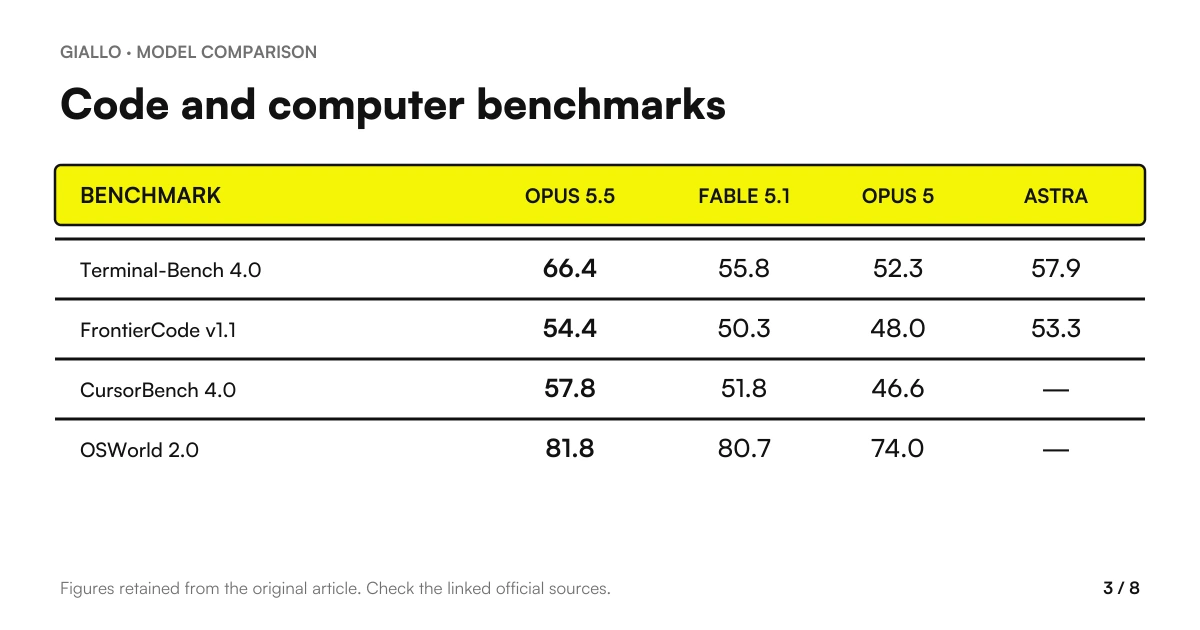
The table below shows the values published by Anthropic on the ad page, with the results of GPT-6 Astra as reported by OpenAI. In percentage, except where indicated. The hyphen means that there is no public data, not that the model made zero.
| Benchmark | What it measures | Opus 5.5 | Fable 5.1 | Opus 5 | GPT-6 Astra |
|---|---|---|---|---|---|
| Terminal-Bench 4.0 | professional tasks from command line | 66,4 | 55,8 | 52,3 | 57,9 |
| FrontierCode v1.1 | changes to the code that would be approved | 54,4 | 50,3 | 48,0 | 53,3 |
| CursorBench 4.0 | ambiguous tasks across multiple files, from real sessions | 57,8 | 51,8 | 46,6 | — |
| OSWorld 2.0 | computer use (partial score) | 81,8 | 80,7 | 74,0 | — |
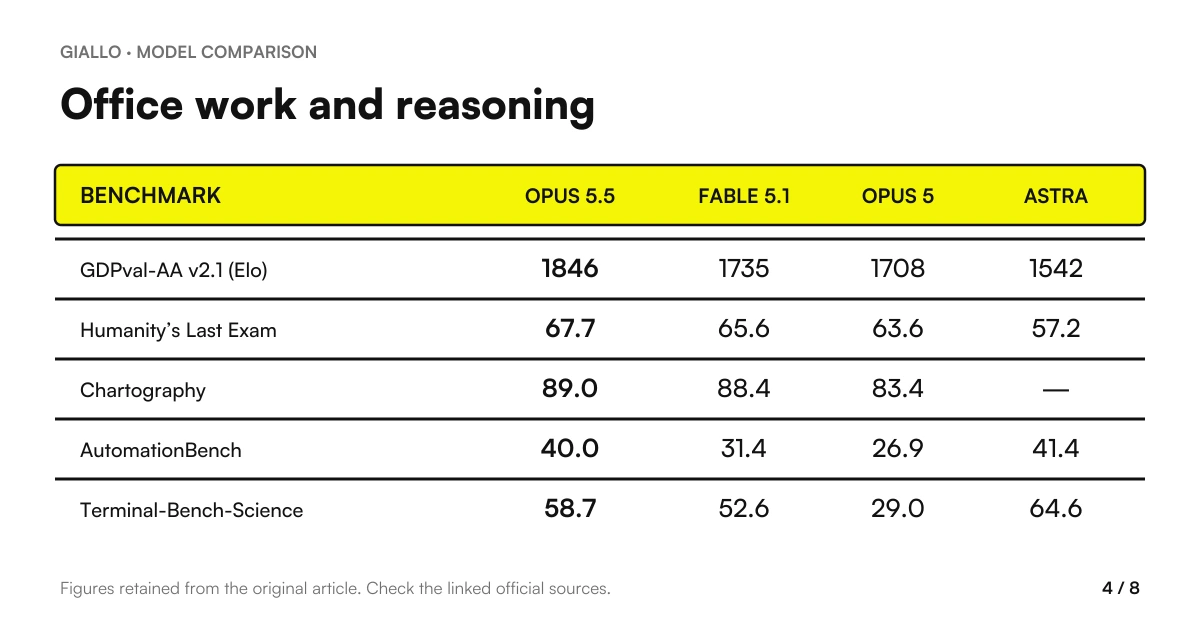
| GDPval-AA v2.1 (Elo) | Real professional work in 44 trades | 1846 | 1735 | 1708 | 1542 |
| AutomationBench | App workflows, measured by Zapier | 40,0 | 31,4 | 26,9 | 41,4 |
| Humanity's Last Exam | multidisciplinary reasoning, with tools | 67,7 | 65,6 | 63,6 | 57,2 |
| Terminal-Bench-Science 0.1 | Scientific Research from Terminal | 58,7 | 52,6 | 29,0 | 64,6 |
| Chartography | reading graphs, with tools | 89,0 | 88,4 | 83,4 | — |
Three notes that Anthropic writes in small and that should be read:
- Opus 5.5 results use adaptive reasoning to maximum effort; Terminal-Bench 4.0 is reported at “xhigh” effort for Opus 5.5 and “high” for Astra, as published by OpenAI. The standard error on Terminal-Bench is ±2.6 points.
- AutomationBench was run by Zapier without backup models: protection interventions count as failures. This is why the Claude score is lower than the one measured elsewhere.
- Anthropic changed the test suite: it no longer publishes GPQA Diamond, SWE-bench Verified or ARC-AGI. Comparisons with Astra's records on those tests, which you find in all GPT-6 Astra benchmarks, are not possible on official sources. Also homonym tests exist in different versions: Terminal-Bench 4.0 for Anthropic and OpenAI, 2.0 for Google, 3.0 for xAI.
The fact that Anthropic emphasizes the most is not the primacy but the efficiency: on FrontierCode, at the predefined effort, Opus 5.5 beats Astra's best score to about one fifth of the cost per activity.
Where GPT-6 Astra stays ahead
It would be easy to stop at the title. In the same table Astra wins two lines, and they are no small lines for an SME:
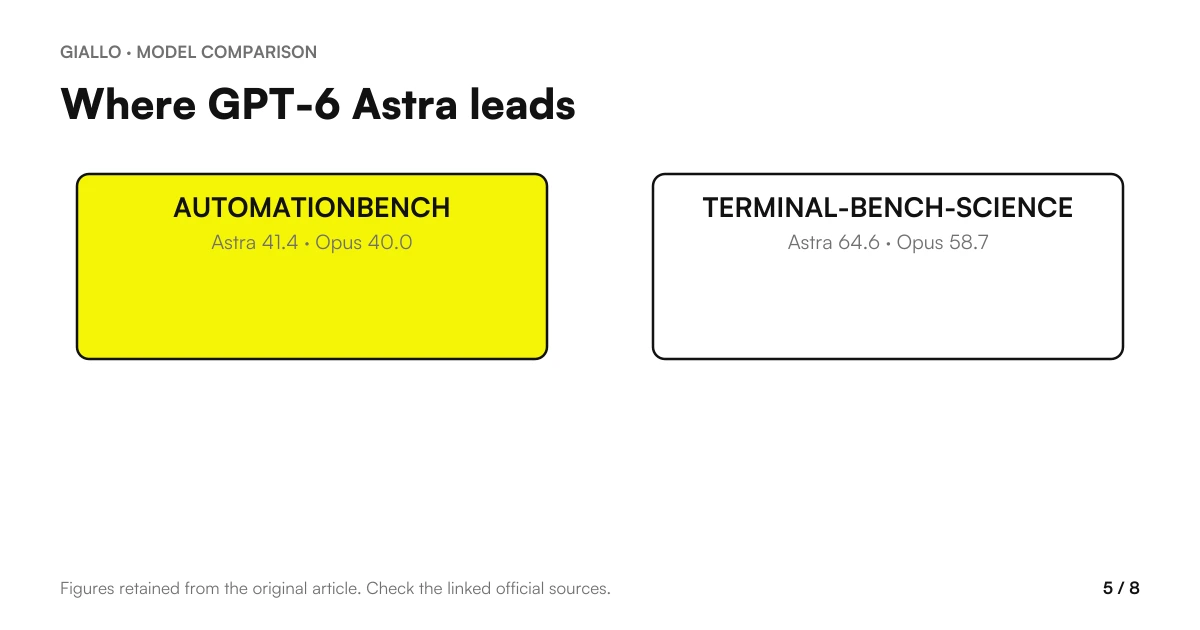
- AutomationBench (41.4 versus 40.0): flows between connected apps, i.e. the work done by automatisms such as "arrive an order, update the management software, alert the warehouse". The difference is 1.4 points, within the margin of error, but it exists.
- Terminal-Bench-Science (64.6 versus 58.7): terminal agent scientific research. For most companies it is not a use case; for those who do R&D it is.
To this are added the records of Astra on tests that Anthropic does not publish, in particular ARC-AGI-3 and FrontierMath. The reasoned comparison between the two top models we did in GPT-6 Astra v Fable 5.1; with Opus 5.5, the conclusion shifts to one point: Astra costs twice and a half at list prices, so the 1.4-point advantage costs 2.5 times as much.
Practical examples
Labor consulting firm, 12 employees. An agent reads customers' emails every morning, extracts requests (ceremonies, hiring, diseases), sorts them, and prepares the draft response. Volume: about 400 mails per day, 2,500 average tokens each incoming and 300 outgoing. With Fable 5.1 the API account was around $13 per day; with Opus 5.5 it drops to just over $5, at an equivalent declared quality. On a working year it is about $1,900 saved without touching the flow.
Mechanical company, 40 employees. The estimator receives drawings and requests in PDF format and must produce a structured quote. Here the benefit is not only the price: on GDPval-AA, which measures real professional work, Opus 5.5 scores 1846 Elo against Fable 5.1’s 1735, and caching at $0.20 makes rereading the 80-page internal price list on every request almost free. The bottleneck returns to the process rather than the model: who validates the quote, how quickly and under which rules.
Opus 5.5 or Fable 5.1: when to use which
Choose Opus 5.5
- Agents running around all day: document reading, classification, answers, data extraction.
- Code and internal automations: wins on all three coding benchmarks.
- Budget counted: $4 and $20 versus $10 and $50.
- You need speed: +30% and Fast mode.
Stay on Fable 5.1 or consider Astra
- Reasoning limit cases where the few extra points are worth the price.
- Flows between many apps where AutomationBench is the right fit: Astra is 1.4 points ahead.
- Agentical scientific research.
- You already have a production system calibrated to a model: it only changes after a test on your cases.
To understand how the other models of the family are positioned, the complete picture is in comparison between Claude models.
Mistakes to Avoid
- Choosing from the title of the benchmark. The homonym tests change version and rules: compare only inside the same official table.
- Confusing price per token and cost per asset. A more expensive model that completes the task in fewer steps can cost less. Anthropic measures exactly this when it reports −40%.
- Changing model to production without a test. The same instructions can give different results: redo your 20 real cases before migrating.
- Ignoring protections. If your process touches on biology, chemistry, or cyber security, try typical requests first: some will be rejected.
- Giving credit to viral numbers. On launch days there are percentages that do not stand in any table. There are two sources: anthropic.com and openai.com.
How to apply it in the company
- Lists the processes in which today a model reads or writes for you: emails, quotes, invoices, tickets, reports. For each one it marks monthly volume and used model.
- Calculate the cost per finished activity, not per token: how much does a read invoice, a completed quote, a closed ticket cost you.
- Take the 20 most difficult cases of each process and run them on Opus 5.5 with the same instructions. Compare quality and cost with what you use today.
- Enable caching for recurring contexts (price lists, manuals, rules): at $0.20 per million, it is the biggest lever.
- It migrates one process at a time and measures for two weeks: errors, human validation time, cost. Then it moves on to the next.
If the first step scares you, start here: What Tokens Are and Why They Matter explains the basis of the account, and Claude for Companies shows where Claude models really get into the processes.
The carousel in 8 card
The same news in social format, to save or turn to who decides the AI budget in the company.
Conclusion
Claude Opus 5.5 is not the strongest model that exists on every test: it is the one that brings Fable 5.1's performance to a price that an SME can budget without thinking about it. Nine out of nine benchmarks against Anthropic's top model, four out of six against GPT-6 Astra, 60% less on the list. Where Astra wins, wins by little and costs two and a half times.
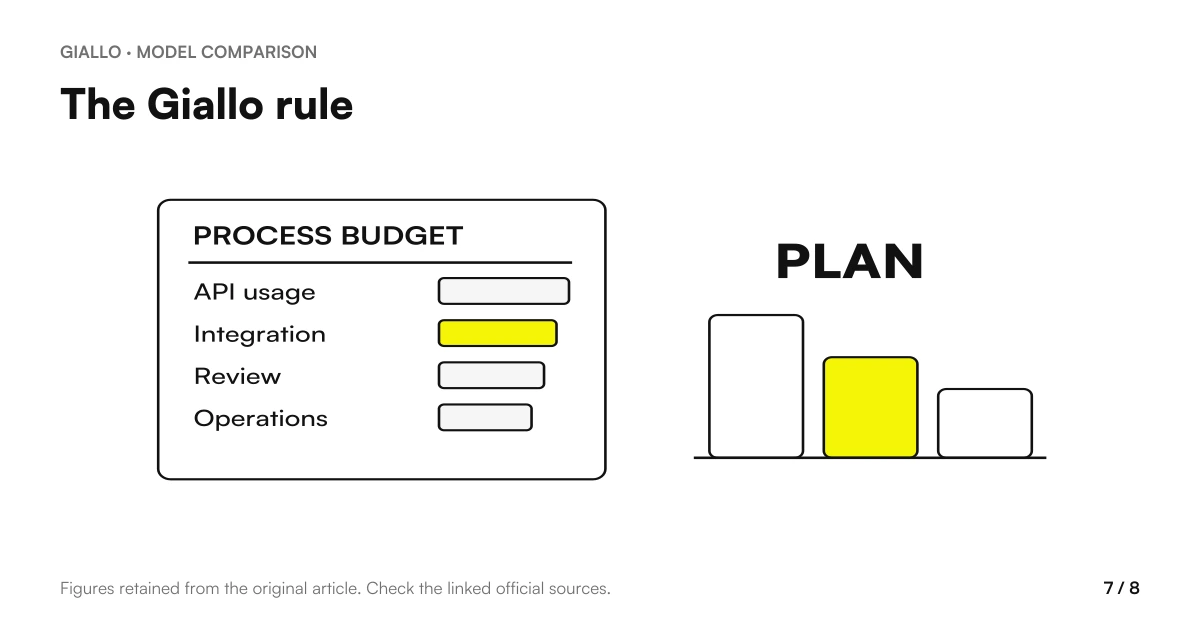
The yellow rule remains the same: do not choose the model from the benchmark, choose from the cost per task finished. If you want to move from testing with ChatGPT to an AI system integrated into business processes, Giallo Studio designs bespoke agents and automations, and in The Lab You can try some of these agents at work.
Giallo Studio guides: methodology and sources
How we apply it in the company
Related resources
 GPT-6 Astra: all official benchmarks
 GPT-6 Astra vs Claude Fable 5.1
 Claude Fable 5.1 vs Sonnet 5
 Claude model pricing: API rates and the cost of getting work done
 Claude models compared: a guide to choosing
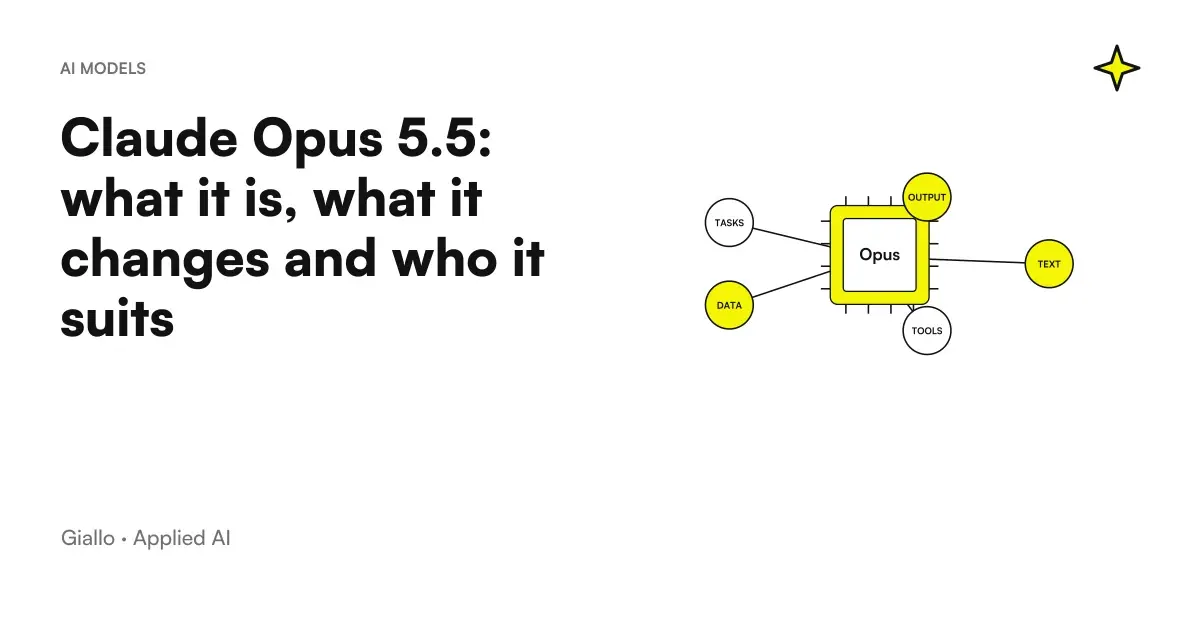 Claude Opus 5.5: what it is, what it changes and who it suits
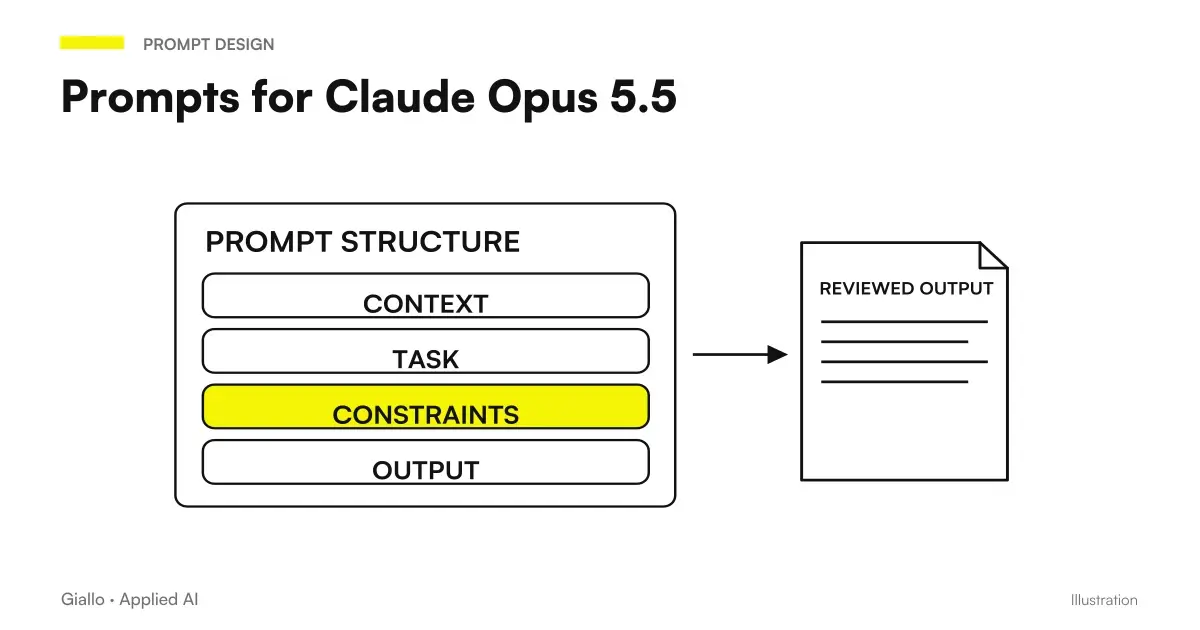 Claude Opus 5.5 prompts: what to remove, what to add and examples
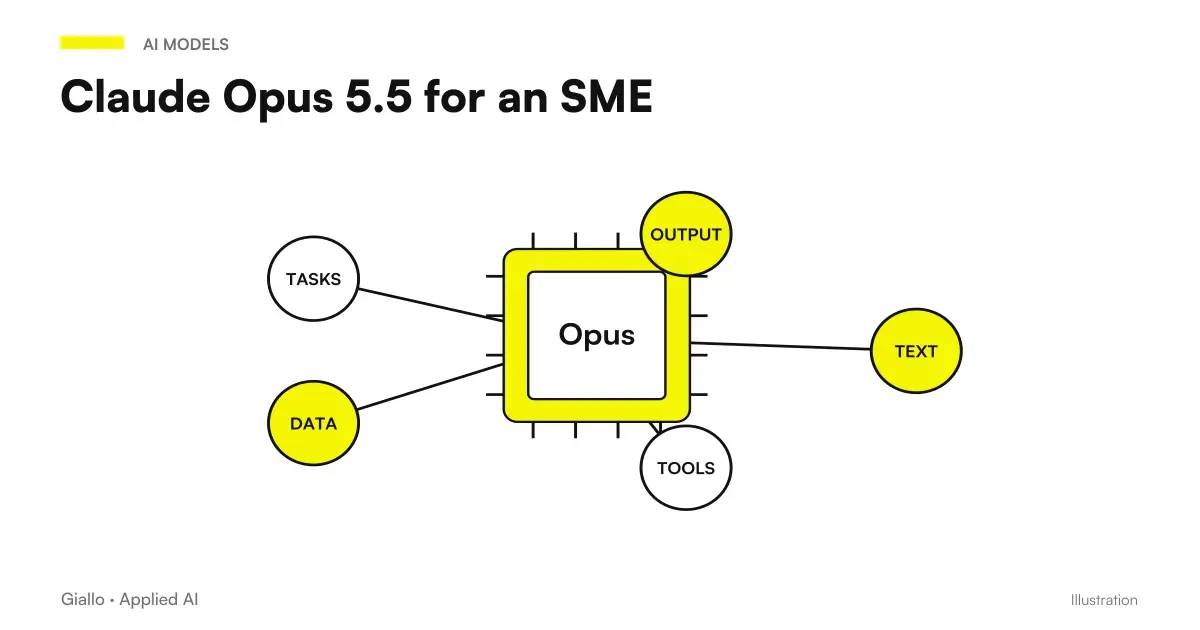 Claude Opus 5.5 for an SME: five concrete uses and when not needed
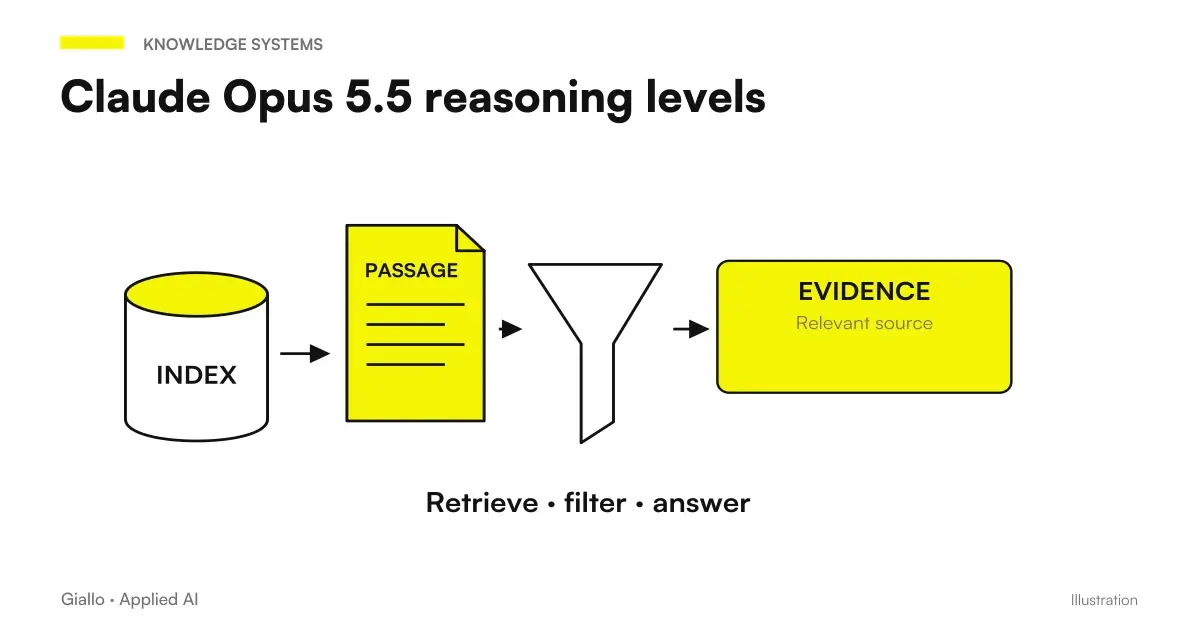 The levels of reasoning of Claude Opus 5.5: what they are and when to raise them
 GPT-6 Sol vs Claude Opus 5.5: the official numbers and when to use which
FAQ
How much does Claude Opus 5.5 cost?
$4 per million input tokens and $20 per million output tokens via the API. Cache reads cost $0.20. Fast mode, which is up to 2.5 times faster, costs $8 and $40.
Is Claude Opus 5.5 better than Fable 5.1?
On the 9 benchmarks published by Anthropic, it ranks ahead of Fable 5.1 on all 9 and costs 60% less at list prices. Fable 5.1 remains the flagship model for edge cases, but Anthropic itself says Opus 5.5 performs at its level on most tasks.
Does Claude Opus 5.5 beat GPT-6 Astra?
On the 6 rows with data for both, Opus 5.5 wins 4 times: Terminal-Bench 4.0, FrontierCode, GDPval-AA and Humanity's Last Exam. Astra stays ahead on AutomationBench and Terminal-Bench-Science, with a list price of $10 and $50.
What do you mean it's 40% cheaper?
Anthropic measures the cost on typical workloads: the price per token is lower than Opus 5 and the model uses fewer tokens to finish the same task. Adding up the two effects, the bill drops by about 40%.
How much context does Opus 5.5 handle?
An input context window of 1 million tokens and up to 128 thousand output tokens, according to Claude platform documentation.
Does it have any special limitations?
Yes. For biology and cybersecurity it uses the same protections as Fable 5.1: some requests in those fields are blocked and for research an organization verification is needed. It is no longer available with the reasoning off.
Are benchmarks comparable to those of OpenAI and Google?
Only in part. Anthropic publishes benchmarks other than the classic ones (no GPQA, SWE-bench or ARC-AGI) and tests with the same name exist in different versions. The reliable comparison is the one within the same official table.