
Fable 5.2 vs Gemini 4 Carbon: Which Wins Where?
Fable 5.2 vs Gemini 4 Carbon: declared benchmarks, pricing and availability as of 14 November 2026, now both are on the API. Which to pick, and for what.
Fable 5.2 and Gemini 4 Carbon are the two flagship models announced less than two weeks apart, and since 10 November 2026 both can be bought. Claude Fable 5.2, released by Anthropic on 9 November 2026, is available in the Claude apps and on the main cloud platforms. Gemini 4 Carbon, announced by Google on 28 October 2026 and opened at first only to a group of cyber defenders, has been available since 10 November through the paid API and is rolling out to Google AI Ultra subscribers, as explained in Google’s announcement of 10 November.
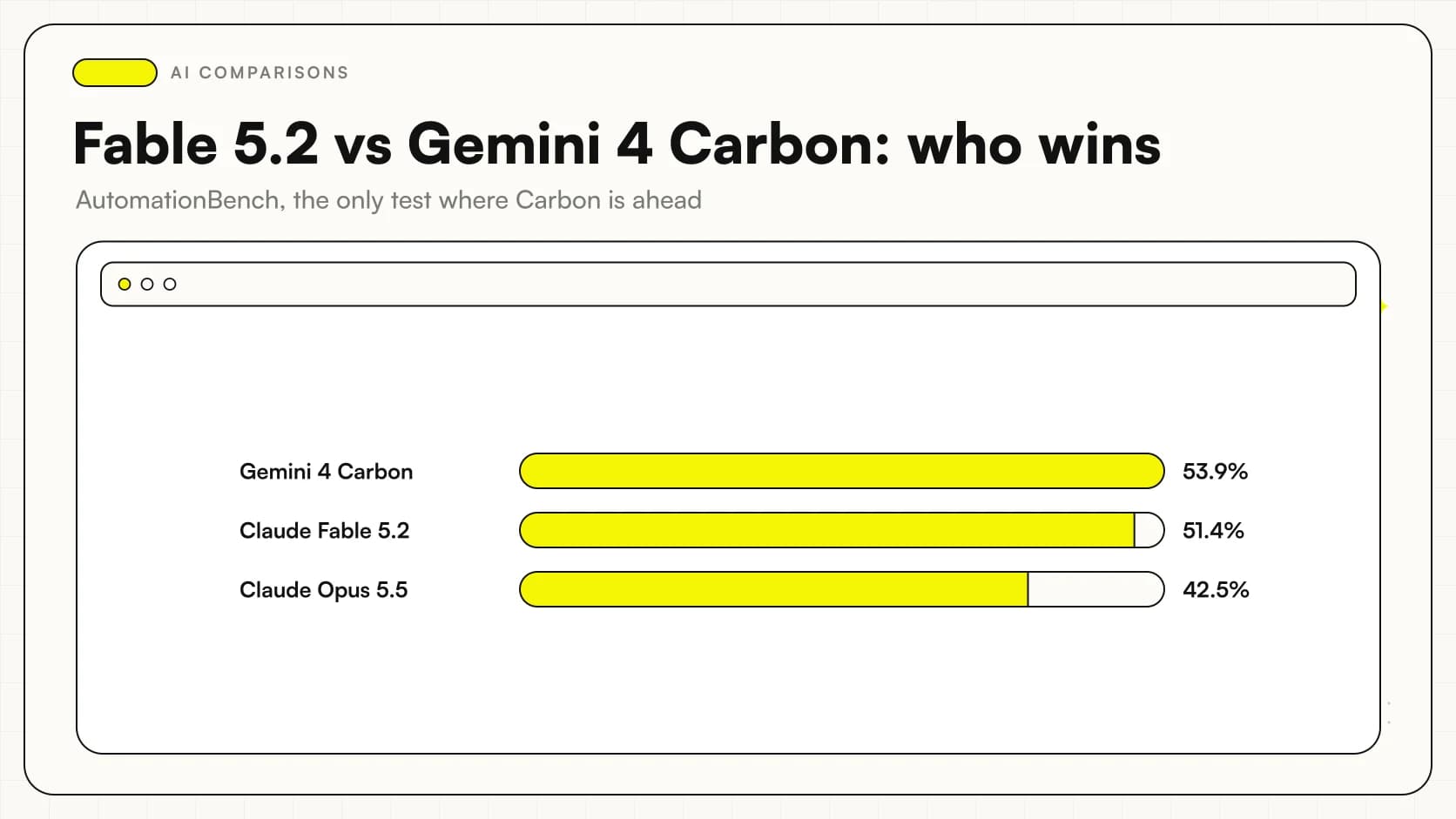
In the Fable 5.2 vs Gemini 4 Carbon comparison, the figures declared by the makers paint a clear picture. Fable is ahead in coding, computer use and scientific research with agents. Carbon is ahead in automated office work and costs less per token, even after the introductory price ends. The data come from Anthropic's announcement, checked on 9 November 2026, and from Google's announcement of 28 October and the Gemini API price list, all accessed on 14 November 2026.
In summary
- In the Anthropic table Fable 5.2 beats Carbon on six of the seven comparable tests; Carbon wins AutomationBench with 53.9% against 51.4%.
- Fable 5.2 costs $8 per million input tokens and $40 per million output tokens (official page); Carbon costs $2 and $10 until 30 November 2026 and $4 and $20 from 1 December 2026 (Gemini API price list).
- Since 10 November 2026 Carbon has been available through the paid API with ID
gemini-4-carbonand a 1,048,576-token window, but not on the free tier (model page). - Fable 5.2, by contrast, has been available since 9 November 2026 with the ID
claude-fable-5-2, and a context window of 1 million tokens. - All benchmarks are declared by the vendors and have not been replicated: treat them as an indication, not a verdict.
- The practical move is a test on your own cases with both models, doing the maths on Carbon's full price rather than the introductory one.
What are Fable 5.2 and Gemini 4 Carbon, and where do they stand?
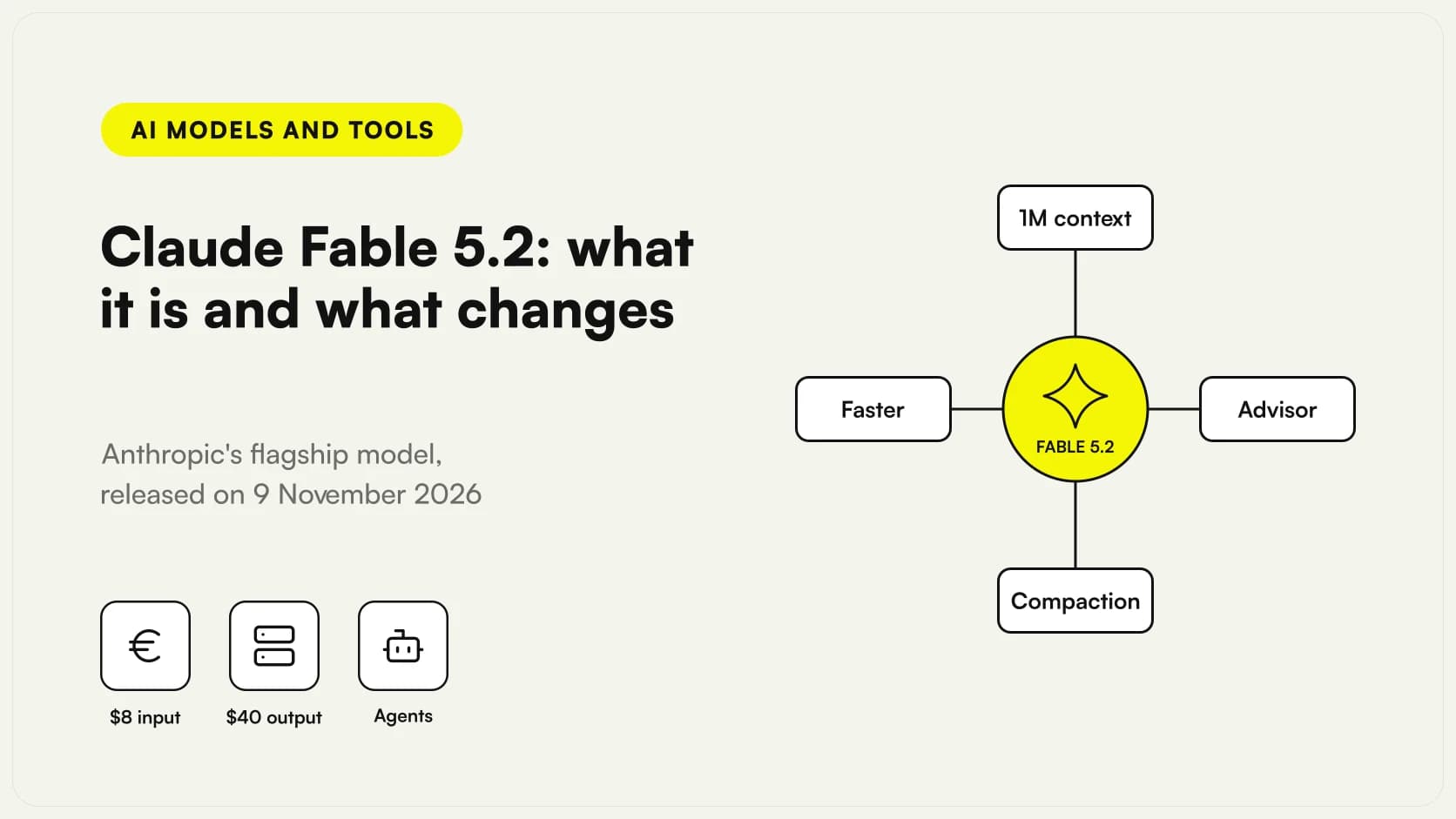
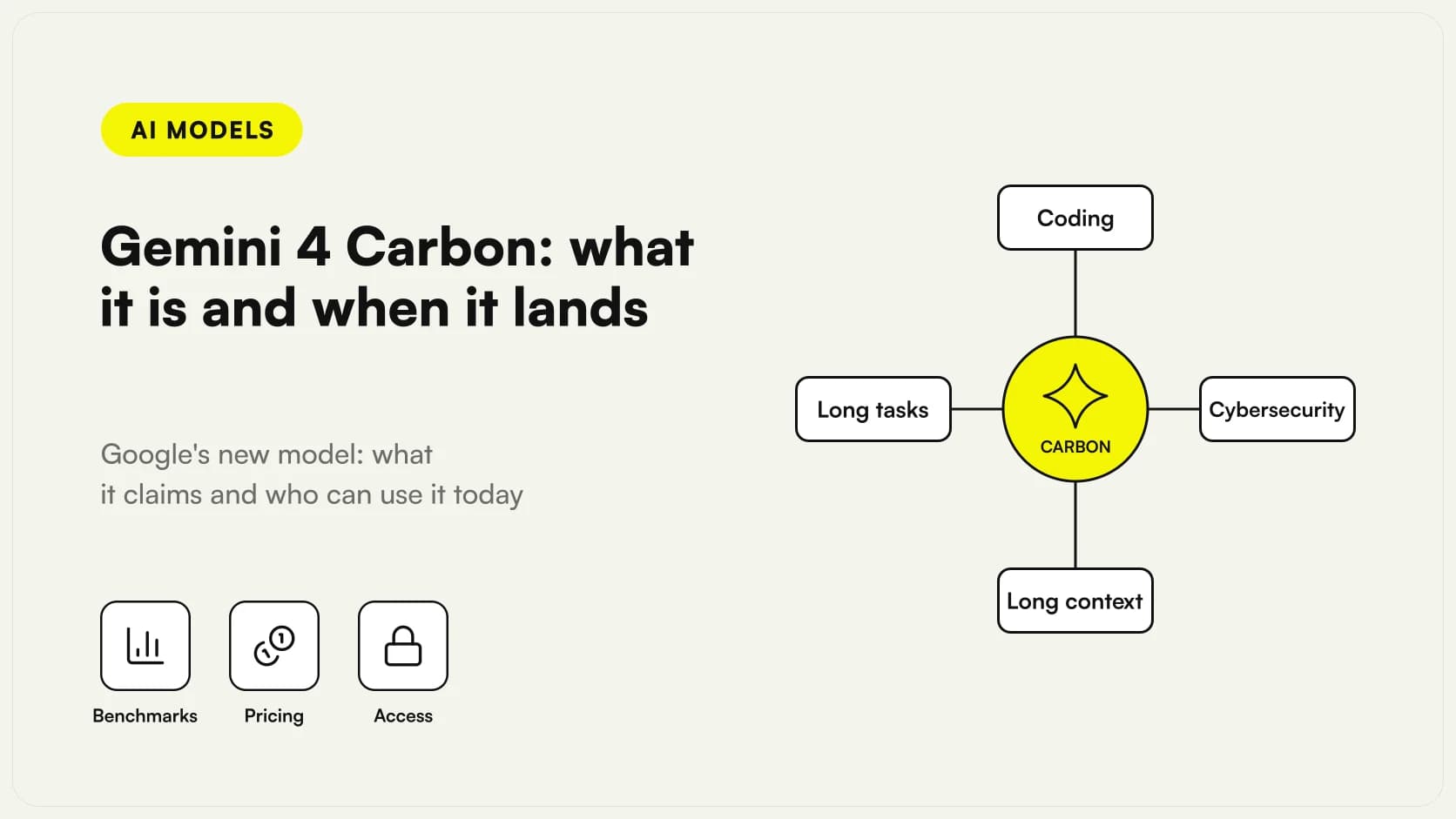
Claude Fable 5.2 is Anthropic's model for the hardest jobs, with a 1 million token context window and a 128K maximum output (official page). Its spec sheet is in the guide Claude Fable 5.2: what it is, pricing and what changes, so we do not repeat it here. Gemini 4 Carbon is the model Google calls its strongest, built for long tasks, coding and cybersecurity, and it is explained in Gemini 4 Carbon: what it is, where to use it and what it costs.
Until 9 November the biggest difference was not in the scores but in the release status: on 28 October Google had opened Carbon only to a group of cyber defenders through the Fairwind Program. On 10 November 2026 Google announced availability for all paying developers and businesses, through the API in Google AI Studio and Gemini for business, and the start of the rollout to Google AI Ultra subscribers in the Gemini app, Google Antigravity and AI Mode in Search. The Gemini API price list states that Carbon is not available on the free tier. The Fairwind Program remains the channel for “Carbon for cyber”, the version dedicated to cybersecurity.
| Aspect | Claude Fable 5.2 | Gemini 4 Carbon |
|---|---|---|
| Announcement date | 9 November 2026 | 28 October 2026 |
| Who can use it | Everyone: Claude apps, API, Amazon Bedrock, Google Cloud, Microsoft Foundry | Paid API (AI Studio, Gemini for business); Google AI Ultra subscribers, rolling out |
| Developers and businesses | Available | Available since 10 November 2026, paid tier only |
| Model ID | claude-fable-5-2 |
gemini-4-carbon |
| Context | 1M tokens | 1,048,576 tokens across input, reasoning and output |
| Maximum output | 128K tokens | 65,536 tokens, up to 1,048,576 with long decode |
| Availability in Italy | Country list not stated on the pages consulted | Country list not stated on the pages consulted |
The sources for the Fable rows are the official page and the announcement; for Carbon, they are Google’s announcement of 10 November, the Carbon model page and the guide to what's new in Carbon. The caution about Italy applies to both: where data are processed for European customers is not stated in the official pages consulted, on 9 November 2026 for Anthropic and on 14 November 2026 for Google.
Which benchmarks actually compare Fable 5.2 and Carbon?
In Anthropic's table, seven tests have a figure for Carbon too: that is the only common ground. We add Humanity's Last Exam, where Carbon's figure is missing. Values are percentages, declared by the vendors; the better of the two is in bold. The source for every row is Anthropic's announcement, while Carbon's method and settings are in Google's evaluation.
| Test (what it measures) | Fable 5.2 (%) | Gemini 4 Carbon (%) | Opus 5.5 (%) |
|---|---|---|---|
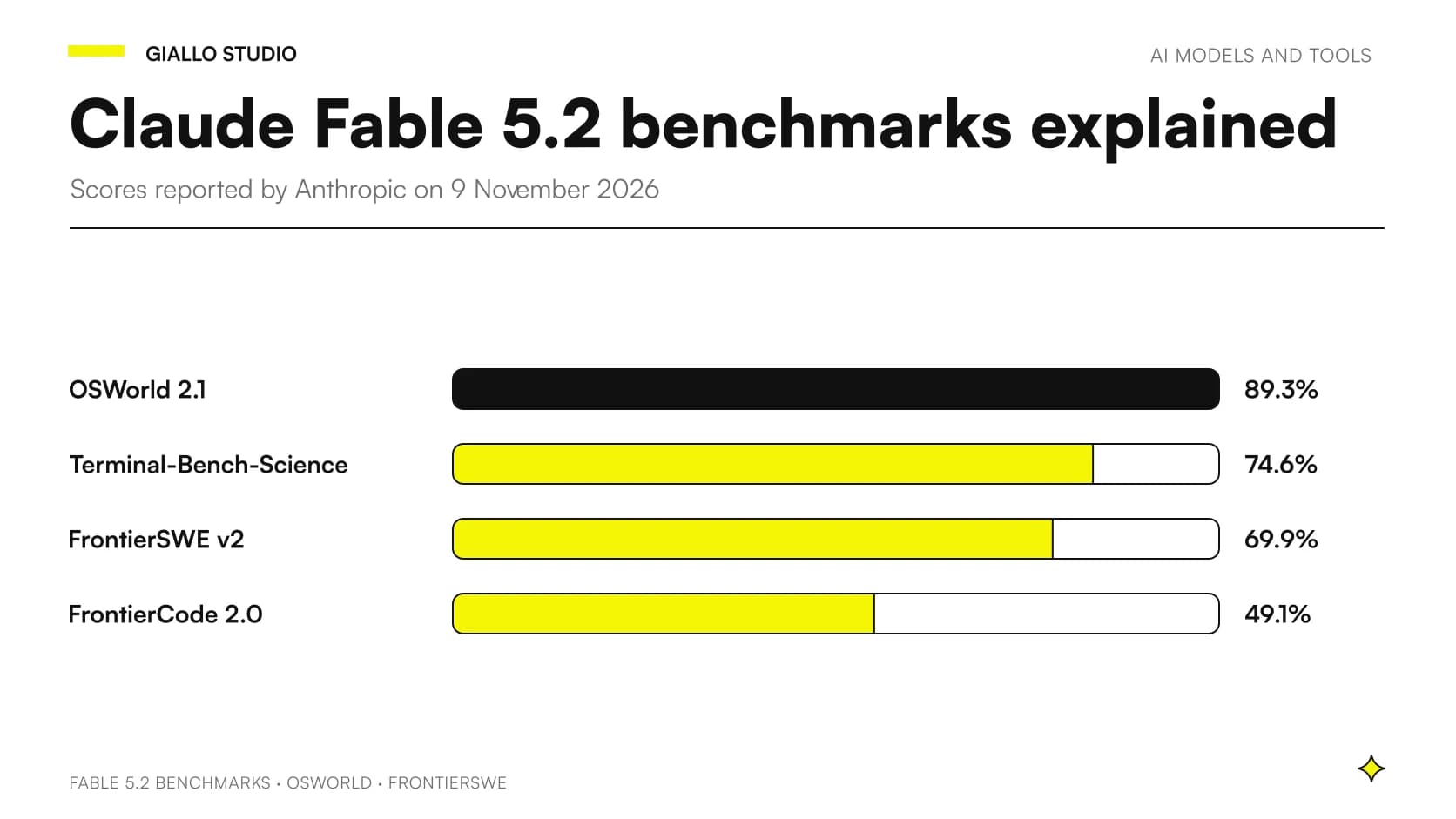
| FrontierCode 2.0 (code that maintainers would accept) | 49,1 | 41,1 | 45,5 |
| FrontierSWE v2 (software engineering) | 69,9 | 61,2 | 62,3 |
| AutomationBench (business workflows) | 51,4 | 53,9 | 42,5 |
| Terminal-Bench-Science (agentic scientific research) | 74,6 | 64,8 | 58,7 |
| OSWorld 2.1 (computer use, partial offline set) | 89,3 | 81,5 | 87,2 |
| Chartography, without tools (chart reading) | 73,4 | 72,5 | 64,4 |
| AA-Briefcase v1.1, rubric score (office work) | 66,1 | 61,8 | 61,2 |
| Humanity's Last Exam, with tools (expert knowledge) | 74,2 | n/a | 67,7 |
Read row by row, the table says three things. The first: Fable's margin in agentic coding is wide, about 8 points on both tests. The second: AutomationBench is the only row where Carbon is ahead, by 2.5 points. The third: on Chartography the gap is under one point, so it is not a difference to base a choice on.
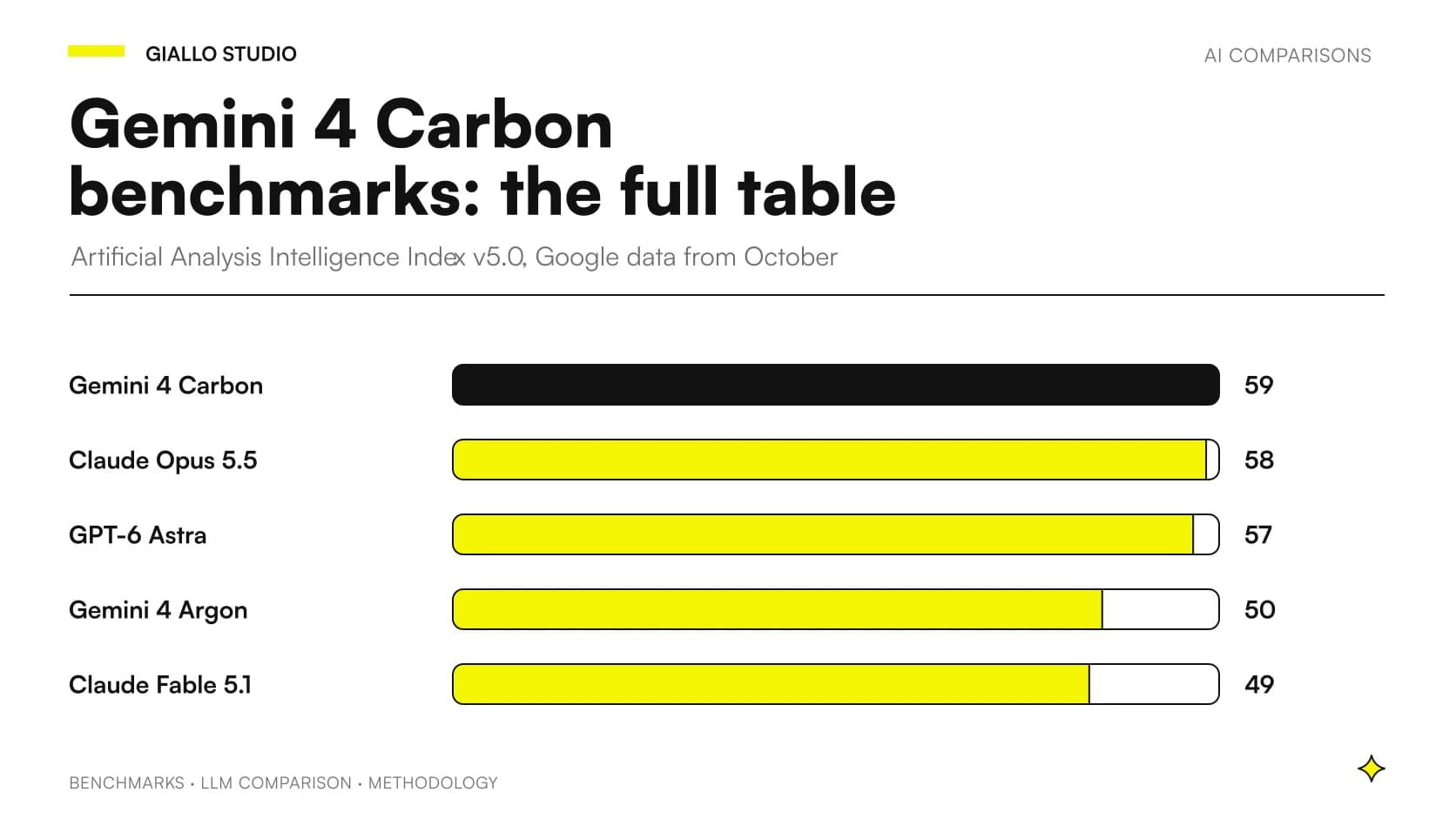
Some tests exist on one side only. Google reports a 96.2% score for Carbon on GraphWalks, the very-long-context test, and three cybersecurity results (Google evaluation); Anthropic reports for Fable 5.2 its results on RoboDojo Sim (64.9%) and Remote Labor Index (41.3%) in its own announcement. These tests cannot be compared directly. In the 10 November announcement Google adds that Carbon ranks first on Zapier's AutomationBench, CursorBench 4.0 and Perplexity's WANDR, at more than two times lower cost per task than the next best external model, without saying which one. This too is a declared figure, not verified by third parties. The full reading is in Claude Fable 5.2 benchmarks explained and Gemini 4 Carbon: the full table.
How much do Fable 5.2 and Gemini 4 Carbon cost?
Per million tokens, Fable 5.2 costs $8 for input and $40 for output, and halves the price with the Batch API; reading from the cache costs $0.20 (official page, 9 November 2026). The Gemini API price list sets Carbon at $2 per million input tokens and $10 per million output tokens until 30 November 2026, then $4 and $20 from 1 December 2026. Caching is implicit only, with a 95% discount on cached tokens, and Batch halves the standard prices. Carbon is not on the free tier and every token is billed, reasoning tokens included.
| Model | Input ($/M tokens) | Output ($/M tokens) | Cost of 5M input + 1M output ($) |
|---|---|---|---|
| Claude Fable 5.2 | 8 | 40 | 80 |
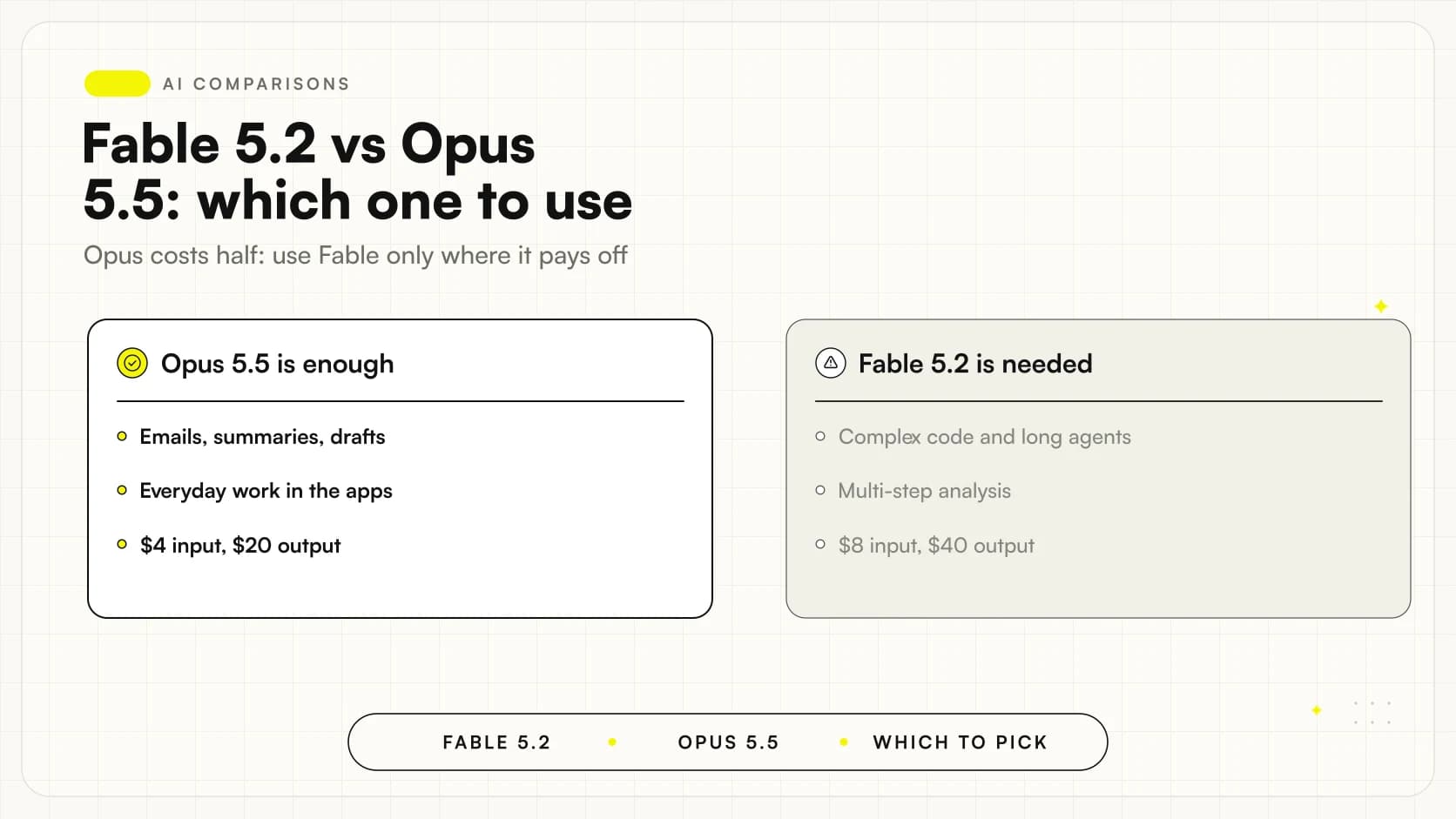
| Claude Opus 5.5 | 4 | 20 | 40 |
| Gemini 4 Carbon, until 30/11/2026 | 2 | 10 | 20 |
| Gemini 4 Carbon, from 1/12/2026 | 4 | 20 | 40 |
The last column is our own calculation on the price lists above, an example without cache and without discounts, useful only to fix the proportions. The price per token is not the cost of the finished job: Anthropic states, in its own announcement, that on FrontierCode Fable 5.2 at High effort reaches 45.3% against 45.5% for Opus 5.5 at Max effort for roughly half the cost per task, so what matters is how many tokens are needed, not just what each one costs. The same goes for Carbon: Google writes in the guide to what's new in Carbon that the model spends more reasoning tokens per turn than Argon, which has the same per-token price. Price list details are in Claude Fable 5.2: API pricing and Gemini 4 Carbon: API pricing.
An awkward fact for the budget: from 1 December 2026 Carbon costs the same per token as Opus 5.5. Anyone planning on the introductory price is building on a number that already has an expiry date, 30 November.
When should you pick Fable 5.2, and when Carbon?
The choice is not “which one is smarter” but “which one can I use, for which task, at what cost”. Here is the rule we apply at Giallo, with the data available on 14 November 2026.
Choose Fable 5.2 if
- the task is complex code, migrations or multi-step engineering work;
- you need an agent that uses the computer or works for hours on documents and tools;
- you also need the model through Amazon Bedrock, Google Cloud or Microsoft Foundry, where Fable 5.2 is already offered;
- Opus 5.5 at high effort, tested on your cases, is not enough.
Look at Carbon if
- your work resembles the AutomationBench workflows, that is, office automation across several applications;
- you work with very long contexts and cost per token is decisive;
- you need the cybersecurity version, “Carbon for cyber”, which goes through the Fairwind Program;
- you want to try it at the introductory price by 30 November 2026, knowing that from 1 December the price doubles.
Neither one is the automatic answer even within its own family, though. Anthropic itself advises starting from Opus 5.5 for most coding and knowledge tasks and moving up to Fable only when needed. Google, in the 10 November announcement, writes that Argon remains “the ideal choice for the majority of software engineering and knowledge work” and keeps Carbon for tasks at the limit. The in-family comparisons are in Fable 5.2 vs Opus 5.5 and in Gemini 4 Carbon vs Argon; the one with the other big competitor is in Fable 5.2 vs GPT-6 Astra.
Example: a logistics company in Piacenza
An example, declared as such. A logistics company in Piacenza with 25 employees receives delivery notes, CMRs, carrier invoices and delay reports from different clients every day. Office staff reconcile the documents, look for discrepancies and prepare the replies. We cover this in general in AI for logistics and shipping.
The work splits into three. Reconciling documents and invoices is an office workflow across several sources, the kind of task AutomationBench sets out to measure: here Carbon is, on paper, an interesting candidate. Reading photographed delivery notes and PDF tables depends on visual understanding, where the two models are one point apart on Chartography and the choice comes down to cost. Any in-house development, such as a script that reads courier tracking data, is coding, where Fable is ahead.
The conclusion for the company in our example is simple. Today it can try Fable 5.2, Opus 5.5, Carbon and Argon on the same 20 real cases, with a paid Gemini API account for the Google models. The decision is made on its own documents, not on a lab benchmark, and Carbon's cost is calculated at the price in force from 1 December.
How do you choose between Fable 5.2 and Carbon in practice?
It takes a few hours, not weeks. A five-step method:
- Pick one process: just one, with many steps and different sources, for example the month-end reconciliation.
- Collect 15-20 closed cases: with the correct outcome already known, including two or three messy or incomplete cases.
- Set the criteria: which errors make the result unusable, how much time human review takes and how much each case costs, reasoning tokens included.
- Test the candidate models: Fable 5.2 and Opus 5.5 on one side, Carbon and Argon on the other, with the same prompt and a comparable effort or reasoning level where possible.
- Keep the model replaceable: permissions, approvals and the action log belong in the software, not in the model, so you can switch when prices or versions change.
If the process involves several tools and has to act on its own, you also need a perimeter of approvals: we build it in our projects for AI agents. For the broader picture on choosing between models, see how to choose an AI model, while the comparison between the two families in the previous version is in Claude vs Gemini.
What mistakes should you avoid when comparing the two models?
- Assuming you already have Carbon. In the Gemini app it is rolling out only to Google AI Ultra subscribers, and the API requires the paid tier, as shown in the Gemini API price list.
- Reading the benchmarks as a single ranking. Fable wins six tests out of seven, Carbon one: it depends on which one resembles your work.
- Deciding on the introductory price. From 1 December 2026 Carbon costs the same per token as Opus 5.5, and it spends more reasoning tokens than Argon.
- Ignoring data and contract terms. For Fable 5.2, retention is at least 30 days and zero data retention (ZDR) is not available without authorization, as explained on the Covered Models page; for Carbon, Google's price list says that content on the paid tier is not used to improve its products, while retention and processing location should be requested and written into the contract.
- Trusting a model without human approvals. With either of the two, an agent that sends, pays or modifies data must be kept under control.
Who wins where, and what to do now
On 9 November Fable 5.2 won for a reason that came before the scores: it was the only one of the two that could be used. Since 10 November the contest has been about the tasks. In the declared data Fable is stronger in coding, computer use and research with agents; Carbon has the edge on AutomationBench and on per-token price, which doubles from 1 December 2026 but stays at half of Fable's. Who wins in your case is decided by a test on your own documents, not by a table.
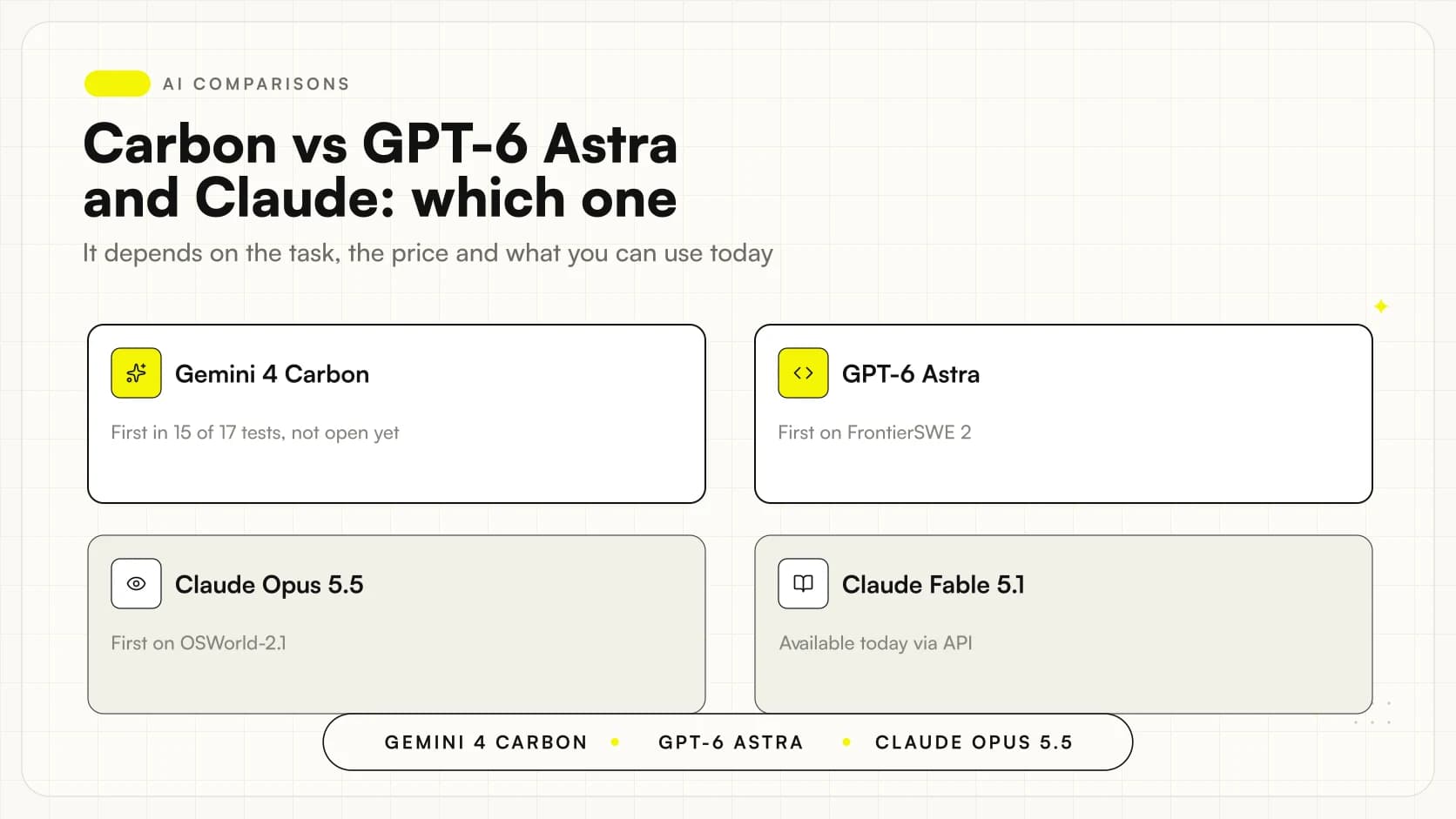
If you want to understand which model holds up on your company's processes, Giallo's AI consulting starts from your cases, builds the test and runs it on the candidate models, Carbon included; from test to real work, AI agents put the model inside permissions and controls. The broader picture of Google's side is in Gemini 4 Carbon vs GPT-6 Astra and Claude.
Giallo Studio guides: methodology and sources
Want to apply this to your business?In 30 minutes, free of charge: the first process to automate and its estimated return, in writing.
Book the free auditHow we apply it in the company
Related resources
 Claude Fable 5.2: What It Is, What Changed and What It Costs
 Gemini 4 Carbon: what it is, where it is used and what it costs today
 Fable 5.2 vs Astra: Claude and GPT-6 benchmarks and prices compared
 Fable 5.2 vs Opus 5.5: which to use and when
 Claude Fable 5.2 benchmarks: what they measure and how to verify them
 Gemini 4 Carbon benchmarks: the full table and how to read it
 Gemini 4 Carbon vs GPT-6 Astra and Claude: Which to Choose for Each Task
 Claude vs Gemini: Which to Use
Other direct comparisons
The same criteria applied to other model pairs.
- Fable 5.1 vs 5.2: what really changes and whether to upgrade
- Fable 5.2 vs Astra: Claude and GPT-6 benchmarks and prices compared
- Claude Fable 5.1 vs Sonnet 5
- Claude Mythos vs Fable 5.2: the real differences and who can use them
- DeepSeek R1 Distill 32B vs Qwen3.8-27B locally
- Fable 5.2 vs Opus 5.5: which to use and when
- Claude vs Perplexity
- Gemini 3.6 Flash vs 3.5 Flash
- Claude vs Gemini: Which to Use
- Gemini 4 Argon vs ChatGPT and Claude: which should you choose?
- Claude vs DeepSeek: Which to Choose
- Gemini 4 Carbon vs Argon: differences and which to choose
FAQ
Is Fable 5.2 better than Gemini 4 Carbon?
It depends on the task. In the table Anthropic published on 9 November 2026, Fable 5.2 is ahead of Carbon on six of the seven comparable tests, but Carbon wins AutomationBench, the test on automated office work (53.9% vs 51.4%). These are figures declared by the vendors, not verified by third parties.
Can you use Gemini 4 Carbon today?
Yes, since 10 November 2026. Google offers it through the API in Google AI Studio and Gemini for business to paying developers and businesses, but not on the free tier of the Gemini API. It is also rolling out to Google AI Ultra subscribers in the Gemini app, Google Antigravity and AI Mode in Search. The Fairwind Program remains the channel for the cybersecurity version.
Which costs less, Fable 5.2 or Gemini 4 Carbon?
On paper, Carbon: $2 per million input tokens and $10 per million output tokens until 30 November 2026, against $8 and $40 for Fable 5.2. From 1 December 2026 the Gemini API price list moves to $4 and $20, still half the price of Fable. The per-token price does not tell you how many tokens it takes to finish the job, though, and Carbon also bills reasoning tokens.
Is Fable 5.2 or Gemini 4 Carbon better for coding?
According to the makers' tables, Fable 5.2 is ahead of Carbon on both FrontierCode 2.0 (49.1% vs 41.1%) and FrontierSWE v2 (69.9% vs 61.2%). Google itself writes, however, that Argon remains the ideal choice for most software engineering work: a test on your own code is worth more than the table.
Where is Claude stronger and where is Gemini?
In the declared data, Claude Fable 5.2 is stronger on agentic coding, computer use and agentic scientific research. Gemini 4 Carbon is stronger on the business workflows of AutomationBench; Google also reports a high result for Carbon on very long context, a test for which Anthropic gives no figure for Fable. On Chartography, which tests chart reading, the two are one point apart.
How do I choose between the two for my SME?
Build 15-20 real, already closed cases and run them with the same prompt on Fable 5.2 and Opus 5.5 on one side, Carbon and Argon on the other. Measure quality, review time and cost per case, pricing Carbon at the rate in force from 1 December 2026.
Does Fable 5.2 handle data better than Gemini 4 Carbon?
It cannot be said from the sources consulted. For Fable 5.2, Anthropic states retention of at least 30 days and no zero data retention unless authorised. For Carbon, offered only on the paid tier of the Gemini API, Google's price list states that content is not used to improve its products; retention periods and processing location do not appear in the pages consulted on 14 November 2026.